

Electrical Contractor Billing Software: A Practical Guide for 2026
Few invoices are as layered as an electrical invoice. A single commercial project can carry a deposit, monthly pay applications with retainage, a dozen signed change orders, and a final lien release. Residential and service work moves faster but stacks its own complexity: time-and-material tickets, marked-up materials, and trip charges. Generic invoicing tools were never built for that structure, and the failure shows up on your balance sheet as unbilled labor, misapplied retainage, and slow collections.
Electrical contractor billing software exists to close a specific gap: the distance between the work your crews perform and the money you actually collect. Here is what that capability looks like in 2026 and what a shop of any size should demand from it.
Why Electrical Contractors Need Specialized Billing Software in 2026
Three realities make billing harder in electrical than in most trades.
First, electrical work is billed in phases. Rough-in, trim-out, and final each represent real cost and a real milestone. Rough-in cannot be closed up until it passes inspection, so most shops bill it as its own event. Software that only issues one-shot invoices cannot model that reality.
Second, material pricing is volatile. Copper THHN and MC cable pricing can swing more than 20 percent in a quarter. When invoices are built from a stale price book or a supplier quote that is three months old, margin disappears one spool at a time.
Third, payment is slow. Sixty to ninety day cycles are routine in construction, and for a solo electrician that means financing someone else's project while spending five to ten hours a week on quotes, invoices, and collection calls. Electrician billing software built for the trade attacks all three problems at once: phase-aware invoices, current material pricing, and automated collections.
Progress Invoicing and AIA Billing: What Electrical Work Demands
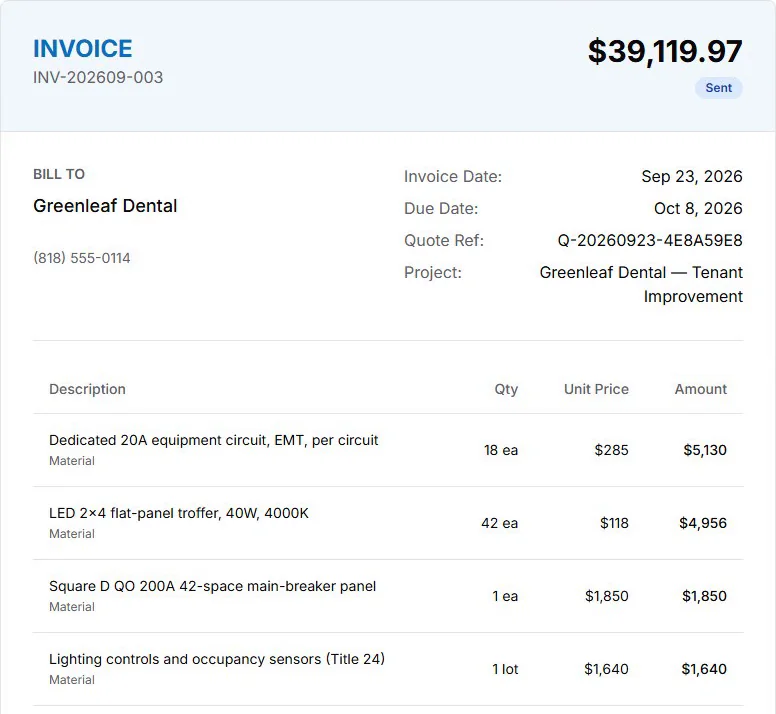
Residential and light commercial jobs are typically billed against milestones: a deposit of 25 to 50 percent to cover materials, a rough-in draw after wiring passes inspection and before insulation and drywall close the walls, a trim-out draw as devices and fixtures go in, and final payment after the punch walk and final inspection.
Commercial projects run on AIA billing. The monthly application is built on the G702 (Application and Certificate for Payment) and G703 (Continuation Sheet), which break the contract into a schedule of values: distribution gear, feeders, branch wiring, devices and fixtures, fire alarm, and testing and commissioning. Each line reports scheduled value, work billed in prior applications, work completed this period, and retainage. The software then calculates total completed and stored to date, subtracts the standard 5 or 10 percent retainage, and nets the amount due against previous payments. Application No. 4 of an eight-month job has to reconcile with Applications 1 through 3 to the penny, because the owner's auditor will check.
Progress invoicing also covers stored materials. Switchgear and transformers often arrive months before installation, and a compliant pay application bills stored materials as a separate line with storage location and insurance documentation. AIA billing software for electricians should generate G702 and G703 documents straight from the schedule of values, track retainage per line, and release it on the final application.
Lien paperwork rides along with every payment. Many states require a preliminary notice within as little as 20 days of first furnishing labor or materials to preserve lien rights, and each progress payment pairs a conditional waiver for the current draw with an unconditional waiver for the prior one. Software that tracks notice deadlines and waiver status by job protects rights that spreadsheets lose.
How AI-Powered Estimating Feeds Accurate Invoices
Billing accuracy starts before the first wire is pulled. When the estimate is a guess, the invoice inherits the guess, and the shop pays for the difference.
AI estimating changes the input side. During the job walk, an electrician records voice notes that AI transcribes into structured line items: two 200-amp services, 14 panelboards, 22,000 feet of branch wiring, 180 devices. A photo of the existing panel schedule becomes data instead of a reminder to check later. The estimator reviews quantities, then applies assemblies that carry both material and labor, so a receptacle assembly includes the device, box, cover plate, MC cable, connectors, and 0.35 labor hours at your loaded rate.
The payoff appears when scope changes. A change order drafted from the same price book and assemblies as the base contract produces an accurate line-item price in minutes, and once signed it flows into the schedule of values or the T&M ticket with no re-entry. The field then bills against the same numbers the estimator used, which prevents most billing disputes before they start.
Automated Follow-Up to Reduce Late Payments on Electrical Jobs
Collections stall because they depend on someone remembering to send an email on Thursday. Automated follow-up removes the memory problem.
A defensible sequence for electrical work looks like this: an online payment option sent with the invoice where payment processing is enabled, a reminder three days before the due date, a firm reminder the day after, a second notice with the late-fee language from your contract at 15 or 30 days past due, and an escalation that generates the notice of intent to lien when an account crosses 60 days. Every message references the specific invoice number, job address, and payment terms. Deposits and draws run through the same pipeline, so the next progress payment request goes out automatically the day after inspection sign-off.
For a solo electrician, this reclaims most of those weekly collection hours. For a growing shop, it means a 40-invoice accounts receivable list gets worked every day without hiring a bookkeeper.
Job Tracking and Crew Scheduling: Connecting Field Work to Billing
Every unbilled labor hour started as an untracked labor hour. When techs clock in on a mobile app tied to the job and cost code (rough-in, trim, service, testing), those hours land in billing automatically. Dispatch closes the other gap: a service call placed on the scheduling board carries the customer record, service history, and agreed rate from the CRM, so the ticket exists before the truck rolls.
This is where a mobile electrical invoice app earns its keep on time-and-material work. In the field, the tech logs labor hours, selects materials with the agreed markup (commonly cost plus 20 to 35 percent on T&M), adds a trip charge of 75 to 150 dollars, photographs the completed work, and captures the customer signature before leaving the site. The invoice goes out from the driveway. With service labor running 90 to 150 dollars an hour depending on market, T&M billing software protects that revenue by capturing every item while the evidence is still in front of the technician.
Equipment charges follow the same path. A lift rental or bucket truck day assigned to the job in the schedule appears on the invoice instead of disappearing into overhead.
QuickBooks Integration and Electrical Accounting Software
Double entry is where billing data dies. An invoice created in the field gets re-keyed into accounting, quantities drift, and job costing breaks.
What should the handoff look like? A proper QuickBooks integration for electrical contractors produces complete, line-level records for customers, invoices, payments, and credit memos that your bookkeeper maps to your existing chart of accounts. Retainage withheld on a pay application should post to a current asset account, so the balance sheet shows the 10 percent held on every open commercial job. Sales tax should flow correctly line by line, which matters because most states treat electrical labor and materials differently, and a service call can be taxable while new construction is exempt.
AceWatt's QuickBooks handoff today is QuickBooks-ready exports (an invoice-list spreadsheet and a QuickBooks-format payroll-hours CSV), not a native, real-time, bidirectional sync; full sync is in development. For shops that need true two-way sync today, several general field-service platforms offer it; confirm the exact sync behavior with any vendor during a demo.
Job costing is the second payoff. When labor hours, materials, and subcontract costs post to the right job in QuickBooks, you can compare billed versus actual on a panel upgrade or tenant buildout within days of invoicing. Waiting until year end means the margin is already gone. Electrical job costing software that shares data with billing makes that comparison routine.
Choosing the Right Electrical Contractor Billing Software for Your Shop
Evaluate candidates against the work you actually bill, and bring a hard test case: last month's most painful pay application. Then check for the following.
- Progress invoicing with schedule of values, retainage tracking, stored materials, and G702/G703 output
- T&M billing from the field with material markup, trip charges, photo documentation, and signature capture
- Estimating and invoicing from one price book, so change orders connect to contract billing
- Automated follow-up sequences with online payment collection
- Crew scheduling and job tracking that feed labor, material, and equipment data into invoices
- QuickBooks data flow with retainage, sales tax, and job costing support, via true two-way sync or line-level exports complete enough that your bookkeeper never re-keys a ticket
- Scalability, so solo service work and multi-crew commercial jobs run in the same system, priced per user as you add electricians
Run a live trial with real jobs. Import your current price book, build one estimate, convert it to a progress invoice with retainage, and check the record that comes out for your bookkeeper. If any step in that chain requires a spreadsheet, the software will fail the same way in production. The right system earns its keep in recovered admin hours and faster collections, and the wrong one becomes one more subscription to cancel.
Related Reading
- Electrical contractor invoicing software: the category guide for estimate-to-invoice workflows and collections.
- How electrical contractors automate progress billing and AIA documents: G702/G703 applications from the schedule of values.
- AIA Billing Software for Electrical Contractors: what to look for when G702/G703 draws matter.
- How electrical contractors automate time-and-material billing: protecting T&M margin in the field.
- Compare what is included on each plan on the pricing page.
- Electrical CRM: Lead-to-Invoice Tracking, First Call to Paid
- Electrician Financing Software: Offer Payment Plans
- Electrical contractor billing software: progress billing for jobs that outlast one invoice