
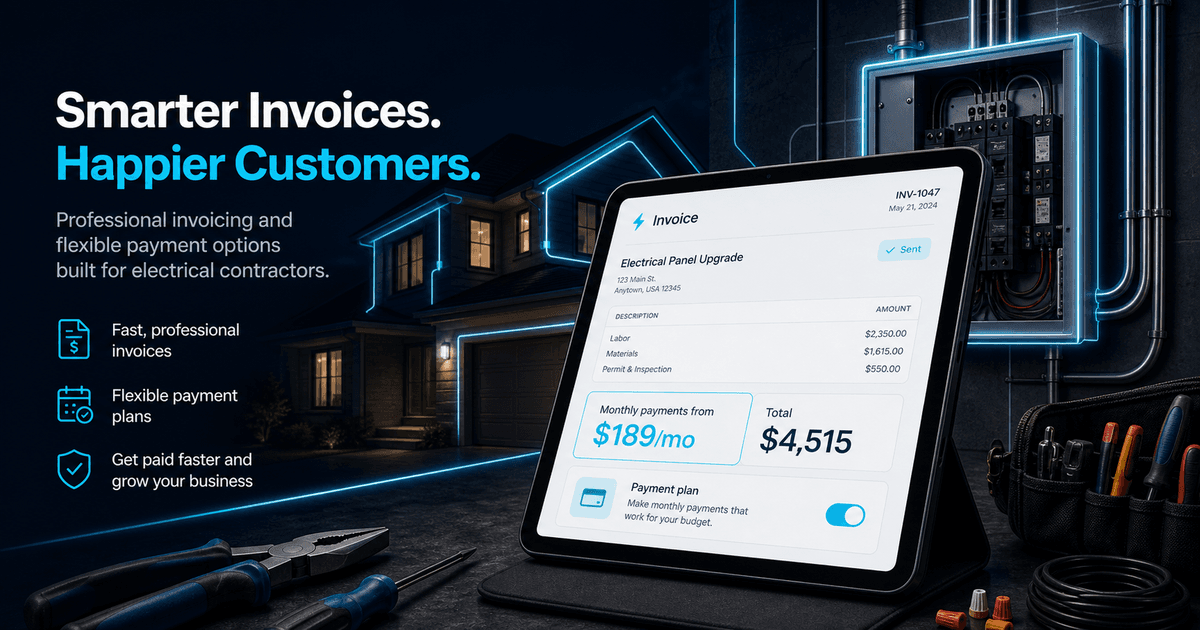
Electrician Financing Software: Offer Payment Plans
You know the job: the panel is overloaded, the homeowner wants the EV charger, and the estimate lands at $6,800. They nod through the scope, understand the safety issue, and then say, "We need to think about it." What they often mean is simpler: they cannot pay the full amount upfront this month. Electrician financing software helps you present payment options at the quote and invoice stage so good residential jobs do not die just because the customer needs monthly payments.
Why electricians lose jobs without financing
Residential electrical work has moved beyond small service calls. A homeowner may call for one outlet, but the real scope becomes a service upgrade, generator transfer switch, EV charger, or solar-ready panel. Industry-reported ranges put panel upgrades around $3,000, $8,000, standby generator installs around $7,000, $15,000, EV charger work around $1,200, $6,000, and solar tie-ins around $5,000, $20,000, depending on region, equipment, trenching, service size, permitting, and utility requirements.
That is not pocket change for most households. Even when the customer agrees the work is needed, a large electrical quote competes with mortgage payments, car repairs, childcare, and insurance. If the only option is "pay all of it now," the homeowner may delay the work, choose a cheaper scope, ask a handyman to cut corners, or call a competitor whose quote shows a monthly payment.
Financing changes the conversation from total project shock to cash-flow fit. Industry estimates often cite 20%, 40% close-rate uplift when financing is offered at the quote stage, but treat those figures as directional, not AceWatt data and not a guarantee. The practical point is enough: customers make decisions differently when they can compare "pay in full" with "monthly payment if approved." For high-ticket scopes, the payment option may be the difference between an approved job and a dead estimate.
For pricing discipline before financing enters the conversation, use an accurate scope and margin model first. Our electrician pricing calculator guide is the better starting point than guessing a monthly number from a rough total.
What "electrician financing software" actually means
Electrician financing software does not mean your electrical company becomes a bank. You are not underwriting loans, setting APRs, collecting monthly payments, or taking credit risk on a homeowner. In the residential workflow that matters most, you connect your quote and invoice process to a third-party consumer financing provider. The provider handles the application, approval decision, disclosures, funding, and customer repayment.
There are three common models:
- Embedded consumer financing. The homeowner applies through a provider link or embedded application tied to the job. If approved and accepted, the provider funds the contractor according to its program rules, and the homeowner repays the provider over time. This is the main model for panel upgrades, EV chargers, solar tie-ins, generators, and rewires.
- BNPL or short-term installment plans. Buy-now-pay-later products can work for smaller tickets, but many are not sized for a $10,000 generator or service upgrade. They also may not fit contractor payment timing.
- Business or commercial financing. Commercial electrical work can involve equipment leasing, lines of credit, progress billing, retainage, and GC payment applications. That is a different lane from homeowner financing.
The key workflow is simple: quote accurately, present payment options clearly, let a financing provider handle underwriting, then keep the job, invoice, payment record, and accounting export organized in your CRM. That is where AceWatt fits.
AceWatt is financing-ready, invoicing, card payments (plus ACH bank payments when your Stripe account has it enabled), and QuickBooks-ready exports are the operational backbone. For consumer financing on big-ticket jobs, use a third-party provider like Sunlight, Wisetack, or ChargeAfter alongside AceWatt. There is no native Sunlight, Wisetack, ChargeAfter, GreenSky, or Hearth integration in AceWatt today.
How financing works inside AceWatt
Inside AceWatt, financing should be treated as part of the quote-to-cash workflow, not as a separate spreadsheet your office manager has to reconcile later.
Step 1: Quote the real scope in AceWatt. Build the job as a proper electrical estimate: labor, materials, permit assumptions, panel conditions, access issues, exclusions, and options. On an EV charger, that may mean charger-only versus charger plus service upgrade; on standby power, it may mean generator size, transfer equipment, gas coordination, and electrical scope. For high-ticket examples, see our guides to EV charger installation software, solar installation software for electricians, and generator installation software for electricians.
Step 2: Present pay-in-full and financing paths. Your AceWatt quote or invoice remains the source of truth for scope and price. If you work with a third-party financing provider, add the provider's application link, QR code, or instructions to your customer presentation. Phrase it as "pay in full" or "apply for monthly payments through our financing provider." Do not promise approval, a specific APR, or a monthly payment unless the provider has generated it for that customer.
Step 3: Let the financing provider handle the loan. The homeowner applies with the provider. The provider determines eligibility, terms, disclosures, and funding. Many providers use soft-pull prequalification, but requirements vary. Industry estimates often place common approval thresholds around a 640+ credit score, yet every provider, lender, state, loan size, and promotion can differ.
Step 4: Record the funded payment in AceWatt. When the provider funds the job or pays you according to its merchant rules, record the invoice payment in AceWatt and keep the financing reference attached to the customer/job notes. If your shop uses QuickBooks, AceWatt's QuickBooks-ready exports on current Growth and Scale plans help keep invoices and payments aligned with accounting.
Step 5: Run the job normally. Scheduling, job walk notes, change orders, customer communication, invoices, and payment status still live in one CRM. Financing should remove payment friction; it should not create a second source of truth.
See how AceWatt invoicing works → Electrical contractor invoicing software
Best financing providers for electrical contractors (2026)
The providers below are third-party financing companies or marketplaces. AceWatt does not endorse them, does not act as their agent, and does not have native integrations with them today. Terms change frequently, state availability varies, and rates depend on borrower profile, merchant program, promotional plan, and lender. Verify current terms directly before quoting any customer.
| Provider | APR range | Loan sizes | Electrician relevance | Integration note |
|---|---|---|---|---|
| Sunlight | Program-dependent; promotional offers and standard fixed rates vary, often from promo APRs to high-20s APR | Often larger home-improvement loans; verify exact program limits | Strong fit for solar-adjacent work, batteries, service upgrades, and larger residential projects | Third-party portal/API path; use alongside AceWatt. No native AceWatt integration today. |
| Wisetack | Provider-reported offers can range from promotional APRs to about 35.99% APR, borrower-dependent | Commonly about $500, $25,000 | Good fit for service and mid-ticket home-improvement work like panels, EV chargers, and generators | Third-party application link or merchant workflow; no native AceWatt integration today. |
| ChargeAfter | Marketplace rates vary by lender and product, from promotional plans to standard consumer-loan APRs | Marketplace-dependent; often small to larger home-improvement tickets | Useful when you want multiple lender options behind one application experience | Third-party marketplace/API; no native AceWatt integration today. |
| GreenSky | Promotional, deferred-interest, and standard APR programs vary; verify current contractor terms | Often used for home-improvement tickets up to tens of thousands | Familiar home-improvement financing option for larger residential scopes | Third-party merchant program; no native AceWatt integration today. |
| Hearth | Lender-dependent personal loan rates, often from mid-single digits to mid-30s APR | Commonly about $1,000, $100,000, lender-dependent | Contractor-friendly marketplace for homeowners comparing loan options | Third-party marketplace/link workflow; no native AceWatt integration today. |
The best provider is not simply the one with the lowest advertised APR. Ask about contractor fees, funding time, chargebacks, cancellation rules, minimum job size, state availability, customer disclosures, and whether your team can present options without overstepping licensing or lending rules.
What to look for in electrician financing software
A financing-ready electrical CRM should make the financing process easy to present while keeping the financial and compliance boundaries clear.
Look for:
- Quoting and invoicing in one record. The financed amount should match the approved scope. If change orders happen, the customer record should show what changed and when.
- Mobile customer application path. Homeowners should be able to apply from their phone while the estimate is still fresh.
- Clear "not a lender" boundaries. Your CRM should help you organize the workflow, not pretend your shop is underwriting loans.
- Payment status and audit trail. When the provider funds the job, the invoice should be updated and traceable.
- Card and bank payments for non-financed work. Many customers still pay deposits or balances directly. AceWatt supports invoicing plus card payment collection, and ACH bank payments when your Stripe account has it enabled.
- QuickBooks sync. Accounting should not require retyping invoices or reconciling mystery deposits. Current AceWatt pricing lists QuickBooks-ready exports on Growth and Scale plans, with full sync in development.
- Room for job documentation. Financing does not replace field accuracy. Photos, notes, permits, and signed change orders still matter.
The software should help your team explain options without making credit promises. Phrases like "subject to credit approval," "terms provided by the financing provider," and "not all applicants qualify" are safer than quoting a universal monthly payment.
Financing vs. other ways to close big jobs
Financing is powerful, but it is not the only way to handle price resistance. Use the right tool for the ticket size and risk.
In-house payment plans feel simple, but the risk sits on your shop. If the customer stops paying after the work is complete, you become the collector. That may be acceptable for a trusted repeat customer and a small balance, but it is risky on a $12,000 generator.
Credit cards are familiar and fast. They work well for service calls, deposits, and customers who want points or a short float. The downside is limit pressure and processing cost. A homeowner may have enough credit for a $1,200 repair but not a $9,000 panel and EV charger bundle.
Discounting can close some jobs, but it trains customers to negotiate and cuts directly into margin. It also does not solve the real problem when the homeowner lacks cash today.
Deposits and staged billing help your cash flow, especially when equipment must be ordered upfront. They do not turn a large total into a manageable monthly payment for the customer.
Third-party consumer financing usually makes the most sense for residential jobs above a few thousand dollars, especially when the customer understands the need but hesitates on timing. The provider takes the repayment relationship; you keep your focus on electrical scope, schedule, documentation, and getting paid according to the provider agreement.
Electrician financing FAQ
Do electricians offer financing?
Yes, many residential electricians offer financing for larger jobs through third-party consumer financing providers. It is increasingly common on panel upgrades, EV chargers, generators, solar tie-ins, and whole-home rewires. The electrician presents the option; the provider handles credit review, terms, disclosures, and repayment.
How do I offer payment plans to electrical customers?
Start by choosing a consumer financing provider, completing its merchant setup, and training your team on compliant language. Then add the provider's application link or instructions to your quote and invoice workflow. In AceWatt, keep the estimate, invoice, payment status, and job documentation together while the provider handles financing outside the CRM.
What credit score do homeowners need for electrical financing?
It depends on the provider and loan product. Industry estimates often cite starting points around 640+, but some providers use broader credit models and some promotional plans may require stronger credit. Do not promise approval. Let the provider show the customer the actual terms.
Does AceWatt offer financing?
No, AceWatt is financing-ready: invoicing, card payments (ACH bank payments when your Stripe account has it enabled), and QuickBooks-ready exports. We recommend integrating a consumer financing provider such as Sunlight, Wisetack, or ChargeAfter for big-ticket jobs. AceWatt is not a lender, does not underwrite homeowner loans, and does not have native consumer-financing integrations with those providers today.
Can I finance commercial electrical work?
Commercial financing is a different category. A business customer may use equipment financing, a line of credit, leasing, progress billing, or construction payment applications. Consumer financing providers for homeowners are not automatically the right fit for tenant improvements, municipal work, or GC-driven projects with retainage.
Is financing better than lowering my price?
Often, yes, for high-ticket residential work, but not always. Financing addresses timing and cash flow without cutting your scope or margin. Discounting may still make sense for a strategic customer or a clearly overpriced option, but it should not be your default response to every objection.
Start closing bigger electrical jobs today
AceWatt gives electrical contractors the financing-ready workflow that has to exist before a financing provider can help: accurate quotes, customer records, invoices, card payments (ACH when enabled in your Stripe account), job documentation, and QuickBooks-ready exports on eligible plans. Use AceWatt as the source of truth for the job, then connect the consumer financing provider that fits your market and risk requirements.
The honest boundary is the advantage: AceWatt is not a lender and does not claim built-in Sunlight, Wisetack, ChargeAfter, GreenSky, or Hearth integrations today. It gives your shop the quote-to-invoice backbone that makes payment options easier to present, track, and reconcile.
Start your 14-day free trial, quote, invoice, and get paid (financing-ready) in one CRM. Plans from $49/mo.