

Why Time and Material Billing Still Slows Down Electrical Contractors in 2026
Time and material (T&M) work remains the backbone of service and repair revenue for electrical contractors across the U.S. Yet in 2026, most shops still run T&M on paper tickets, spreadsheets, or disconnected apps. The result: missed labor hours, uncharged materials, and invoices that sit in a drawer until the project manager remembers to key them in. For a trade where a single forgotten 20-amp GFCI receptacle or an hour of apprentice time can swing a job's profitability by $150 to $300, those leaks add up fast.
The problem isn't a lack of effort. It's that the workflow, from the truck to the office, has too many handoffs. An electrician finishes a service call, scribbles hours and materials on a carbon-copy ticket, tosses the receipt in a glovebox, and hopes the office catches it all. Meanwhile, the back office chases missing signatures, re-keys data into QuickBooks, and sends invoices 10 to 14 days after the work. Days-sales-outstanding (DSO) on T&M routinely hits 45 to 60 days, compared to 30 days for fixed-price projects.
Modern electrical contractor time and material billing software mobile platforms close that loop by letting field crews capture everything at the point of work (labor, materials, equipment, photos, and voice notes) and pushing it straight into estimating, invoicing, and accounting without re-entry.
The Real Cost of Handwritten T&M Tickets and Lost Job Site Notes
A typical service electrician runs 3 to 5 calls a day. Each call generates:
- Labor: Journeyman at $95 to $135/hr, apprentice at $45 to $65/hr, plus overtime rules that vary by state (CA daily OT after 8 hrs, federal after 40).
- Materials: Wire, connectors, breakers, GFCI/AFCI devices, often pulled from the truck stock or picked up at a supply house. Markup typically 15 to 25% over cost.
- Equipment: Lift rental, megohmmeter, thermal imager, billable at $50 to $150/day.
When any of those line items stay on a paper ticket, the shop loses revenue. A 2025 NECA benchmarking study found that contractors using paper T&M tickets underbill 6 to 9% of direct costs annually. On a $2M service division, that's $120K to $180K left on the table.
Beyond revenue, missing documentation creates compliance risk. NEC 210.12 (AFCI) and 210.8 (GFCI) require specific device types and locations. If an inspector or insurance adjuster asks for proof that a 20A GFCI was installed per 210.8(A)(6), a smudged ticket with "GFCI" and no model number won't hold up. The same goes for prevailing wage jobs, where certified payroll demands exact hours per classification, per day.
Mobile Field Capture: Logging Labor, Materials, and Equipment From the Truck
The fix starts with a mobile field capture app. Where signal is weak (basements, rural sites), clock in/out, field notes, expenses and project notes queue offline and send when signal returns. Electricians clock in on the job from their phone, with location and an at-the-job-site flag, and clock out when done. Hours are priced at one hourly rate per job title, so there is no mental math; overtime and double-time premiums are not applied automatically.
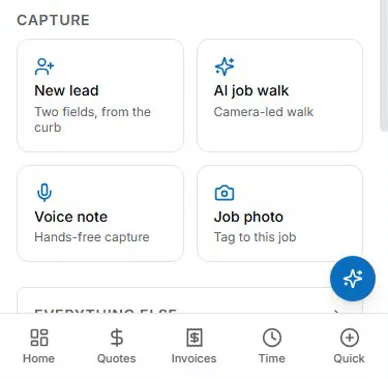
Materials are logged three ways, always at cost (markup is set on the quote, not added in the field):
- Job expense: log the purchase as an expense on the job; it queues offline and sends when signal returns.
- Field note: note what came off the truck in the job's field notes so the office can bill it.
- Manual entry with type-ahead search from a 50,000+ SKU electrical catalog (NEMA, UL, NEC-referenced).
Equipment usage is a checkbox: "Scissor lift, 4 hrs" or "Thermal camera, 1 hr." The app attaches the equipment rate from the shop's price book.
Every clock-in carries location, a timestamp, and the electrician's ID. At day's end, the foreman reviews the daily log, adds a one-sentence summary ("Troubleshot 480V feeder, replaced 3-pole 100A breaker, megger tested OK"), and hits Submit. The office sees a complete, coded T&M ticket in real time, with no carbon copies or lost receipts.
AI Voice and Job Walk Documentation for Hands-Free Time Tracking
Solo electricians and small crews can't type while pulling wire or climbing a ladder. AI Voice and Job Walk Documentation lets them talk through the job as they walk it:
> "Job 4421, 1423 Oak St. Replaced faulty AFCI breaker in panel P-1, 20A Siemens QAF2. Pulled new 12/2 NM-B from panel to bedroom outlet, secured per NEC 334.30. Tested AFCI trip, passes. Labor: 1.5 hrs JW, 0.5 hr AP. Materials: breaker, 25 ft wire, 4 staples."
The AI turns it into a job-walk report with a materials list on the job, ready for the office to bill. No after-hours paperwork.
For larger jobs, the same voice capture works during the initial walk-through. The estimator gets a structured scope with quantities, not a voice memo they have to replay three times.
Connecting AI Estimating to Actual Hours and Materials Billed
AI Estimating doesn't just build the bid. It sets the baseline for T&M tracking. When the estimator prices a service upgrade, they price from the company pricebook and assembly templates (e.g., 0.8 hrs per 20A circuit, 1.2 hrs per AFCI device). The estimate becomes the budget for the work order.
As the crew logs actuals via mobile capture, the system runs a continuous estimate vs. actual comparison:
- Labor: Estimated 4.2 hrs → Actual 5.0 hrs (flag: +19%)
- Materials: Estimated $320 → Actual $385 (flag: +20%, supply house price surge on AFCI breakers)
The project manager sees the variance on a dashboard, not in a month-end report. They can call the customer before the invoice goes out: "We ran 45 minutes over on the feeder pull. Conduit was undersized per NEC 300.17. Need your okay to bill the extra time." That conversation happens while the value is fresh, not 30 days later when the customer disputes the invoice.
Automated Invoicing, Payment Tracking, and QuickBooks-Ready Exports
Once the foreman approves the daily log, the system auto-generates a T&M invoice using the shop's template:
- Header: Job name, PO#, contract reference, NEC scope lines
- Labor lines: Classification, hours, rate, extension
- Material lines: Qty, description, cost, extension
- Equipment lines: Days/hours, rate, extension
- Subtotal, tax (per state/local rules), total
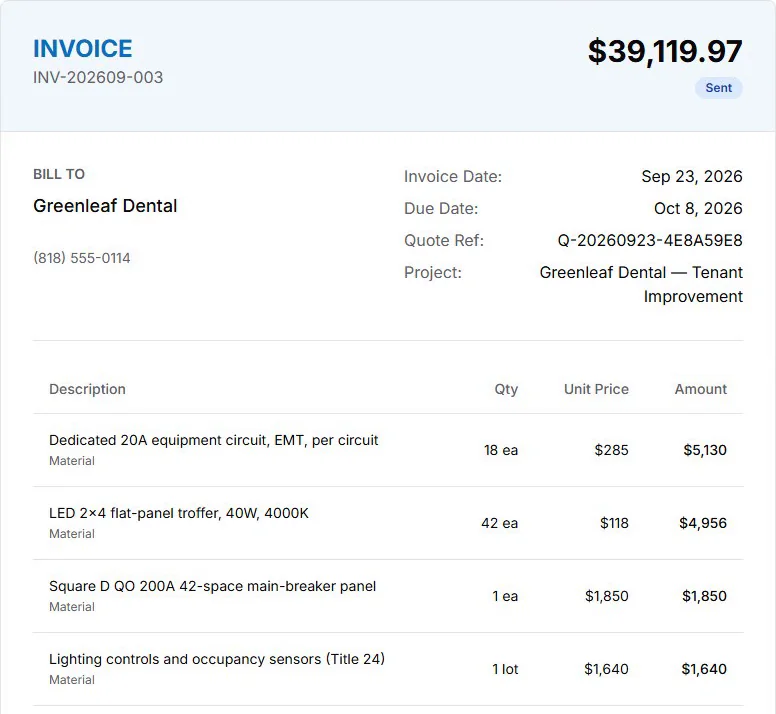
The invoice emails to the customer with a Pay Now button (card, or ACH if enabled in your Stripe account). Automated Follow-Up emails reminders when the invoice is 1, 7, 14 and 30 days past due. Payment posts back to the invoice, updates the AR aging, and triggers a receipt.
QuickBooks-ready exports hand your bookkeeper the invoice list as a spreadsheet and payroll hours as a QuickBooks-format CSV — no native, real-time sync today, and full sync is in development — while labor burden, material costs, and equipment expense stay itemized on the job. Job costing reports in the app match the field data. At year-end, the CPA sees clean audit trails: every dollar tied to a work order, a tech, and a timestamp.
How Crew Scheduling and Job Tracking Keep T&M Billing Accurate
Crew Scheduling and Dispatching helps assign the right electrician to each T&M call on a drag-and-drop board, weighing:
- Who is free on the board (license class and apprentice ratios stay the dispatcher's call)
- Location on the live dispatch map while the app is open (route optimization is straight-line, on the Scale plan)
- Skill tags (VFD troubleshooting, medium voltage, solar, EVSE)
The dispatch board shows real-time availability. When a "no heat, 240V furnace" call comes in, the dispatcher sees which JW has a megger and thermal camera on their truck today. That electrician gets the work order on their phone with the customer history, panel photos from last visit, and the exact AFCI breaker model needed.
Job Tracking links every labor hour, material line, and equipment entry to the work order number. If a customer calls asking "What did you do last Tuesday?", the office pulls the job, sees the voice note, photos of the replaced breaker, and the signed ticket in 10 seconds. No digging through file cabinets.
What to Look for in Electrical Contractor T&M Billing Software in 2026
Not all field service platforms handle electrical T&M the same way. Evaluate on these non-negotiables:
| Capability | Why It Matters for Electrical T&M |
|---|---|
| Offline-first mobile app | Basements, hospitals, rural sites: no signal can't stop billing |
| NEC-referenced material catalog | Auto-matches AFCI/GFCI types, wire ampacities, conduit fill |
| Labor rule engine | State OT, prevailing wage, union rules, apprenticeship ratios |
| AI voice capture | Hands-free documentation for solo techs and ladder work |
| Estimate-to-actual variance dashboard | Catch overruns while the job is still open |
| QuickBooks handoff | Invoice-list and payroll-hours exports for your bookkeeper |
| Automated follow-up with payment links | Cuts T&M DSO from 50+ days to under 30 |
| Crew scheduling with skill/license matching | Right tech, right truck, right billable hours |
| Photo + voice + GPS audit trail | Defends every line item if questioned |
A connected platform (AI-powered CRM, AI Estimating, Automated Follow-Up, Crew Scheduling and Dispatching, Job Tracking, Invoicing and Payment Tracking, AI Voice and Job Walk Documentation, QuickBooks-Ready Exports) covers much of the above, with three exceptions: offline capture is limited to clock in/out, new leads, field notes, expenses and project notes; labor is priced at one hourly rate per job title rather than by an overtime or prevailing-wage rule engine; and dispatch gives skill-based suggestions rather than license matching. That is what turns T&M from a leaky bucket into a predictable, high-margin revenue stream.
Electrical contractors who move T&M off paper and into a connected mobile workflow in 2026 will bill more accurately, collect faster, and sleep better knowing every hour, every foot of wire, and every AFCI breaker is documented, priced, and paid for. The tools exist. The only question is how much more revenue you're willing to leave on the next crumpled ticket.
Related reading: Time & Material Billing for Small Electrical Contractors: Templates, Apps & Change-Order Workflows.
Related Reading
- How to Automate Time & Material Billing for Electrical Contractors Without Double Entry
- Electrical invoicing software: how contractors get paid faster in 2026
- Electrical contractor billing software for progress invoicing and AIA
- Electrical T&M Billing Software: 2026 Buyer's Guide
- T&M Billing Automation for Small Electrical Contractors