
Why After-Hours Emergency Calls Are the Highest-Margin Work in Electrical Contracting (and the Easiest to Lose)
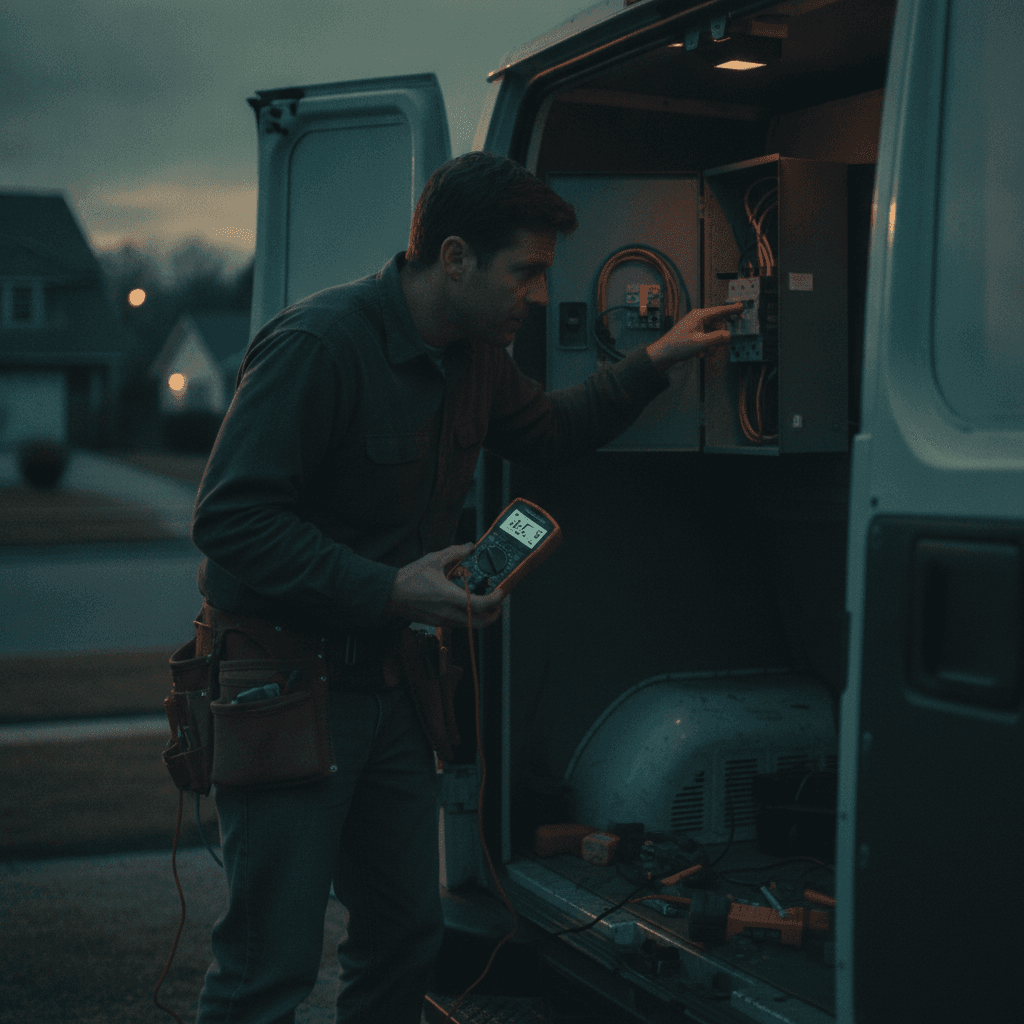
The 2 a.m. call sounds the same every time: main breaker tripped, half the house dark, homeowner panicked. You roll the truck, find a failed panel with a scorched bus bar, pull an emergency permit the next business day, and bill four hours at 1.5 to 2 times your standard rate plus materials. One call can outearn a full day of rough-in work.
Most shops let that revenue walk anyway. The call hits voicemail. The on-call tech is buried in another job. The callback takes 45 minutes. By then the homeowner has hired whoever answered on the first ring.
After-hours emergencies (total outages, Federal Pacific Stab-Lok and Zinsco panel failures, storm-damaged service masts, tripped mains feeding commercial refrigeration) are premium time-and-material work. There is no competitive bid and no change-order haggling, because the customer has immediate need and zero use. But capturing that revenue consistently requires infrastructure most shops lack: emergency electrical dispatch software with after-hours scheduling built in, not a shop phone forwarded to whoever slept lightest.
The True Cost of Slow Emergency Dispatch in 2026: Missed Calls, Idle Crews, and Unbilled Overtime
Slow dispatch bleeds money in three places at once.
Missed calls. A homeowner with a dead panel does not leave a voicemail. They tap the next name in Google Maps within a minute, and if you are running Local Services Ads, slow response times quietly drag your ranking down with every unanswered lead. A live answering service runs $200 to $500 per month or $1 to $2 per minute, and the operator still cannot quote a trip fee, triage a burning smell versus a nuisance trip, or reach your on-call tech any faster than a text would.
Idle crews. When dispatch is a whiteboard and a group text, nobody knows which truck is 10 minutes from wrapping up and which tech is two towns over. The average emergency response stretches by 30 to 60 minutes of pure windshield time, and response time is the only thing the customer remembers when they write the review.
Unbilled overtime. This is the silent killer. Under the FLSA, your non-exempt field techs are owed time-and-a-half for hours over 40 regardless of whether the paperwork ever lands on an invoice. If those hours get scribbled on a paper ticket and never entered, you are paying roughly $70 an hour in loaded overtime wages and billing nothing for it. Run the math on a typical weeknight no-outage call: four hours at 1.5 times a $110 standard rate is $660 in labor, plus about $75 in markup on $300 of truck stock, plus a $185 after-hours trip charge. That is a $900-plus invoice. Miss three of those calls a month and you have handed a competitor more than $30,000 a year.
How AI-Powered Crew Scheduling and Dispatching Puts the Closest Qualified Electrician On Site Faster
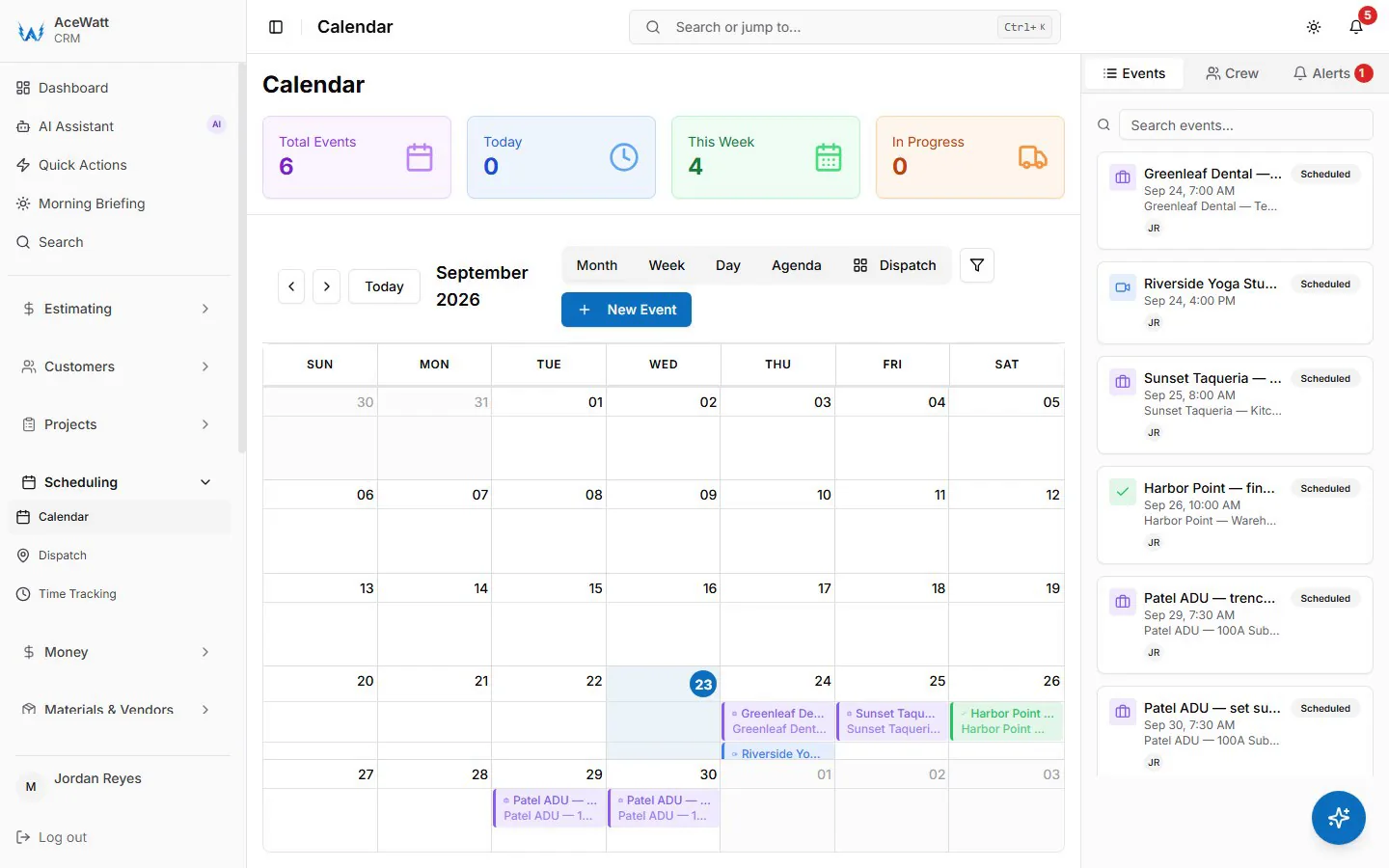
Fast dispatch is not about driving faster. It is about the system already knowing three things before the phone rings.
Who is on call. A rotation calendar inside the software holds the after-hours schedule, so there is no calling around at 11 p.m. to figure out whose night it is. The rotation is set weeks ahead, visible to the whole team, and enforced by the system rather than by memory.
Who is closest and available. Live Job Tracking shows each tech's status, and the live dispatch map shows where they are while their app is open. When an emergency lands, dispatch can see that your journeyman wraps his current job in 15 minutes two miles away, and route the call to him instead of pulling a tech off an in-progress panel change across the metro. When a thunderstorm rolls through at 9 p.m. and ten calls land in an hour, the status board becomes the difference between triage and chaos. That is the core of professional electrical dispatch software: routing decisions based on real-time data instead of gut feel.
Who is qualified. A storm-torn service mast is Article 230 work, and mast supports fall under NEC 230.28. Work inside energized gear requires a qualified person under NFPA 70E, and panel and service replacements require a journeyman or master license depending on your state. Skill-based suggestions on the drag-and-drop dispatch board help the dispatcher send those emergencies to the right person; license level is still the dispatcher's check, so a first-year apprentice is never sent to a job he cannot legally perform or safely touch.
The moment a tech is assigned, a quick call or email to the customer with the electrician's name and an ETA stops the callback spiral and starts the clock on a five-star review.
Handling the 2 a.m. Call: Phone Menu, CRM Lead Capture, and Follow-Up
AceWatt does not answer calls with AI. It has a phone menu (Voice Receptionist) that routes callers and, after hours, tells them a team member will call back and alerts your staff, including the calls that come in while your on-call tech is up to his elbows in a live panel. The tech calls back, captures the name, address, callback number, and a description of the problem, and triages. Burning smell, sparking, smoke, or a sparking meter base escalates immediately to the on-call tech. A single dead receptacle or a nuisance GFCI trip gets queued for the morning with the customer told exactly when to expect a call.
Every call you log becomes a tracked lead in the CRM, not a scribbled note on the seat of the truck. If the address is on file, the tech sees the history before he rolls: the Zinsco panel flagged last spring, the unfinished attic with knob-and-tube still live, the customer who mentioned a heat pump upgrade.
That history is where emergency calls compound. Say the 2 a.m. outage traces to a failed 100-amp service that cannot support the heat pump the homeowner wants installed anyway. A load calculation under NEC 220.83 confirms the service is undersized. Your office sends the photos and findings the next morning, a link to a scheduled estimate two days later, and a reminder the week after; Automated Follow-Up itself only emails overdue-invoice reminders, so this sequence is yours to run. A $900 emergency call converts into a $3,000 to $5,000 service upgrade when that follow-up actually happens. This is the difference between a call center and true electrical service management software: the emergency is the entry point, not the end of the story.
Documenting Emergency Work Hands-Free: AI Job Walk Records for Insurance Claims, Permits, and Disputes
Emergency documentation happens in the worst conditions: attics at 2 a.m., crawlspaces, energized gear, arc-flash gloves that make a phone keyboard useless. AI Voice and Job Walk Documentation lets the tech simply talk. He narrates what he sees (corrosion on the neutral lug at the meter base, scorch marks on the left bus bar, water intrusion at the service head), and the software transcribes it, timestamps it, and attaches it to the job record along with photos.
Three things happen with that record:
- Insurance claims. Storm-damaged masts and fallen service conductors need adjuster-ready evidence. A timestamped narration with photos, captured before anything is touched, closes claims faster and gets paid in full.
- Permits and inspections. Most jurisdictions allow emergency disconnection and restoration with the permit filed the next business day. Photos of existing conditions before cover-up, plus a documented scope of work, make the inspection a formality instead of a re-inspection.
- Disputes. When a homeowner later claims the scope was different, you have a recorded walkthrough and an approved change order on file, not a verbal agreement and a memory.
Time-and-Material Billing for Emergency Calls: AI Estimating, Overtime Premiums, and On-Site Invoicing
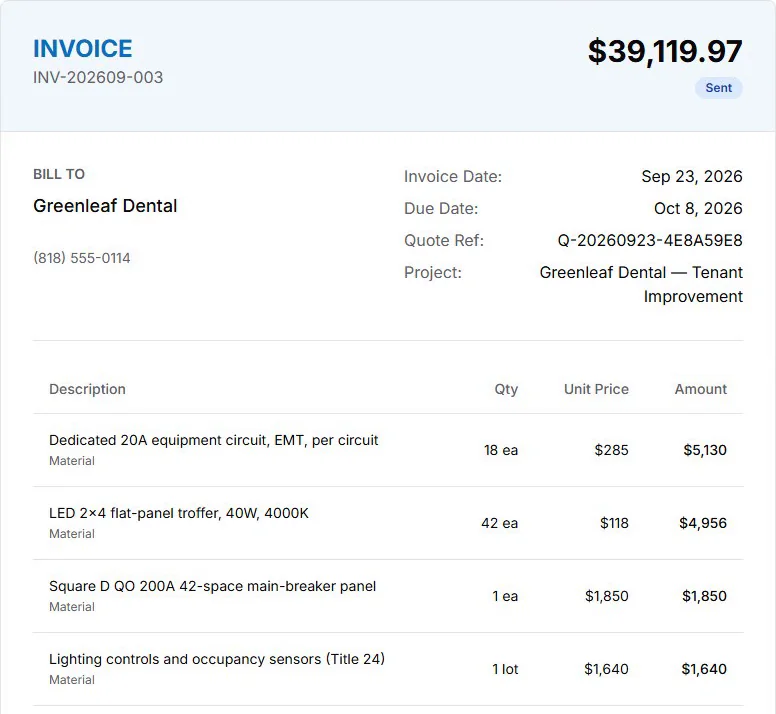
Billing is where after-hours work is won or lost, and it is the number one reason shops evaluate our platform in the first place. A proper rate table holds your standard rates plus the after-hours premiums that mirror your actual labor cost; in our platform the labor rate is one hourly rate per job title and these premiums are added as their own line:
| Scenario | Billing multiplier | Typical invoice effect |
|---|---|---|
| Weeknight after hours | 1.5x standard rate | $110/hr becomes $165/hr |
| Weekend after hours | 2x standard rate | $110/hr becomes $220/hr |
| Holiday after hours | 2.5x standard rate | $110/hr becomes $275/hr |
| Trip charge, after hours | Flat, set by you | $185 minimum before the first minute |
AI Estimating drafts the quote from your pricebook on the tech's phone, for review before the work starts, with the after-hours premium added as its own line. The customer signs it standing in the driveway, which ends the "you never told me it would be that much" argument before it begins. Job Tracking holds the hours the tech clocks in and out on the job, so the after-hours invoice is built from the same record. This is exactly what dedicated time and material billing software for electrical contractors is built to do, and it is the difference between an emergency call that carries 45 percent margin and one that quietly breaks even after overtime payroll.
Getting Paid Before the Truck Leaves: Payment Tracking and QuickBooks-Ready Exports for After-Hours Revenue
You may never see the 2 a.m. customer again, so you cannot afford 30-day terms on emergency work. Invoicing and Payment Tracking emails the invoice with a pay link, so the customer can pay by card (ACH if enabled in your Stripe account) before the truck moves. Anything left unpaid gets flagged automatically, with reminders that go out without anyone touching a spreadsheet.
Then the back office has to absorb the night. The whole night lands in the app: labor hours on the payroll-hours CSV export and in job costing, truck stock materials on the right job, mileage on the right truck, and each invoice on the invoice-list export for your bookkeeper. There is no native, real-time sync today; full sync is in development. What it ends is the Monday stack of paper tickets and emergency revenue sitting in limbo on paper. Job costing then proves what you suspected: after-hours calls, billed correctly, carry your best margin in the business. This is why electrical contractor billing software with a real QuickBooks integration matters more than any dispatch bell or whistle.
What to Look for in Emergency Electrical Dispatch Software in 2026: A Buyer's Checklist
Core capabilities, non-negotiable in any year:
- On-call rotation calendars that enforce themselves, with escalation chains
- Nearest-available-electrician assignment using live job status
- License and skill matching so masts and panels go to qualified personnel
- T&M rate tables with weeknight, weekend, and holiday multipliers
- On-the-spot estimating with signature capture before work begins
- Hands-free voice documentation with timestamped photo sync
- On-site payment collection and automated payment reminders
- QuickBooks integration covering labor, materials, and mileage (line-level exports or two-way sync)
The 2026 baseline, where the field has moved in the past two years:
- An AI voice agent that can actually triage. It escalates burning-smell calls to a human in under a minute, handles the address-and-availability conversation without looping, and identifies itself as AI where state bot-disclosure rules require it. Test it with your own worst-caller scenarios before you buy.
- Estimating catalogs on the 2026 NEC cycle. The 2026 edition of the National Electrical Code rolls out this year and state adoptions begin immediately after. Your assemblies and labor units should track it, and material pricing should sync live, because copper wire pricing swung violently through 2024 and 2025 and a stale price book now costs real money on every T&M invoice.
- TCPA-ready consent capture. Automated text follow-up only works if marketing consent is captured and logged at the point of booking, so your reminder sequences stay compliant.
- A certified QuickBooks Online integration, not a CSV export with "integration" on the sales page. Line items, classes, and payroll items should map cleanly.
- Transparent AI pricing. Flat per-technician pricing that includes AI intake beats metered per-minute AI billing, which punishes you for exactly the call volume you bought the system to capture.
- Offline mode. Basements, crawlspaces, and metal buildings eat signal. Documentation should queue and sync when the tech resurfaces.
A generic field service app will clear maybe four items on those lists. An electrical contractor scheduling app built for this trade should clear most of them, so check each item in a trial, ours included.
From Solo Electrician to Multi-Crew Shop: Scaling 24/7 Emergency Service Without Burning Out Your Team
For the solo electrician, the software is the office. It answers the phone while you are on a ladder, captures the lead, and lets you approve the dispatch from your pocket. Non-urgent calls queue for tomorrow's callback window instead of interrupting the job that pays for the truck. You invoice from the driver's seat and get paid before you pull out of the driveway. Genuine 24/7 coverage without hiring anyone.
For growing shops, the problem shifts from missing calls to burning out the people who answer them. If the same tech takes every 2 a.m. call because nobody else knows the rotation, he quits, and his license was carrying your emergency service. Purpose-built on-call electrician scheduling software enforces fair rotations, balances after-hours load across crews, and shows you exactly how many night hours each tech is carrying so you can adjust before the resignation letter. It is how a four-truck shop delivers true 24/7 electrical dispatch without a night dispatcher on payroll.
Conclusion: Put the Whole Emergency Chain on One Platform
Emergency work is the highest-margin work in the trade precisely because it is the hardest to capture: it comes at the worst hour, it demands the right license, it requires bulletproof documentation, and the money has to be collected on the spot. Every one of those links (intake, dispatch, documentation, estimating, invoicing, payment, follow-up) is a place where revenue leaks when the chain runs on voicemail, group texts, and paper tickets.
Our platform handles the chain in one system built specifically for electrical contractors: a phone menu that routes after-hours callers and alerts your staff, crew scheduling and dispatching, AI job walk documentation, AI estimating from your pricebook, invoicing with online card payment through a pay link, automatic email reminders on overdue invoices, and QuickBooks-ready exports (an invoice-list spreadsheet and a QuickBooks-format payroll-hours CSV) — not a native, real-time sync.
Book a walkthrough and bring your rate table. We will load your hourly rates and your rotation, then run a 2 a.m. call end to end so you can see exactly what a captured emergency looks like before it ever happens.
Related Reading
- Best electrical dispatch software for emergency service calls: a 2026 comparison with GPS routing and real-time crew tracking.