

The 8 Best Electrical Estimating Software Tools of 2026, Compared for Electrical Contractors
Every tool on this list can produce a bid number. Where they differ is how much of the work before and after the estimate they actually cover, and that difference decides whether you rekey data every evening or send proposals from the truck by mid-afternoon. This guide compares the eight tools electricians actually shortlist in 2026, scored on takeoff type, AI capability, pricing model, and fit for solo shops versus multi-crew operations.
Why Faster Estimates Win More Electrical Bids in 2026
Most general contractors give electrical subs a 48 to 72 hour window between plan release and bid day. Residential service work runs on an even shorter clock: a homeowner rewiring a 1962 ranch typically collects two or three bids and signs with whoever hands over an itemized number first. The first professional estimate in the inbox sets the anchor for every bid that follows, and a proposal that arrives three days after the walk usually arrives after the customer has signed someone else's.
Code cycles add pressure. The 2026 NEC is current at the NFPA level, but most jurisdictions still enforce the 2023 or 2020 editions, so material lists vary by county. Panel replacements show why: since the 2020 NEC, section 230.67 requires a Type 1 or Type 2 surge protective device when you replace a dwelling service. That is a real line item, roughly $150 to $400 in material, that a checklist written before 2020 misses entirely. The 2020 NEC also widened 210.8 GFCI protection beyond 15 and 20 amp receptacles in garages, basements, and outdoors, which changes device counts on those circuits.
Material pricing moves just as fast. COMEX copper broke $5 a pound in May 2024 and set fresh records in 2025, and THHN and MC pricing follow it. A price book exported six months ago can turn a profitable rewiring bid into a loss on branch wiring alone.
The shops winning bids in 2026 run a compressed cycle: capture scope at the job walk, price it the same day, send the proposal, and follow up until the customer answers.
What Electricians Actually Need From Estimating Software
Four capabilities separate real estimating systems from expensive PDF viewers.
Takeoff type. Commercial estimators need plan takeoff: counting receptacles, fixtures, and panels, and measuring EMT and branch runs on digital drawings. Service electricians need scope capture, since the estimate starts at the job walk with a voice note and photos of the panel, not a drawing set. Many electrical takeoff software products handle only one of these two workflows.
Live material pricing on real assemblies. Assemblies are what make electrical estimating fast. A "200A service upgrade" assembly should pull a meter-main combination, a 20-space or 40-space panel, an SPD per 230.67, a grounding electrode conductor sized per 250.66, two ground rods per 250.53(A)(2), and permit line items in one motion. Tools without pricing databases make you rebuild that list every time.
Labor units. Takeoff counts quantities. Estimating applies labor. The NECA Manual of Labor Units remains the reference most databases build from, and any serious electrical bid software lets you adjust labor for wall type, ceiling height, and working conditions instead of accepting a single national average.
T&M billing. A large share of service revenue is billed time and material, and most estimating products stop at the proposal. The software should carry logged hours and marked-up materials straight into an invoice, which is where time and material billing software for electrical contractors earns its keep.
The 8 Best Electrical Estimating Software Tools Compared for 2026
1. AceWatt (best AI electrical estimating software for service and light commercial work) AceWatt is an AI-native platform built specifically for electrical contractors, covering the full arc from job walk to paid invoice.
- Takeoff type: Scope capture from job walks via AI Voice and Job Walk Documentation, plus itemized assemblies for service and light commercial work
- AI: Voice transcription turns the walk recording into a structured, itemized estimate; the AI-powered CRM scores and routes leads
- Pricing: Month-to-month subscription per seat, no implementation fee
- Best fit: Solo electricians through roughly 10-crew shops doing service, residential, and light commercial
- After the estimate: Automated Follow-Up on overdue invoices, Crew Scheduling and Dispatching, Job Tracking, Invoicing and Payment Tracking, and QuickBooks-Ready Exports
2. Trimble Accubid The enterprise standard for plan-spec electrical and MEP estimating, now cloud-based as Accubid Anywhere with LiveCount for on-screen takeoff.
- Takeoff type: Full digital plan takeoff with keyword symbol search
- AI: Minimal; keyword takeoff and database lookups, no generative estimating
- Pricing: Quoted, with multi-seat commercial deployments commonly reaching five figures annually once labor database subscriptions are included
- Best fit: Commercial and industrial contractors with dedicated estimators
- After the estimate: Exports to Trimble field products; accounting requires third-party integration work
3. McCormick Systems A legacy electrical and mechanical estimator with deep assembly and labor databases, long popular with union commercial shops. Its Design Estimating Pro platform traces its lineage back decades, which shows in both its databases and its interface.
- Takeoff type: Plan-based with strong assembly support
- AI: None
- Pricing: Quoted, same enterprise tier as Accubid
- Best fit: Established commercial ECs with trained estimators
- After the estimate: Exports to Excel and accounting systems; job management requires add-ons
4. TurboBid Electrical and mechanical bid software from Applied Computer Technologies, aimed at smaller shops bidding residential and light commercial plans.
- Takeoff type: Plan-based, with residential and commercial templates
- AI: None
- Pricing: Monthly subscription quoted after a demo, a fraction of enterprise pricing
- Best fit: Small shops bidding new construction plans
- After the estimate: Includes T&M billing and change order tools, a genuine differentiator at this price point
5. PlanSwift A general-purpose digital takeoff product from ConstructConnect that electricians adapt with counting and measuring tools.
- Takeoff type: Generic counts and linear measurements; electrical assemblies require plugins or manual setup
- AI: None in the core product
- Pricing: Annual license in the four-figure range
- Best fit: Contractors who need flexible takeoff across trades
- After the estimate: Stops at takeoff export to Excel; estimating, follow-up, and invoicing live elsewhere
6. STACK Cloud takeoff and estimating with a genuinely free takeoff tier, which makes it the standard answer to the free electrical estimating software question.
- Takeoff type: Cloud plan takeoff with prebuilt electrical materials and assemblies on paid tiers
- AI: Automated symbol counting; no AI estimating
- Pricing: Free takeoff plan; estimating plans quoted
- Best fit: Shops learning digital takeoff without upfront spend
- After the estimate: Stops at the estimate and proposal
7. Best Bid A budget electrical estimator sold as a one-time license, aimed directly at small shops and solo bidders.
- Takeoff type: List and plan based, with basic assemblies and panel schedules
- AI: None
- Pricing: One-time perpetual license, among the lowest entry costs in the category
- Best fit: Solo electricians bidding residential work on tight budgets
- After the estimate: Stops at the printed proposal
8. Electrical Bid Manager (Vision InfoSoft) A long-running US electrical estimator with tiered editions and material pricing data available as a subscription add-on.
- Takeoff type: Plan-based with integrated pricing databases
- AI: None
- Pricing: Quoted tiers plus the pricing data subscription
- Best fit: Small to mid-size ECs nationwide with steady bid volume
- After the estimate: Stops at the bid; exports handle the rest
AceWatt: AI Estimating Built for Electrical Contractors, From Job Walk to Paid Invoice
Walk through a 200A service change to see how the pipeline runs.
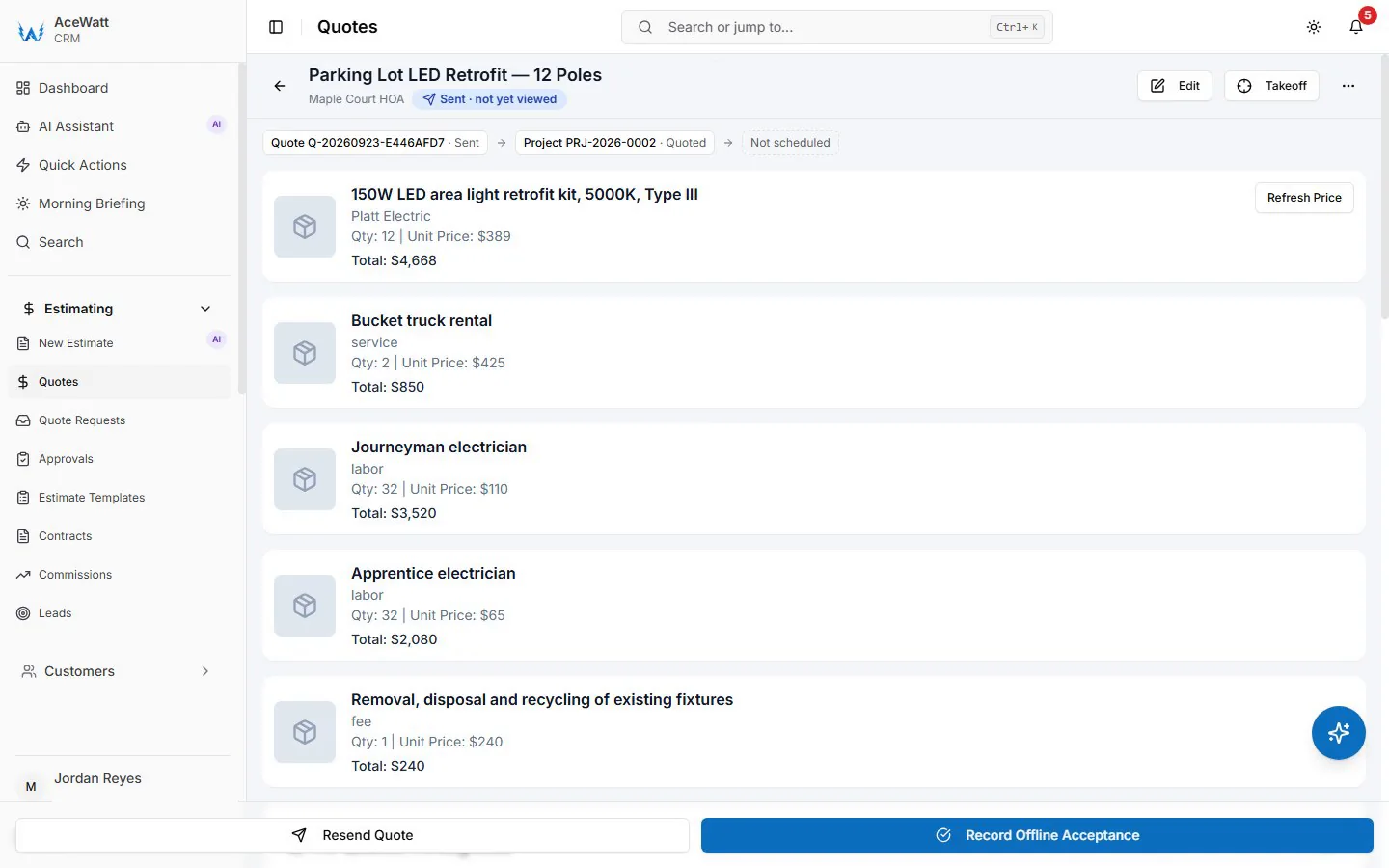
You arrive at a 1978 split-level and open the job walk app. While you inspect the meter, panel, and grounding, you narrate what you see: overhead service drop, meter and main in one enclosure, 20 circuits on a Federal Pacific panel, no grounding electrode visible at the water pipe, unfinished basement with open joists. You photograph the panel schedule and the GEC. The AI Voice and Job Walk Documentation feature transcribes the recording into structured scope: meter-main replacement, 20-space panel with room for the two attic circuits, Type 2 SPD per 230.67, GEC per 250.66, two ground rods per 250.53(A)(2), bonding, permit and inspection.
AI Estimating applies labor hours and current material pricing to each line, builds in your margin, and produces an itemized proposal with a deposit line. You send it from the truck the same afternoon. The CRM logs the lead, the estimate, and the status.
If the homeowner goes quiet, the open quote stays visible in the CRM so you know when to call. When the job is won, Crew Scheduling and Dispatching assigns the tech and the date, and Job Tracking moves the work from deposit through rough-in to final inspection. Midway through, the crew finds knob and tube in the attic: the change order is logged in the field, priced, and approved internally before the extra work starts. The final invoice goes out with a payment link, Payment Tracking shows the balance until it clears, and QuickBooks-ready exports give your bookkeeper the invoice list and payroll hours.
Days become one afternoon on the estimating side, and the evening paperwork disappears on the back end.
Quick Comparison Table: Takeoff Type, AI Features, Pricing, and Best Fit by Shop Size
| Tool | Takeoff type | AI capability | Pricing model | Best fit | After the bid |
|---|---|---|---|---|---|
| AceWatt | Job walk scope capture, assemblies | Voice-to-estimate, AI CRM | Month-to-month per seat | Solo to 10 crews, service and light commercial | Overdue-invoice reminders, dispatch, tracking, invoicing, QuickBooks-ready exports |
| Trimble Accubid | Plan takeoff (LiveCount) | Keyword search only | Quoted, five figures multi-seat | Commercial ECs with estimators | Exports to Trimble field tools |
| McCormick | Plan takeoff, assemblies | None | Quoted, enterprise | Union commercial shops | Excel and accounting exports |
| TurboBid | Plan templates | None | Monthly subscription | Small shops on new construction | Built-in T&M billing |
| PlanSwift | Generic digital takeoff | None in core | Annual license, four figures | Multi-trade takeoff users | Stops at Excel export |
| STACK | Cloud plan takeoff | Auto symbol counting | Free takeoff tier, paid quoted | Takeoff learners | Stops at proposal |
| Best Bid | List and plan based | None | One-time license | Solo residential bidders | Stops at proposal |
| Electrical Bid Manager | Plan-based with pricing data | None | Quoted tiers plus data subscription | Small to mid ECs | Stops at bid |
Solo Electrician vs. Growing Shop: How to Pick the Right Estimating Tool
Solo electricians live and die on turnaround. Your estimating app needs to work on your phone, price a job walk the same day, and produce a T&M invoice from the truck without a second login. Simple, flat monthly pricing matters because your bid calendar is irregular. AceWatt fits this profile directly: the voice walk to estimate to invoice loop is the whole product. Best Bid and STACK's free takeoff tier are viable starting points if budget is the binding constraint, and TurboBid earns a look if you bid new residential plans regularly.
Growing shops with two to ten crews face a different bottleneck: volume. You may have 30 or more open bids at once, and unreturned follow-ups are where those bids die quietly. When you evaluate CRM options for electrical contractors, score automated follow-up sequences, bid status visibility, and dispatch first. Accubid or McCormick belong on the shortlist when a dedicated estimator bids plan-spec commercial work; AceWatt covers the service and light commercial pipeline that feeds the crews between big jobs, with dispatch, job tracking, and QuickBooks-ready exports included.
Beyond the Bid: How the Best Tools Connect Estimates to Scheduling, Invoicing, and QuickBooks
Pure takeoff tools stop at the bid, and the gap shows up in the office. An estimate won in PlanSwift still gets retyped into QuickBooks. A change order approved verbally on a STACK job never becomes an invoice unless someone remembers it. Follow-up on unanswered bids depends on whoever has the slowest Tuesday.
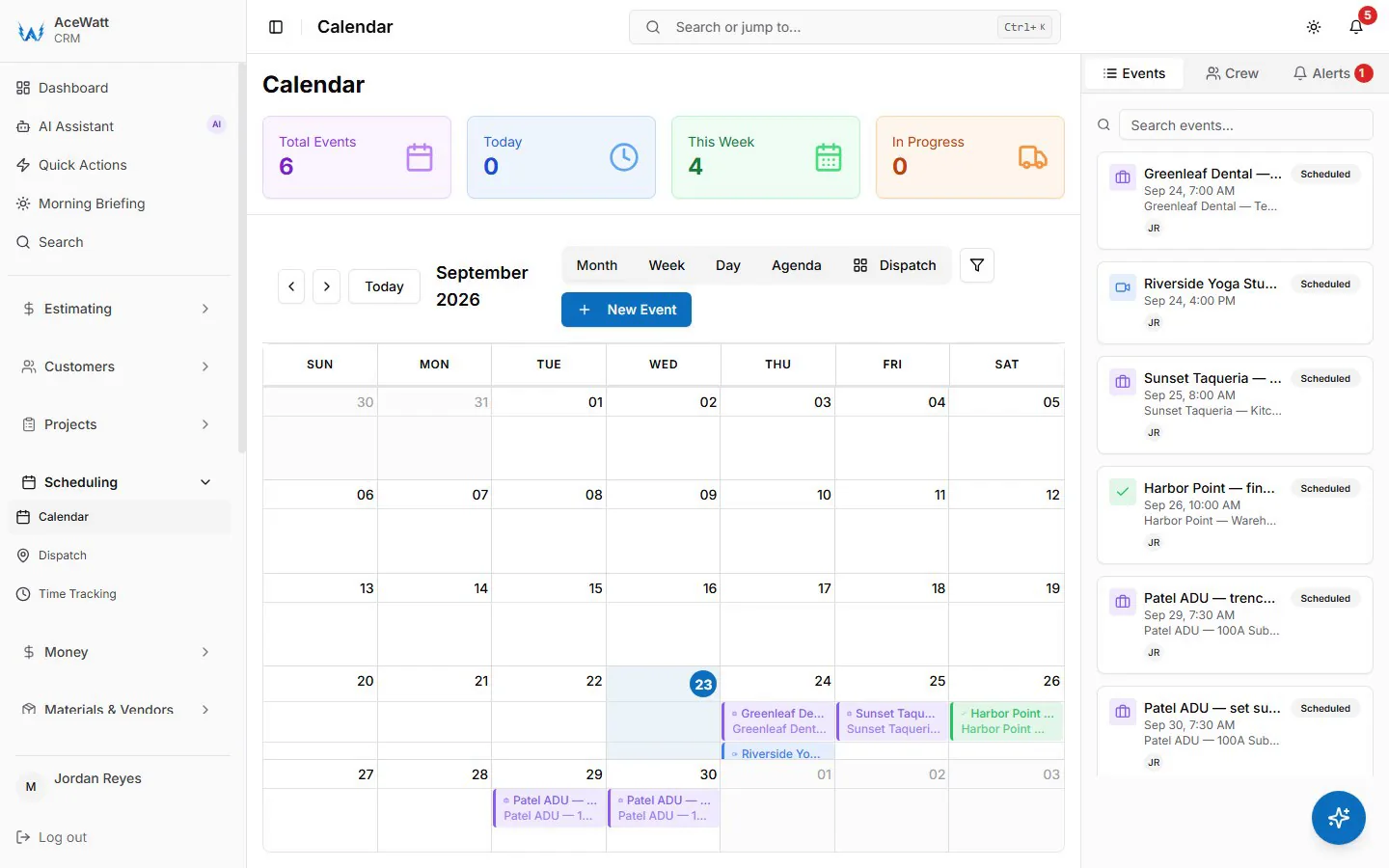
The T&M flow is where connected electrical contractor software with QuickBooks sync can pay for itself. The sequence runs like this: the tech clocks hours against the job from a phone in Job Tracking, and logs materials as they are pulled. The invoice generator pulls the date, tech name, hours at your contracted rate (plan on $95 to $135 per hour depending on market), materials at cost (markup is set on quotes, not added to the invoice automatically), and tax applied per jurisdiction. The customer signs on the device, receives a payment link by email, and Payment Tracking shows partial payments and unpaid balances until the account clears. QuickBooks-ready exports give your bookkeeper the invoice list and payroll hours, and job-level profitability stays accurate in AceWatt.
Two practices tighten this loop. Get a signed T&M rate agreement before work starts, covering hourly rate, minimum hours, material markup, and disposal fees, so the invoice matches expectations. And run follow-up on every open bid with a fixed cadence, day 2 and day 5 touches plus a 30-day check-in, because shops carrying dozens of open bids cannot manage that discipline from memory.
Among the eight tools above, only AceWatt runs this entire chain natively. TurboBid carries T&M billing a step past the bid, and the enterprise systems export toward Trimble's own ecosystem. The rest hand you a spreadsheet and a handshake.
Electrical Estimating Software FAQs for 2026
Is there free electrical estimating software? STACK offers a free takeoff tier that handles counts and measurements on digital plans. Many electricians also start with an Excel template built around NECA labor units. Both are honest starting points, and both stop there: no live material pricing, no follow-up, no invoicing.
What is the best electrical estimating software for a solo electrician? The tool that prices a job walk the same afternoon. For service work, that is AceWatt, because the voice recording becomes the itemized estimate and the invoice comes from the same platform. For bidding new construction plans on a tight budget, TurboBid or Best Bid are the practical picks.
How much does electrical estimating software cost in 2026? The range runs from $0 for STACK's takeoff tier, through four figures annually for PlanSwift, to five figures per year for multi-seat Accubid or McCormick deployments. AceWatt sits in between as a month-to-month per-seat subscription with no implementation fee, and Best Bid sells a one-time license.
Does electrical estimating software sync with QuickBooks? AceWatt produces QuickBooks-ready exports: your invoice list as a spreadsheet and your payroll hours as a QuickBooks-format CSV for your bookkeeper, with full sync in development. Most takeoff-first tools export to CSV or Excel and leave the QuickBooks work to you.
What is the difference between electrical takeoff software and estimating software? Takeoff software counts quantities from plans: devices, fixtures, feet of conduit. Estimating software applies labor units and material pricing to those counts and produces the bid. Several products on this list do takeoff only.
Can AI estimating software price a job without plans? Yes, for service and remodel work, when the scope comes from the walk. AceWatt's voice documentation turns your narration and photos into structured line items with labor and material applied. You still own the risk calls, wall conditions, access problems, and jurisdiction-specific code requirements, so review the generated estimate against the walk before it leaves your outbox. Run one real job through the workflow and compare the output to your last hand-built estimate; that is the fastest way to know whether it belongs in your truck.