
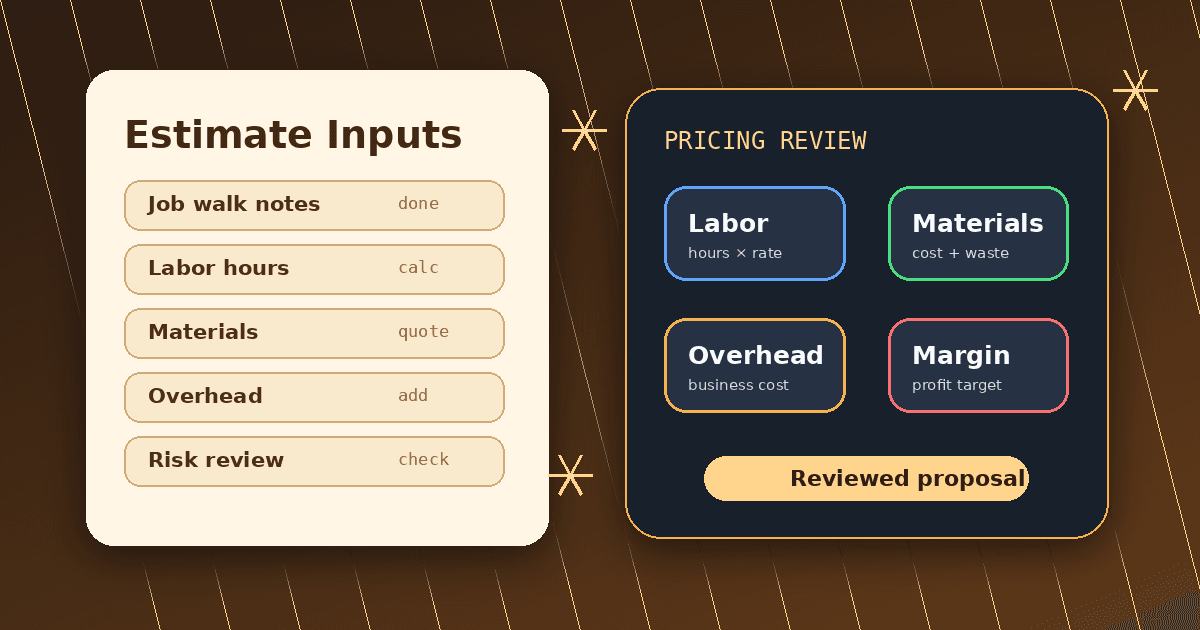
Learning how to estimate electrical work is not just learning a formula. A profitable estimate starts with a clear job walk, complete scope notes, realistic labor assumptions, material costs, overhead, margin, exclusions, and qualified review before the customer sees the final price.
Direct answer: To estimate electrical work, document the site, define the exact scope, break the job into labor tasks, list materials, calculate labor hours, add material costs, include overhead and profit, account for permits/travel/equipment/risk, write exclusions, and have a licensed electrician or qualified reviewer verify scope, safety, code/compliance considerations, pricing, and site conditions before sending the estimate.
This guide is written for electrical contractors, not homeowners shopping for a national average. Prices vary by market, labor rate, materials, permit requirements, site conditions, scope, and risk. Treat every number below as an example for process only, not a universal price sheet.
For tools that support the workflow, use AceWatt's free electrical bid calculator, estimate template, job walk reporter, and automated estimating. Browse all free electrical contractor tools for more calculators and templates.
Electrical Estimate Formula
A practical estimating formula looks like this:
Estimated selling price = labor cost + material cost + equipment/travel/permit costs + overhead allocation + profit margin + risk bufferThat formula is simple. The hard part is making each input honest.
| Input | What it means | Common mistake |
|---|---|---|
| Labor hours | Time needed to complete the work, including setup and cleanup | Estimating only hands-on install time |
| Loaded labor rate | Wage plus burden, payroll costs, benefits, insurance, and real company cost | Using employee wage as the billable cost |
| Materials | Devices, wire, conduit, fittings, panels, breakers, fixtures, consumables | Forgetting waste, handling, delivery, or price changes |
| Overhead | Office, software, vehicles, insurance, admin, rent, tools, management time | Treating overhead as separate from job pricing |
| Profit margin | The return the business needs after costs | Adding a random markup without checking margin |
| Risk buffer | Uncertainty from site access, hidden conditions, changes, delays, or unclear scope | Pretending every job will go perfectly |
A calculator helps, but the estimate is only as good as the scope and review behind it.
Estimate vs. Quote vs. Bid
An estimate is the internal price model. It helps you decide what the work will likely cost and what selling price protects the business.
A quote is the customer-facing offer. It should describe the work, price, assumptions, exclusions, terms, and next step.
A bid is usually a competitive proposal. It may include scope, schedule, price, alternates, terms, exclusions, and project-specific requirements.
For small service jobs, the words may blur. For larger electrical work, confusing them creates risk. The estimate may be a working document, but the quote or bid becomes part of the customer's expectation. Make sure the public-facing document says exactly what is included and what is not.
Step 1: Qualify the Job Before You Estimate
Do not estimate every request from a sentence in a text message. A quick qualification step can save hours of rework.
Ask:
- What work does the customer want done?
- Is this service, repair, installation, replacement, troubleshooting, or maintenance?
- Is there urgency or a safety concern?
- What is the property type?
- Is access easy or restricted?
- Are photos available?
- Is a permit, inspection, utility coordination, or customer approval likely?
- Is the job within your licensing, insurance, geography, and service focus?
For example, “install EV charger” is not enough. The estimate may depend on panel location, charger model, parking location, wall path, distance, panel capacity context, permit requirements, load-management needs, trenching, conduit route, customer-supplied equipment, and local utility rules.
If the request is outside your normal work or requires more review, say so before producing a number.
Step 2: Walk the Site and Document Scope
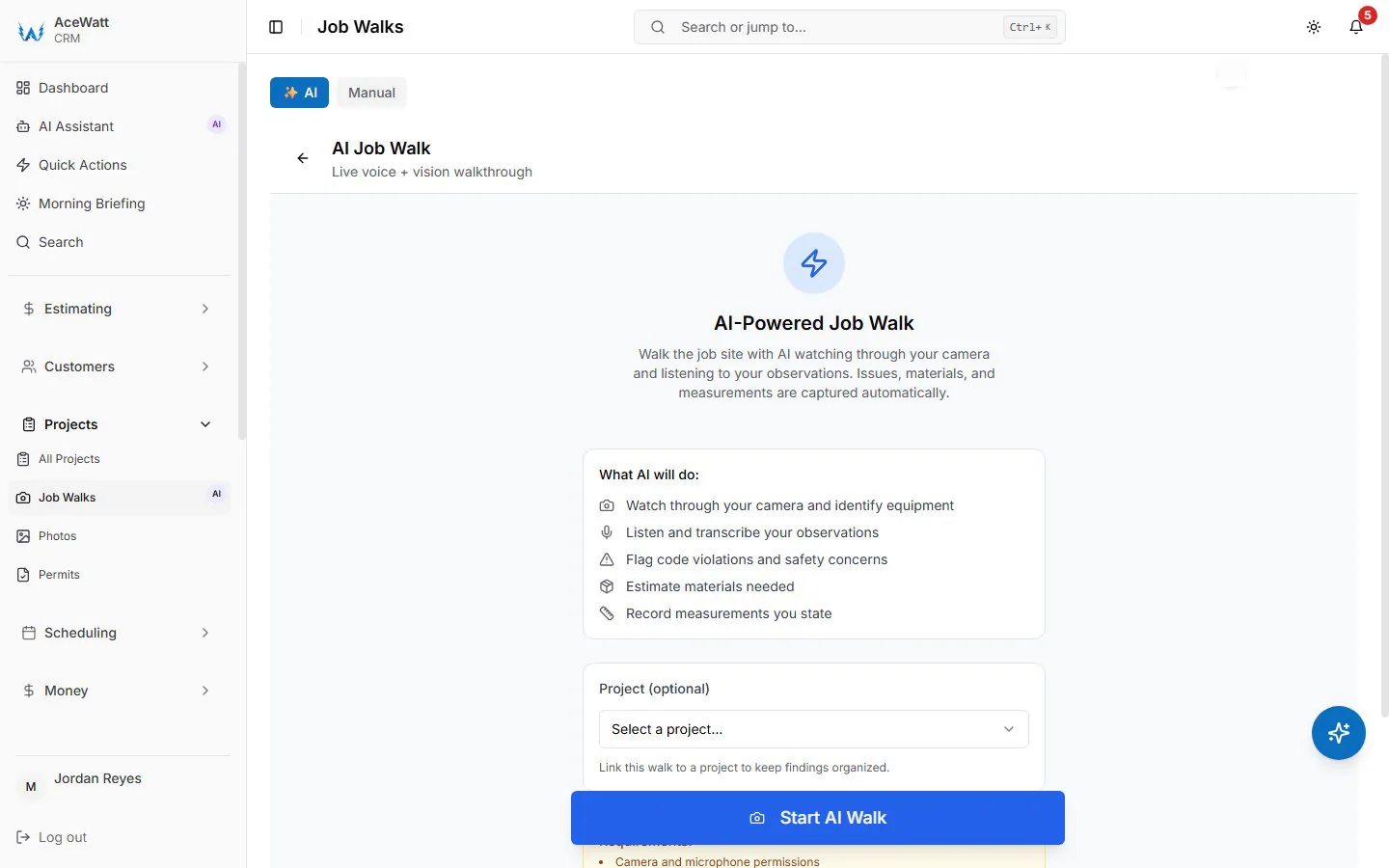
The job walk is where many estimates are won or lost. Rushed site notes lead to missing labor, materials, and exclusions.
Capture:
- Customer name, address, and contact details.
- Photos of the work area, panel, equipment, access path, and visible constraints.
- Measurements or counts when relevant.
- Existing conditions.
- Customer preferences.
- Required shutdowns or access windows.
- Open questions.
- Safety observations.
- Permit or inspection questions.
- Customer-provided materials.
- Cleanup, patching, or restoration expectations.
Electrical work can involve real safety risks. OSHA's public electrical safety resources at osha.gov/electrical are useful general background, but every job still needs qualified review and local code/AHJ awareness. Do not turn a field note into a compliance guarantee.
AceWatt's job walk reporter can help organize observations into a cleaner report before estimating.
Step 3: Break the Work Into Labor Tasks
Estimating labor starts by breaking the work into tasks. Do not jump straight to one total hour number.
For a panel-related job, tasks might include:
- Customer coordination and setup.
- Site protection and access.
- Shutdown planning.
- Remove or prepare existing components.
- Install new equipment.
- Pull wire or install conduit if required.
- Labeling and documentation.
- Testing and verification.
- Cleanup.
- Customer handoff.
- Inspection or return visit if applicable.
For a smaller outlet or switch job, tasks may be simpler. For commercial work, tasks may include lift setup, after-hours coordination, tenant communication, phased work, disposal, and multiple return trips.
The point is consistency. If you estimate by gut feel every time, two similar jobs can produce two very different prices.
Step 4: Build the Material List
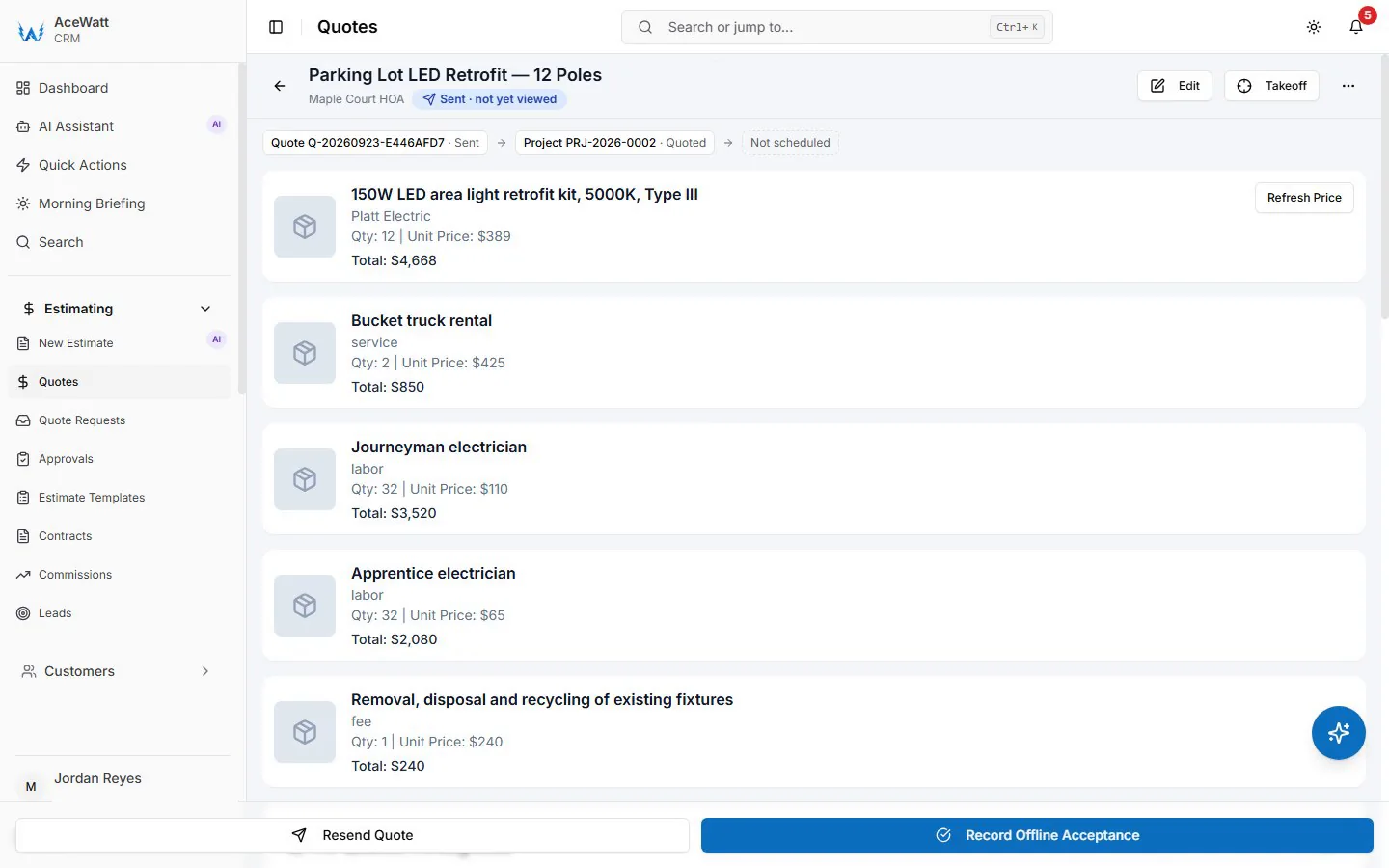
Create a material list before calculating price. Include obvious parts and small parts.
Common categories include:
- Wire and cable.
- Conduit, fittings, boxes, connectors, straps, and supports.
- Breakers, panels, subpanels, disconnects, or devices.
- Receptacles, switches, dimmers, covers, fixtures, lamps, drivers, or controls.
- Labels, fasteners, anchors, sealants, and consumables.
- Customer-supplied equipment notes.
- Rental or specialty equipment if needed.
Material pricing changes. Build your process so the estimator checks current supplier pricing for important items instead of relying on stale memory. Add waste, handling, delivery, and small materials where appropriate. For a reusable structure that keeps these line items consistent across jobs, see our electrical contractor price book guide.
Step 5: Calculate Labor Hours
Labor hours should include more than the visible install time.
Consider:
- Travel and mobilization.
- Setup and protection.
- Access difficulty.
- Troubleshooting time.
- Material pickup.
- Coordination with customer, property manager, utility, or inspector.
- Cleanup.
- Documentation.
- Return trips.
- Permit and inspection handling.
- Expected productivity for the technician or crew assigned.
A simple labor formula:
Labor cost = estimated labor hours × loaded hourly labor costLoaded hourly labor cost is not the same as what the employee sees on a paycheck. It can include payroll burden, benefits, insurance, training, vehicle costs, management time, and other company costs. The SBA's manage your finances guidance is a helpful reminder that pricing must support the business, not only the job.
Step 6: Add Overhead and Profit
Overhead is the cost of staying in business. Profit is the return that makes the risk worth taking. Both belong in the estimate.
Common overhead categories include:
- Office labor and admin time.
- Vehicles, fuel, maintenance, and insurance.
- Tools and equipment.
- Software.
- Rent or storage.
- Licensing and compliance costs.
- Marketing and sales.
- Management time.
- Warranty and callback administration.
Do not hide overhead in random markups. Use a consistent method your company understands. Some shops allocate overhead by labor hour. Others use percentage methods or job categories. The right method depends on your business model and accounting setup, so review with a qualified advisor where needed.
Profit margin should be deliberate. A job can look profitable if you add markup to materials while ignoring overhead. It may be unprofitable once company costs and risk are included.
Step 7: Add Permits, Travel, Equipment, and Risk
Electrical work often includes costs outside direct labor and materials.
Examples:
- Permit fees.
- Inspection coordination.
- Utility coordination.
- Lift or equipment rental.
- Parking or access costs.
- After-hours premium.
- Disposal.
- Customer-required documentation.
- Return trip risk.
- Hidden-condition risk.
Risk buffer is not a license to inflate prices randomly. It is a way to account for uncertainty you can explain. If the job has hidden conditions, state the assumption and write an exclusion or allowance. If opening a wall may reveal additional work, say so clearly.
Step 8: Write a Clear Customer Proposal
A customer proposal should be easy to read. The customer does not need your internal cost model. They need a clear explanation of what is included, what is excluded, what assumptions you made, and what happens next.
Include:
- Customer and site information.
- Scope of work.
- Materials or equipment included where helpful.
- Labor or service description.
- Price and payment terms.
- Assumptions.
- Exclusions.
- Timeline or scheduling notes.
- Permit/inspection notes if applicable.
- Approval process.
- Contact information.
Avoid vague scope like “complete electrical repair.” Better: “Replace two GFCI receptacles in kitchen, test operation, and document observed breaker behavior. Excludes panel replacement, wall repair, and additional circuit troubleshooting unless approved separately.”
Step 9: Follow Up Without Forgetting
Estimating does not end when the proposal is sent. Track status:
- Draft.
- Sent.
- Customer question.
- Needs revision.
- Approved.
- Declined.
- Follow-up due.
- Converted to job.
- Converted to invoice.
A CRM workflow matters because estimates are sales conversations. If follow-up lives in memory, good opportunities can disappear.
AceWatt connects the estimate process to customer records, job notes, and follow-up. Review electrical contractor estimating software, electrical estimating software, and CRM for commercial electrical bidding for the broader software angle.
Example Electrical Estimate: Process Only
This example is intentionally simplified. Do not use it as a customer quote. Actual pricing depends on market, labor, materials, permit requirements, site conditions, and scope.
Example job: add a dedicated circuit for a garage appliance.
| Estimate item | Example input |
|---|---|
| Labor | 5 hours |
| Loaded labor cost | $62/hour |
| Labor cost | $310 |
| Materials | $185 |
| Permit / admin allowance | $75 |
| Travel / setup / small parts | $60 |
| Direct subtotal | $630 |
| Overhead allocation | $160 |
| Risk buffer | $80 |
| Cost basis before profit | $870 |
If the business targets a margin, the selling price needs to be calculated from the cost basis and desired margin. A common mistake is adding a small markup without checking whether the resulting gross margin supports the business.
Again: this is a process example, not universal pricing. A licensed electrician or qualified reviewer should verify the scope and a business owner or estimator should verify the pricing method.
Common Mistakes That Make Estimates Unprofitable
Estimating from memory
Memory loses details. Photos, measurements, access notes, and customer constraints should be documented.
Using wage as billable labor cost
Employee wage is not loaded company cost. Ignoring payroll burden, vehicle cost, admin time, insurance, and overhead can underprice work.
Forgetting return trips
A job may require inspection, customer coordination, material pickup, or a second visit. If the estimate ignores that time, profit disappears.
No exclusions
If drywall repair, trenching, utility coordination, permit fees, after-hours work, or hidden conditions are not included, say so clearly.
Treating AI as the estimator
AI can organize notes, create draft language, and prompt missing questions. It should not independently approve electrical scope, code/compliance, safety, permits, pricing, or site conditions.
Where AceWatt Fits
AceWatt helps contractors keep the estimating workflow connected:
- Job walk reporter for structured site notes.
- AI job walk for organizing field context.
- Free bid calculator for labor, material, overhead, and margin inputs.
- Estimate template for customer-ready proposal structure.
- Automated estimating for AI-assisted draft support with human review.
- Electrical bidding software when the estimate becomes a competitive proposal.
- Pricing when you are ready to evaluate plans.
The safe promise is workflow support. AceWatt helps organize estimating inputs and customer follow-up. The contractor still owns final scope, professional judgment, code/compliance review, permit decisions, safety review, and final price.
Contractor-Side vs. Homeowner-Side Calculators
Many search results for electrical pricing are written for homeowners. Those pages can be useful for understanding customer expectations, but they are not enough for a contractor building a profitable estimate.
A homeowner-side calculator asks, “What might I pay?” A contractor-side calculator asks, “What will it cost us to perform the work correctly, what risk is present, and what selling price protects the business?” Those are different questions.
Contractor-side estimating should include loaded labor, material handling, overhead, profit, callbacks, permit/inspection effort, travel, equipment, and scope uncertainty. It should also preserve customer-facing clarity. A price that protects the business still needs a proposal the customer can understand.
Flat Rate vs. Time and Materials
Flat-rate pricing can work well for repeatable service work when the company understands its average labor, material, overhead, and risk. It gives customers clarity and lets the shop standardize common work.
Time-and-materials pricing can be safer when the scope is uncertain, troubleshooting-heavy, or dependent on hidden conditions. It can also create customer anxiety if expectations are not clear. If you use time and materials, define how labor, materials, travel, diagnostic time, and follow-up will be handled.
Many electrical shops use both. The important part is matching pricing method to job risk and explaining it clearly before work starts.
FAQs About Estimating Electrical Work
How do you estimate electrical work?
Estimate electrical work by documenting the job, defining scope, breaking the work into labor tasks, listing materials, calculating labor and material cost, adding overhead and profit, accounting for permits/travel/equipment/risk, writing exclusions, and reviewing the proposal before sending it.
What should an electrical estimate include?
An electrical estimate should include customer details, site address, scope of work, materials or equipment, labor description, assumptions, exclusions, price, payment terms, schedule notes, permit or inspection notes when relevant, and approval instructions.
How do electricians calculate labor hours?
Electricians calculate labor hours by breaking the job into tasks, estimating time for each task, and adding setup, access, troubleshooting, travel, cleanup, documentation, inspection, and return-trip time when applicable.
What markup should electricians use on materials?
There is no universal material markup. Contractors should account for supplier cost, handling, waste, delivery, warranty risk, overhead, desired margin, market conditions, and customer expectations. Review your pricing method with qualified business/accounting support where needed.
Can AI help estimate electrical work?
AI can help organize job-walk notes, draft scope language, identify missing questions, and prepare estimate-ready summaries. It should not replace licensed electrician review, final pricing judgment, safety decisions, code/compliance review, permit decisions, or site-condition verification.
What is the difference between estimating and bidding electrical work?
Estimating builds the internal cost and price model. Bidding turns that estimate into a competitive proposal with scope, assumptions, exclusions, terms, and follow-up. Many jobs need both workflows.
Related Reading
- See all CRM features for electrical contractors in one platform.