
Prevailing Wage and Certified Payroll for Electricians: A 2026 Compliance Guide
Prevailing wage certified payroll for electrical contractors is the weekly paperwork federal law attaches to public-works jobs: pay every worker at least the locally determined wage for their classification, then submit a signed payroll report (usually Form WH-347) to the contracting agency each week. If you are bidding your first school, courthouse, or federally funded tenant improvement, here is what the rules actually require, where the traps are, and what records you need your software to keep.
Quick answer: Davis-Bacon rules apply to federal and federally assisted construction contracts over $2,000. Each week, you pay no less than the wage determination rate for each classification, submit prevailing wage certified payroll with a signed Statement of Compliance, and keep the underlying hour and pay records for three years after the work ends.
What Prevailing Wage Means for Electrical Contractors
A prevailing wage is the combination of a base hourly rate and fringe benefits that the U.S. Department of Labor determines prevails for each trade classification in a given county. On a covered job, your apprentice, your journeyman electrician, and a laborer each have a published rate floor for the hours they work on the site of the work. The rate comes from the wage determination attached to the contract, published by DOL and searchable on SAM.gov before you bid.
The number matters because it is a floor, not an estimate. If the wage determination says an inside electrician earns $48.50 per hour plus $12.00 in fringe, paying $42 cash with no fringe is a violation, even if the worker agreed to it. Overtime on covered work follows the weekly 40-hour rule at time and a half on the combined rate, and most states add their own "Little Davis-Bacon" rules for state- and city-funded projects, often with lower or zero thresholds. Check both the federal determination and your state's public-works rules before you price the labor on any government-funded bid.
When Certified Payroll Applies: Thresholds and Triggers
Prevailing wage certified payroll obligations attach based on the funding source, not the type of electrical work. The Davis-Bacon Act covers every contract over $2,000 for the construction, alteration, or repair of public buildings and public works of the United States, and the Davis-Bacon Related Acts extend the same requirements to federally assisted projects: highways, HUD housing, airports, water treatment plants, military construction, and disaster reconstruction among them. The implementing rules live in 29 CFR 5.5.
Three practical triggers electrical contractors should watch:
- The prime contract, not your subcontract, sets the obligation. If the project is covered, every tier of subcontractor is covered, including the two-person electrical shop two tiers down. Ask for the wage determination in your subcontract documents; a GC who cannot produce one is a red flag.
- Related Acts often carry the same $2,000 threshold but different paperwork recipients. On federally assisted work you may submit to the agency, the owner, or the sponsoring entity rather than the federal agency itself. Read the contract's labor-standards clause.
- Mixed private funding is where shops get caught. A private developer accepting a federal loan guarantee can pull an entire project into coverage. When funding is unclear, ask for the determination in writing before mobilizing.
The WH-347 Form and the Statement of Compliance
Form WH-347 is the standard weekly certified payroll: one row per worker showing name, work classification, hours worked, straight and overtime rates, fringe contributions or cash in lieu, and gross wages for the week. Page 2 is the Statement of Compliance, a signed representation that the payroll is accurate and complete and that each worker was paid at least the required prevailing wage rate, including fringe, for the work performed. A certified payroll submitted without the signed statement is not certified, and a signature from someone who did not actually supervise or pay the crew is a compliance defect waiting for an audit.
The weekly rhythm is the part that surprises service-focused shops. Prevailing wage certified payroll is due weekly while work on the covered project is in progress, not monthly with your pay application, and the information has to reconcile: hours by worker and classification, at determination rates, tied to days on that site. That is a recordkeeping load most residential service shops have never run, and it is exactly where disorganized labor records become violations. If you cannot reconstruct, per day, which tech was on which federally funded site for how many hours, you cannot produce a defensible certified payroll.
Fringe Benefits: Bona Fide Plans or Cash in Lieu
Every prevailing wage determination splits the obligation into a base rate and a fringe amount. You can satisfy the fringe two ways: pay it into bona fide benefit plans (health, pension, vacation, apprenticeship training) or pay it as cash wages on top of the base rate. The math has to reach the combined determination number either way, and on the WH-347 you document which route each worker is on, plan by plan, including the hourly credit you claim for each.
One caution worth flagging: claiming a credit for unfunded or "reasonably anticipated" fringe costs requires prior DOL approval under 29 CFR 5.28. Most small electrical contractors are better served by clean cash-in-lieu or funded-plan arrangements they can document line by line. Whichever route you choose, the fringe figure has to tie back to hours worked on the covered site, which again puts the burden on your time records.
A Weekly Prevailing Wage Certified Payroll Workflow Your Shop Can Actually Run
Here is a realistic weekly loop for an electrical contractor on a covered public-works job:
- Before bidding: pull the wage determination, price every classification at determination rates plus fringe plus payroll burden, and confirm apprentice ratios and registered-program requirements.
- Daily: capture clock-in and clock-out per tech, per job, with the classification worked that day. Phone-based time capture with a location flag is the cleanest evidence that hours were worked on the site of the work.
- Weekly: total hours per worker and classification, apply determination rates and fringe, run payroll, then complete and sign the WH-347 (or the state equivalent) with its Statement of Compliance.
- Submit the certified payroll to the recipient named in the contract, weekly, while work is in progress, and keep proof of submission.
- Retain payrolls and the underlying hour, classification, and payment records for three years after all work on the contract is finished.
The failure pattern is always the same: hours live in one app, invoices in another, and the WH-347 gets assembled Thursday night from memory. Keeping the job, the hours, and the billing in one system is what makes step 3 a copy-and-check exercise instead of an investigation.
Penalties and Recordkeeping: What Noncompliance Costs
Federal enforcement responses escalate with severity: back-wage restitution with withheld payments, contract termination, and, for repeated or willful violations, debarment from federal contracts for three years under the current debarment rules. Falsifying a prevailing wage certified payroll carries separate exposure. None of this is legal advice; it is the risk picture that should shape how carefully you keep records.
The recordkeeping rule is the quiet one that bites hardest: payroll records and the basic hour and wage records behind them must be maintained for three years after the work is complete. An audit two years after project closeout will ask for daily detail, and "we closed the company file" is not an answer. Archive deliberately.
What AceWatt Does and Does Not Do Here
AceWatt is an electrical contractor CRM, not a certified payroll generator, and the distinction matters for compliance planning. What it verifiably does:
- Records clock-in and clock-out from the phone with location, and flags whether the tech was at the job site, so the daily hour evidence behind a certified payroll exists from day one. Our time tracking guide for electrical contractors covers how that record feeds payroll prep.
- Keeps job, invoice, and payment records in one place, including invoice payment status and balances per project, so reconciling the payroll against what was billed and paid on the covered job is a lookup, not a reconstruction.
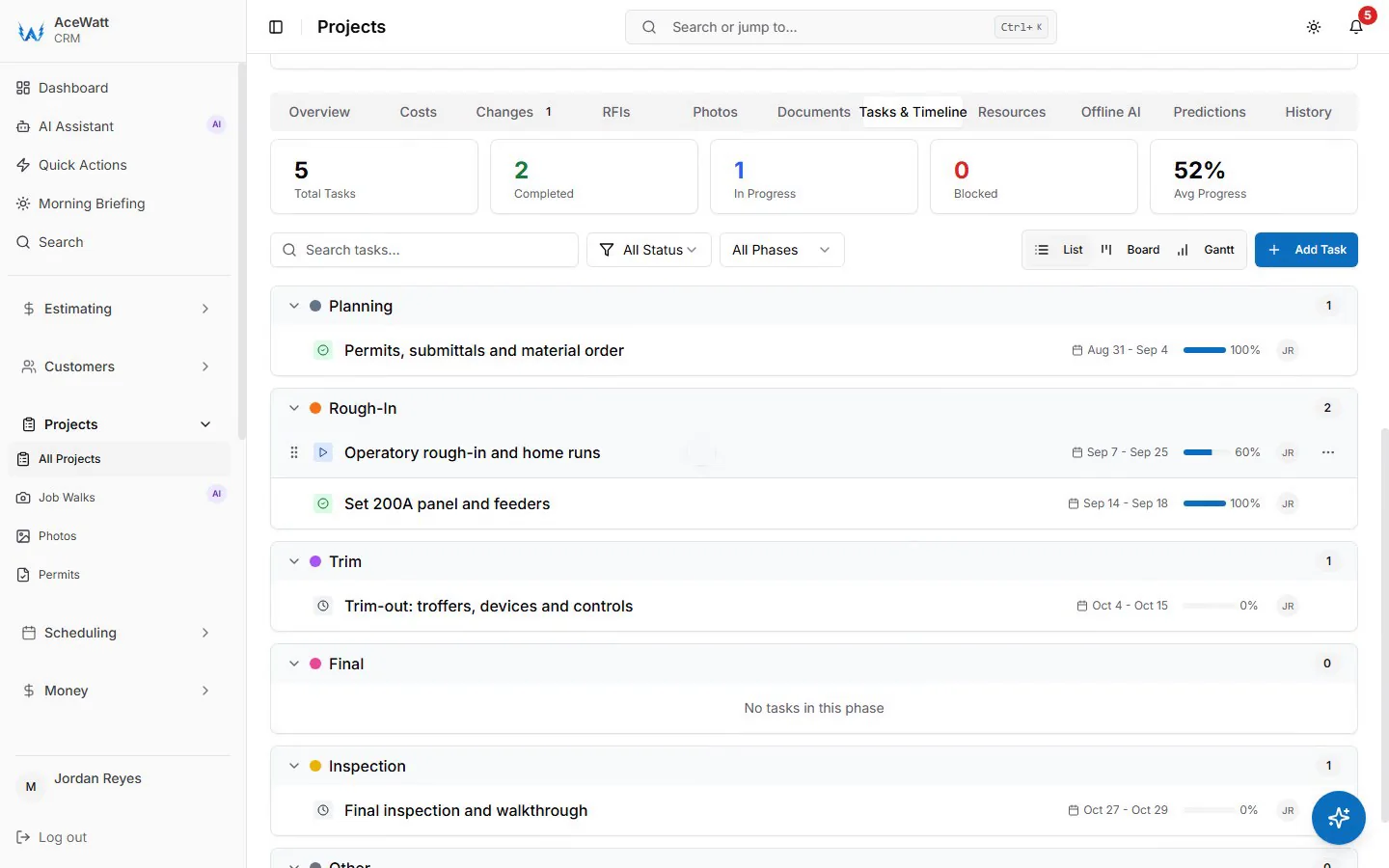
- Ties labor to specific jobs and phases, the structure a certified payroll demands, and keeps subcontractor payment records organized when your subs carry their own certified payroll obligations on the same project.
What it does not do: AceWatt does not generate or file WH-347 forms, look up prevailing wage rates, calculate fringe credits, or guarantee compliance. Certified payroll itself is a payroll process you run with your payroll provider or certified payroll service, and prevailing wage questions on a specific contract deserve a construction attorney or your DOL wage-hour district office. For the accounting-stack side, see our certified payroll accounting software guide, and verify the exact scope of what fits your workflow during a demo.
Preparing for Your First Covered Bid: A Checklist
- [ ] Get the wage determination in writing before pricing labor
- [ ] Price every classification at determination rate plus fringe plus burden
- [ ] Confirm apprentice ratio and training-program registration rules
- [ ] Set up daily, per-tech, per-job hour capture with classification
- [ ] Choose your fringe route: bona fide plan or cash in lieu, documented per worker
- [ ] Decide who signs the Statement of Compliance (someone who actually supervises payment)
- [ ] Calendar weekly prevailing wage certified payroll (WH-347) submission and retain proof for three years post-completion
- [ ] If you use subs, flow the obligation down in writing and collect their certified payrolls
Frequently Asked Questions
Does Davis-Bacon apply to small electrical jobs?
Davis-Bacon applies to federal and federally assisted construction contracts over $2,000, so virtually any covered public-works electrical work qualifies, including small service and alteration subcontracts. The threshold is per contract, not per year, and Related Acts extend similar requirements to federally assisted projects. State prevailing wage laws add their own thresholds for state-funded work.
What is Form WH-347?
Form WH-347 is the Department of Labor's standard weekly certified payroll for Davis-Bacon work. It lists each worker, classification, hours, rates, fringe payments, and gross wages for the week, and it must carry a signed Statement of Compliance certifying the payroll is accurate and that prevailing wages, including fringe, were paid. Some agencies accept equivalent state forms with identical wording.
How often is certified payroll due?
Weekly. Prevailing wage certified payroll is submitted for each week while work on the covered contract is in progress, even if only a few hours were worked, and the requirement continues through closeout of the final weeks on site. Submission goes to the federal agency or, on federally assisted work, to the recipient named in the contract.
What is the difference between prevailing wage and union scale?
Prevailing wage is a government-determined minimum for covered public work, set per classification and county from DOL wage surveys; union scale is a collectively bargained rate that can be higher and applies under a labor agreement. On a covered job you owe at least the determination rate regardless of union status; union shops typically exceed it.
Does AceWatt handle prevailing wage certified payroll?
No. AceWatt keeps the underlying hour, job, classification, and payment records your payroll provider needs to prepare prevailing wage certified payroll, but it does not generate or file WH-347 forms, look up wage determinations, or certify compliance. Pair it with your payroll service, and verify the workflow during a demo.
The Bottom Line for Electrical Contractors
Prevailing wage certified payroll is not complicated math; it is disciplined records. Pull the determination before you bid, capture classified hours daily, pay the combined rate, file the signed WH-347 weekly, and keep everything for three years. Shops that treat the hour record as the source of truth find certified payroll is a quiet weekly routine; shops that reconstruct it from invoices find it is the reason they stop bidding public work. If a federally funded job is in your pipeline, get your job costing and accounting records in order now, so the compliance paperwork lands on top of a system rather than a scramble.
_This article is informational and not legal advice. Prevailing wage rules vary by state and contract; confirm requirements for a specific project with a construction attorney or the relevant agency._