

Electrical Contractor Certified Payroll Software: The 2026 Guide to Davis-Bacon Compliance and the Best Accounting Setup
Federal money is still moving through the electrical trade in 2026, and it is carrying paperwork with it. IIJA-funded school modernizations, CHIPS Act fab work, BEAD broadband buildouts, and NEVI EV charging installations all trigger Davis-Bacon coverage, which means weekly certified payroll is now a fact of life for shops that used to stay comfortably in the private commercial lane. Any federally assisted construction contract over $2,000 (40 U.S.C. 3142) pulls the job into prevailing wage territory, and every week on that job requires a signed WH-347 submitted within seven days of the close of the pay period. Miss weeks, misclassify a wireman, or let fringe contributions drift, and the consequences arrive fast: withheld progress payments, back wage assessments, and for willful violations, referral for debarment from federal contracts for up to three years.
The contractors winning repeat public work are not the ones with the cheapest bids. They are the ones whose field data, payroll records, and accounting system produce a clean, consistent WH-347 without a spreadsheet ritual every Friday. For the plain-English version of the rules themselves (thresholds, the WH-347 field by field, fringe mechanics), start with our prevailing wage certified payroll guide for electrical contractors; this guide focuses on the software and accounting stack, and it covers the rules that actually burn electrical shops, where generic tools break down, and how to evaluate electrical contractor certified payroll software in 2026.
Why Certified Payroll Is Make-or-Break for Electrical Contractors on Public Works in 2026
Three things have changed. First, volume: BEAD alone is a $42.45 billion program, and every mile of fiber and every charging station pull involves electricians working under a wage determination. Second, enforcement: the Department of Labor's Wage and Hour Division increasingly cross-references certified payrolls against quarterly 941 filings, trust fund remittance reports, and GC-collected data through portals like LCPtracker. A WH-347 that does not match your quarterly filings is no longer a quiet discrepancy. It is an audit trigger. Third, cash flow: agencies and GCs hold retainage and can withhold contract funds outright when payrolls are late or deficient.
Run the math on a single misclassification. A helper classified and paid at $26.00 base plus $4.50 fringe who performs inside wireman work for twelve weeks at 40 hours, on a wage determination requiring $58.42 base plus $24.17 fringe, leaves a gap of $52.09 per hour. Over 480 hours that is roughly $25,000 in back wages from one person on one job, before penalties and before the compliance reviewer starts re-checking every other week you certified. And note the detail that burns careful shops: on weeks with no work performed, most agencies still expect a signed "No Work" payroll. Blank weeks are treated as missing weeks.
Davis-Bacon, Prevailing Wage, and Fringe Benefit Rules Electricians Actually Deal With
Each covered project carries one or more wage determinations pulled from SAM.gov, keyed by state and sequence number, and they change. A determination locks an hourly base plus a fringe obligation for each classification: Inside Wireman, Foreman, Cable Splicer, apprentice steps. A current building WD in a major metro might read Journeyman Inside Wireman at $58.42 base plus $24.17 fringe, Foreman at $64.26 plus $26.59, and Apprentice Step 3 at 65 percent of journeyman base with full fringe.
The fringe component is where electrical shops bleed. Health and welfare, pension, NEBF at 3 percent of gross labor, local annuity, and JATC training contributions (typically $1.50 to $2.25 per hour) must reach the correct funds on the correct schedule. Under the Copeland Act (29 CFR Part 3), fringe is either paid out as cash wages on the check or contributed to bona fide plans, and the arithmetic has to be provable either way. Miss a pension remittance and you are explaining to a trustee why the WH-347 you certified under penalty of perjury does not match the fund's receipts.
Apprentice rules are equally concrete. Only apprentices registered with a recognized program may be paid apprentice percentages, and most inside wireman agreements enforce 1:1 to 1:3 journeyman-to-apprentice ratios per crew, per day. If two apprentices get dispatched with one journeyman because a third wireman called out, that day's payroll is non-compliant even though every check was correct. Investigators look at daily crew composition, not weekly averages. State overlays add more: California requires DIR public works registration before mobilization, electronic certified payroll through eCPR, and daily overtime rules that differ from federal weekly rules.
This is also why prevailing wage rates belong in estimating from the first takeoff. An estimate that carries the current WD rates in its labor costs prevents you from bidding a school job at private-residential rates and discovering the gap at payroll time.
Where Spreadsheets and Generic Bookkeeping Tools Fail Electrical Contractors
A spreadsheet tracking 12 electricians across two prevailing wage jobs and one private warehouse looks manageable in week one. By week six you are juggling:
- Split days. A wireman spends four hours on the Davis-Bacon school job and four on the private warehouse, and each block requires its own WH-347 line under a different wage determination with different fringe treatment.
- Mid-contract rate changes. The agency issues a revised determination or a collective bargaining agreement bumps health and welfare on a set date, and every open week has to be recalculated and, in some cases, re-certified.
- Daily apprentice ratios. Dispatch pulls two apprentices onto a three-person crew on Tuesday, and nobody catches it until the GC's compliance vendor flags the week.
- No-work weeks. The job stalls for weather or inspection holds, and the blank week you did not file becomes a missing payroll on the agency's ledger.
- Portal transcription. Hours that live in a spreadsheet have to be retyped into LCPtracker, eCPR, or whatever portal this GC uses, and every retyped cell is a chance to introduce a number that no longer matches your 941.
- Overtime layering. Federal Davis-Bacon overtime applies after 40 hours in a week, but state rules like California's daily overtime after 8 hours apply simultaneously, and a spreadsheet formula written for one rule silently miscalculates the other.
The deeper problem is structural. Off-the-shelf bookkeeping software has no concept of an Inside Wireman versus a Low Voltage Technician, no wage determination library, no fringe allocation logic, and no ratio tracking. Generic payroll adds a "construction" checkbox and stops there. Prevailing wage software for electricians needs to be built around electrical classifications, crew structures, and the actual WDs attached to your job codes, because the DOL investigator will be.
Certified Payroll, Invoicing, and Job Costs From One Record, With QuickBooks-Ready Exports
Most electrical shops already run QuickBooks, and their accountant knows it inside out. The right move is not to replace it. The right move is to stop double-entering into it.
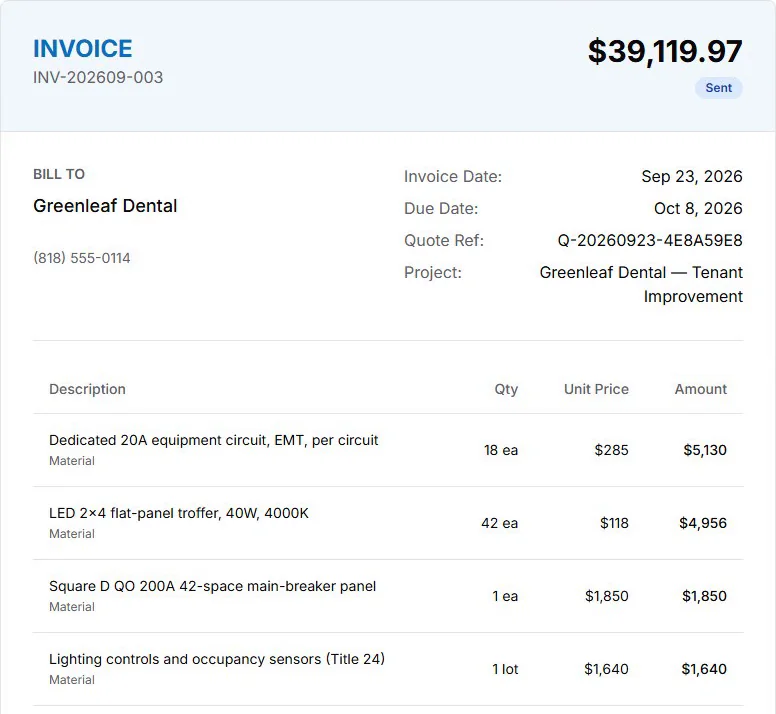
With our platform, the same time entries your WH-347 is prepared from also export as a QuickBooks-format payroll-hours CSV for your bookkeeper, and the invoice list exports as a spreadsheet. That is what our platform does today, not a native, real-time sync; full sync is in development. Invoicing and Payment Tracking then bills the public works job with milestone (percentage-of-completion) billing, drawn from the same job as those tracked labor costs; pay applications and retainage are not built in. Payments are tracked against the job as they land, which means your accounts receivable on the federal job reflects what the agency actually released, not what you assumed.
The payoff shows up at quarter end. Your WH-347s, your quarterly 941, your trust fund remittances, and your general ledger all draw from one set of source data, so the numbers match when WHD cross-references them. Union fringe benefit tracking works the same way: each fund (health and welfare, pension, NEBF, annuity, JATC) is coded as its own liability account, remittances post as they are paid, and the balance owed to each fund is visible before it becomes a delinquency letter.
Tying Crew Scheduling, Dispatching, and Job Tracking to Accurate Prevailing Wage Reporting
Certified payroll accuracy starts a day before the timesheet exists. When Crew Scheduling and Dispatching assigns an electrician to a job, the hours clocked on that job stay tied to it, so you can see who worked Wednesday's panel job at the courthouse. Matching those hours to the heavy commercial WD rather than a residential rate, and checking the apprentice ratio for the crew actually assembled that day, is still an office review step.
Job Tracking then captures hours at the task level: rough-in, trim-out, panel installation, pull wire, terminations. That granularity is what defends classifications in an audit. If an investigator questions why a helper was paid journeyman scale for two weeks, you can show the daily task records proving he was hanging fixtures and pulling circuits under direct supervision, which is journeyman work under the determination. Task-level hours on a clean job record also protect you on back charges, because you can prove whose crew was in which room on which day when the GC claims a wall got closed before inspection.
Split days stop being a hazard: two time entries on two jobs give the office both lines to classify for certified payroll.
AI Voice and Job Walk Documentation: Creating a Defensible Compliance Paper Trail
The evidence that wins wage disputes and back charge fights rarely lives in the payroll report. It lives on the jobsite, and it evaporates if nobody writes it down. AI Voice and Job Walk Documentation fixes that by letting a foreman record a 60-second voice note at the truck: who is on site today, which apprentice is paired with which journeyman, the change order conversation with the GC's superintendent, the wet slab condition in the switchgear room. The audio is transcribed, timestamped, and attached to the job record automatically.
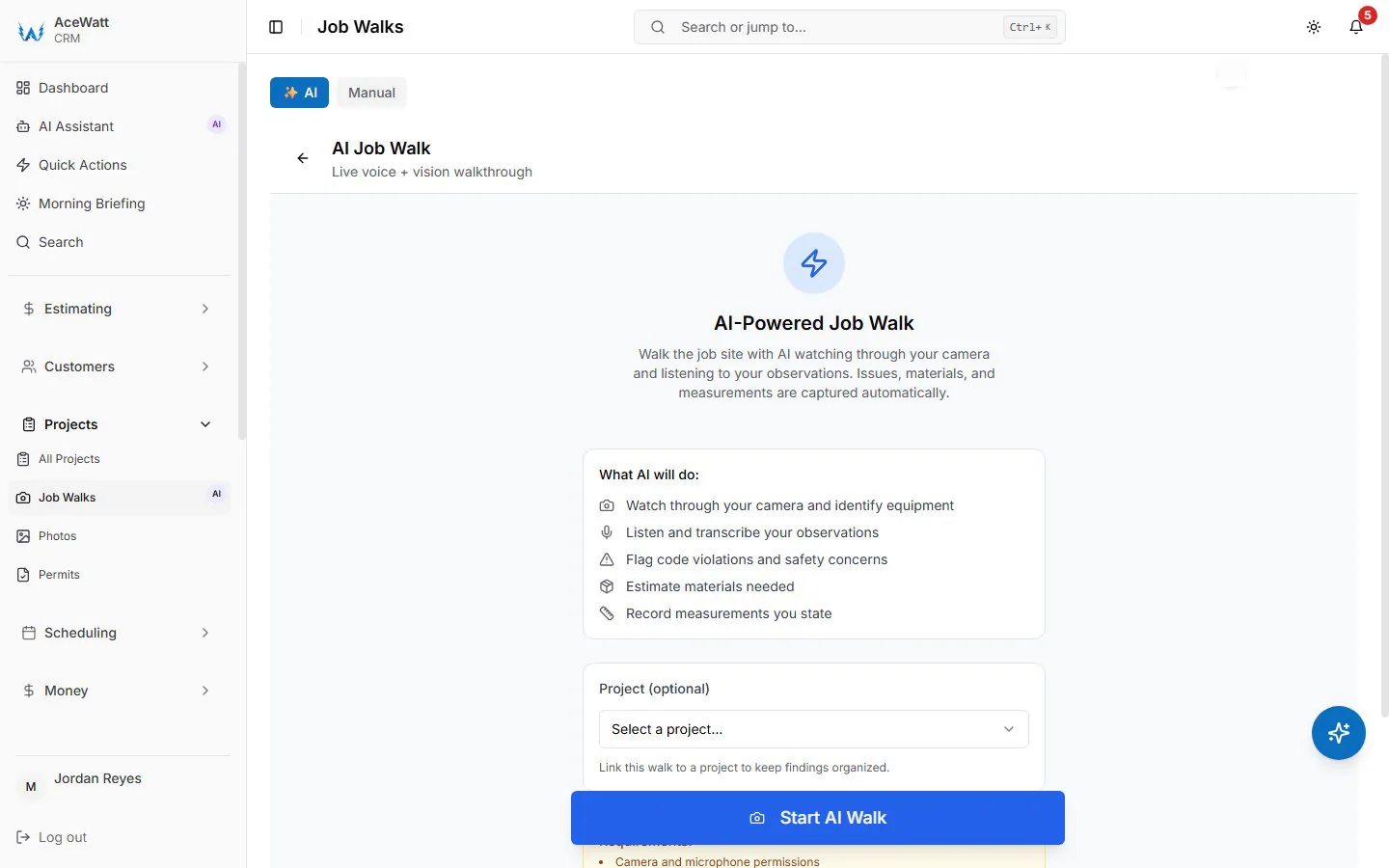
That record does three jobs at once. It documents daily crew composition, which is your proof of apprentice ratio compliance. It captures change order scope in the words of the person requesting it, which is your proof when the extra 200 feet of conduit becomes a dispute. And it establishes site conditions at a moment in time, which is your defense against back charges for schedule delays you did not cause. When a wage complaint lands two years later, you are answering with timestamped daily documentation instead of memory.
What to Look for in Electrical Contractor Certified Payroll Software in 2026
Evaluate any platform against this checklist:
- Wage determination management. WDs keyed to SAM.gov with revision alerts, so a modified determination prompts a recalculation instead of a surprise.
- Electrical classifications out of the box. Inside Wireman, Foreman, Cable Splicer, Low Voltage, apprentice steps, plus room for local titles.
- A real fringe allocation engine. Cash fringe versus bona fide plan contributions, per-fund tracking, percentage-based funds like NEBF handled correctly.
- Daily apprentice ratio monitoring. Ratios enforced per crew per day against registered apprentice records, not weekly averages.
- Split-day and split-week allocation. Hours divided across jobs and determinations without manual line surgery.
- No-work payroll generation. Automatic signed statements for non-work weeks on active contracts.
- Federal and state form coverage. WH-347 plus state requirements: California eCPR for DIR, Washington's Intent and Affidavit of Wages Paid, Oregon BOLI filings, New York Labor Law 220 records.
- GC portal export. Clean uploads to LCPtracker and comparable compliance portals.
- QuickBooks sync. Two-way flow of time, invoices, and payments into your existing chart of accounts.
- Audit trail. Every edit to a certified week logged with user and timestamp.
- Overtime rule engines. Federal weekly overtime after 40 hours layered with state daily overtime where it applies.
The Best Accounting Software for Electrical Contractors Handling Prevailing Wage Work
Pairing the right general ledger with the right trade layer matters more than buying one giant system. The realistic options in 2026:
- QuickBooks Online Plus or Advanced, paired with trade-specific certified payroll software. The best fit for solo electricians through shops of 50 to 100. Plus runs roughly $90 per month and Advanced roughly $200 at current list pricing, your accountant already speaks the language, and job costing, class tracking, and payment tracking are solid once an electrical-focused platform feeds it clean data. This is the setup our platform is built around.
- Sage 100 Contractor. Construction accounting with certified payroll and union fringe handling built in. Strong for mid-size self-performing shops, but expect implementation support and annual costs that start in the low four figures.
- Foundation. Construction-specific accounting with a dedicated certified payroll module and deep union reporting. Well suited to heavily unionized shops, at a similar investment tier to Sage.
- Viewpoint Spectrum or Vista. Enterprise-grade construction ERP. Only justified once you are running large multi-state public work with dedicated office staff; overkill for a growing shop.
- QuickBooks Desktop holdouts. The desktop line has been phased toward subscription-only and Online migration, so if you are still on Desktop, plan the move on your schedule rather than Intuit's.
For most growing electrical shops, option one wins: keep the GL in QuickBooks, and put the prevailing wage logic in software designed around electrical crews. Note that standalone QuickBooks, with no trade layer on top, will not produce a compliant WH-347 by itself.
The Bottom Line
Certified payroll in 2026 is a data flow problem, not a form problem. The shops that win public work repeatedly run one connected system: AI Estimating drafts the bid for your review from your pricebook, Crew Scheduling and Dispatching suggests the right crew for every ticket by skill, Job Tracking captures task-level hours, AI Voice and Job Walk Documentation timestamps the evidence, certified payroll is prepared from the same clocked hours, Invoicing bills milestones against the same job, and QuickBooks-ready exports give your bookkeeper the payroll hours and invoice list behind the filings. Add an AI-powered CRM on the front end and Automated Follow-Up's overdue-invoice email reminders on the back end, and the same platform that lands the bid closes the loop on getting paid for it.