

Electrical contractor accounting software with job costing gives your shop a live view of profit per job, connecting estimates, field capture, and invoices to the numbers your bookkeeper keeps. Here is how to evaluate it in 2026, and where AceWatt fits as the field-operations layer.
Electrical contractors run on tight margins. Copper wire pricing swings week to week, state adoption of the 2026 NEC edition changes material and installation requirements, and competitive bidding pressure never lets up. Profitability depends on knowing where every dollar goes on every job, every phase, and every change order. Generic small-business accounting treats a service call the same as a commercial build-out. It cannot model the permit fees and utility coordination behind a 200-amp panel swap, or the different labor curve between a residential rough-in and branch circuit work across a 50-unit apartment complex.
The shops that scale in 2026 pair a field platform with their accounting system, so estimating, field execution, and the books share one data backbone. An AI-assisted estimate becomes the job's budget baseline, techs capture materials and hours from the field instead of paper tickets, and the results flow into job costing while the accounting system stays the financial record. AceWatt handles that field side — AI quote builder, job tracking, invoicing, and payment collection — while QuickBooks remains your system of record, with QuickBooks-ready exports available on AceWatt's Growth and Scale plans.
Connecting AI Estimating and Job Tracking to Real-Time Job Costing
Job costing for electricians fails when the estimate lives in one system and the field data lives in another. Most shops still estimate in spreadsheets: manual takeoffs from PDF plans, conduit fill lookup tables, and a labor multiplier that has not been updated since 2019. That approach leaks money in two directions. You underbid because you missed the dedicated circuit for the EV charger, or you overbid and lose the job to a competitor who calculated the exact footage of MC cable required.
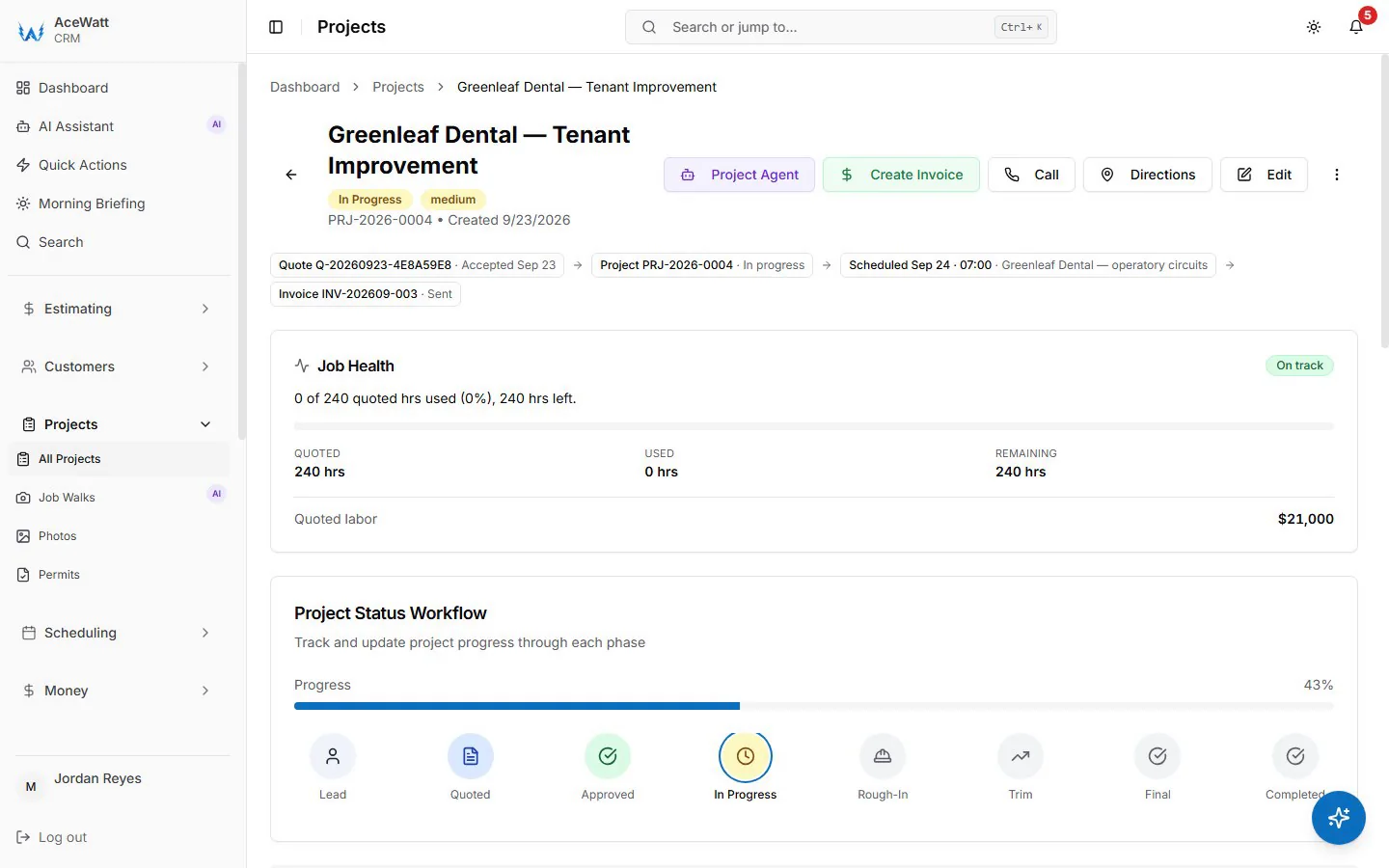
AI Estimating changes the math. It drafts the quote for your review from a job walk, photos, a typed description or an uploaded PDF plan set, priced from your company pricebook and assembly templates. When you win the job, that estimate does not sit in a PDF. It becomes the budget baseline inside Job Tracking.
Every hour a crew logs against "Phase 3: Branch Circuit Rough-In" rolls up against the estimated 42 hours. Every reel of THHN #12 scanned out of the truck in the mobile app hits the material line item. By day three you see the truth: labor at 38 percent of budget with 25 percent of the work complete, material at 62 percent of budget with 30 percent complete. That visibility lets you resize crews, authorize overtime, or flag a scope gap before it erodes margin. For a shop running five concurrent projects, this is the difference between a 12 percent net margin and a 3 percent loss you discover in the month-end WIP report.
Eliminating Data Entry with QuickBooks Accounting Sync
Double entry is the silent profit killer. The office manager keys the estimate into the CRM, then re-keys the invoice into QuickBooks. The bookkeeper reconciles payments in QuickBooks, then updates the CRM status by hand. An approved change order gets emailed in, printed, entered as a separate QuickBooks line item, and (if someone remembers) added to the job cost report.
A true QuickBooks Accounting Sync closes that loop. When a project manager converts an approved estimate into an invoice, it pushes to QuickBooks Online or QuickBooks Desktop with the correct customer, job, class, and item mapping automatically. Payments recorded in QuickBooks, whether ACH, credit card, or a check scanned through mobile deposit, flow back to the CRM, mark the invoice paid, and update the job's cash position in real time.
The reconciliation gap disappears. QuickBooks no longer shows $14,200 outstanding while the CRM shows $9,800. The sync respects your chart of accounts, your sales tax rules across state lines, and your progress billing schedule. When you evaluate electrical contractor accounting software, job costing and QuickBooks integration should be judged as a single capability, because either one alone leaves a gap that money falls through. That is the bar to hold every vendor to, AceWatt included: AceWatt's handoff today is QuickBooks-ready exports — an invoice-list spreadsheet and a QuickBooks-format payroll-hours CSV — not a native, real-time, bidirectional sync; full sync is in development.
Capturing Accurate Job Walk Documentation and AI Voice Notes for Precise Invoicing
The job walk is where scope lives or dies. A foreman walks a 12,000 square foot tenant improvement with the general contractor, spots three receptacle locations the plans missed, and gets verbal approval to add them. Two weeks later the work is done. The foreman fills out a paper time-and-material ticket from memory, and the office bills four hours and two boxes of wire. Then the GC disputes the ticket because he remembers agreeing to two receptacles.
AI Voice and Job Walk Documentation ends that dispute before it starts. The foreman opens the mobile app, taps Record, and walks the site: "Adding three 20A receptacles in conference room 204 per GC request. Need 60 feet of 12/2 MC, three 4-11/16 boxes, three decorator plates. Estimating two hours for pull and trim out." The audio transcribes, tags to the job and phase, and captures a timestamp and GPS location. Photos attach automatically. AI Job Walk turns it into a report with a materials list, and the change order is written from that record instead of from memory.
When the crew finishes, they confirm actuals: pulled 55 feet of MC, used two boxes after one arrived damaged, 1.75 hours. The invoice reflects reality, with no memory gaps and no arguments. Solo electricians running three service calls a day can document an emergency panel repair from the driver's seat between jobs instead of at the kitchen table at 10 p.m.
Simplifying Cash Flow with Automated Follow-Up and Payment Tracking
Electrical contractors carry receivables longer than almost any other trade. GCs pay on 60 and 90 day cycles, and residential clients go quiet after the certificate of occupancy. A $42,000 commercial retrofit can sit in accounts receivable for 74 days because nobody followed up after the first statement.
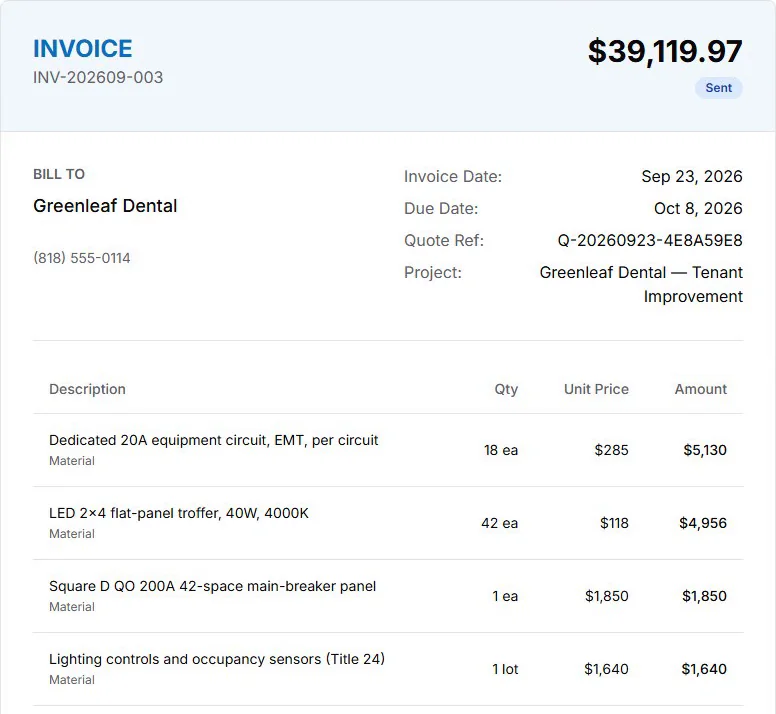
Automated Follow-Up combined with Invoicing and Payment Tracking turns collections into a system instead of a scramble. The CRM watches invoice aging and acts on it. Once an invoice is past due it is marked overdue, and a polite email with a pay link goes out at 1, 7, 14 and 30 days late; customers pay by card, or by ACH if your Stripe account has it enabled. Past that, the aging report (0–30 through 120+ days) shows who still owes you, so the call to AP at Ridgeline Builders about PO 4482 happens on time.
Payment Tracking gives you a live dashboard: total AR of $187,400, $23,100 over 60 days, and $14,500 promised this week. You see which jobs are cash positive and which are quietly funding the rest of the operation. For a shop at $2.4 million in annual revenue, cutting DSO by 12 days frees roughly $79,000 in working capital, enough to buy a used bucket truck without financing.
How Crew Scheduling and Dispatching Impacts Labor Cost Reporting
Labor is the largest controllable cost for most electrical shops, typically 35 to 45 percent of revenue. Yet most shops schedule from a whiteboard or a shared spreadsheet. The dispatcher assigns Mike and Jake to the Smith residence without knowing Mike already has 38 hours this week and overtime triggers at 40, or that Jake holds the fire alarm certification required for Thursday's inspection.
Crew Scheduling and Dispatching connected to Job Tracking fixes that. The scheduler sees each tech's week on the drag-and-drop dispatch board, with skill-based suggestions for who fits each job. Mike takes the 12-hour service call Wednesday; Jake, whose skills include fire alarm work, covers the inspection Thursday. If a change would pile more hours on Mike, the dispatcher sees it on the board and drags the job to someone else before it hits payroll.
When crews clock in from the phone, with location and an at-the-job-site flag, actual hours flow to the job cost report. No paper time cards. The labor report shows Job 1402 with budgeted labor of $8,400, actuals of $6,100 at 72 percent complete, and a projected $9,200 at finish, a 9.5 percent overrun. That projection uses the hourly rate for each job title and the hours actually worked, so you can rebalance the schedule before the overrun reaches the P&L.
Choosing the Right AI-Powered CRM for Your Growing Electrical Shop
Not every platform marketed as electrical contractor software delivers this depth, and field service management for electricians only works when the pieces share one database. Demand these capabilities:
- Single data model: estimating, scheduling, job tracking, invoicing, and accounting sync share one system, with no middleware and no nightly batch jobs.
- Trade-specific cost data: pre-loaded NECA labor units and CSI MasterFormat codes, plus the ability to import supplier price files by CSV, API, or EDI.
- Mobile-first field experience: voice capture, photo annotation, material scanning, and offline mode for basements and sites with no signal.
- Two-way QuickBooks sync: real-time, with conflict resolution when a record is edited in both systems.
- An automation engine: rules for follow-up sequences, change order approval routing, and lien deadline tracking per state statute.
- Scalable licensing: per-user pricing that does not penalize you for adding a part-time estimator or a seasonal apprentice.
Shops that adopt this level of integration in 2026 are not just going digital. They are building a financial nervous system that reports daily whether each job makes money and why. That is how you bid the next job smarter, and how you grow from three trucks to fifteen without losing control of the numbers.
One boundary worth repeating: AceWatt is the electrical-contractor CRM and job-management layer, not a full accounting system or a QuickBooks replacement. QuickBooks, Sage, or Foundation stays your accounting system of record; AceWatt's Growth and Scale plans include QuickBooks-ready exports — your invoice list as a spreadsheet and your payroll hours as a QuickBooks-format CSV for your bookkeeper, not a native two-way sync. For a deeper pairing discussion, see our electrical contractor accounting software guide and the electrical job costing software walkthrough, then review AceWatt pricing for which plans include the exports.
Your electrical business runs on precision. Your software should too.
Frequently Asked Questions
Does AceWatt replace QuickBooks for electrical contractors?
No. AceWatt is the job management and CRM layer that captures quotes, job notes, invoices, and payments. QuickBooks handles the formal accounting. AceWatt Growth and Scale plans include QuickBooks-ready exports: your invoice list as a spreadsheet and your payroll hours as a QuickBooks-format CSV for your bookkeeper. There is no native, real-time sync today.
How does job costing work for electrical contractors?
Job costing compares what a job was estimated to earn against what it actually cost — labor hours, materials, change orders, and permits. AceWatt keeps that operational job-cost context connected to the quote and the invoice, while your accounting system tracks the official financial records for the CPA.
What should electrical contractor accounting software include?
Look for job costing by class or location, progress billing and retainage support, bidirectional QuickBooks sync, 1099 and payroll handoffs, and reports a bookkeeper can reconcile without manual journal entries. The field side — estimates, time, and material capture — should connect to it without double entry.
Related Reading
- 7 best electrical contractor billing software tools
- Best Accounting Software for Small Electrical Contractors in 2026
- Mobile invoicing field apps that sync to accounting
Related reading: Best Accounting Software for Electrical Contractors with Job Costing & Change Order Management in 2026. Related reading: Best Electrical Contractor Accounting Software 2026.