

What Time and Material Billing Means for Electrical Contractors in 2026
Time and material billing is the standard model for electrical service work: troubleshooting calls, panel upgrades in older homes, and remodels where the scope shifts the moment you open a wall. In 2026, the pressure to document every hour, every fitting, and every code-driven change keeps increasing. Insurance adjusters, general contractors, and homeowners all expect line-item transparency. Miss a single conduit fitting or forget to log the apprentice who pulled wire for two hours, and that margin is gone.
For a solo electrician or a growing shop, the difference between a profitable T&M job and a write-off comes down to how you capture data in the field and move it to the invoice without re-entry. A purpose-built system, not a spreadsheet, is what tends to pay off.
Essential Fields Every Small Electrical Contractor T&M Billing Template Needs
A template built for HVAC or plumbing will shortchange electrical work. Your T&M document must reflect the trade's labor hierarchy and material reality:
| Field | Why It Matters for Electrical |
|---|---|
| Labor tiers | Apprentice ($65 to $85/hr), journeyman ($95 to $125/hr), master electrician ($130 to $165/hr). Rates vary by region, but the tier structure is non-negotiable. |
| Overtime and double-time rules | After 8 hrs/day or 40 hrs/week per state labor law; Sunday and holiday rates often run 1.5x to 2x base. |
| Truck or trip charge | $75 to $150 covers vehicle, insurance, fuel, and tool wear. Keep it separate from labor. |
| Material cost plus markup | 1.5x to 2.5x cost depending on supplier terms. Must capture wire, connectors, breakers, conduit, straps, wire nuts, tape, and labels. |
| Permit and inspection fees | Pass-through with admin markup, typically 10 to 15 percent, for pulling permits, scheduling inspections, and correcting violations. |
| Change-order line items | A separate section for scope additions: 100A to 200A panel upgrades, AFCI and GFCI retrofits, grounding electrode upgrades. |
| Job-site conditions | Photos of existing violations, access constraints, asbestos or lead warnings. This protects you when the GC or owner disputes hours. |
A small electrical contractor T&M billing template that omits any of these fields creates blind spots. The most common one is the $12 in wire nuts and push-in connectors used on a service call. Multiply that by 200 calls a year and you have $2,400 in direct material cost, plus markup, quietly disappearing.
Where Excel and Paper Templates Break Down for Growing Electrical Shops
Spreadsheets work for one truck. They fail the moment you add a second crew or start juggling three service calls a day. Time and material billing run on paper also breaks down the same way: the record is somewhere else while the work is on-site.
- No real-time sync. The apprentice writes hours on a crumpled ticket; the office admin enters them Tuesday. By then, the wire nut count is a guess.
- No material lookup. Typing "3/4 EMT 10-ft" forty times a week invites typos, and without supplier pricing attached, journeyman labor rate markup gets applied inconsistently.
- Change orders live in texts. A homeowner approves a panel swap by text message, and that approval never reaches the electrician change order form or the invoice.
- Double entry to QuickBooks. An invoice built in Excel gets re-typed into QuickBooks. Transposition errors on a $4,200 T&M invoice delay payment 14 to 21 days.
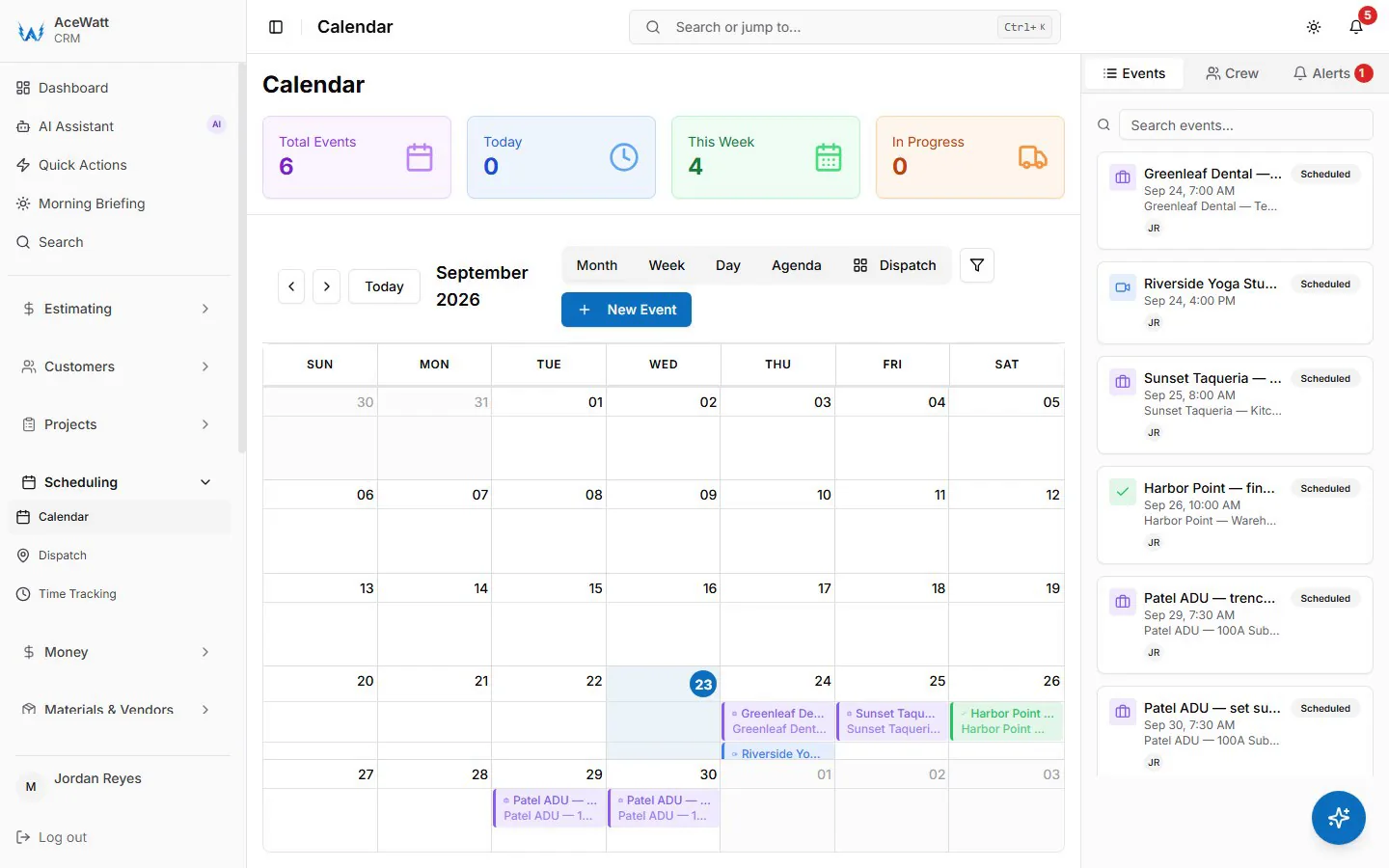
- No crew visibility. The dispatcher cannot see which tech has capacity for an emergency trouble call because the schedule lives on a whiteboard.
Shops running 3 to 5 trucks lose 8 to 12 billable hours per week to this administrative friction. At a $110/hr blended rate, that is $45,000 to $68,000 a year in recoverable revenue.
Capturing Billable Hours and Materials in Real Time with AI Voice and Job Walk Documentation
The fix is not better discipline. It is removing the friction between the work and the record. AI Voice and Job Walk Documentation lets a journeyman speak into a phone while pulling wire: "Job 442, added 40 ft of 12/2 NM-B, 6 blue wire nuts, 2 NM connectors. Apprentice J. Martinez 1.5 hrs pulling. Found open ground on circuit 7, needs GFCI retrofit, homeowner approved." The same voice-to-record workflow we cover in AI job walk documentation for electrical contractors applies to every T&M entry: speak it once, and it lands in the job record structured.
The system then:
- Transcribes and structures the entry into a report with the labor notes (journeyman, apprentice), a materials list, and a flag for the GFCI retrofit change.
- Keeps the timestamp, while the tech's clock-in records location and an at-the-job-site flag as proof of on-site presence.
- Pushes the completed work order to the office dashboard before the tech loads the truck for the next call.
No typing on a cracked phone screen in a crawlspace. No lost sticky notes. The electrical T&M invoice template is 90 percent complete before the job wraps.
Change-Order Workflows for T&M Electrical Work: Panel Upgrades, Code Issues, and Scope Creep
T&M electrical work is change-order work. You open a wall for a recessed light and find knob-and-tube feeding the circuit, which NEC 394.12 restricts from being concealed again in most alterations. You find no equipment grounding conductor, so a code-compliant receptacle replacement falls under NEC 250.130(C) or requires GFCI protection under 406.4(D). The panel is full and the homeowner now wants an EV charger, which forces a 200A service upgrade.
Each discovery triggers a change order, and the workflow must be instantaneous. This is where time and material billing either protects your margin or leaks it:
- Field tech documents the condition with a photo plus voice note: "Panel full, 100A Zinsco, no space for a 2-pole EV breaker. Recommending 200A Eaton swap."
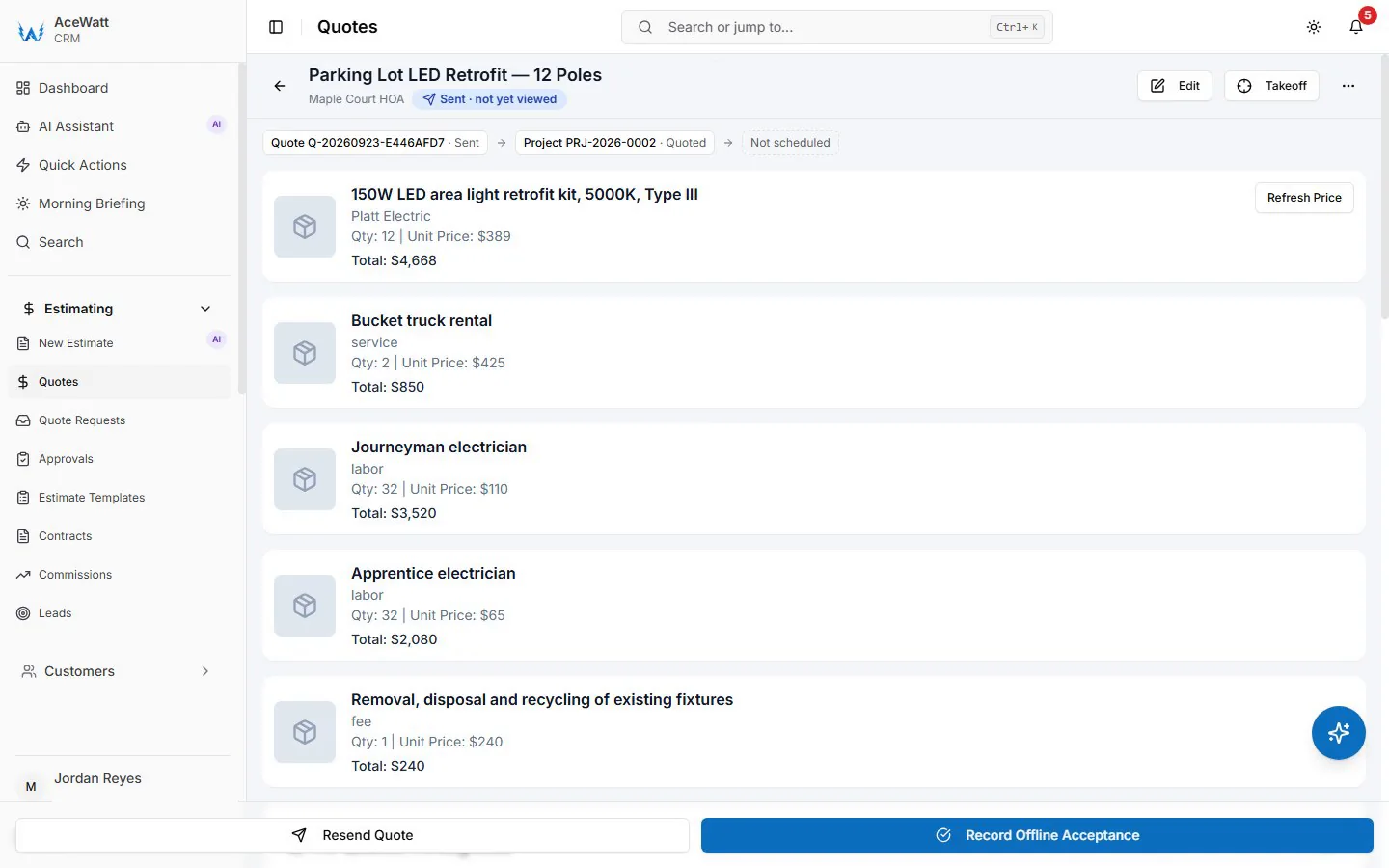
- AI Estimating generates the change-order estimate from the assembly: master 4 hrs, apprentice 4 hrs, panel kit, SER cable, grounding electrode system, permit fee. The estimating logic is the same automated electrical estimating flow used on original quotes, applied to the added scope.
- Customer e-signs the quote for the added work from an emailed portal link, with timestamp captured; the change order itself is approved internally.
- The approved change order auto-appends to the original T&M work order. One invoice, full audit trail, no manual merge.
Without this loop, shops either do the work unapproved and hope for payment, or stop work and reschedule, losing the truck roll and crew momentum. Both kill margin.
From the Field to the Invoice: Automating T&M Billing with Invoicing and Payment Tracking
The invoice should never be a Monday-morning project. Time and material billing only pays off when the field record becomes the invoice the same day. With invoicing and payment tracking for electrical contractors building one structured record from field capture through payment, the flow looks like this:
| Step | Manual Process | Automated Process |
|---|---|---|
| Work complete | Tech submits paper ticket | Tech taps Complete on mobile; all voice-captured lines finalize |
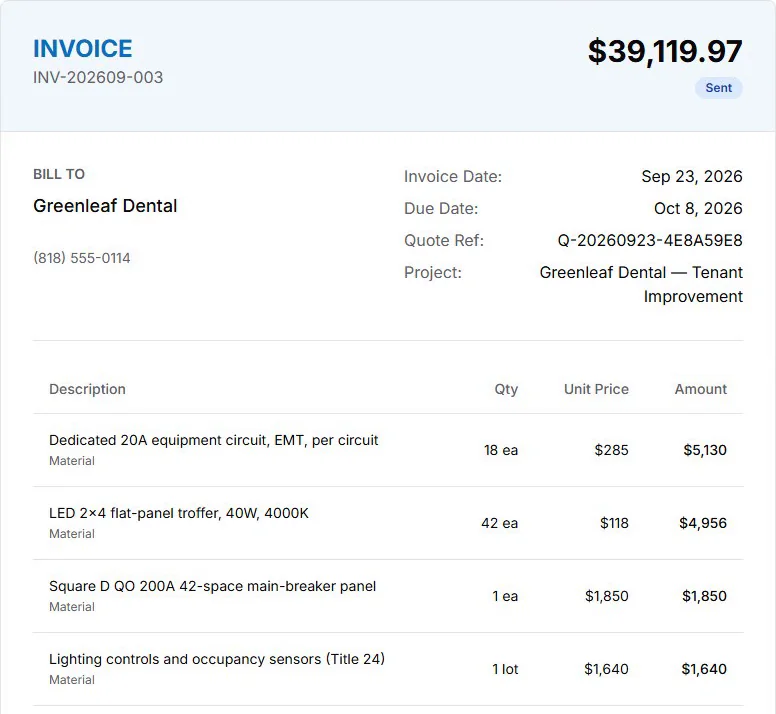
| Invoice creation | Admin builds in Excel or Word | The accepted quote is invoiced with its line items (markup included) and emailed automatically; labor carries one hourly rate per job title |
| Customer delivery | PDF emailed, check mailed | Invoice emailed with a Pay Now link for card payment (ACH if enabled in your Stripe account) |
| QuickBooks entry | Double entry of invoice and payment | Invoice list with status and balance, exported for your bookkeeper to post |
| Reconciliation | Monthly bank-to-QB matching | Real-time: paid invoices show green, overdue accounts flagged for follow-up |
Automated Follow-Up sends professional email reminders at 1, 7, 14, and 30 days past due, so the owner never has to make an awkward collections call. Payment posts, the invoice's balance updates on the export, and the dashboard reflects cash collected in real time instead of at month-end.
Choosing T&M Billing Software Built for Electrical Contractors
Generic field service platforms treat electrical like plumbing with different icons. When you evaluate time and material billing software for electricians, compare these capabilities:
| Capability | Generic FSM | Electrical-Specific |
|---|---|---|
| Labor tiers | One technician rate | Apprentice, journeyman, and master rates with state overtime rules |
| Material catalog | Generic parts list | Electrical items: wire by AWG and type, breakers by frame and amp rating, conduit and fittings by trade size |
| Permit tracking | Optional checkbox | Jurisdiction-aware permit workflow with inspection scheduling |
| Change orders | Separate module | Inline on the T&M work order with full audit trail |
| QuickBooks sync | Basic invoice push | Ask vendors to prove it: a native chart-of-accounts sync, or (AceWatt today) an invoice-list spreadsheet and a payroll-hours CSV your bookkeeper works from |
| Estimating | Square-foot templates | Assembly-based: a 200A panel swap loads as 4 hrs master plus 4 hrs apprentice, panel kit, 4/0 SER, and permit fee |
Solo electricians and growing shops should also prioritize one connected platform over stitched-together apps. An AI-powered CRM that logs every inbound service call, Crew Scheduling and Dispatching that assigns the emergency trouble call to the right tech, and Job Tracking that shows each work order's stage from dispatch to paid invoice all need to share the same data. When they do, the estimate becomes the work order, the work order becomes the invoice, and nothing gets re-typed along the way.
The Bottom Line for 2026
Electrical contractors running T&M work on paper, Excel, or generic apps are subsidizing their customers' projects with unbilled hours and materials. The math is simple: 3 missed wire nuts per call times 200 calls times $1.20 cost times 2x markup equals $1,440 a year in direct material loss. Add 2 forgotten apprentice hours per week at $75/hr and you lose another $7,800 a year. That is over $9,000 gone before you count delayed payments, change-order disputes, and QuickBooks cleanup, which is the quiet cost of running time and material billing without a system built for it.
A unified platform combining AI Voice and Job Walk Documentation, AI Estimating, an AI-powered CRM, Automated Follow-Up, Crew Scheduling and Dispatching, Job Tracking, Invoicing and Payment Tracking eliminates the gaps, and what reaches QuickBooks today is an invoice-list spreadsheet and a payroll-hours CSV, not a live-sync claim we do not make. The tech speaks the work into the job record. The office sees it instantly. The invoice goes out same day. The money arrives faster. That is how a modern electrical contracting business protects every dollar it earns in the field.
Frequently Asked Questions About Time and Material Billing
What is time and material billing for electrical contractors?
Time and material billing charges the customer for actual labor hours at agreed rates plus actual materials at cost plus markup, instead of a fixed price. It fits troubleshooting, panel upgrades in older homes, and remodels where the scope shifts once walls are opened.
When should an electrical contractor use T&M instead of a fixed price?
Use time and material billing when the scope is unknown: diagnostic trouble calls, repairs in older buildings, and any job where hidden conditions (knob-and-tube, open grounds, full panels) can change the work. Use fixed price when the scope is fully defined, like a straightforward EV charger install on an upgraded service.
How do I document a change order on a T&M electrical job?
Document the condition with a photo and a voice note, generate the change-order estimate from your assembly pricing, get the customer's e-signature before proceeding, and append the approved change order to the original work order so both appear on one invoice with a full audit trail.
What labor rates should a small electrical contractor bill on T&M work?
Typical tiers run apprentice ($65 to $85/hr), journeyman ($95 to $125/hr), and master electrician ($130 to $165/hr), varying by region, with overtime rules after 8 hrs/day or 40 hrs/week per state labor law. Set your rates in the system once so every invoice applies them consistently.
Does T&M billing software sync with QuickBooks?
Some platforms push invoices natively; others do not. AceWatt's handoff today is QuickBooks-ready exports: your invoice list as a spreadsheet and payroll hours as a QuickBooks-format CSV for your bookkeeper, not a native two-way sync. Ask any vendor to prove the exact sync behavior during a demo before buying.
How much unbilled revenue does a small electrical shop lose on paper T&M tickets?
Common losses are small and constant: missed fittings and connectors (about $1,400 a year on 200 service calls), plus forgotten apprentice hours (about $7,800 a year at $75/hr for two hours a week). Same-day field capture recovers both because the record is built while the work happens.
Related Reading
- Browse the full AceWatt feature set: AI job walk, estimating, invoicing, scheduling.
- From takeoff to T&M invoice: the estimating-to-billing workflow: how the estimate becomes the invoice without rebuilds.