

Time and Material Billing Automation for Electrical Contractors: Ending Double Entry in 2026
Most electrical service work is billed time and material. Troubleshooting a dead circuit, a panel swap on a 1960s split-bus service, remodel rough-ins, and the change orders that pile up after an inspector flags something: none of that fits a flat-rate book. T&M is how electricians actually get paid, and it is also where revenue leaks, because every billable hour, part, and fee has to survive the trip from the field to the invoice to the books.
For most shops, that trip still involves typing the same information two or three times. This is a solvable problem, and in 2026 it is the single highest-use fix available to a busy electrical contractor.
Why Time & Material Billing Still Creates Double Entry for Electrical Contractors in 2026
A single T&M service call generates more billing data than most shops realize:
- Technician hours, split between straight time and any after-hours or emergency multiplier
- Truck stock pulled during the job, from wire connectors to a $70 dual-function AFCI/GFCI breaker
- A supply house run, tagged at the Graybar or City Electric counter under the shop account
- Permit and inspection fees from the building department, often reimbursable
- Travel time, portal-to-portal or one-way depending on how the shop prices it
- Equipment charges, such as a lift rental for parking lot pole work
In a typical two-truck shop, each of those items lives somewhere different: hours in a text message to the office, materials on a paper ticket or a photo of a receipt, permits in a folder, travel in someone's memory. The office then rekeys all of it into an invoice template, and later rekeys it again into QuickBooks. That is two rounds of manual entry per job, thousands of times a year.
The problem persists in 2026 because shops have software, just not connected software. A time clock app, a spreadsheet, and an invoice generator each solve one piece, and the human in the office is still the integration layer. Meanwhile, code-driven scope changes keep multiplying the paperwork. The 2023 NEC expanded GFCI protection to 240-volt dryer and range receptacles in dwellings, the 2026 NEC is beginning its state-by-state adoption, and every inspection-driven addition becomes another T&M line that needs documentation.
The Real Cost of Rekeying Labor, Materials, and Change Orders
Double entry is not just an annoyance. It has a price you can calculate.
Take a two-truck shop running 120 service calls a month. If rekeying each invoice takes 12 minutes, that is 24 hours of pure administrative time every month, roughly $7,200 a year in office labor spent retyping information the business already captured once.
The larger losses come from what never makes it onto the invoice at all:
| Leak | What it looks like | Annual impact (illustrative) |
|---|---|---|
| Unrecorded labor | 45 minutes per tech per week that never hits a ticket | About $5,600 per tech at a $150 per hour billing rate |
| Truck stock walk-offs | A $70 breaker here, a $180 roll of 12/2 NM-B there | $1,000 to $3,000 for a two-truck shop |
| Admin rekeying | 12 minutes per invoice across disconnected systems | 24 hours and $7,200 per year at 120 calls a month |
| Missed minimums and differentials | The $125 trip charge or 1.5x emergency rate never applied | Pure margin, gone |
Disputes cost even more. When a homeowner or GC questions 2.5 hours of troubleshooting and the shop has no time-stamped record of arrival, findings, and repair, the conversation usually ends with a discount. Commercial change orders are worse: standard AIA G701 workflows expect signed field tickets and receipts with the markup stated, and missing documentation gives the GC a clean reason to reject the line item.
Slow invoicing also compresses your legal protections. In California, a 20-day preliminary notice preserves full lien rights, and Texas runs month-by-month notice deadlines. Every week an invoice waits to be keyed is a week off your window to protect payment.
Then there is reconciliation. At month end, the supply house statement arrives with every tagged ticket, and someone has to match each one to a job and an invoice. Unmatched tickets are either unbilled materials or double charges, and both take hours to find.
What True Time and Material Billing Automation Looks Like for Electrical Shops
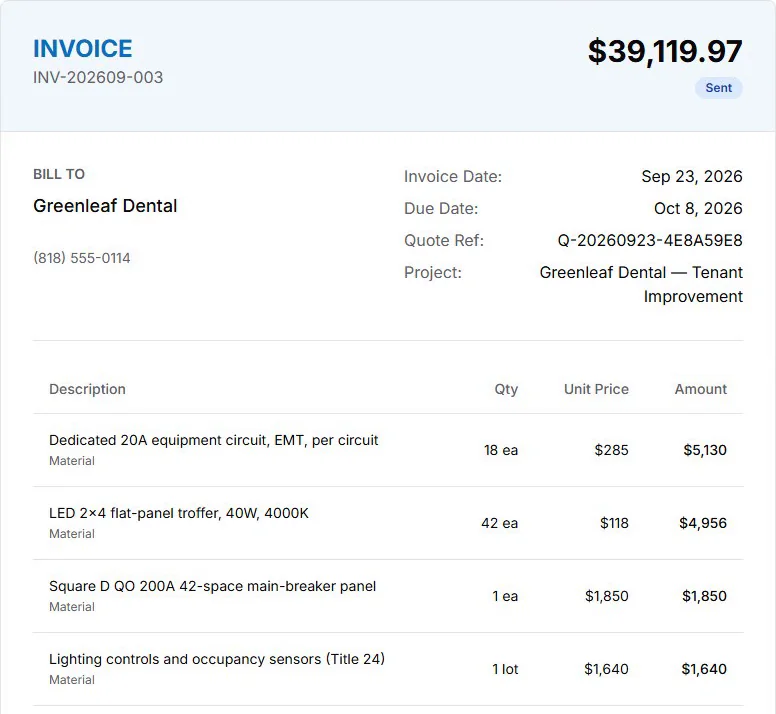
A basic electrician invoice app formats a PDF. That is not automation, it is word processing with better fonts.
True electrical contractor time and material billing automation means data is captured once, at the source, by the person doing the work, and everything after that is flow:
- The tech clocks in and out on the job, and on-site time attaches to the correct customer and work order automatically.
- Materials get logged from the phone as they are pulled from the truck or picked up at the counter, with photos of receipts attached.
- Voice documentation captures findings, conditions, and customer approvals while the tech is still standing at the panel.
- The invoice assembles itself from the logged labor, materials, fees, and travel, with the shop's rates and markup rules applied.
- Payment tracking runs from the same record, so the status of every dollar is visible without a phone call to the office.
The office role changes from data entry clerk to reviewer. Instead of reconstructing the job from texts and scraps of paper, someone approves an invoice that is already 95 percent complete and correct.
How AI Estimating Connects Field Work to Accurate T&M Billing
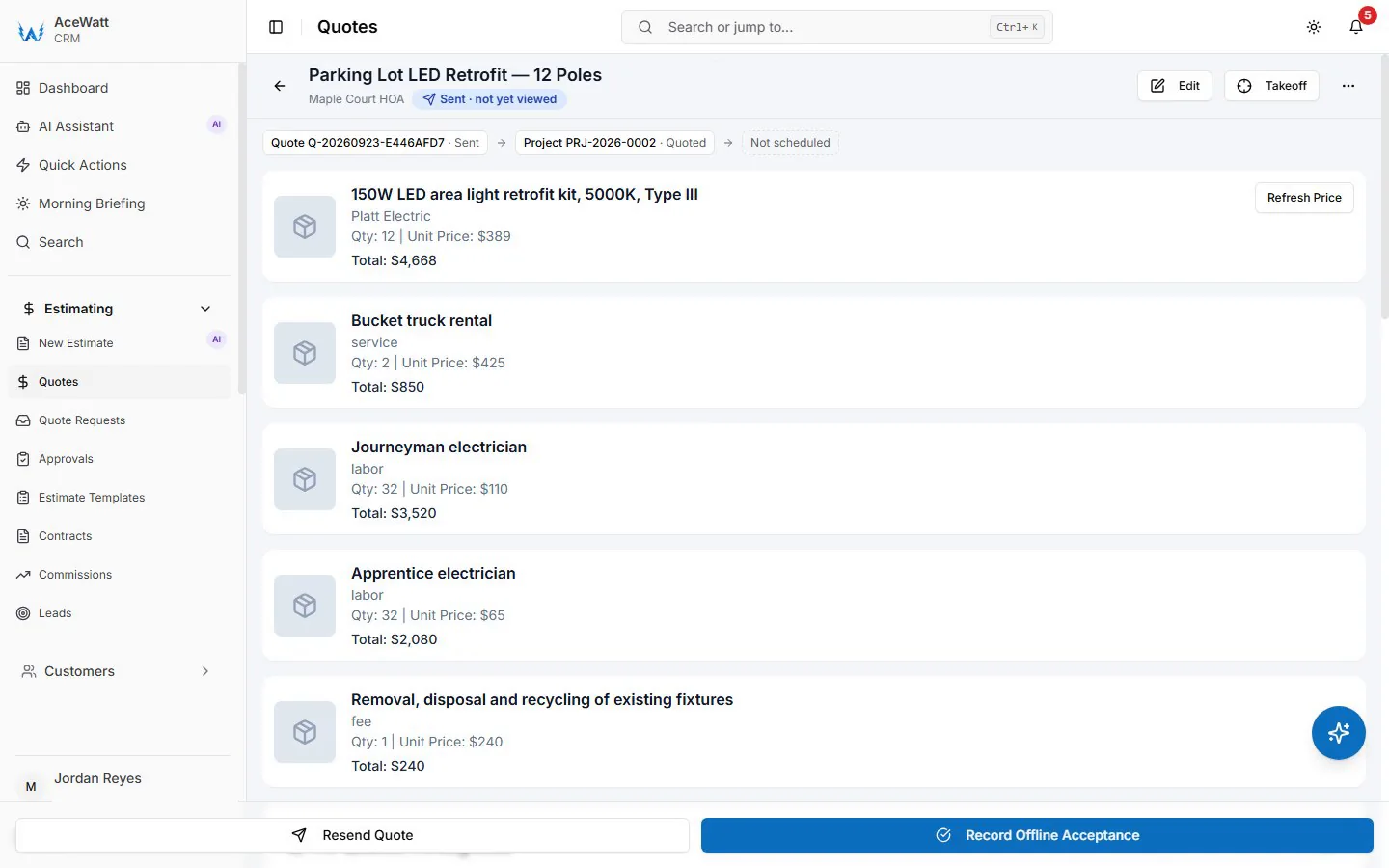
Even open-ended T&M work starts with a number. The customer wants to know what a panel upgrade will run before the truck rolls, and the GC wants a not-to-exceed figure on a change order. That is where AI Estimating earns its keep on T&M jobs.
AI Estimating builds estimates from your actual labor rates, current material pricing, your markup structure, and job-specific conditions. It drafts from your pricebook and assembly templates for your review, so the hours for a 200-amp service replacement in a split-bus home or a hot tub circuit with 60 feet of trenching come from your own standards rather than a guess. The estimate then becomes the billing framework for the job: agreed labor rates, material markup percentage, allowances, and exclusions are documented before work starts, which is exactly the structure that keeps T&M billing defensible.
The bigger win is variance visibility. When actual hours and materials are logged in the field against the estimate, overruns surface mid-job instead of at invoice time. A job trending 3 hours over estimate triggers a conversation with the customer while the wall is still open, not an argument after the fact. For work that converts from estimate to T&M, such as uncovering knob and tube during a remodel, the documented baseline makes the deviation a clean, billable change order instead of a contested surcharge.
Automated Follow-Up and Job Tracking That Keep Billable Items from Falling Through the Cracks
Most revenue loss is not one big missed invoice. It is a dozen small items sitting in limbo between job statuses.
An AI-powered CRM with job tracking gives every service call a defined lifecycle: scheduled, dispatched, on site, completed, invoiced, paid. Because every billable action lives in that same record, the system can flag the failures that humans miss. A job marked complete with no invoice attached gets flagged. A ticket with logged labor but no material photos gets flagged. An unpaid invoice gets automatic email reminders at 1, 7, 14 and 30 days past due, without anyone on your team lifting a finger.
Automated Follow-Up also protects work that happens after the invoice. Deposit requests go out before mobilization. Balance requests follow completion. When the tech notes a recommendation during a job walk, such as a full panel or an ungrounded circuit discovered in an older home, that note becomes a follow-up opportunity in the CRM instead of disappearing into a paper ticket. Every billable item ends up with a status and an owner, and nothing waits silently in someone's inbox.
Crew Scheduling, Dispatching, and Job Walk Documentation as Billing Inputs
Dispatch data is billing data, and shops that treat it that way eliminate an entire category of manual entry.
When crew scheduling assigns a tech to a job, the billing record begins: the date, the customer, the job site, and the assignment that establishes travel time under your pricing policy, whether portal-to-portal or one-way. Clock-in and clock-out from the phone, with location and an at-the-job-site flag, stamp the actual on-site window. Electrical dispatch software that connects directly to invoicing means those clocked hours are already on the job when the invoice is built, instead of leaving dispatch notes in one app and hoping the office reconstructs them in another.
AI Voice and Job Walk Documentation closes the documentation gap on the job site. A tech walks a commercial tenant fit-out or an older home and narrates what is there: existing conditions, panel capacity, accessible conduit runs, code deficiencies observed. The transcription attaches to the job record, time-stamped. When the customer later questions why 2.5 hours went to troubleshooting, the record shows arrival time, findings, the repair performed, and the approval given on the day it happened. On commercial work, documented pre-existing conditions and verbal approvals captured on site are the difference between a paid change order and a rejected claim. This is dispute armor built into the billing process.
QuickBooks-Ready Exports: What Happens After the Invoice
Many shops that fix the invoice still lose hours on the second rekey: entering the finished invoice into QuickBooks, then entering the payment when it lands. That is the gap QuickBooks-ready exports narrow today.
AceWatt's handoff today is QuickBooks-ready exports, not a native two-way sync; full sync is in development. Completed invoices, with status and balance, land on an invoice-list spreadsheet and payroll hours on a QuickBooks-format CSV for your bookkeeper, and the office sees current receivables in the app without re-typing from paper tickets. Because labor and material lines use the same price book items consistently, job costing becomes real: you can see actual margin on a panel upgrade versus a service call instead of guessing at month end. Supply house purchases coded to jobs in the field reconcile cleanly against statements, which shrinks the month-end matching session from hours to minutes.
For a small or growing shop, the accounting software for electrical contractors does not have to replace QuickBooks. The handoff preserves your accountant relationship and your books while cutting the paper chasing that makes reconciliation miserable.
How Growing Electrical Contractors Can Move to Automated T&M Billing Without Disrupting Operations
A migration that stalls out usually failed on sequencing, not on the software. A phased approach works for two-truck shops and twenty-truck shops alike:
- Audit one week of current billing. Sample ten completed invoices and find the missed charges, the delayed invoices, and the rekeying time. This baseline is how you will measure the payoff.
- Build the rate card before go-live. Hourly rates for each job title, trip and diagnostic charges, and permit pass-through items must be set up first; overtime or emergency premiums go on as their own line, and material markup is set on the quote. Automation applies rules; it cannot invent them.
- Import records. Pull in customers, open jobs, and your item list so the first invoice lands in a system that already knows the business.
- Pilot with one crew for one billing cycle. Run the old process for jobs already in flight and start all new jobs in the platform. Compare the pilot invoices to the old ones for completeness.
- Train on field capture, not software. Techs need short sessions on the two habits that matter: clocking in and out on the job, and logging materials with a photo at the moment of pull.
- Retire the paper ticket. Once the pilot cycle closes clean, move every crew over and stop accepting field data by text.
Most two-to-five-truck shops complete this in two to four weeks without missing a billing cycle. Track three numbers after 60 days: days from completion to invoice, unbilled labor hours per week, and weekly admin hours. Shops that move to electrical contractor invoicing software with connected field capture typically cut days-to-invoice from weeks to the same day, and that alone shortens the cash cycle and protects lien notice deadlines.
T&M billing rewards the shops that document well and punishes the ones that document twice. In 2026, capturing the job once, at the source, and letting the estimate, invoice, and books follow from that single record is no longer a large-shop luxury. It is the working standard for electrical contractors who intend to keep the margin they earned.
Related Reading
- Time Material Billing Software for Electrical Contractors
- How Electrical Contractors Automate Time & Material Billing
- Mobile Time Material Billing for Electrical Techs
- From takeoff to T&M invoice: the full estimating-to-billing workflow, automated end to end.