

Electrical Contractor Bid Software: The 2026 Buyer's Guide for Electricians
Every electrical bid is a bet. You are betting that your labor estimate holds, that the material quote is still good when you order, and that the panel swap does not turn into a service upgrade with a load calculation and a utility coordination call. Electrical contractor bid software exists to take the guesswork out of that bet by putting labor units, material pricing, markup, and overhead in one system instead of a spreadsheet, a highlights folder full of PDFs, and a whiteboard in the truck.
This guide covers what actually matters to electricians in 2026: electrical-specific estimating, AI takeoff speed, and what happens after the bid is sent, which is where most bids are quietly lost.
Why Electrical Contractor Bid Software Matters in 2026
Three forces are squeezing electrical contractors harder than usual this year.
First, code cycles keep moving. The 2026 NEC is rolling out, and jurisdictions adopt on their own schedules, which means you may be bidding under the 2023 NEC in one county and a 2026-amended code in the next. Device-level requirements drive real cost: a 20A AFCI combination breaker runs roughly $45 to $60 versus under $10 for a standard thermal-magnetic breaker, and expanded AFCI and GFCI coverage under recent cycles (NEC 210.8 and 210.12) changes device counts on nearly every dwelling job. If your estimating template is two code cycles old, your bids are wrong in one direction or the other.
Second, material volatility is brutal on copper-heavy trades. 12 AWG THHN, MC cable, and copper wire pricing moved double digits between order cycles in recent years, and a bid priced off a distributor quote from six weeks ago can erase the margin on a 5,000-foot wire pull before you ever set a ladder.
Third, commercial electrical contractor rates per hour keep climbing (commonly $75 to $150 depending on market and license class), which raises the cost of every hour your estimators and office staff spend chasing plans, retyping numbers, and hunting down unanswered bids.
Bid software attacks all three pressures by making estimates faster, more current, and more consistent, so you can bid more work without adding office overhead.
What Makes Bid Software Different for Electricians
Generic estimating tools assume a job is a job. Electrical work is not generic. A credible electrical estimating software platform has to handle:
- Rough-in versus trim-out as separate cost phases. The labor to rough a 2,000-square-foot house is a different animal from trim, and bid software built for electricians tracks them separately instead of forcing you into one blended labor number.
- Labor units, not guesses. Estimators in this trade price off labor units measured in tenths of hours per device, in the tradition of the NECA Manual of Labor Units. A wall device, a 4-square box on a deck, or a 200A panel each carry a defensible labor value your software should store and adjust for job conditions.
- Permit time and inspection windows. A 200A service upgrade needs a permit, often $50 to $300 residential and valuation-based in many commercial jurisdictions, plus a load calculation under NEC Article 220 and inspection scheduling. That time has to be in the bid.
- Travel, lifts, and access conditions. Attic pulls, crawl spaces, and scissor lift time on a warehouse lighting retrofit are real costs that generic templates miss.
- Service calls and change orders as distinct pricing models. A diagnostic call with a trip minimum, a T&M troubleshooting ticket, and a change order on a contracted project each price differently.
Electrical contractor bidding software that cannot distinguish a feeder pull from a switch leg is just a spreadsheet with a subscription fee.
Best Electrical Contractor Bid Software Tools for 2026
The market splits into three camps, and knowing which one you are shopping in matters more than any feature checklist.
Legacy electrical estimating suites. Products like McCormick Systems and Trimble Accubid built their reputations on takeoff and labor-unit databases, and they remain strong for plan-and-spec estimating on larger commercial projects. The tradeoff is depth without breadth: winning the bid still leaves you manually pushing data into scheduling, invoicing, and accounting systems that were never designed to talk to each other.
Generalist field service platforms. Tools like ServiceTitan, Jobber, and Housecall Pro handle scheduling, invoicing, and customer management well. ServiceTitan in particular targets larger operations at premium per-technician pricing. The estimating side, where electrical assemblies, labor units, and code-driven device counts live, tends to be the thinnest part of these platforms for electricians specifically.
AI-native all-in-one platforms. This is the 2026 category, and it is where our platform sits: AI-powered CRM, AI estimating, automated overdue-invoice reminders, crew scheduling and dispatching, job tracking, invoicing and payment tracking, AI voice and job walk documentation, and QuickBooks-ready exports in a single system. The point is not that any one feature is revolutionary. It is that the bid, the schedule, the job record, and the invoice are the same data object moving through one pipeline instead of four programs held together with re-entry and luck.
For solo electricians, the all-in-one approach is usually the only approach that makes sense; you are the estimator, dispatcher, and bookkeeper, and context switching is the tax. For growing shops with multiple crews, it is what lets you add a truck without adding an office hire.
How AI Estimating Speeds Up Electrical Bidding
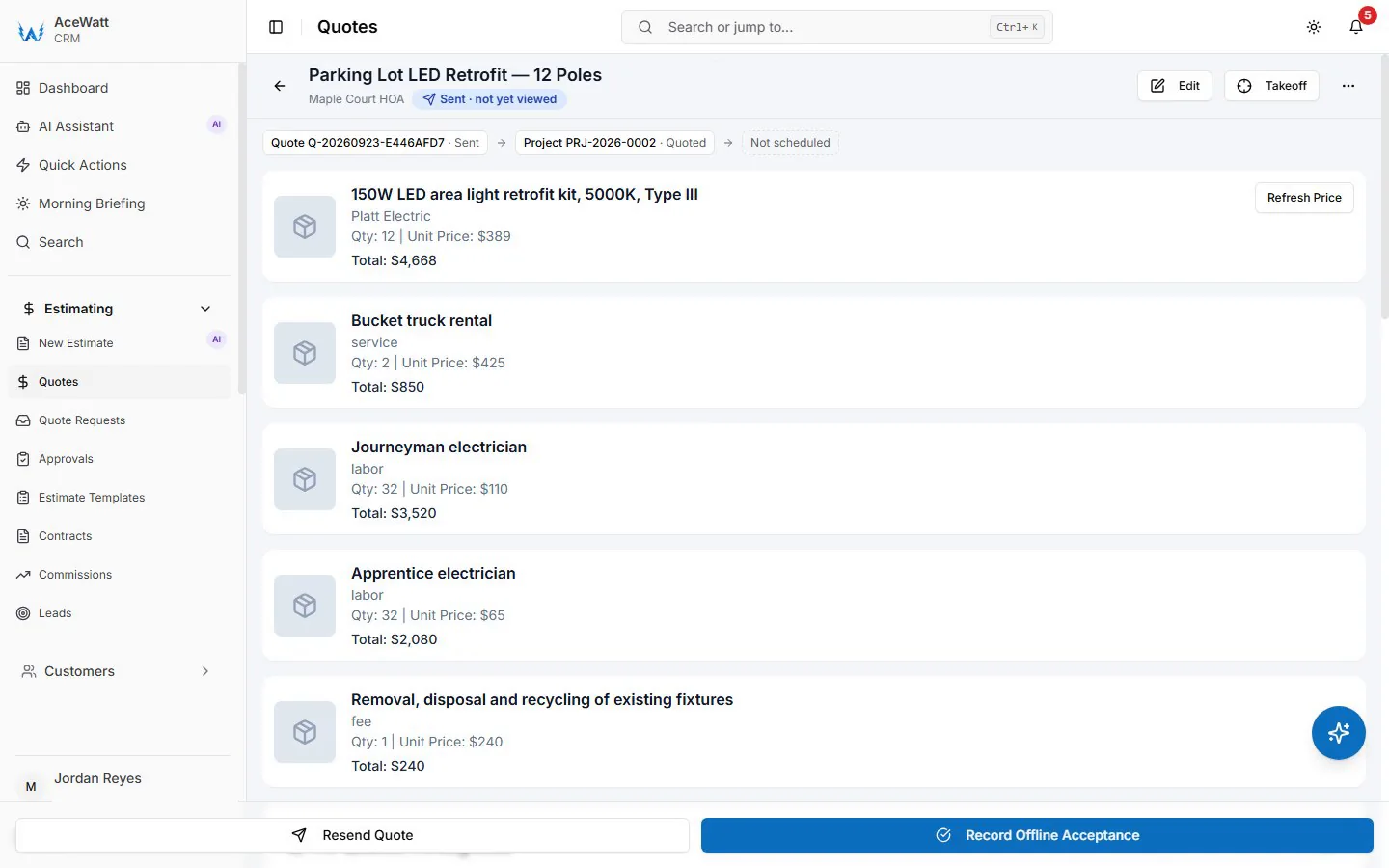
Traditional electrical estimating is slow in predictable places: counting devices on PDF plans, looking up current material pricing, and rebuilding the same assemblies job after job. AI electrical estimating software attacks each of those steps.
Assemblies are the foundation. A residential bedroom circuit, a commercial 277V lighting drop, or a subpanel feed with conduit, wire, connectors, and labor should be saved units you drop into an estimate, not line items you retype. AI estimating goes further by learning from your history: which labor adjustments you consistently make for occupied homes, how long trim actually took on your last six tract houses, and what you really paid for that 12 AWG THHN last quarter instead of what the list price says.
The bigger speed gain happens at the job walk. With AI voice and job walk documentation, you record your observations on site: "existing 100A Zinsco panel, no main breaker, corrosion on neutrals, customer wants room for two EV chargers later." The transcription attaches to the job record alongside photos of the panel and service entrance. Back at the office, that documented walk feeds the estimate, and it protects you later when the customer disputes scope. Voice documentation of existing conditions is one of the cheapest dispute-prevention tools in the trade, and on service upgrades and remodels it can pay for itself the first time a claim arises.
The correct posture toward AI output is review, not blind trust. The AI drafts the takeoff and pricing; a licensed electrician still checks the device counts, the load calc, and the labor adjustments before the bid goes out. That review takes minutes. The takeoff that used to take an evening takes minutes too.
Connecting Bids to Scheduling, Dispatch, and Job Tracking
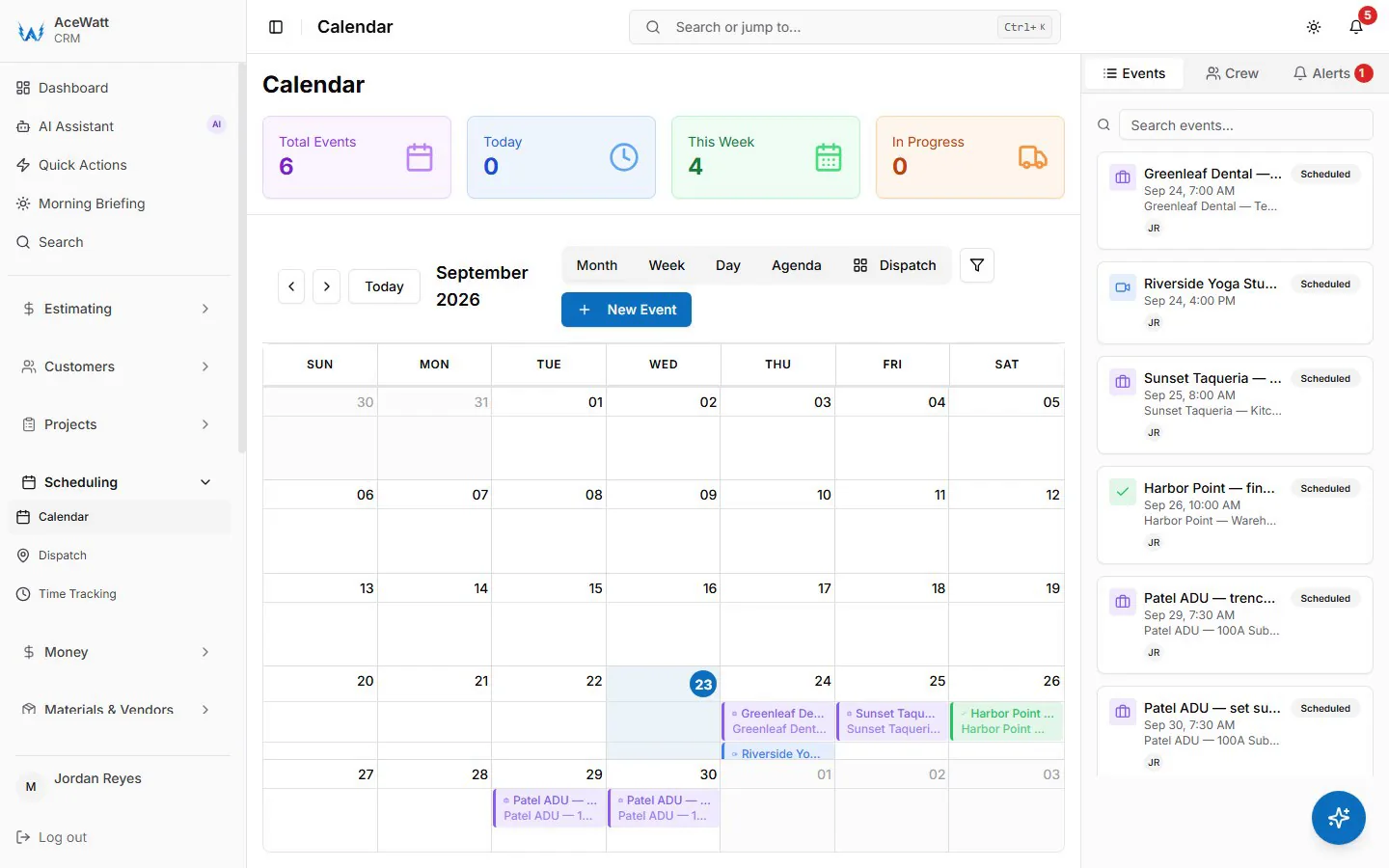
The most expensive moment in many electrical shops is the word "yes." A won bid immediately creates a chain of obligations: order material, schedule rough-in, book the inspection, stage trim, and invoice. When estimating lives in one program and job management in another, someone re-enters everything, and errors born in re-entry surface as missing 4-squares on rough day.
Integrated job management software for electricians collapses that gap. When the customer signs the estimate, the job exists: material list ready for ordering, phases mapped (rough-in, inspection, trim-out, closeout), and the job visible to electrical dispatch software for crew assignment. Dispatch matters more in this trade than most because licensing drives eligibility: a journeyman can cover a rewire rough-in, but the service upgrade needs your master or the qualifier on record, and troubleshooting calls need your best diagnostic heads, not whoever is idle.
Job tracking then gives you the two numbers that determine whether you will make money next year: estimated hours versus actual hours by phase, and estimated versus actual material cost. Without it, every bid is based on memory, and memory is optimistic.
Time and Material Billing Support for Electrical Projects
Fixed-price bidding works when scope is visible. Half of electrical work fails that test. Troubleshooting a dead circuit, chasing a intermittent fault, opening walls in a 1960s house with possible aluminum branch wiring, and change orders on active projects all carry unknowns that make a fixed bid a gamble.
Electrical contractor time and material billing software handles this properly:
- Signed T&M authorization before work starts, stating the hourly rate, material markup (15 to 35 percent is common), and any trip minimum, so the customer agreed to terms before you opened the panel.
- Mobile clock in and out tied to the job record, so billed hours match job tracking hours and nothing leaks.
- Material logging from the field, with photos of failed parts, captured from the electrical invoice app so the parts appear on the invoice the same day instead of on a crumpled receipt three weeks later.
- On-site invoicing and payment capture, including card processing, so a service call closes out before your tech leaves the driveway.
For commercial work, the same structures support progress billing and retainage tracking, since many commercial contracts hold 5 to 10 percent until substantial completion. If your software cannot track retainage, your receivables report is lying to you.
How Bid Software Improves Follow-Up and Win Rates
Here is the uncomfortable truth about bidding in this trade: a large share of bids are not lost on price. They are lost to silence. A homeowner collecting three quotes hires the contractor who followed up, and a property manager awarding a lighting retrofit goes with the bidder who made the decision easy. The first qualified responder wins a disproportionate share of work, and bids sent and never mentioned again lose to contractors who were simply more present.
Automated follow-up fixes this mechanically. When a proposal goes out, the system tracks whether it was opened and, on a supported e-signature flow, whether it was signed. Then it runs the sequence you set: a check-in the next day, a value reminder on day three, a gentle expiration notice before the quote's validity window closes, since material pricing volatility justifies a 30-day quote limit and saying so creates honest urgency. None of this requires the estimator to remember anything, which is the entire point.
The CRM side closes the loop. Every bid, won or lost, becomes data: which job types you win, which price points stall, and which customers always say no. Bidding without that history means repricing the same lessons forever.
Choosing the Right Bid Software for Your Electrical Shop
Run any platform you evaluate through this 2026 checklist:
- Electrical assemblies and labor units. Can it store your rough-in and trim-out labor separately, or is it a generic template?
- AI estimating with a review step. Does the AI draft from job walk data while keeping a licensed human in the approval loop?
- Automated follow-up and e-signature. Can it run a follow-up sequence without anyone remembering to?
- Scheduling and dispatch that understands phases and licenses, not just calendars.
- T&M billing, deposits, and payment tracking, including card capture and retainage on commercial jobs.
- QuickBooks sync that maps estimates, invoices, and payments cleanly, so your bookkeeper is not reconciling two systems by hand.
- Mobile everything. Your office is a truck. Voice job walk documentation, photos, material logs, and invoicing have to work from it.
- Honest implementation time. A solo electrician should be bidding from a new platform within a week. If onboarding sounds like a construction project of its own, keep shopping.
Solo electricians should weight items 2, 3, and 6 heaviest: speed to bid, follow-up that runs itself, and books that reconcile without Sunday-night data entry. Growing shops should weight 4 and 5, because dispatch chaos and unbilled T&M are what break shops at the three-to-five crew stage.
The bids you send in 2026 will be priced against contractors using all of this. The ones you win will come from getting the estimate right and staying in front of the customer until the decision is made, and both of those are now software problems with good solutions.