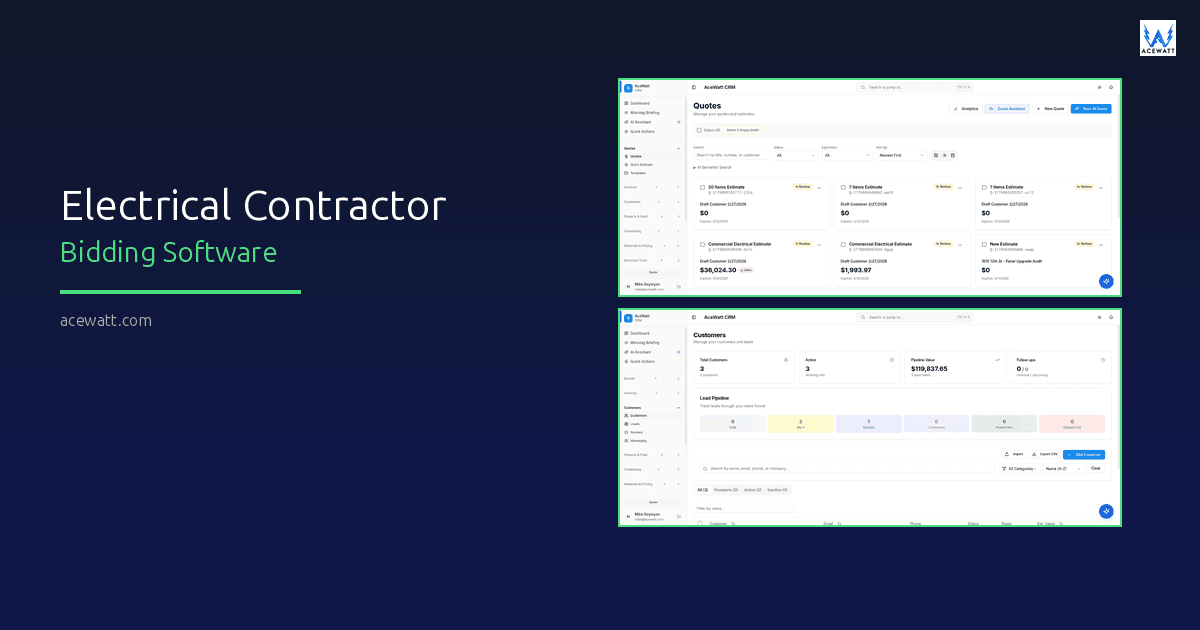
Electricians bidding software covers the tools electrical contractors use to create, price, submit, and track competitive bids. In 2026, that definition spans two very different categories: traditional takeoff-and-database systems built for plan-and-spec estimators, and modern CRM-based platforms that carry a bid from first customer contact through proposal, follow-up, scheduling, and invoicing. Picking the right electricians bidding software, or the right combination, depends on whether your shop lives on blueprints or job walks.
Direct answer: Electrical contractor bidding software is software that helps electrical contractors build, submit, and track bids. Traditional tools like McCormick and Accubid focus on on-screen takeoff and material pricing from large databases. Modern CRM-based tools like AceWatt connect estimating to proposals, follow-up, scheduling, and invoicing in one workflow. The right choice depends on your job type, shop size, and whether you need deep plan takeoff or a complete bid-to-cash pipeline. For code-sensitive, safety-sensitive, or price-sensitive electrical work, a licensed electrician or qualified reviewer still verifies scope, code/compliance considerations, site conditions, pricing, permits, and exclusions before any bid reaches the customer.
What Is Electrical Contractor Bidding Software?
Electrical contractor bidding software is software designed to help electrical contractors create, price, submit, and track competitive bids for electrical work. For shops evaluating electricians bidding software, the key is understanding that it sits at the intersection of estimating, proposal generation, and bid management. The best tools also handle the customer relationship around each bid.
To understand where bidding software fits, it helps to distinguish it from adjacent categories:
- Estimating software is broader. It covers the internal cost model: labor hours, material costs, equipment, overhead, and margin. Bidding software may include estimating, but estimating software does not always produce a customer-facing bid.
- Takeoff software is narrower. It measures quantities from blueprints: conduit runs, circuit counts, fixture quantities. Takeoff feeds into estimating, but it does not produce a proposal or track whether the customer said yes.
- CRM software manages the customer relationship: lead intake, communication history, follow-up reminders, and job records. CRM-based bidding platforms embed the bid inside that relationship rather than treating it as a standalone document.
Electrical bid software matters because competitive bidding is where margin is won or lost before a single wire gets pulled. A bid that under-prices materials, skips overhead, or forgets exclusions can turn a profitable-looking job into a loss. A bid that over-prices to play it safe can lose the job entirely. And a bid that goes out clean but never gets followed up on is a bid that might as well have never been sent. The U.S. Bureau of Labor Statistics projects steady demand for electricians through 2033, so shops that want to win competitive work without leaving margin on the table increasingly depend on dependable electricians bidding software.
For a deeper look at the estimating side specifically, see our electrical estimating software guide and our electrical contractor estimating software comparison.
Traditional Bidding vs. Modern CRM-Based Bidding
The electrical bidding software market in 2026 is split between two approaches. Understanding both helps you pick the right electricians bidding software, or the right combination.
Traditional Takeoff-Based Bidding
Traditional electrical bid software was built for plan-and-spec estimators who bid commercial and industrial work from blueprints. Many of these tools reference NECA labor standards and NEC assemblies to standardize labor calculations across projects. The workflow in traditional electricians bidding software looks like this:
- Import a plan set (PDF or DWG).
- Perform on-screen takeoff: count fixtures, measure conduit runs, tally devices.
- Apply material pricing from a built-in database (often 50,000+ electrical items).
- Apply labor units based on NEC assemblies or NECA manuals.
- Add overhead, margin, and tax.
- Export a bid summary or spreadsheet.
Typical tools: McCormick, Accubid (now Trimble), BestBid, TurboBid, ProEst.
These platforms are powerful for what they do. McCormick and Accubid have been refined over decades and carry deep electrical assemblies, union and non-union labor tables, and material databases that are updated regularly. A dedicated estimator at a mid-size or large electrical contractor can produce highly detailed, competitive bids using these systems.
The limitation is what happens after the numbers come out. Traditional tools typically stop at the bid summary. The proposal, customer communication, follow-up, scheduling, and invoicing all happen in separate systems, or on paper, or in someone's head.
Modern CRM-Based Bidding
Modern electrical contractor bid management platforms treat the bid as one step in a longer customer workflow. In electricians bidding software built on a CRM foundation, that workflow looks like this:
- Lead comes in (web form, phone call, referral).
- Job walk or site visit captures scope, photos, and notes.
- AI-assisted or template-based estimating produces a draft bid.
- The bid becomes a formatted proposal sent to the customer.
- Follow-up reminders keep the bid active.
- When the bid is won, it hands off to scheduling and invoicing.
Typical tools: AceWatt, Jobber, Housecall Pro.
These platforms are built for service-oriented electrical contractors, meaning the shops bidding residential service calls, panel upgrades, EV charger installations, small commercial tenant improvements, and maintenance contracts. The bid lives inside the CRM, connected to the customer record, communication history, and eventual invoice.
The trade-off is takeoff depth. CRM-based bidding tools typically do not offer the same on-screen plan takeoff or assembly-level detail as McCormick or Accubid. For many service contractors, that trade-off is worth it because their bids come from field visits, not blueprint rooms.
Why the Market Is Shifting
The shift toward CRM-integrated bidding is driven by three things:
- More service work, less plan-and-spec. The residential and light commercial electrical market has grown faster than large commercial construction. Service contractors need speed and follow-up, not 200-page bid packages.
- Customer expectations. Homeowners and small business owners expect a fast, professional proposal, then follow-up, then easy approval, then easy payment. Tools that handle that entire flow win more jobs.
- Small shop economics. A three-truck electrical shop cannot afford a dedicated estimator, a CRM subscription, a proposal tool, and a separate invoicing system. An integrated platform replaces all four.
For more on how pricing works across these job types, see our electrical contractor pricing guide.
Core Features to Look For in Bidding Software
Whether you choose a traditional takeoff system or a modern CRM-based platform, these are the features that separate useful bidding software from expensive shelfware:
On-Screen Takeoff
The ability to import plan sets and digitally measure conduit runs, count devices, and quantify fixtures. Critical for commercial plan-and-spec work. Less important for service contractors who bid from site visits. If you bid from blueprints regularly, this is non-negotiable, and you will likely need a dedicated takeoff tool rather than a CRM add-on.
Material Database
A built-in, regularly updated database of electrical materials with current pricing. Traditional tools offer massive databases (50,000+ items). CRM-based tools typically offer smaller catalogs or integrations with supplier pricing. Either way, stale material pricing is one of the fastest ways to lose money on a bid.
Labor Calculation
The ability to apply labor units to tasks, either manually, from NEC assemblies, or from historical averages. The best tools let you adjust labor factors for job conditions (height, access, existing construction vs. new work) and track estimated vs. actual labor over time.
Markup and Margin Controls
Easy, visible controls for overhead, profit margin, and markup at the bid level or line-item level. This should not be buried in a formula somewhere. Margin is too important to hide.
Bid Templates
Pre-built templates for common job types: panel upgrades, EV charger installations, lighting retrofits, service calls, commercial tenant improvements. Templates speed up bidding and reduce the chance of missing standard scope items.
Bid Tracking and Follow-Up
A system for tracking which bids are out, which are overdue for follow-up, which were won, and which were lost. This is where traditional tools fall short and CRM-based tools shine. A bid that sits in a folder with no follow-up is a wasted estimate.
CRM Integration
The ability to connect the bid to the customer record, communication history, and downstream workflow (scheduling, invoicing, job costing). Without this, the bid is a standalone document that someone has to manually reconnect to the rest of the business.
2026 Comparison: Electrical Contractor Bidding Software
This table compares the major platforms across the features that matter most for electrical bidding. Use it as a starting point and verify current capabilities and pricing with each vendor before deciding.
| Tool | Type | Price Range | Takeoff | Material DB | Labor Calc | AI | CRM | Bid Tracking | Mobile |
|---|---|---|---|---|---|---|---|---|---|
| McCormick | Traditional estimating | $2,500 to $6,000+/yr | Yes (advanced) | 50K+ items, electrical-specific | NECA/NEC assemblies | Limited | No (standalone) | Basic | Limited |
| Accubid / Trimble | Traditional estimating | $3,000 to $8,000+/yr | Yes (advanced) | 100K+ items with Trimble ecosystem | Deep assembly library | Limited | No (standalone) | Basic | Limited |
| BestBid | Traditional estimating | $1,500 to $3,000/yr | Yes | Electrical-specific | Yes | No | No | Basic | No |
| TurboBid | Traditional estimating | $1,000 to $2,500/yr | Yes | Moderate | Yes | No | No | Basic | Limited |
| PlanSwift / Stack | Takeoff-focused | $1,500 to $3,500/yr | Yes (core strength) | Via integration | Via integration | No | No | No | No |
| ProEst | Cloud estimating | $2,000 to $5,000+/yr | Yes | Via integration | Yes | Limited | Via integration | Yes | Limited |
| AceWatt | CRM-based bidding | See pricing | No (pair with takeoff tool for plan work) | Electrical-focused | AI-assisted with review | Yes | Yes (built-in) | Yes (full lifecycle) | Yes |
| Jobber | Field service CRM | $69 to $249/mo | No | Basic | Basic | Limited | Yes (built-in) | Yes | Yes |
| Housecall Pro | Field service CRM | $79 to $199/mo | No | Basic | Basic | Limited | Yes (built-in) | Yes | Yes |
How to read this table: No single tool scores perfectly across every column. Traditional tools win on takeoff depth and material databases. CRM-based tools win on bid tracking, follow-up, and the full customer workflow. The right choice, or combination, depends on what your shop actually bids on.
For more on how to build estimates from job walks rather than blueprints, see our guide on how to estimate electrical work.
What Traditional Tools Get Right (And Wrong)
What They Get Right
Deep material databases. McCormick and Accubid have spent decades building and maintaining electrical-specific material catalogs. These databases cover conduit, wire, fittings, devices, panels, transformers, and specialty items with multiple manufacturer options and current pricing. For a dedicated estimator, this is invaluable.
Precise on-screen takeoff. The ability to import a plan set, overlay measurements, count symbols, and extract quantities automatically saves hours of manual counting. For contractors bidding large commercial projects from plans, this is the core workflow.
NEC assemblies and labor tables. Traditional tools include pre-built assemblies that bundle material, labor, and equipment for common electrical installations. A "200A panel upgrade" assembly might include the panel, breakers, feeder wire, connectors, grounding, and labor hours, all priced and ready to apply.
Industry credibility. General contractors, engineers, and owners who solicit formal bids often expect the detail level that tools like McCormick and Accubid produce. If you are bidding plan-and-spec work, these tools speak the language the buyer expects.
What They Get Wrong
No CRM. After the bid goes out, there is no built-in system for tracking whether the customer responded, scheduling follow-up calls, or reconnecting the bid to the customer record. You need a separate tool for that, or you rely on memory.
No follow-up workflow. Bidding is a sales process. The estimate is only half the job. Following up, answering questions, revising scope, and closing the deal often matter more than the initial number. Traditional tools leave this entirely to the contractor.
Standalone architecture. Traditional estimating tools were built before cloud-native workflows became standard. Many still install locally, sync poorly with other systems, and require manual export to get data into proposals, CRMs, or accounting software.
Cost and learning curve. McCormick and Accubid are significant investments, both in subscription cost and in training time. A dedicated estimator can learn to use them effectively, but the typical three-truck service shop may never recover that investment.
No invoicing or job-costing handoff. When a bid is won, the data stays in the estimating system. Someone has to re-enter scope, pricing, and customer details into scheduling, invoicing, and job-costing tools. That manual handoff is where details get lost.
For contractors tracking costs after the bid, see our guide on electrical job costing software.
What Modern CRM-Based Bidding Gets Right (And Wrong)
What It Gets Right
Bid to proposal to follow-up in one workflow. Modern CRM-based tools treat the bid as part of the customer relationship. The estimate becomes a formatted proposal. The proposal triggers follow-up reminders. When the bid is won, it flows into scheduling and invoicing without re-entry. That continuity is the core advantage.
Speed. A service electrician can capture scope on a job walk, generate a draft estimate with AI assistance, review it, and send a formatted proposal before leaving the site. For residential and light commercial bids, that speed closes deals. Customers often accept the first professional quote they receive.
Follow-up that actually happens. CRM-based bidding platforms track bid status, automate follow-up reminders, and keep every bid visible in a pipeline. No more lost sticky notes or forgotten callbacks. The bid pipeline alone can justify the subscription for shops that were previously tracking bids in spreadsheets.
Mobile-first. Modern tools are built for the field. You can build, review, and send a bid from your phone. That matters for electricians who spend most of their day on job sites, not at desks.
Connected to invoicing and job records. When a bid is won, the scope, pricing, and customer details are already in the system. Invoicing, scheduling, and job costing can reference the original bid without manual re-entry. That saves time and reduces errors.
What It Gets Wrong
Lighter takeoff. CRM-based bidding tools do not offer the same on-screen plan takeoff as traditional estimating systems. If you regularly bid large commercial projects from blueprints, you will need a dedicated takeoff tool alongside your CRM.
Fewer assemblies. The pre-built assembly libraries in CRM-based tools cover common residential and light commercial work but do not match the depth of McCormick or Accubid for complex commercial and industrial installations.
Less estimating rigor for large bids. For a $500K commercial electrical package, the precision of a dedicated estimating system, with detailed takeoff, assembly-level labor, and material optimization, may be worth the cost and complexity. CRM-based tools are better suited to the volume and speed of service bidding.
Pricing control varies. Some CRM-based platforms apply generic markups rather than electrical-specific cost structures. Contractors should verify that markup, overhead, and margin controls are transparent and adjustable, not hidden behind a "smart pricing" algorithm.
How AceWatt Handles the Bidding Lifecycle
AceWatt is built for electrical contractors who want the bid connected to the rest of the business, not sitting in a standalone spreadsheet. Here is how the bidding workflow works:
1. Lead Intake
A customer submits a request through your website, calls, or sends a text. AceWatt captures the lead, creates a customer record, and logs the request details. Every bid starts with context: who the customer is, what they need, and how they reached you.
2. Job Walk and Scope Capture
During the site visit, you capture photos, notes, measurements, and scope details, including through AI-assisted voice capture. Job-walk context stays attached to the bid instead of getting lost in a camera roll, and the same capture repeats cleanly across every job.
3. AI-Assisted Estimating
AceWatt's AI generates a draft estimate based on the scope you captured, suggesting line items, materials, and labor hours for your review. This is a starting point, not a final number. You adjust, add, remove, and verify every line before the bid goes out. See our automated estimating feature.
4. Markup and Margin
You apply overhead, profit margin, and any job-specific adjustments at the line-item or bid level. Margin controls are visible and adjustable, not buried in formulas.
5. Proposal Generation
The estimate becomes a formatted, professional proposal that includes scope, pricing, exclusions, terms, and your branding. It is sent electronically so the customer can review and approve digitally.
6. Follow-Up Tracking
Every bid enters a pipeline with status tracking and automated follow-up reminders. You can see at a glance which bids are out, which need follow-up, which were won, and which were lost.
7. Bid Won → Schedule → Invoice
When the customer approves, the bid hands off to scheduling and invoicing without re-entering data. Scope, pricing, and customer details flow from the original bid into the job record and invoice.
Honest Limitations
AceWatt handles AI-powered estimating and proposals. For on-screen takeoff from blueprints, pair it with a dedicated tool like PlanSwift or Stack. For large commercial bids requiring assembly-level detail from a 50,000+ item database, a traditional estimating system like McCormick or Accubid may be the right primary tool, with AceWatt or another CRM handling the customer workflow around it.
AceWatt is designed for the bidding volume that service and light commercial electrical contractors actually do: residential service calls, panel upgrades, EV charger installations, small tenant improvements, and maintenance contracts. It is not positioned as a replacement for enterprise plan-and-spec estimating software.
For the full CRM workflow that supports this bidding process, see CRM for electricians.
Small Shop vs. Growing Shop vs. Dedicated Estimator Needs
The right bidding software depends heavily on the size and type of your operation.
Solo Electrician or Two-Truck Shop
You bid from job walks, not blueprints. Speed and follow-up matter more than assembly-level detail. A CRM-based bidding platform like AceWatt gives you the full workflow of estimate, proposal, follow-up, and invoicing without the overhead of a traditional estimating system. You probably do not need dedicated takeoff software unless you occasionally bid small commercial work from plans.
Recommended: AceWatt, Jobber, or Housecall Pro. Focus on the one that handles electrical estimating and proposals most naturally.
Growing Shop (3 to 15 Trucks)
You have a mix of service and light commercial work. You may have someone dedicated to estimating part-time. You need repeatable bid templates, margin controls, and a pipeline that keeps bids from falling through the cracks. You may also need to pair your CRM with a dedicated takeoff tool for the occasional plan-based bid.
Recommended: AceWatt for the full bid-to-invoice workflow, with PlanSwift or Stack as a takeoff companion for plan-based jobs.
Dedicated Estimator or Large Commercial Contractor
You bid primarily from plans. You need deep takeoff, massive material databases, assembly-level labor calculations, and multi-trade bid comparison. The CRM and follow-up workflow may be handled by a separate system or team.
Recommended: McCormick, Accubid/Trimble, or ProEst for estimating rigor. Pair with a CRM (AceWatt or otherwise) for the customer workflow, follow-up, and invoicing. This is the honest split: the best traditional estimating tool is not a CRM, and the best CRM is not a plan-and-spec estimating engine.
Implementation Roadmap: 5 Weeks
Switching bidding software, or adopting it for the first time, does not have to be a multi-month project. Here is a practical 5-week rollout:
Week 1: Evaluate and Choose
- List your last 20 bids. Categorize them: service, residential, light commercial, plan-and-spec.
- Identify which tool handles the majority of your bid types. If 80% come from job walks, start with a CRM-based platform. If 80% come from plans, start with a traditional estimating tool.
- Sign up for trials. Run two real bids through each tool you are considering.
- Make a decision based on workflow fit, not feature count.
Week 2: Set Up Templates and Pricing
- Build bid templates for your five most common job types.
- Enter your current material pricing, labor rates, overhead, and margin targets.
- Configure markup rules so they are visible and adjustable, not hidden.
Week 3: Migrate Active Bids
- Enter every active bid into the new system.
- Attach customer records, communication history, and any existing scope documents.
- Set follow-up dates for every open bid.
Week 4: Train the Team
- Walk every estimator and office team member through the new workflow.
- Have each person complete a practice bid from start to proposal.
- Document your shop's review process: who checks scope, who checks pricing, who sends the proposal.
Week 5: Go Live and Review
- Run all new bids through the new system.
- At the end of the week, review: What was faster? What was slower? What needs adjustment?
- Schedule a 30-day review to compare bid accuracy, close rate, and follow-up completion against your previous baseline.
Frequently Asked Questions
What is the best bidding software for electrical contractors?
There is no single best tool. The right choice depends on your work mix. For service and light commercial contractors who bid from job walks, CRM-based platforms like AceWatt provide the full bid-to-invoice workflow. For dedicated estimators bidding large commercial work from blueprints, traditional tools like McCormick and Accubid offer the takeoff depth and assembly libraries that plan-and-spec work demands. Many growing shops pair both: a traditional estimating tool for plan-based bids and a CRM for the customer workflow around every bid.
Can AI estimate electrical work automatically?
AI can generate a draft estimate from scope notes, photos, and voice capture, but it cannot replace a qualified reviewer. AI-assisted tools like AceWatt's automated estimating suggest line items, materials, and labor hours based on the scope you provide. A licensed electrician or experienced contractor still verifies scope, code compliance, safety considerations, site conditions, and final pricing before the bid reaches the customer. AI makes the draft faster; human review keeps it accurate and safe.
Do I need on-screen takeoff for electrical bidding?
Only if you regularly bid from blueprints. On-screen takeoff measures quantities from plan sets: conduit runs, fixture counts, device counts. It is essential for commercial plan-and-spec work and unnecessary for service contractors who bid from site visits. If you bid from plans occasionally, you can pair a CRM-based bidding tool with a dedicated takeoff tool like PlanSwift or Stack for those jobs.
How much does electrical contractor bidding software cost?
Costs range from under $100 per month for CRM-based platforms to several thousand dollars per year for traditional estimating systems. Jobber and Housecall Pro start around $69 to $79 per month. AceWatt's pricing varies by plan; see our pricing page. McCormick and Accubid typically run $2,500 to $8,000+ per year depending on configuration and user count. The right investment depends on bid volume, job complexity, and how much of the workflow you want in one tool.
What is the difference between electrical estimating software and electrical bidding software?
Estimating software focuses on the internal cost model of labor, materials, overhead, and margin. Bidding software covers the full competitive bid process: estimating plus proposal generation, submission, follow-up, and tracking. Many platforms do both, but the emphasis differs. Traditional tools lean toward estimating depth. CRM-based tools lean toward bid management and customer workflow. For electrical contractors, the practical difference is whether the tool stops at the cost breakdown or carries the bid through to a customer-facing proposal and follow-up.
Electrical contractor bidding software has evolved past the old binary of "estimating tool or spreadsheet." In 2026, the real decision is between takeoff depth and workflow breadth, and for an increasing number of service and light commercial contractors, the answer is a CRM-based platform that carries the bid from first contact to final invoice. Evaluate based on the bids you actually do, not the features you might someday need, and you will land on the right tool, or the right combination, for your shop.
For related reading, AI estimating fits into a broader bid pipeline rather than replacing it. For the tool-by-tool breakdown of AI features, takeoff, and follow-up automation, see best AI estimating software for electrical contractors (2026).
For most shops, electricians bidding software is what keeps estimates, jobs, and invoices in sync.