
The data center boom is real, and it is pulling labor, capital, and switchgear out of the same electrical labor pool small shops depend on. If you run a 1-to-15 truck residential and commercial shop, the macro headlines matter less than what shows up in your service-call backlog, your wage pressure, and the jobs your local GC now sends your way. This post walks through what the boom actually looks like in 2026, where it hits small electrical contractors, and how to win the work it leaves behind.
How Big Is the Data Center Boom? (The Numbers That Matter to Your Shop)
The macro numbers are striking, but only a few of them translate into something your dispatcher feels on a Tuesday morning. The ones that do are power capacity, project scale, and equipment lead times.
US data center power: 31GW → 41GW → 66GW (Goldman Sachs)
Goldman Sachs projects US data center power demand to grow from 31GW in 2026 to 41GW by the end of that year and 66GW by 2027. Every additional gigawatt is real estate, switchgear, transformers, generators, UPS systems, structured cabling, and the licensed electricians to terminate and commission all of it. Megawatts translate into craft hours whether or not your shop ever sets foot on a hyperscale campus.
What megaproject scale means: 100MW campuses, $3B builds, 12–18-month switchgear lead times
A single 100MW campus requires medium-voltage feeders, paralleled switchboards, and substation-grade gear that used to ship in a few weeks. Today's reported lead times for large switchgear assemblies run 12 to 18 months. Reported hyperscale project costs cross $3 billion on the larger campuses. Those lead times and budgets reshape the whole upstream supply chain: medium-voltage cable, bus duct, large transformers, and the commissioning crews qualified to sign off on them.
If you have ever lost two weeks waiting on a 480V switchboard, you understand the magnitude. Multiply that by an order of magnitude and you see why general contractors are pulling crews off commercial TI jobs and onto data center work.
How the Boom Hits Small Electrical Contractors
Small shops do not need to win a hyperscale contract to feel the data center boom. Three forces show up long before the campus breaks ground: labor pull, rate inflation, and project backlog.
The labor pull: when AI projects recruit your electricians by the thousands
The New York Times reported in July 2026 that AI companies are recruiting electricians "by the thousands" to staff data center builds. That hiring pull starts with the apprentices you spent two years training and ends with the journeymen who lead your service trucks. The pay differential is real: even a journeyman rate card — say, $145/hr on a T&M truck — has to chase the per diem, overtime, and sign-on bonuses that campus work offers.
Rising rates and backlog: the service-call economics of a shortage
When labor leaves a market, the remaining shops raise rates and stretch out. A shop that ran three service trucks in 2024 may now run two. The result: fewer available appointments, longer lead times, and dispatch boards that fill two weeks out instead of two days. For a shop that prices its work honestly, this is the moment to revisit electrical estimating software and tighten your pricing playbook for electrical work so the rate card moves with the market.
Spillover work: the jobs mega-projects leave behind
Mega-projects pull the largest, best-capitalized crews. That leaves a vacuum that small shops can fill, if they know where to look. The right framing is not "we cannot compete with hyperscale," but "the hyperscale GC cannot send a $4,000 service truck to a 200A panel swap, so they call us." If you have not actively asked your GC partners what residential and light-commercial spillover they are routing, now is the time.
Spillover Work Small Shops Can Actually Win
Spillover is not glamorous, but it is reliable, recurring, and mostly free of lowball GC bidding. Three categories pay the bills in a boom-era market.
Residential and commercial upgrades driven by load growth and panel demand
Every neighborhood near a new data center sees rising electric bills, ADU additions, EV charger installs, and homeowner inquiries about 200A or 400A service upgrades. A panel upgrade that you could not get on the schedule three years ago is now a back-to-back job class. Build a clean panel-upgrade template in your bid calculator so your PM quotes the same scope the same way every time and your techs know exactly what they are walking into. The rest of the free electrical contractor tools are worth a look too.
Maintenance, repair, and inspection work data center crews won't touch
Campus crews run new construction; they do not run service trucks. That means recurring maintenance contracts (infrared scans, breaker exercising, generator testing), small repair work, and code-compliance inspections all fall to local shops. If your commercial electrical contractor software supports recurring contract billing, you can price annual maintenance at a margin the data center GC will not even bid on.
Subcontract support roles (and when to say no)
You may get pulled into data center work as a subcontractor: low-voltage terminations, lighting controls, small tenant buildouts inside a campus, or temporary power for commissioning. Say yes when the scope is well-defined, your crew has the right qualifications, and the GC pays on terms your shop can absorb. Say no when the scope is vague, the safety plan requires full-time site supervision you cannot staff, or the payment terms push retainage past 90 days. A shop that chases every data center opportunity burns its best people on the worst jobs.
How to Price Boom-Era Electrical Work (Without Leaving Money on the Table)
Pricing in a tight labor market is its own skill. The objective is not to gouge customers; it is to stop subsidizing the labor gap with stale rate cards.
Three rules that hold up in 2026:
- Update rate cards quarterly, not annually. Copper, conduit, and breakers move with the supply chain. Your hourly rates should move with the labor market. If you have not pulled new labor rates from your last eight jobs and rebuilt the rate card in 90 days, your margins are silently eroding.
- Quote change orders before the work happens. Scope creep is where small-shop margin dies in any market, but it accelerates when crews are stretched thin. Every "while you're here" extra should be priced before the wire gets pulled.
- Lock in material at quote time, not at install time. Use vendor pricing feeds inside your estimating software for electrical contractors or your job-costing setup so the number on the proposal reflects what you will actually pay. If copper spikes 14% between quote and install, that is not your customer's savings.
If your shop is still pricing out of last year's spreadsheet, you are giving the boom's inflation back to the customer.
What Small Shops Should Do This Quarter
Macro analysis is interesting; Tuesday-morning actions are what matter. If you run a 1-to-15 truck shop and the data center boom is showing up in your service board, here is the practical playbook for the next 90 days.
Audit your service board for spillover patterns. Pull the last 60 days of completed jobs and tag each one by category: panel upgrade, service call, EV charger, tenant improvement, maintenance contract, small commercial buildout. Look at which categories grew month over month, which GC partners sent the work, and where your crews are stretched. The pattern tells you which spillover lane to lean into and which to deprioritize. A shop that runs three service trucks and pulls a clean read on its last 200 jobs usually finds that the majority of its revenue — often 60 percent or more — is concentrated in two or three categories, and those are the categories to defend first.
Tighten your rate card against current labor. Walk every active technician's loaded labor cost (wage, benefits, payroll tax, vehicle, insurance, small tools) and compare it to the rate card you quoted last month. If your average loaded cost jumped 6 to 9 percent in the past year and your rate card has not moved, your gross margin is shrinking on every T&M hour. Most shops in 2026 need a quarterly rate-card review, not an annual one.
Build a recurring maintenance lane. Data center GCs do not run service trucks. They also do not run recurring maintenance on their own campuses — that work goes to specialized vendors, and a small shop with the right certifications (infrared thermography, breaker exercising, generator testing, NFPA 70B compliance) can win annual contracts that pay monthly retainers. A single 40-hour monthly retainer across ten accounts is a full-time technician's salary without the dispatch chaos. Price these contracts in your bid calculator the same way you price a service call, then sell the predictability to the GC.
Document faster than the jobs come in. When volume spikes, documentation slips. Every shop hits this; the ones that survive it have a system that makes documentation faster than skipping it. Mobile clock-in tied to the job record, photo capture for material receipts, voice notes for change orders, and a CRM for electrical contractors that closes the loop between the field and the invoice. The goal is to make the right thing the fast thing.
Stay close to your GC partners. The single best signal of where spillover is heading is your existing GC partners. Ask each one, in the next conversation, what they are routing away from campus work and which of those routes they would hand to a reliable small shop. Most GCs already have a list; they have just never been asked directly. The shop that asks first hears about the next panel-upgrade contract before it goes to bid.
These are not new ideas. They are the same fundamentals that worked before the boom. The boom just compresses the timeline — what used to be a five-year evolution (better rate cards, recurring maintenance, mobile documentation, GC relationships) is now a five-quarter evolution. Shops that move on this in the next two quarters capture the spillover margin while it is still there; shops that wait two more quarters are competing against every other shop in town for the same work.
Handling the Paperwork When Volume Spikes
When your service board fills and your crews are running double shifts, the bottleneck moves from "finding work" to "capturing the work you already have." That is where most small shops quietly leak margin.
Capturing hours, materials, and sign-offs while jobs pile up
Every hour not logged on a T&M truck is an hour you cannot invoice. Every material receipt that stays in a glovebox is a markup that goes to zero. Every unsigned change order is a future dispute. The pattern is well known: in busy weeks, technicians skip the documentation because they are busy doing the work, and PMs discover the gap at month-end when invoices cannot be sent. A CRM for electrical contractors that ties clock-in, material capture, and sign-off to the job record makes the busy week and the documentation week the same week.
When a spreadsheet stops being enough
A two-truck shop can run a spreadsheet for years. A six-truck shop in a boom market cannot. The signals that you have outgrown a spreadsheet: dispatch texts that get lost, change orders that arrive a week after install, weekly invoicing that takes two days instead of two hours, and customer callbacks about "what was that line item?" If any of those sound familiar, the spreadsheet is not the problem; the missing system around the spreadsheet is.
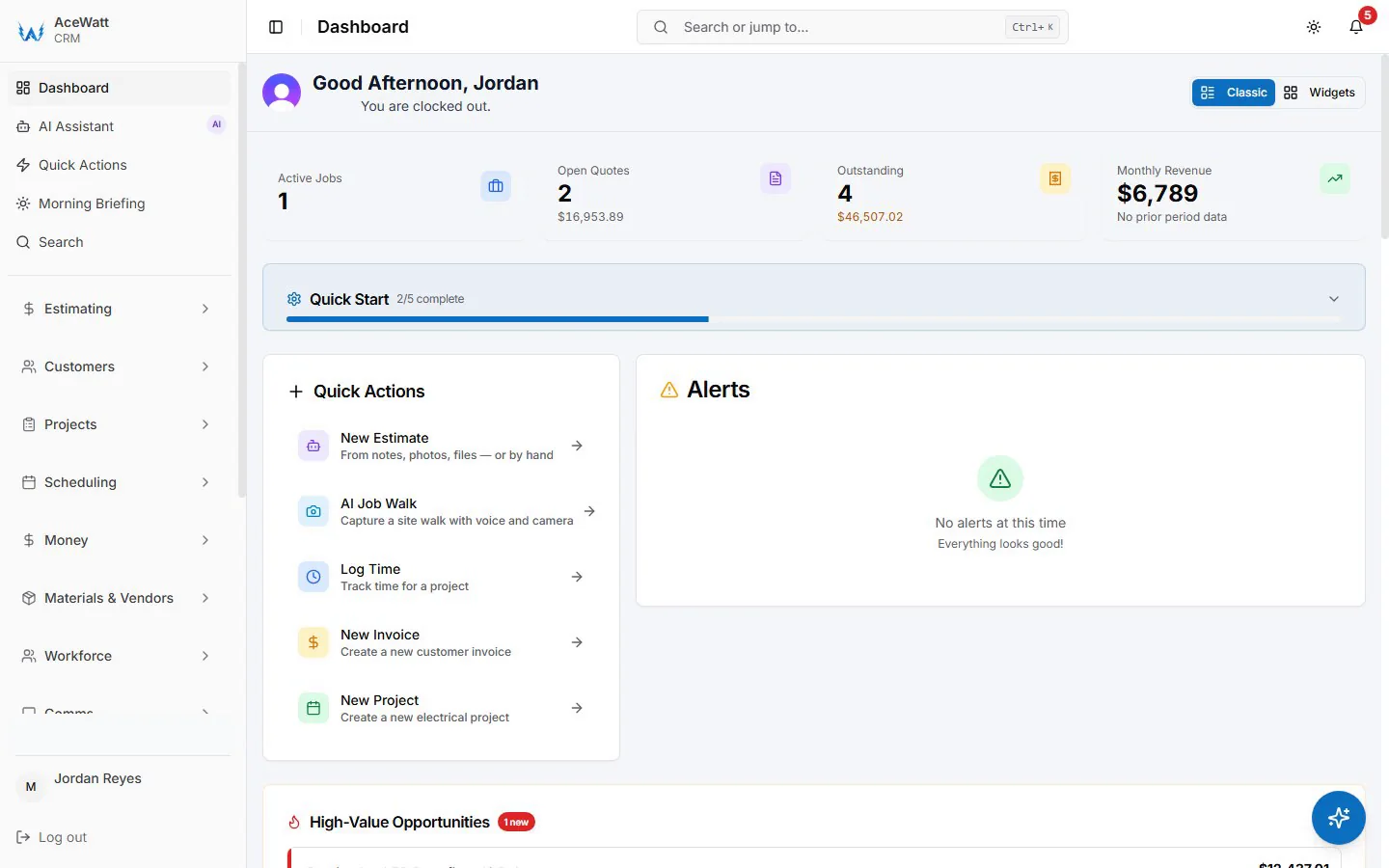
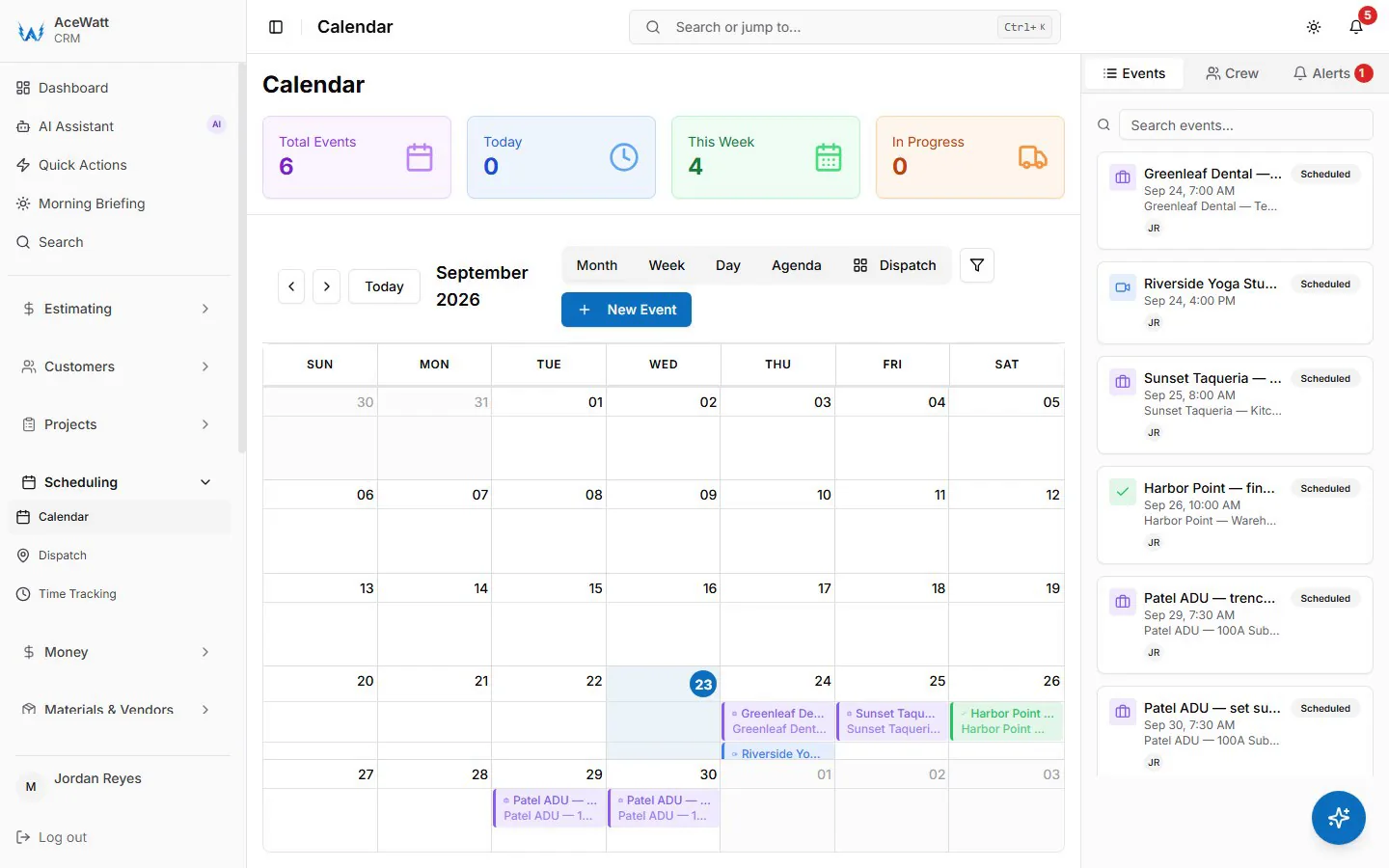
Tools like AI job walk voice capture, recurring maintenance billing, and QuickBooks sync move documentation from "remember to do it" to "cannot close the job without it." The goal is not more software; it is fewer end-of-month surprises.
Frequently Asked Questions
Will the data center boom slow down?
Goldman Sachs's projection runs through 2027, and reported project pipelines extend further than that. Lead times on large switchgear (12 to 18 months) and the capital deployed on announced campuses ($3B and up per project) suggest demand stays elevated through at least the next planning cycle. Small shops should plan for a tight labor market through 2027, not a quick return to pre-boom economics.
Should a small electrical shop chase data center work directly?
Most small shops should not. The bonding, safety program, workforce scale, and working-capital requirements put direct hyperscale contracts out of reach for 1-to-15 truck operators. The higher-use move is to ask your existing GC partners what spillover they are routing (panel upgrades, service calls, maintenance contracts, small tenant buildouts) and win that work on speed and reliability rather than scale. If you want to read the contract terms on a larger job before deciding, the pricing breakdown for AceWatt is a useful starting point for what software overhead looks like at higher volumes.
How do I keep techs when data centers pay more?
You cannot match hyperscale sign-on bonuses. You can offer steadier hours, less travel, more predictable schedules, a clearer path to journeyman or master electrician licensing, and a shop where the owner actually knows their name. Many techs who leave for a campus job leave for the money — and a good share come back for the lifestyle within a year or two. Build the shop they want to come back to.
Win the Work the Boom Leaves Behind
The data center boom is not your competition; it is your context. The GCs pulling crews onto campus work are the same GCs who need a reliable shop for residential upgrades, service calls, maintenance contracts, and small commercial buildouts in the neighborhoods around the new campus. Position your shop for the spillover: tighten your rate card, price change orders before the work, capture hours and materials the day the work happens, and stay close to the GC partners already routing you work.
If you want a starting point, run your next panel upgrade or service-call bid through the bid calculator and see how your current rate card compares to a 2026 market. If your electrical subcontractor software is still a spreadsheet, this is the cycle to upgrade. See the pricing options to find the plan that matches your shop size.
For a full view of the tooling that supports high-volume electrical work, see the AceWatt features hub.