

AI for Electrical Contractors: 7 Ways to Win More Bids in 2026
Why AI Is Reshaping Electrical Contracting in 2026 (and Why Most Bids Are Still Lost the Old Way)
Electrical contractors rarely lose work because someone wired it better. They lose it in three predictable places:
- The estimate comes too slow or lands wrong. A homeowner replacing a Federal Pacific Stab-Lok panel collects three to five quotes. The contractor who sends a clean, priced bid within 24 hours, not the one who spent three evenings on takeoffs, usually gets the job.
- Leads and follow-ups fall through the cracks. Missed calls while you're on a ladder, web form submissions buried in an inbox, and a referral written on the back of a fish tape packet: every one of those is a bid you never got to send.
- Admin drag delays the money. The rough-in passes inspection in March, the invoice finally goes out two weeks later, and the check clears sometime after that.
AI for electrical contractors in 2026 is not a robot bidding your jobs. It is a set of specific capabilities: transcription of recorded job walks, auto-generated estimate line items, scheduled follow-up sequences, and accounting sync that moves field data into the books. In every case, the electrician reviews and approves the output. Here are seven ways that plays out on real electrical work, whether you're a solo electrician or running four trucks.
Way 1: AI Estimating That Turns a Recorded Job Walk Into a Priced Bid in Hours
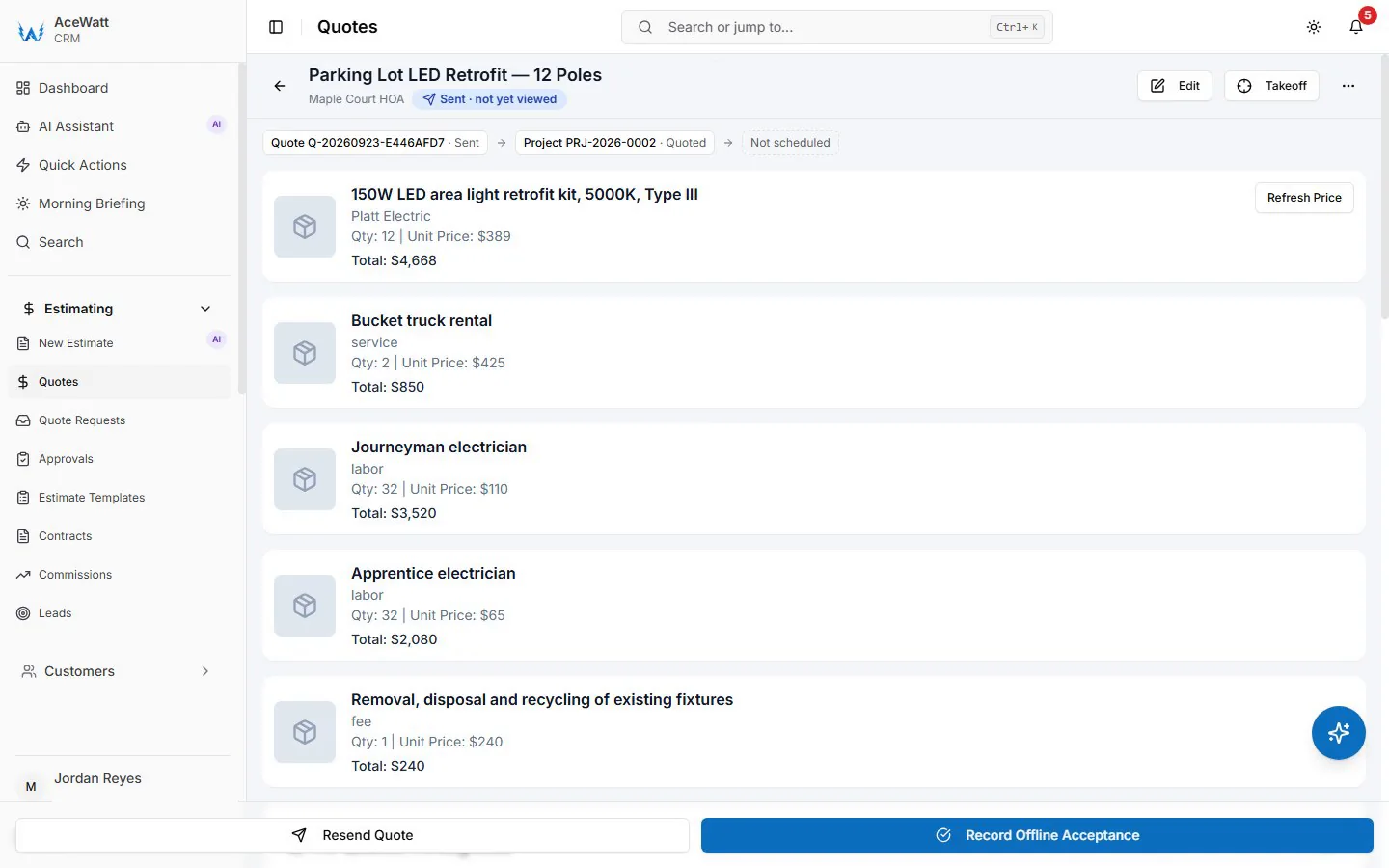
Record the job walk like you already do, talking through the scope the way you'd explain it to your supplier. AI Estimating transcribes the walk and converts it into material and labor line items, which is the takeoff work that used to eat your evenings. This is what modern electrical estimating software looks like in 2026: a transcript in, a reviewable bid out.
On a 100A-to-200A service upgrade, that means a draft estimate covering the 200A meter socket, 40-space main breaker loadcenter, 4/0 AWG aluminum service entrance cable, ground rods, permit fee, and labor hours for a two-person crew, with utility coordination time built in. On an EV charger install, the system drafts the branch circuit at 125% of the charger's nameplate rating per NEC 625 (a 48A EVSE needs a 60A, 240V circuit) and flags the NEC 220.83 load calculation question: does the existing service have capacity, or does this job become a load-management device or a panel upgrade? On whole-home rewires and commercial tenant fit-outs, device counts, fixture schedules, and branch circuits pulled from the transcript become a material list instead of a legal pad.
The bid still goes out under your license. The difference is that you're reviewing and adjusting line items for an hour, not building them from scratch at 10 p.m.
Way 2: An AI-Powered CRM That Stops Lost Leads From Missed Calls, Web Forms, and Paper Referrals
A missed call during a panel upgrade is not just a missed call. It's a $3,000 job calling the next contractor on Google. A CRM built for electricians, rather than a generic sales pipeline, closes that gap by capturing every channel (calls, texts, web forms, and referrals) into a single pipeline. Nothing lives on paper scraps or in a text thread you scroll through later.
For the solo electrician, this is what replaces an office manager: every inquiry logged, every conversation attached to the job record, and the "replace my Zinsco panel" lead flagged ahead of the "swap a light fixture" one. For the growing shop, it means the dispatcher sees the full board, meaning who's hot, who quoted, and who's waiting on a decision, instead of reconstructing it from three people's memory.
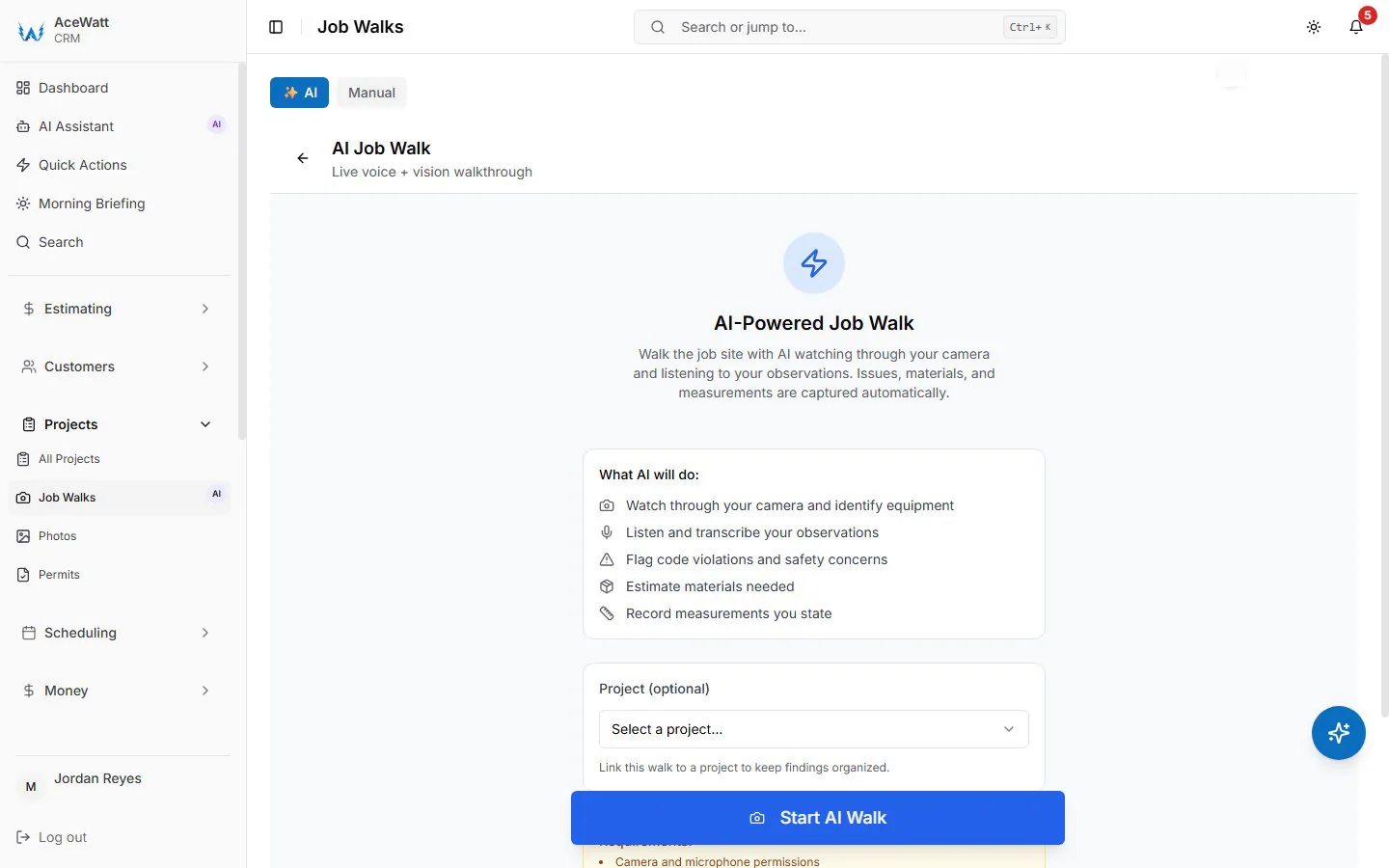
Way 3: AI Voice and Job Walk Documentation for Load Calcs, Panel Conditions, and Site Notes
The most valuable data on any electrical job is collected while both hands are busy. AI Voice documentation lets you talk through the site as you work, and the transcription lands directly on the job record:
- "100A Stab-Lok, 20 spaces, all filled, discoloration on two neutrals."
- "Cloth NM on the two kitchen circuits. Include replacement in the rewire scope."
- "Load calc per 220.83 comes in at 92 amps existing. The EVSE pushes it over on this service."
That's panel condition, available capacity, and scope risk documented in real time, not reconstructed in the truck afterward from a notepad you can't find. Because the notes live on the job record, they feed directly into the estimate and protect you when the customer disputes scope later.
Way 4: Follow-Up That Wins the Bid After the GC or Homeowner Goes Quiet
Follow-up is where electrical contractors quietly lose work they should have won, and the fastest responsive contractor wins in three specific moments:
- Homeowners collecting multiple quotes. If they're waiting on three bids for panel work and yours arrives first with a professional follow-up two days later, you're often the only name they remember.
- GC bid awards on commercial jobs. General contractors award when a question gets answered fast. A scheduled check-in around the award date keeps you in the conversation instead of buried under the GC's stack of bids.
- Change-order approvals. An unsigned change order delays the work and the payment. A same-day check-in keeps approvals moving.
Quote follow-up is yours to send; the automatic part comes later, when overdue invoices get email reminders at 1, 7, 14 and 30 days late. You handle the electrical work.
Way 5: Crew Scheduling and Dispatching That Puts the Right Electrician, Truck Stock, and Permit Packet on the Right Job
Scheduling software for electrical contractors fails when it treats every job as interchangeable. It isn't. A three-phase gear swap needs a journeyman who has done it; device trim-out doesn't. When you compare the best electrical software tools for scheduling and dispatch, skill-based assignment is the dividing line. Crew scheduling and dispatching assigns the right person, loads the truck with job-specific stock (that 40-space panel, the 2-pole breakers, the 12/2 NM-B) the first time, and puts the permit packet in the truck before rollout, with the inspection already requested.
For multi-truck shops, it's the difference between a dispatch board and a group text: an emergency no-power call gets slotted to the nearest crew, and the rewire that has been on the books for three weeks doesn't lose its day.
Way 6: Job Tracking, Invoicing, and Payment Tracking That Close the Gap From Rough-In to Cleared Check
Every electrical job has milestones: deposit, rough-in, rough-in inspection, trim-out, final inspection, and final invoice. Job tracking makes each one visible, and on a project billed by milestone (percentage of completion) you draft each milestone's invoice and send it the day the milestone is reached, not whenever someone gets back to the office.
Payment tracking matters just as much. You can see at a glance which jobs have unbilled change orders, which deposits are outstanding, and which invoices have gone overdue, in an aging report from 0–30 to 120+ days. That's the difference between managing cash flow and discovering it at tax time.
Way 7: One Job Record and QuickBooks-Ready Exports That Protect Your Margins
Ask any electrician what they hate about electrical contractor billing software and the answer is the same: typing the same invoice into two systems. With QuickBooks-ready exports, an invoice created in the field shows up on the invoice-list spreadsheet your bookkeeper works from — full sync is in development. A payment recorded once shows up once. Supply house tickets and labor hours flow into job costing on that record, so the actual margin on that $18,500 rewire (material, labor, permits, and all) is visible without a spreadsheet.
For small electrical contractors evaluating accounting software, the test is simple: does data entered in the field ever need to be typed again? If the answer is yes, margins leak a little every week. When job costs land on the job record without retyping, underpriced scopes surface on the next estimate instead of on the year-end P&L, and your CPA gets clean books instead of a shoebox reconciliation project.
How to Choose AI Electrical Contractor Software in 2026: A Checklist for Solo Electricians and Multi-Crew Shops
Whether you're a solo electrician replacing an office manager or a multi-crew shop replacing duct tape and group chats, evaluate any field service management software for electrical contractors against this list:
- Job walk transcription that captures panel conditions, load calculations, and scope notes hands-free
- Estimating built for electrical scopes (service upgrades, EVSE circuits, rewires, and fit-outs) with real material and labor line items, not generic templates
- A CRM that captures every channel: calls, texts, forms, and referrals in one pipeline
- Automated follow-up for quote follow-ups, GC bid awards, and change-order approvals
- Scheduling and dispatching that assigns by skill and stage, with truck stock and permit packets attached
- Milestone-based invoicing with deposits, retainage, and payment status per job
- QuickBooks data flow: line-level exports your bookkeeper can trust, or true two-way sync if the tool actually has it (confirm which before you buy)
- Human approval on every output: the AI drafts, and you, the license holder, decide
The goal isn't software adoption. It's winning the bids you're already qualified to win and getting paid faster for the work you've already done. If you want to see what that looks like on a real job, watch a recorded panel-upgrade job walk turn into a priced, reviewable bid, with AI estimating and the CRM working start to finish. The AI Job Walk Documentation walkthrough shows that capture-to-quote flow on a finished-basement service call.