
_Last updated: July 2026._
Quick answer: An AI answering service for electricians answers inbound calls 24/7, captures job details, qualifies urgency, books appointments, and sends call notes to your calendar or CRM. The best answering service for electricians depends on call volume, emergency escalation needs, pricing model, and whether the tool passes clean lead data into your electrical CRM.
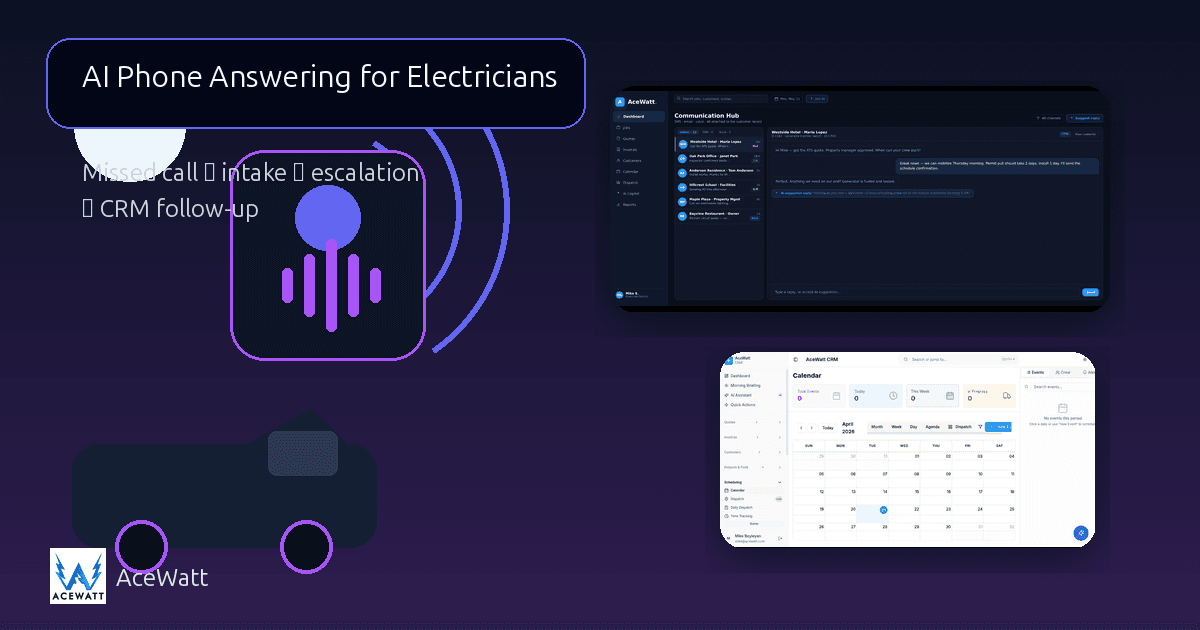
An AI phone answering service for electricians answers inbound calls when the crew is busy, captures job details, identifies urgency, books or requests appointments, and sends a summary to the office or CRM. The strongest setup does not stop at answering the phone. It connects the call to the rest of the electrical job workflow.
Why Electricians Miss Revenue From Missed Calls
Electrical contractors miss calls for practical reasons. You might be driving, working in a panel, standing in an attic, speaking with an inspector, or helping a customer on site. Answering the phone in those moments can be unsafe or impossible.
The problem is that many electrical buyers call more than one contractor. If the first shop does not answer, the caller often moves to the next result. That is especially true for urgent troubleshooting, panel issues, EV charger requests, generator work, and same-week service needs.
An AI answering service for electricians helps only if it does three things:
- Captures the caller's information accurately.
- Routes urgent work to the right human path.
- Creates a next action in the CRM, calendar, or dispatch workflow.
If a call summary sits in a separate portal and nobody follows up, the lead is still leaking.
What an AI Answering Service for Electricians Should Do
A useful electrician answering service should handle the first layer of intake without pretending to be a licensed electrical expert.
| Capability | Why electricians need it | Safety / truth note |
|---|---|---|
| 24/7 or after-hours answering | Calls come during jobs, driving, evenings, and weekends | Do not advertise emergency coverage unless your shop can respond. |
| Service-type intake | Panel, EV charger, outlet, lighting, generator, commercial, troubleshooting | Intake is not diagnosis. |
| Urgency triage | Burning smell, sparks, outage, water near equipment, exposed conductors | Escalate; do not solve by script. |
| Customer details | Name, phone, address, service area, preferred time, photos if supported | Follow privacy and consent rules. |
| Appointment booking | Saves back-and-forth for routine service calls | Confirm calendar rules and service-area limits. |
| Call summaries | Gives office and field teams context | Summaries should be reviewed before quoting. |
| CRM/calendar handoff | Keeps lead from living in a separate tool | Verify integration or export method before buying. |
| Spam filtering | Saves time on non-service calls | Still allow urgent human override paths. |
This is why an AI answering service for electricians should be evaluated as part of the full lead workflow, not as a standalone novelty.
AI Answering Service Options for Electricians to Compare
The market changes quickly. Treat this table as a buying checklist, not a permanent ranking. Verify current features and pricing directly with each vendor before relying on anything below.
| Service | Best fit | Trade-specific page? | 24/7 + emergency triage | CRM/calendar handoff | Public pricing | What buyers should confirm |
|---|---|---|---|---|---|---|
| Allo | Trade/electrician AI answering | Yes (electrician page) | Marketed as 24/7; triage rules to confirm | Verify webhook, CRM, calendar exports | Verify current vendor page | Confirm electrical emergency escalation script and integrations. |
| Dialzara | Small-business AI receptionist | Marketing references electricians | 24/7 marketed; emergency handling to confirm | Verify trade-specific scripts and CRM handoff | Verify current vendor page | Confirm electrician script setup and CRM/calendar push. |
| Trillet AI | AI answering with electrician-focused page | Yes (electrician page) | 24/7 marketed; triage rules to confirm | Verify CRM/calendar integration | Verify current vendor page | Confirm actual electrical scripts vs generic templates. |
| DaVoice AI | 24/7 electrician answering positioning | Yes (electrician page) | 24/7 marketed; emergency rules to confirm | Verify CRM/calendar handoff method | Verify current vendor page | Confirm canonical page and live product scope. |
| My AI Front Desk | AI front desk / answering for SMBs | Marketing references electricians | 24/7 marketed; triage rules to confirm | Verify CRM/calendar handoff method | Verify current vendor page | Confirm electrician script library and call routing. |
| UpFirst | AI receptionist for contractors | Trade-focused positioning | 24/7 marketed; emergency rules to confirm | Verify CRM/calendar handoff | Verify current vendor page | Confirm electrician fit vs general home-service framing. |
| Phonely | AI phone answering with trade pages | Marketing references electricians | 24/7 marketed; triage rules to confirm | Verify CRM/calendar push | Verify current vendor page | Confirm electrician-specific call flows. |
| AceWatt | Electrical CRM and job workflow after intake | Not an answering service, AI CRM companion | Not a phone-answering product | Native CRM, job walks, estimates, schedule, invoices | Transparent on pricing | Pair with an answering service for inbound calls; confirm the vendor's handoff into AceWatt. |
Disclosure: This is an AceWatt editorial comparison. AceWatt is an AI-powered CRM for electrical contractors, not a standalone phone answering company. Vendor pages, pricing, integrations, and emergency-triage capabilities change often, verify each row on the vendor site before relying on it. If you buy a third-party answering service, confirm exactly how call data reaches AceWatt or your chosen CRM before assuming automatic handoff.
Call Scripts and Qualification Questions
A good answering flow asks practical questions without diagnosing electrical work.
Residential service call
- What is your name, phone number, and service address?
- What issue are you seeing?
- When did it start?
- Is power out in one area or the whole property?
- Are there sparks, smoke, burning smells, water near equipment, or exposed wires?
- Can you safely send photos if requested?
- What times work for a licensed electrician to call or visit?
Panel upgrade request
- What prompted the panel upgrade request?
- Do you know the current panel size?
- Are you adding EV charging, HVAC, generator, solar, or new circuits?
- Is this residential, commercial, or multi-unit?
- Are there timeline, permit, inspection, or utility coordination constraints?
EV charger install
- What vehicle and charger type are you planning for?
- Where will the charger be installed?
- Rough distance from panel to parking location?
- Any photos of the panel and parking area?
- Is this a home, condo, rental, commercial site, or HOA property?
Emergency or urgent call
The AI should recognize potentially dangerous symptoms and escalate to a human path. It should not tell the caller that the situation is safe. The safest language is conservative: if there are sparks, smoke, burning smells, water near electrical equipment, exposed conductors, or fire risk, stop using the affected area and contact emergency services or a qualified electrician as appropriate.
Safety, Disclosure, and Compliance Guardrails
AI answering can help with intake. It should not replace professional judgment.
Key guardrails:
- AI should not diagnose electrical hazards.
- Emergency claims require real emergency response capacity.
- Call recording and transcription may trigger consent rules depending on state and local law.
- Any automation that sends SMS or callbacks should be reviewed for consent and opt-out handling. USA.gov's telemarketer and scam call complaint page points readers toward the relevant public agency channels for call/text issues.
- Marketing copy should avoid exaggerated AI claims. Use conservative language and verify claims through qualified legal/compliance review before publishing campaigns.
- A licensed electrician or qualified contractor reviews scope, code/compliance issues, safety decisions, and pricing before work is approved.
Pricing Questions to Ask Before Buying an AI Answering Service
Do not compare an AI answering service for electricians by headline price alone. Ask:
- Is pricing per call, per minute, per appointment, per user, or flat monthly?
- Are after-hours calls included?
- Is booking included, or only message capture?
- Are emergency escalations included?
- Are call recordings and transcripts included?
- Does the service export to your CRM, calendar, email, SMS, or webhook?
- Is setup billed separately?
- Are there call-volume overages?
- Can you test calls before launch?
- How does the AI disclose itself to callers?
AceWatt's own pricing page is transparent for the CRM side of the workflow. For third-party answering vendors, verify current pricing directly.
Why Answering Alone Is Not Enough
A booked call is only step one. The lead still needs a job record, scheduled appointment, job-walk notes, quote, follow-up, invoice, and customer history.
That is where AceWatt fits:
- Use CRM for electricians to keep lead and customer history together.
- Use electrical contractor software and electrician job management software to handle the full job lifecycle once a call is captured.
- Pair with field service software for electricians when crews and dispatch need to run from one place.
- Use scheduling to move the lead to a real appointment.
- Use AI job walk and voice documentation to capture field details.
- Use automated estimating to organize scope for contractor review.
- Use invoicing to close the loop after work is completed.
- Use the electrician lead generation guide to improve the channel before the call arrives.
- Read the voice AI for electrical contractors, AI CRM for contractors, best electrician apps, electrician job management software, and best field service software for electricians 2026 guides for adjacent context.
In practice, the right answering service for electricians is the one that hands clean, actionable lead data into the CRM without manual re-entry. Answering solves availability. CRM solves continuity. Electrical contractors usually need both.
If you want the full picture of what happens after the call is captured, the AI agent for electricians guide walks the whole lifecycle: intake, job-walk documentation, estimate drafting, follow-up, and invoicing.
When an AI Answering Service for Electricians Is a Good Fit
AI answering is worth testing when:
- You miss calls while working in the field.
- You get after-hours calls but cannot hire a receptionist.
- Your team forgets to call leads back.
- You need better intake details before dispatch.
- Your service area and job types are clear enough for scripts.
- You have a CRM or calendar workflow ready for the handoff.
It may be a poor fit when:
- Your jobs require complex consultative sales before scheduling.
- Your service area changes frequently.
- You cannot respond to urgent escalations.
- You do not have consent, privacy, or call-recording policies ready.
- The vendor cannot show how data reaches your CRM or calendar.
Frequently Asked Questions
What is the best AI answering service for electricians?
The best AI answering service for electricians depends on call volume, service area, urgency rules, booking needs, pricing model, and CRM handoff. Compare electrician-specific services, test real calls, and verify integrations before relying on a vendor.
Can AI answer emergency electrical calls?
AI can identify urgent symptoms and escalate to a human path, but it should not diagnose hazards or promise response unless the contractor has real emergency capacity. Electrical emergencies require qualified human judgment.
How much does an AI answering service cost for electricians?
Pricing for an AI answering service for electricians varies by vendor and model: per minute, per call, per appointment, flat subscription, setup fee, or custom package. Verify current pricing directly with the vendor and compare total cost to call volume and booked-job value.
Is an AI receptionist better than a human receptionist?
AI may provide 24/7 coverage with a different cost structure than staffing, while humans handle nuance, relationship-building, and complex judgment better. Compare total cost, call volume, setup, overages, and escalation coverage before choosing.
Does AceWatt answer inbound phone calls?
Not with AI. AceWatt has a phone menu (Voice Receptionist) that routes callers and, after hours, tells them a team member will call back and alerts your staff; it does not answer, qualify, or book calls with AI. Use AceWatt to manage the job lifecycle after a call is captured, and confirm how any third-party answering service passes call data into AceWatt before buying.
Do callers need to know they are speaking with AI?
Disclosure, call recording, and consent obligations depend on jurisdiction and workflow. Ask vendors how they handle AI disclosure, recording consent, transcript storage, SMS consent, and opt-out handling. Consult qualified legal counsel for your business rules.
Sources and Verification Notes
- Vendor pages referenced: Allo, Dialzara, Trillet AI, DaVoice AI, My AI Front Desk, UpFirst, and Phonely. Verify live pricing, electrician-specific call flows, and CRM/calendar handoff directly on each vendor site before committing.
- U.S. Bureau of Labor Statistics, Electricians, Occupational Outlook Handbook, for context on electrician demand and job intake volume.
- FTC business guidance on truthful AI claims and disclosure: review the FTC's Business Guidance on AI before publishing marketing language about AI receptionists.
- FCC/TCPA consent and robocall expectations: see USA.gov's telemarketer and scam call complaint page for the relevant public agency channels and consult qualified counsel.
- National Electrical Contractors Association (NECA), Electrical Safety Resources, industry guidance on electrical safety practices relevant to call-triage and emergency-escalation language.
- NFPA 70 (National Electrical Code), maintained by the National Fire Protection Association, the code baseline for licensed-electrician scope; AI intake scripts should defer to code-compliant contractor review.
- AceWatt product context: pricing, CRM for electricians, AI job walk.
Treat every row in the comparison table as "verify on vendor site." This article is an AceWatt editorial comparison and is not an independent product review. When choosing an AI answering service for electricians, test real calls, verify CRM handoff, and confirm emergency escalation rules before committing.
Related reading: AI Answering Service for Electricians: Never Miss a Lead.