
AI Agents for Electricians: What They Can Actually Do for Your Business
Quick answer: An AI agent is software that automates the full electrical job lifecycle: answering calls 24/7, documenting job walks by voice, generating estimates from your templates, following up with leads, coordinating dispatch, and tracking invoices. It handles the paperwork while you're on the ladder, so you stop losing leads to missed calls and slow follow-ups.
An AI agent for electricians is software that answers calls, documents job walks, drafts estimates, and chases invoices, all without you babysitting each step. For a closer look at the note-capture lane specifically, see AI tools that auto-update CRM notes. You're on a ladder pulling wire when your phone buzzes. It's a new lead, someone who found you on Google and wants a quote for a panel upgrade. You can't answer. By the time you climb down and call back an hour later, they've already booked someone else.
That missed call probably cost you $1,500.
Now multiply that across a week. Five missed calls. Three estimate requests you never followed up on. Two invoices that are 30 days past due because nobody remembered to send a reminder. This is the daily reality for thousands of electrical contractors running lean crews and wearing every hat themselves. According to U.S. Bureau of Labor Statistics data on electrician employment, the vast majority of electrical businesses are small shops where the owner is also the estimator, dispatcher, and bookkeeper, which is exactly the workload profile an AI agent is built to absorb.
An AI agent for electricians is designed to close those gaps, not by replacing you but by handling the work that pulls you away from the work that actually pays.
In this guide, we'll break down what AI agents can actually do for electrical contractors, where the technology draws the line, and how to evaluate an AI agent for electricians on the market right now.
What is an AI agent for electricians?
An AI agent for electricians is software that uses artificial intelligence to handle day-to-day business tasks (answering calls, documenting job walks, generating estimates, scheduling follow-ups, dispatching crews, and tracking invoices) without requiring constant human input at every step.
Unlike a basic tool that does one thing (like an online form or a calendar app), an AI agent operates across multiple stages of your workflow. It can take a customer call, pull the details into a job record, trigger an estimate, and schedule a follow-up, all before you even unlock your truck in the morning.
The key word is agent. It doesn't just respond to commands. It takes initiative based on rules you set. If a lead comes in after hours, the agent answers, qualifies the job, and books a time on your calendar. If an invoice hits 14 days unpaid, the agent sends a polite reminder. If a crew member finishes a job early, the agent suggests the next available dispatch slot.
For electrical contractors, this matters because most shops don't have a dedicated office manager, dispatcher, or estimator. You're doing all of it between jobs, at night, or on weekends. An AI agent for electricians absorbs that overhead so you can focus on the work that requires your license and your expertise.
AI agent vs AI chatbot vs AI answering service
These terms get thrown around interchangeably, but they're very different tools. Here's how they stack up:
AI chatbot: A text-based assistant that lives on your website. It can answer FAQs ("Do you do EV charger installs?") and maybe collect a name and phone number. That's about it. It doesn't make calls, generate estimates, or follow up with leads.
AI answering service: Answers phone calls using AI voice or text. Can take messages, route calls, or answer basic questions. Some can book appointments. But it stops at the front door. It doesn't follow the job through estimating, dispatch, or invoicing. We cover this distinction in more depth in our guide to AI answering service for electricians. For phone-first routing and qualification, compare AI phone agent tools for electricians.
AI agent: Operates across the full job lifecycle. Answers the call, qualifies the lead, creates the job record, helps with the estimate, schedules the follow-up, dispatches the crew, and tracks the invoice. It's not a single-function tool. It's a connected system that moves work forward on its own.
If you're looking at AI tools and they only handle one stage of your workflow, that's not an agent. That's a feature.
| Capability | What It Does | Best For |
|---|---|---|
| AI call answering | Picks up every call 24/7, qualifies the lead, and books the job on your calendar | Contractors losing jobs to missed calls |
| Voice job walk docs | Turns your spoken observations into structured, searchable notes attached to the job record | Electricians who spend 30+ min retyping site notes |
| Estimating & quotes | Builds draft estimates from your pricing templates and job walk data for you to review and approve | Shops doing 5 to 10 estimates a week |
| Follow-up automation | Sends timed texts and emails so estimates don't quietly die in a customer's inbox | Solo operators with no time to chase leads |
| Dispatch coordination | Matches the right tech to the right job based on location, qualifications, and availability | Multi-crew operations juggling 2+ trucks |
| Invoicing & payment tracking | Generates invoices from the job record and fires reminders when payments are past due | Contractors with cash-flow gaps from late payers |
6 ways AI agents help electrical contractors
Here are the actual capabilities available today. These aren't hypothetical; they're functions that an AI agent for electricians can perform to move work forward in your business without you babysitting each step.
1. AI call answering and lead qualification
When a potential customer calls, the AI agent picks up immediately, even at 9 PM on a Saturday. It greets the caller by name (if it can pull from caller ID or your CRM), asks what kind of work they need, and collects the essential details: service type, address, urgency, and preferred timeframes.
More importantly, it qualifies the lead. Is this a residential panel upgrade or a commercial buildout? Is it within your service area? Does the timeline match your availability? The agent filters out the jobs that don't fit and prioritizes the ones that do.
For electrical contractors who lose leads to missed calls, this alone can be meaningful. The lead information flows directly into your CRM for electricians, so when you check your phone at the end of the day, you see a clean list of qualified opportunities instead of a pile of voicemails you need to transcribe.
If you are evaluating voice-first call handling separately, see AI voice agent tools for electricians.
2. AI job walk documentation (voice to structured notes)
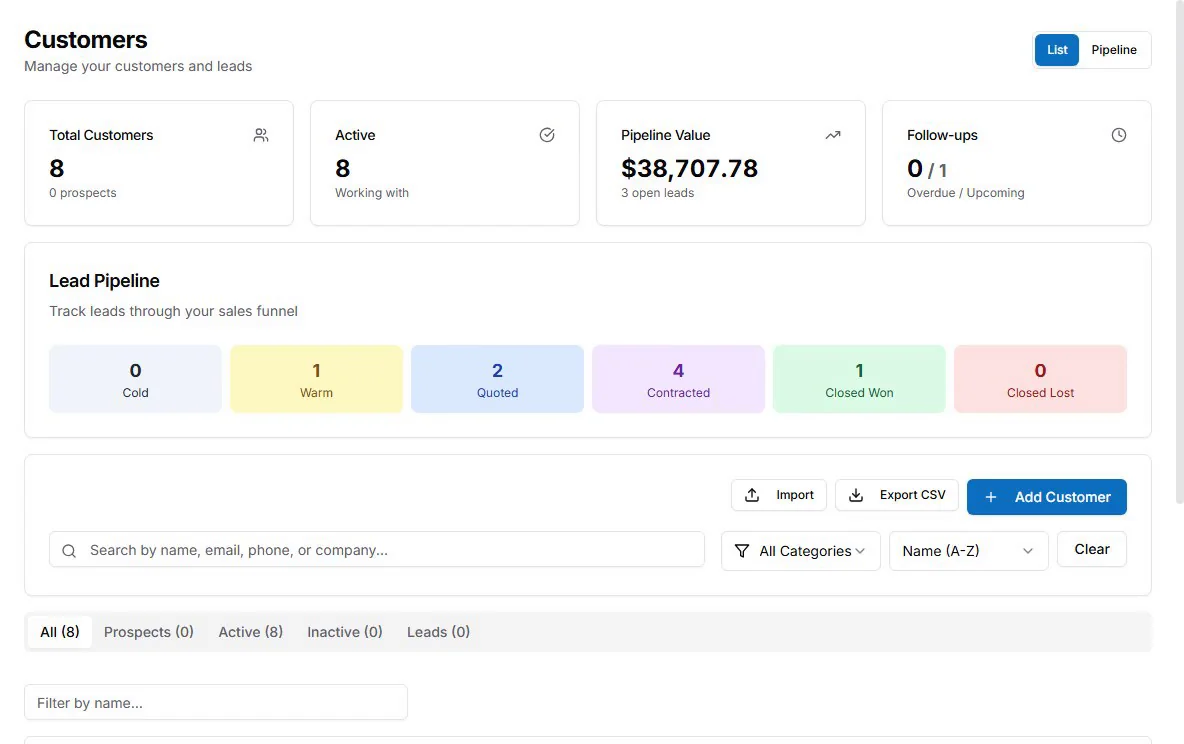
When you arrive on site for a job walk, an AI agent for electricians captures what you say out loud (panel type, conductor condition, GFCI locations, scope of work) and turns it into structured notes attached to the job record. This replaces the spiral notebook + clipboard workflow that slows down electrical contractors and loses details by the time you're back at the truck.
Job walks are one of the most time-consuming parts of an electrician's day. You walk the site, take photos, jot notes, and then spend 30-45 minutes back at the truck typing everything into a report or estimate.
An AI agent with voice documentation changes that workflow. You speak your observations out loud as you walk the site ("200-amp panel, Square D, looks like it's from the mid-90s, no obvious damage, Romex throughout, going to need a new feeder to the detached garage") and the AI converts that into structured, organized notes in real time.
The output isn't a raw transcript. It's a formatted job walk summary with categorized sections: panel info, wiring observations, scope notes, and recommended next steps. You can attach photos directly to each section. When it's time to build the estimate, you're not reconstructing your observations from memory or scribbled notes. You have a clean, searchable record ready to go.
Our AI job walk documentation feature is built specifically for this use case, because we've heard the same complaint from hundreds of electricians: "I spend as much time on paperwork as I do pulling wire."
3. AI estimating and quote generation
Estimating is where a lot of electrical contractors lose time and money. You're either building quotes from scratch every time, copying from old spreadsheets, or guessing and hoping you didn't underprice the job.
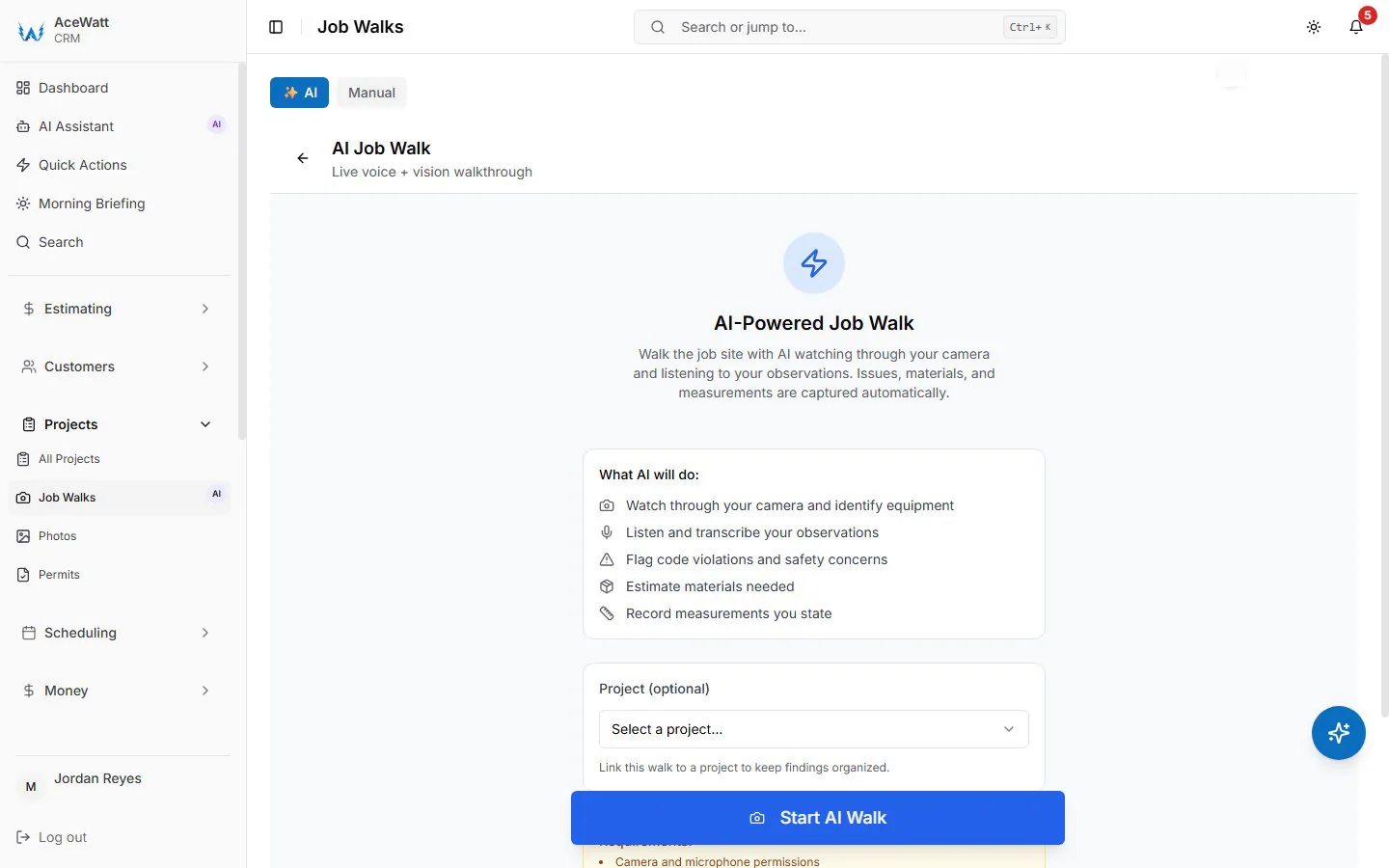
An AI agent can speed this up significantly. Based on the job walk notes and the service type, the agent can suggest line items, pull from your saved pricing templates, and generate a formatted estimate ready for customer review. You set the labor rates, material markups, and service categories. The AI does the assembly.
This isn't the AI making pricing decisions for you. You review and approve every estimate before it goes out. But instead of spending 40 minutes building a quote from scratch, you're reviewing and tweaking a draft that's already 80% done. That's the value of automated estimating: it handles the assembly, you handle the judgment.
For contractors doing five to ten estimates a week, those savings add up fast: time you can spend on billable work instead of administrative tasks.
4. AI follow-up and scheduling
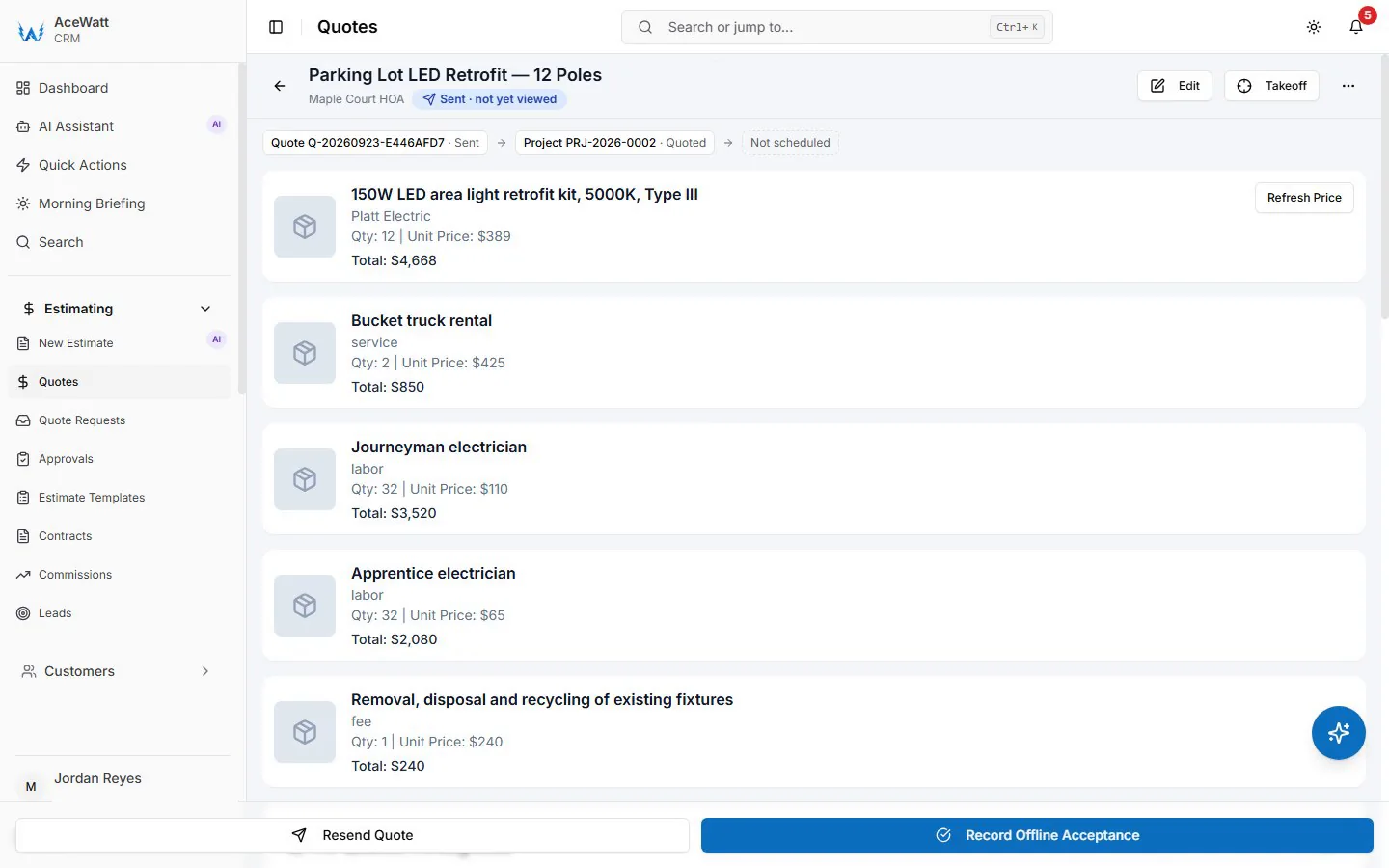
An AI agent for electricians keeps leads warm by following up automatically based on rules you set (text, email, or both) so the estimate you sent at 9 AM doesn't quietly die in someone's inbox three days later.
Here's a number that surprises most electricians: research cited by the Lead Response Management study shows that 78% of customers buy from the first company that responds, and leads contacted within the first hour are 7x more likely to qualify compared with slower follow-up. But when you're on a job site with your hands full, that first-hour window closes fast.
An AI agent handles follow-up automatically. When a lead comes in, the agent sends a confirmation text or email within minutes. After an estimate is sent, the agent follows up at the interval you choose (one day, three days, one week) to check if the customer has questions or is ready to book. For a broader playbook on keeping your pipeline full, see our guide to electrician lead generation strategies.
The scheduling piece works the same way. When a customer says yes, the agent checks your calendar, proposes available time slots, and confirms the appointment. If a job runs long and you need to push the afternoon appointment, the agent contacts the customer and reschedules without you having to stop what you're doing.
This is one of the areas where an AI agent clearly outperforms a basic chatbot or answering service. Those tools can take a message, but they can't manage the ongoing relationship with the customer from first contact to scheduled job.
5. AI dispatch and crew coordination
For electrical contractors with a crew, an AI agent for electricians can handle dispatch suggestions, matching the right tech with the right job (factoring in location, qualifications, and schedule) instead of a dispatcher manually building a row of assignments.
If you run a crew, or multiple crews, dispatch is a daily puzzle. Who's available? Which job is closest? Does anyone have the right certifications for a commercial panel job?
An AI agent can help coordinate dispatch by tracking crew availability, job locations, and skill requirements in real time. When a new job is confirmed, the agent can suggest the best crew assignment based on who's finishing up nearby and what their qualifications are.
For multi-crew operations, the agent can also handle the communication side: sending crew members their daily schedule, notifying them of changes, and collecting job-completion confirmations. Instead of calling three electricians to figure out who can take a last-minute job, the agent already knows and handles the outreach for you.
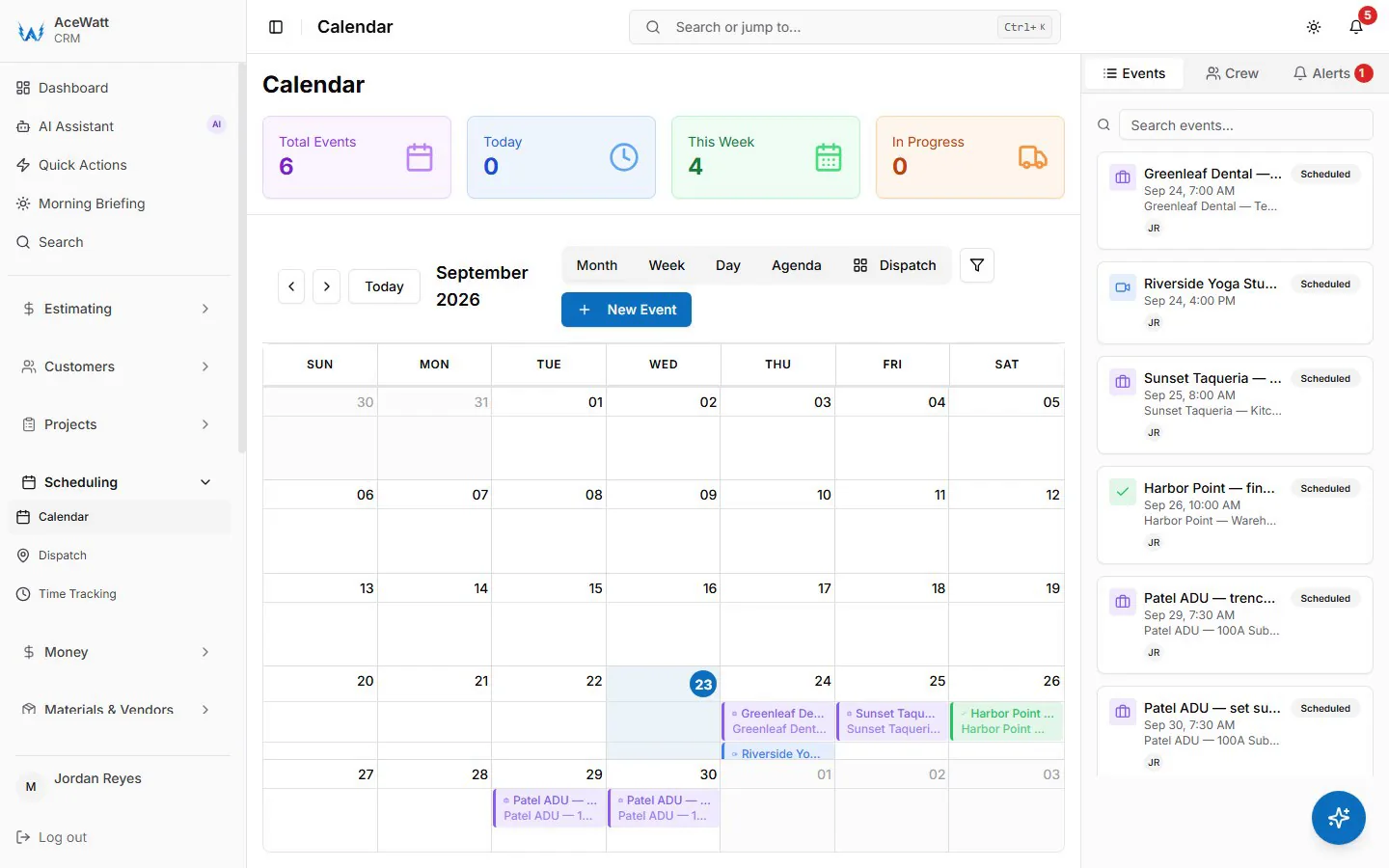
This kind of coordination is especially valuable for contractors who are growing beyond a one-truck operation and feeling the growing pains of managing a team while still working in the field. For more on how AI fits into crew coordination, see our guide to AI dispatch software for electricians.
6. AI invoicing and payment tracking
Invoicing is where a lot of electrical contractors lose cash flow: the work is done, the estimate matched the scope, but the invoice never goes out or the reminder never fires. An AI agent for electricians generates the invoice from the job record and tracks payment status so you don't have to remember.
The job is done, but the work isn't finished. Now you need to create an invoice, send it, and then hope the customer pays on time. For many electrical contractors, chasing payments is one of the biggest and most frustrating time sinks in the business.
An AI agent with built-in invoicing capabilities can generate invoices based on the completed job record, send them to the customer, and track payment status automatically. When an invoice is approaching its due date, the agent sends a reminder. When it's past due, it escalates the follow-up based on rules you define.
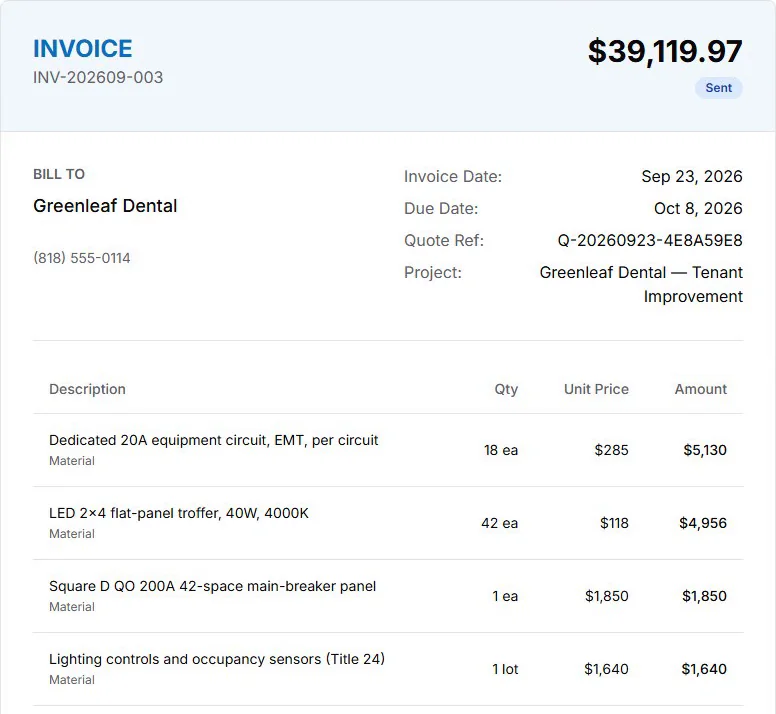
The result is a more consistent invoicing process with less manual effort. You're not forgetting to send invoices, you're not letting payments slip to 60 or 90 days past due, and you're spending your evenings with your family instead of chasing checks. If you're comparing dedicated invoicing tools, our breakdown of the best electrician invoicing apps covers what to look for.
For contractors exploring AI tools for electricians more broadly, invoicing automation is often the feature that delivers the most immediate, tangible return.
Most "AI agents" only answer phones. Here's what's missing.
Here's the uncomfortable truth about most AI tools marketed to electrical contractors: they're answering services with better branding. A real AI agent for electricians covers the full lifecycle (call, job walk, estimate, follow-up, dispatch, invoice), not just the first ring.
You've seen the ads. "AI receptionist for your electrical business!" "Never miss a call again!" These products do one thing, answer phone calls, and they do it reasonably well. But if you sign up expecting an agent that handles your entire workflow, you're going to be disappointed.
What's missing from phone-only AI tools:
- Job walk documentation. They can't follow you on site and turn your voice notes into structured records.
- Estimating. They don't generate quotes, apply your pricing, or build line-item estimates.
- Follow-up sequences. They take the call, but they don't nurture the lead over the following days and weeks.
- Dispatch coordination. They don't know where your crews are or who's available.
- Invoicing and payment tracking. The call ends, and so does their involvement in the job.
- CRM integration. Many don't connect to a real CRM, so your data lives in their silo instead of in a system you control.
This is the distinction that matters. An answering service is a point solution. An AI agent is a workflow solution. If you're evaluating tools for your electrical business, ask yourself: do I need someone to answer the phone, or do I need a system that carries the job from the first call all the way to a paid invoice?
If it's the latter (and for most contractors, it is), then you need more than a phone bot. We cover the broader technology picture in our guide to AI for electrical contractors.
How to evaluate AI agent software for your electrical business
Not all AI agents are created equal, and the marketing can be misleading. The right AI agent for electricians covers the full job lifecycle, not just the call-answering front end. The National Electrical Contractors Association notes that shops adopting integrated software report faster quote turnaround and fewer lost leads than those stitching together single-function tools, which is exactly the gap between a real agent and a phone bot. Here's a practical framework for cutting through the noise and finding a tool that actually helps your business.
Must-have features checklist
Before you sign up for any AI agent platform, make sure it can do the following:
- Answer calls and qualify leads 24/7. If it can't answer a call at 10 PM on a Friday, it's not an agent. It's office-hours software.
- Integrate with a real CRM. Your customer data, job history, and estimates should live in one connected system, not scattered across three apps.
- Support voice-to-text documentation. You should be able to speak notes in the field and have them appear as structured records in your system.
- Generate estimates from job data. Not from scratch. The AI should use your templates, pricing, and job walk notes to build a draft estimate.
- Automate follow-up communications. Text, email, or both: the agent should handle ongoing outreach without you having to trigger it manually.
- Track invoices and send reminders. Invoicing should be connected to the job record, and payment follow-up should be automatic.
- Work on mobile. You're not at a desk. The platform needs to work as well from your phone as from a laptop.
- Be configurable. You should control the scripts, pricing, follow-up timing, and escalation rules, not the AI vendor.
Red flags in AI agent marketing claims
Be skeptical of any AI agent platform that makes these claims:
- "Replaces your office staff." AI can automate tasks, but it doesn't replace human judgment, relationship-building, or the ability to handle edge cases that don't fit a script.
- "Guaranteed ROI in 30 days." No legitimate vendor can guarantee a financial return because it depends on your call volume, close rate, pricing, and how consistently you use the tool.
- "Handles code compliance." AI cannot verify that your work meets NEC, local, or state code requirements. That requires a licensed electrician.
- "No setup required." Any AI agent worth using needs to be configured with your business information, pricing, service area, and workflows. "No setup" usually means "no customization."
- "Used by 10,000+ contractors." Vague social proof without names, case studies, or verifiable reviews is a marketing invention. Look for specific testimonials from real electrical businesses.
The best AI agent platforms are honest about what they can and can't do. They show you the product, let you try it, and set clear expectations. If the marketing feels like it's overpromising, the product probably is too.
What AI agents can't do (yet)
This guide wouldn't be honest if we only talked about capabilities. AI agents are powerful tools, but they have real limitations, and any vendor who tells you otherwise isn't being straight with you. A legitimate AI agent for electricians is explicit about these boundaries.
AI cannot perform licensed electrical work. It can't pull wire, test circuits, or install a panel. It can't inspect existing work or certify that an installation meets code. These tasks require a licensed electrician with training, experience, and legal authority. Nothing in this guide suggests otherwise.
AI cannot pull permits. Permit applications often require contractor license numbers, signature authority, and sometimes in-person submissions. AI can help you prepare documentation, but the permit process itself is your responsibility.
AI cannot guarantee code compliance. It can reference NEC articles and common code requirements, but it cannot verify that your specific installation in your specific jurisdiction meets every applicable code. The NFPA publishes the National Electrical Code (NEC), but local amendments, inspector interpretations, and field conditions all require professional judgment.
AI cannot replace your professional judgment on pricing. It can assemble estimates from your templates and historical data, but every job has unique conditions (access issues, material availability, unexpected code requirements) that affect pricing. You should always review and adjust estimates before sending them to customers.
AI cannot build relationships with your customers the way you can. It can send polite, professional communications, but it doesn't replace the trust that comes from face-to-face interaction, honest conversations about scope, and the personal accountability of a local contractor.
The goal of an AI agent isn't to replace you. It's to handle the administrative overhead that takes you away from the work that only you can do.
AceWatt's AI agent for electricians
AceWatt is built specifically for electrical contractors, not plumbers, not HVAC companies, not general contractors. That focus means every feature is designed around the way electricians actually work. The AI agent for electricians built into AceWatt operates as a copilot across your entire job lifecycle, from the first customer call to the final payment (see the AI copilot feature page for the current workflow). Here's what that looks like in practice.
AI Copilot workflow
Incoming call or lead. A customer fills out a web form, books online, or calls. AceWatt's phone menu routes the call and, after hours, tells the caller a team member will call back and alerts your staff; the lead lands in your AI CRM for contractors for you to qualify.
Job walk. You arrive on site, open AceWatt on your phone, and start talking. The AI captures your observations (panel type, wiring condition, scope of work) and organizes them into structured notes. You snap photos and attach them to the record. The job walk that used to take 90 minutes of combined walking and typing now takes 20 minutes of walking and talking.
Estimating. Back at the truck (or that evening), you open the job record and generate an estimate. The AI agent pulls from your pricing templates, suggests line items based on the job walk notes, and builds a formatted quote. You review it, make adjustments, and send it to the customer with one tap.
Follow-up. The customer reviews and e-signs the quote from a portal link. Once they accept, AceWatt emails the invoice with a pay link automatically: a deposit invoice when the quote asks for one (the balance invoice follows once the deposit is paid), otherwise the full invoice with the quote's line items, so nothing is re-typed.
Dispatch. If you have a crew, the drag-and-drop dispatch board gives skill-based suggestions for who should take the job. Crew members receive their assignments on their phones with all the job details attached.
Invoicing. The invoice already went out with a pay link when the customer accepted, and AceWatt tracks the payment status and emails automatic reminders at 1, 7, 14 and 30 days late if it goes unpaid; extra work is billed from the job record with a button.
Reporting. Every job feeds into your business dashboard. You can see lead volume, close rates, average job value, outstanding invoices, and crew use, all updated in real time.
The entire cycle runs from a single platform. No integrations to maintain, no data to sync between apps, no monthly subscription for five different tools that don't talk to each other.
You can explore AceWatt pricing to find the plan that fits your operation, whether you're a one-truck shop or managing multiple crews.
Frequently Asked Questions
What is an AI agent for electricians?
An AI agent for electricians is software that uses AI to automate business tasks across the full job lifecycle, from answering calls and qualifying leads to documenting job walks, generating estimates, scheduling follow-ups, dispatching crews, and tracking invoices. Unlike chatbots or answering services, an AI agent for electricians operates across multiple workflow stages and takes initiative based on rules you set.
How is an AI agent different from an AI answering service?
An AI answering service handles one task: answering phone calls. It can take messages, answer basic questions, and maybe book appointments. An AI agent for electricians goes further by managing the entire workflow: documenting job walks, generating estimates, following up with customers, coordinating crews, and tracking invoices. An answering service is a single feature; an AI agent is a connected system. For more walkthroughs like this, browse the AI tools for contractors hub.
Can an AI agent replace my office manager?
Not entirely. An AI agent for electricians can automate many of the tasks an office manager handles (call answering, scheduling, invoicing, follow-up), but it can't replace human judgment for complex customer situations, nuanced scheduling conflicts, or relationship management. Many electrical contractors use an AI agent to handle routine tasks so their office manager, or they themselves, can focus on higher-value work.
Is an AI agent safe for my electrical business?
Yes, when used as a tool to assist, not replace, your professional work. An AI agent for electricians handles administrative tasks like call answering, note-taking, and invoicing. It doesn't perform electrical work, verify code compliance, or pull permits. Your license, expertise, and professional judgment remain essential to every job.
How much does an AI agent for electricians cost?
Pricing varies by platform and the features included. Basic answering services start around $50 to $100 per month, but a full-lifecycle AI agent for electricians with CRM integration, estimating, invoicing, and dispatch typically costs more. You can see AceWatt pricing for specific plans designed for electrical contractors.
Do I need to be tech-savvy to use an AI agent?
No. The best AI agent platforms are designed for contractors, not IT professionals. If you can use a smartphone and navigate an app, you can use an AI agent for electricians. AceWatt, for example, is built to work primarily from your phone because that's where electricians spend their day.
Will an AI agent work for a one-person electrical business?
Absolutely. In fact, solo electricians often see the biggest impact because they're wearing every hat: estimator, dispatcher, office manager, and electrician. An AI agent for electricians absorbs the administrative overhead so you can focus on billable work. You don't need a crew or a large operation to benefit.
Can an AI agent handle after-hours calls?
Some can. Dedicated AI answering tools answer calls 24/7, qualify the lead, and book an appointment or take a message for the morning. AceWatt does not answer calls with AI: its phone menu (Voice Receptionist) routes callers and, after hours, tells them a team member will call back and alerts your staff. If after-hours AI answering matters to you, pair AceWatt with a dedicated AI answering service.
How does an AI agent help with estimating?
An AI agent for electricians can pull from your job walk notes and pricing templates to generate a draft estimate with suggested line items, labor calculations, and material costs. You review and adjust the estimate before sending it to the customer. The AI handles the assembly; you handle the judgment. This can cut estimate preparation time significantly compared to building quotes from scratch.
What should I look for when choosing an AI agent for my electrical business?
Look for a platform that covers the full job lifecycle, not just call answering. A real AI agent for electricians must include: 24/7 call answering and lead qualification, CRM integration, voice-to-text documentation, automated estimating, follow-up sequences, invoicing with payment tracking, mobile-friendly design, and configurable rules. Avoid platforms that overpromise with guaranteed ROI claims or suggest they can handle code compliance.
For a full tour of what an AI-powered platform can cover, browse the AceWatt features overview. To see the capture step in action, read AI Job Walk Documentation: Turning Field Notes and Photos Into a Quote-Ready Scope.