

Top Rated Electrical Estimating Software 2026: 9 Best Tools Hands-On Tested
Estimating is where electrical jobs are won or lost, and in 2026 the margin for error is thinner than ever. General contractors expect turnaround on tenant build-out bids in 24 to 48 hours. Copper and PVC conduit pricing has moved enough in two years that a stale price book produces a bid you regret winning. And with the 2026 NEC cycle rolling out across states on their own adoption schedules, a material library that does not track code revisions will quietly put the wrong products on your quotes.
We ran nine electrical estimating platforms through three real job scenarios to see which ones actually hold up: a commercial tenant build-out takeoff, a residential 200A service upgrade, and a time-and-material change order that had to be documented, signed, and invoiced. One of the nine, AceWatt, is our own product. We flag that clearly wherever it appears so you can weigh our bias accordingly.
1. Why Electrical Estimating Software Matters More Than Ever in 2026
A mid-size commercial takeoff done in Excel or on paper typically runs 6 to 10 hours, and it still leaves room for errors that eat entire profits. A miscount of 20 receptacles at roughly $85 installed each is a $1,700 swing. Missing one 4/0 copper feeder pull costs four figures before you catch it. On a job where you planned to clear 12 percent, one sloppy count takes you to break-even.
The bigger shift is that estimating is no longer a stand-alone task. The estimate you build becomes the schedule, the material order, the crew plan, the change order log, and finally the invoice. Contractors who treat estimating as a disconnected spreadsheet re-key the same data three or four times across a job, and every re-entry is a chance to bill wrong or not bill at all.
That is why AI estimating tools for electricians became the defining category of 2026. The question is no longer whether to move off Excel. It is which platform fits how electrical work actually gets done.
2. How We Hands-On Tested the Top Electrical Estimating Tools
Every platform completed the same three scenarios, scored against a control estimate built by a veteran estimator on our team with more than two decades of commercial electrical experience.
Scenario 1: 12,000 sq ft office tenant build-out. Plans contained 145 receptacles, 80 lighting fixtures, roughly 2,900 feet of EMT with fittings and hangers, two 42-space 208Y/120V panels, and homeruns requiring a load calculation per NEC Article 220. We measured takeoff time, count accuracy against the control, and depth of the labor summary.
Scenario 2: Residential 200A service upgrade. Meter-main relocation, 4/0 aluminum service entrance conductors, grounding electrode system per NEC 250.53, water bonding per 250.104, and a permit-ready material list. We scored how quickly each tool produced a flat-rate quote a homeowner could approve on the spot.
Scenario 3: Time-and-material change order. A mid-job scope addition of six relocated receptacles, two three-way switch legs, and one 30A dryer circuit. The test: daily ticket, photo and signature capture, marked-up T&M rates, and clean posting into QuickBooks.
| Criterion | Weight |
|---|---|
| Estimating accuracy and labor unit depth | 30% |
| Electrical-specific libraries (assemblies, NEC-aware items, conduit and wire labor) | 20% |
| T&M and change order workflow | 15% |
| Accounting integration (QuickBooks) | 10% |
| Dispatch and job management connectivity | 10% |
| Ease of adoption for field staff | 10% |
| Price and value | 5% |
3. Top 9 Electrical Estimating Software Platforms for 2026
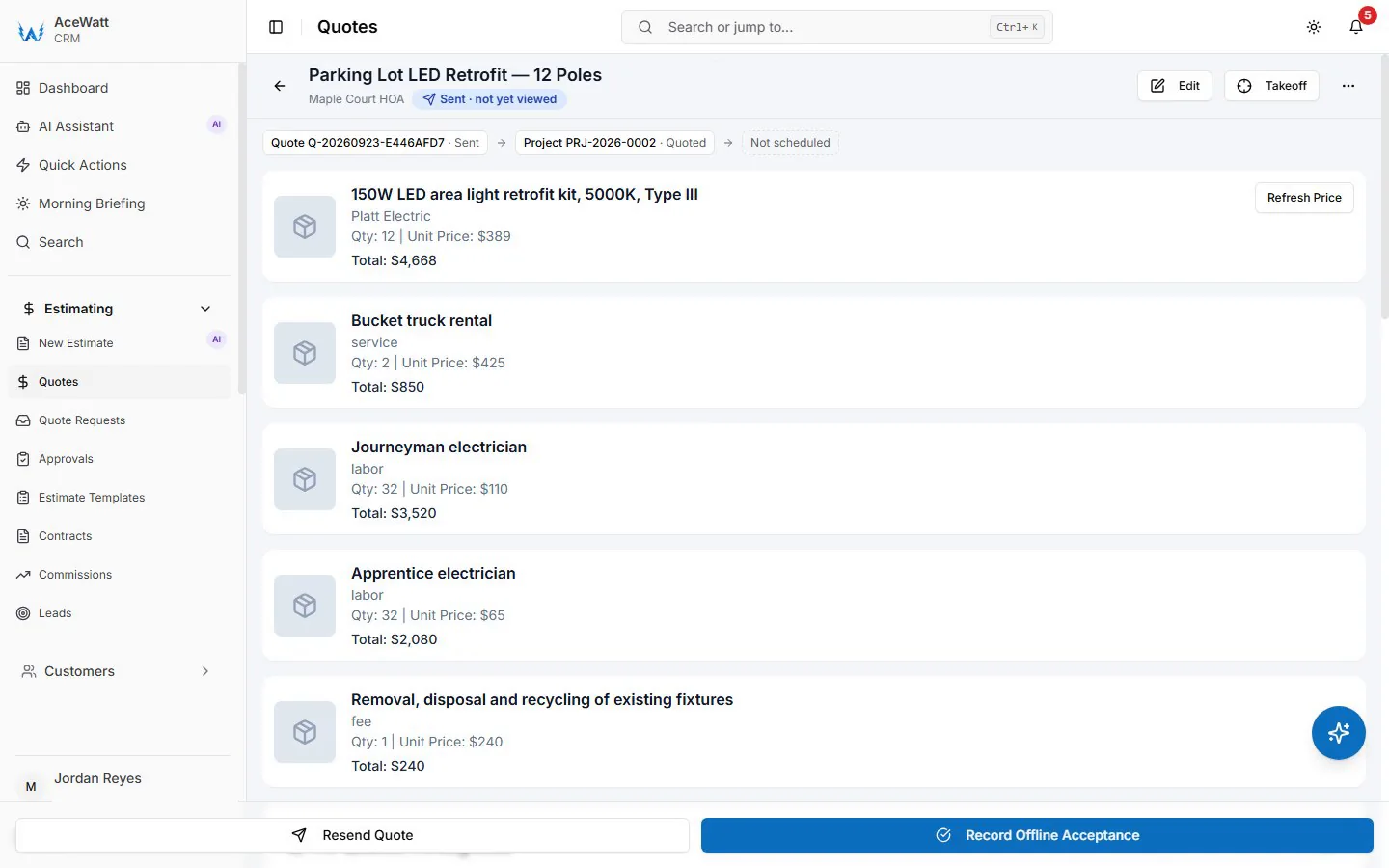
1. AceWatt: AI Estimating Tied to the Full Job Lifecycle
Full disclosure: this is our product, so discount our enthusiasm accordingly. What earned it the top spot in our own testing is not the estimating alone. It is that the estimate never leaves the system.
Upload plans, photos or a job walk and AceWatt's AI Estimating drafts a priced quote for your review from your pricebook and assembly templates, with labor units that follow how electricians actually install: per foot of conduit, per wire pull, per device. Symbol counts from plans are not reliable yet, so the estimator checks every quantity against the drawings. In our test runs, Scenario 2 went from walk-through to homeowner-approved flat-rate quote in under 20 minutes, and Scenario 3 produced an in-house-approved T&M change order and an invoice that landed on the QuickBooks-ready invoice-list export for the bookkeeper. That handoff is an export, not a native, real-time sync; full sync is in development.
The adjacent capabilities separate it from every other tool on this list. The AI-powered CRM holds the customer record from first call to final payment. Automated Follow-Up chases overdue invoices with email reminders at 1, 7, 14 and 30 days late; following up on unsigned estimates stays with you. Job Tracking, Crew Scheduling and Dispatching, and Invoicing and Payment Tracking all consume the accepted estimate directly, and AI Voice and Job Walk Documentation converts your verbal scope notes on site into documented scope. That recording is what protects you when a homeowner claims a change order was never discussed. The limitation is honest: AceWatt is not built for 50-million-dollar design-build industrial bids with formal plan-room requirements.
2. Trimble Accubid
The enterprise standard for large commercial and industrial electrical contractors. Accubid's labor libraries break installation hours down by condition, and its breakdown structure remains the benchmark for bid-level detail on plan-spec work. Pricing is quote-based and typically lands in five figures annually once you add modules and data. The tradeoff is a steep learning curve and a heavy implementation. Shops running residential service work will never touch 90 percent of it.
3. McCormick Design Estimating Pro
McCormick has been in electrical estimating since 1979, and it shows in the assembly database. Auto-count from digital plans performs well on device-heavy drawings, and the takeoff-to-summary flow is efficient for steady commercial bidding. Pricing is quote-based and sits in enterprise territory at the Pro tier. It is a dedicated estimator, so plan on a separate system for dispatch, invoicing, and T&M tickets.
4. Vision InfoSoft Electrical Bid Manager
The strongest budget option among truly electrical-specific estimating tools. Annual licenses typically run $1,000 to $2,000, and you get real electrical assemblies, labor references, and material price updates rather than generic construction takeoff categories. Our tester completed Scenario 2 accurately, though the Scenario 3 change order required manual workarounds outside the product. A solid choice for small shops bidding residential and light commercial work.
5. FastEST
An assembly-driven system well suited to contractors graduating from Excel. FastEST walks you through riser diagrams, panel schedules, and branch device counts with sensible defaults, and perpetual licenses sit in the low four figures. Scenario 1 takeoff time was reasonable, but labor adjustments for overhead conditions required manual editing. Best for one to three truck shops doing residential and light commercial work.
6. TurboBid
TurboBid earns its place on bid management strength. Bid summary sheets are thorough, and it handles change orders better than most dedicated estimators at its price point, which sits in the low four figures. Labor and material depth is a step below Accubid or McCormick, but for contractors bidding service and small commercial work, it covers the necessary ground.
7. STACK
A cloud takeoff and estimating platform with real electrical assemblies, shared plan rooms, and strong collaboration for teams bidding in multiple locations. It offers a free takeoff tier, with paid plans generally between $1,200 and $3,000 per year. Count accuracy in Scenario 1 was solid. The gap is electrical-specific labor intelligence: it counts well but does not think like an electrician about installation hours per condition.
8. PlanSwift
On-screen takeoff with electrical plug-ins that handle counts, runs, and areas, exporting cleanly to Excel at roughly $1,200 for a yearly license. Flexibility is excellent because your estimate logic lives in the spreadsheet you build. That is also the weakness: every formula, labor assumption, and price update is yours to maintain, and there is no path from takeoff to invoice.
9. Bluebeam Revu
Revu is the document standard on commercial jobs, and its counting and measurement tools work well for verifying quantities, with the Complete tier running about $600 per seat per year. But it is a PDF markup tool, not an estimator. There is no labor library, no pricing, no estimating logic. Most contractors we work with use Bluebeam to review plans, then estimate somewhere else.
4. AI-Powered Estimating: What Sets the Best Tools Apart
Genuine AI electrical estimating software does three things in 2026 that matter to your bottom line.
First, it cuts the manual material counting. Symbol recognition reads receptacles, switches, and luminaires off the plan set, and schedule extraction pulls fixture quantities straight from the drawings. Treat those counts as a draft: symbol recognition still misses and double-counts devices, so every count needs a human pass against the plans.
Second, it accelerates labor costing. Instead of hand-applying labor units per assembly, the engine suggests hours based on installation type and condition, and you adjust based on your crew's real productivity. Contractors who track actual hours against estimated hours see bid accuracy compound over time.
Third, it captures what paper never could. A voice note recorded during the job walk that becomes a documented scope line is the difference between a paid change order and an argument.
The boundary matters, though. AI counts symbols. It does not verify site conditions, apply local code amendments, or make compliance decisions. GFCI locations under NEC 210.8 and AFCI requirements under 210.12 still need an electrician's judgment, and every AI-assisted takeoff deserves a human pass against the fixture schedule before it becomes a bid. The best tools treat AI as a first draft at machine speed, not a signature.
5. From Estimate to Invoice: Why Integration with Job Management and Accounting Is Critical
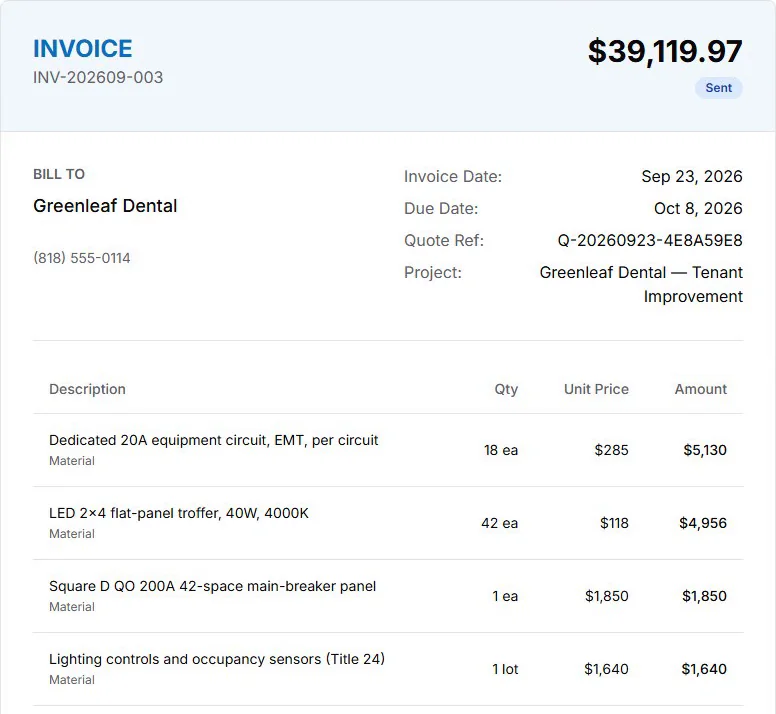
The most expensive estimating software is the one that feeds into nothing. In our testing, AceWatt was the one tool of the nine that carried a job from first takeoff through an approved change order to a payment-recorded invoice without leaving the system, with the accounting handoff at the end being an invoice-list and payroll-hours export rather than a native sync. Every other platform required at least one manual export before that point, and four of the nine required three or more.
The cost of those gaps is not clerical. It is revenue. A change order discussed in the field but never written into the system is an unbillable change order. Industry surveys of field service contractors consistently find that a meaningful share of approved extra work never reaches an invoice, and disconnected estimating is usually why. When your electrical time and material billing software is the same system that recorded the ticket, the photo, and the signature, that leak closes.
On the accounting side, demand real QuickBooks sync, not a CSV export. In a proper sync, items map to your chart of accounts once, invoices post to the correct customer and job, and payments reconcile without a bookkeeper re-entering anything. That is the standard any accounting software for electrical contractors should meet in 2026. On the operations side, an accepted estimate should become a dispatch-ready job with a material list attached, so your office is not rebuilding scope for the crew. Estimating tools that stop at a PDF proposal force you to run that translation manually for the life of every job.
6. Choosing the Right Electrical Estimating Software for Your Shop Size
Solo electricians and one-truck operations. You need speed on site more than bid-level labor breakdowns. Look for mobile-first quoting, a flat-rate price book, payment capture at the table, and an electrician invoice app that shares data with your estimate instead of duplicating it. AceWatt fits here because one login covers the estimate, the invoice, and payment tracking, and the free-form voice documentation handles scope conversations that would otherwise live in your memory. If you bid a steady volume of new construction from plans, Electrical Bid Manager at its price point is the stronger dedicated estimator, but expect to run invoicing separately.
Two to five trucks. Your bottleneck shifts to coordination. Shared job visibility, electrical dispatch software, and T&M ticketing start to matter as much as takeoff accuracy. AceWatt covers estimating plus Crew Scheduling and Dispatching in one workflow. TurboBid or FastEST work well if bidding is the center of gravity and you will tolerate separate dispatch and invoicing systems. STACK suits teams bidding across multiple locations from a shared plan room.
Multi-crew commercial and industrial contractors. If you bid plan-spec work with formal scopes and submittals, Accubid or McCormick are still the right primary estimators; nothing else on this list matches their labor breakdown depth. Pair them with a field management layer for the operations side, and accept that the two systems will need a deliberate handoff process.
7. Common Mistakes Electrical Contractors Make When Switching Estimating Tools
Accepting default labor units. Every tool ships with generic labor hours. Until you calibrate them against your crews' actual recorded hours over 60 to 90 days, your bids are someone else's productivity wearing your letterhead. Fix the calibration before you trust the numbers on a large bid.
Cutting over in the middle of a major bid. A big plan-spec estimate is the worst possible first project in new software. Run your first two weeks of estimates in parallel on small residential and T&M jobs where a miss is survivable, then commit.
Migrating a polluted price book. Porting ten-year-old part numbers and obsolete catalog entries into a new system imports your old errors with them. Rebuild your common assemblies from current supply house pricing files and lock the rest until you touch them.
Ignoring the accounting setup until the first invoice. Decide your QuickBooks item mapping, T&M rate structure, and service versus job costing treatment before you send estimate one. Retrofitting accounting structure after fifty invoices exist is a weekend you will not enjoy.
Buying enterprise depth for residential volume. Paying five figures annually for Accubid to quote 200A service upgrades is paying for capability you will never exercise. Match the tool to your actual bid mix.
Keeping both systems alive indefinitely. A parallel run is a transition, not a destination. Shops that never fully cut over end up double-entering every job, which is worse than either system alone.
8. Final Verdict: The Best Electrical Estimating Software for 2026
After three scenarios and a control estimate, the results split cleanly by need. For large commercial and industrial plan-spec bidding, Trimble Accubid remains the standard, with McCormick close behind. For a budget dedicated estimator, Vision InfoSoft Electrical Bid Manager delivers the best electrical-specific value under $2,000 a year. For pure takeoff on a tight budget, PlanSwift and STACK hold their ground.
For solo electricians and growing shops doing residential and light commercial work, AceWatt took the top spot in our testing, bias acknowledged. It was the one platform in this test where the estimate, the change order ticket, the crew schedule, and the QuickBooks-ready invoice lived in one record, and the 20-minute homeowner-approved quote in Scenario 2 is the kind of speed that wins service work outright.
Whatever you choose, test it the way we did. Hand every vendor your last real planset and your last ugly change order, and watch what happens end to end. The tool that handles both without making you re-key data is the one that earns your subscription.