
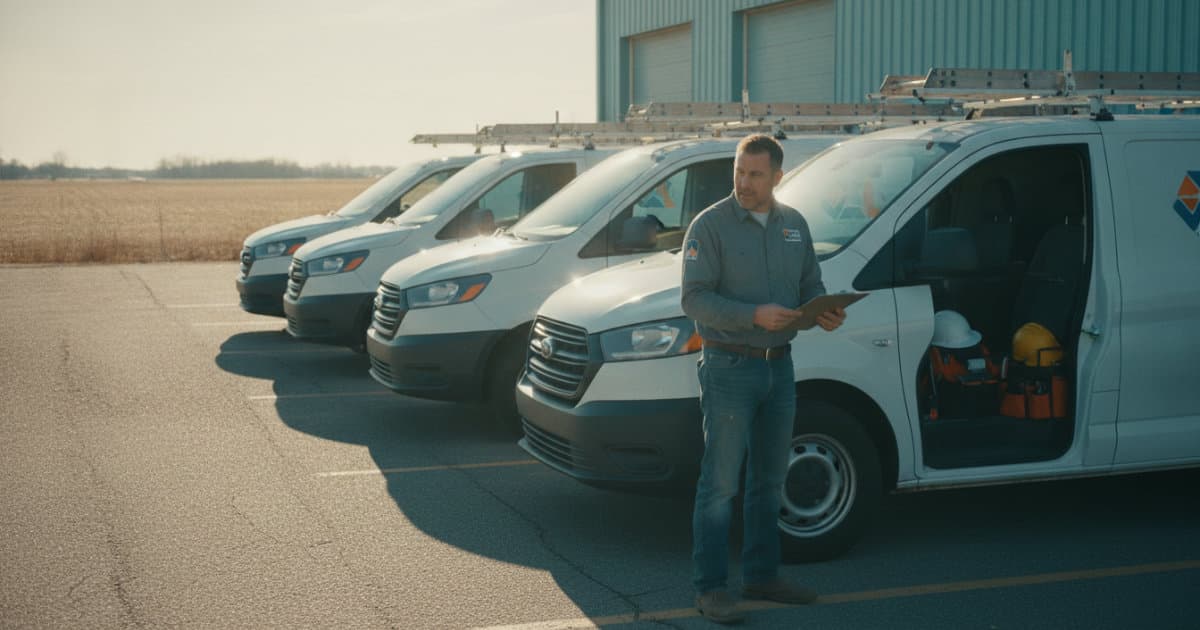
How to Scale an Electrical Contracting Business from 1 Truck to 10
Scaling an electrical contracting business from one truck to ten means replacing owner-dependent habits with systems for estimating, follow-up, dispatching, job tracking, invoicing, and accounting. Most shops stall between one and three trucks because every quote, callback, and schedule change runs through the owner. Fixing those systems first lets you add crews without adding chaos.
Why Most Electrical Shops Stall Between 1 and 3 Trucks
The jump from solo electrician to a small shop is where most businesses plateau, and the reasons are predictable. The owner is still pricing every job personally, often from the driver's seat between service calls. Dispatching happens through phone calls and texts. Job status lives in the owner's head. Invoicing waits until Sunday night.
Each of those habits works at one truck. At three trucks, they break. An owner answering calls while running a panel upgrade will miss estimate requests, and a missed estimate request is a lost job, because homeowners typically collect two or three bids and award the work within days. At three trucks, the owner has also stopped being the best electrician on the payroll, because half the week goes to admin.
Stalling here is not a motivation problem. It is a systems problem, and the sections below cover the systems to build, in the order that matters.
If you are still in the earlier stage, our guides on how to start an electrical business and how to manage an electrical contracting business cover the foundations this article assumes you already have: licensing, insurance, a legal entity, and steady work.
Build a Repeatable Estimating System Before You Hire

Estimating is the first bottleneck to fix because it gates revenue. If every quote depends on the owner remembering material costs and labor hours, your quoting capacity caps your growth no matter how many electricians you hire.
A repeatable estimating system for an electrical shop should cover your core job types with consistent pricing logic:
- Service calls: diagnostic fee, minimum hours, truck stock markup
- Panel upgrades: 200A service upgrades priced with permit, inspection, and utility coordination built in, not added later
- Remodels and additions: device counts, circuit runs, drywall repair allowances
- Small commercial: TI work priced per fixture, per circuit, and per foot of EMT or MC cable
AceWatt's AI estimating drafts a quote for your review from a job walk, photos, a typed description, or an uploaded PDF plan set. That matters because your loaded labor cost (wages, payroll taxes, workers' comp, vehicle, and tool costs) is specific to your shop. The U.S. Bureau of Labor Statistics tracks median wages for electricians, and combined with your overhead, that number should anchor your billable hourly rate, not something you found in a Facebook group.
Consistency is the real win. When two estimators produce quotes 20% apart for the same job, you either lose money on one or lose the bid on the other. Standardized quoting makes every quote comparable, which also makes every job's profitability measurable after the fact.
Automate Follow-Up So Leads Stop Leaking

Follow-up is the cheapest revenue to recover. The leak looks like this: a homeowner calls while you are under a sink disposal rough-in, you do not call back until evening, and they have already booked another contractor. Or an invoice goes out, payment never arrives, and the job quietly stops producing cash.
AceWatt attacks the leak in two places. When a customer accepts a quote, AceWatt can create a deposit invoice and email it with a pay link, so money moves before material is ordered. On the back end, AceWatt emails automatic reminders for overdue invoices at 1, 7, 14, and 30 days past due, and unpaid invoices are flagged as overdue with an aging report from 0 to 30 days through 120+ days. None of that requires the owner to remember anything.
The revenue math is blunt. If your shop generates 40 estimate requests a month and closes 30% of them, lifting conversion even a few points through faster response adds jobs without spending a dollar more on marketing. Before you invest in scaling lead generation, which we cover in how to grow your electrical business, fix the conversion and collection of the work you already have.
Use Crew Scheduling and Dispatching to Protect Billable Hours
Once you run two or more trucks, dispatching quality directly controls profitability. Every hour a journeyman spends driving between badly sequenced jobs is an hour you paid for and cannot bill.
Good dispatching for electrical work has to account for factors generic schedulers miss:
- Skill match: a second-year apprentice should not be dispatched solo to a 480V gear troubleshooting call
- Permits and inspections: scheduling the rough-in around the inspection window, not after it
- Material availability: a panel upgrade only gets scheduled once the panel, meter can, and service entrance conductors are on the truck
- Geography: clustering calls by area to cut windshield time
- Emergency slots: holding capacity for no-power calls without blowing up the day
AceWatt's drag-and-drop dispatch board includes skill-based scheduling suggestions so the right tech lands on the right job. Techs clock in and out from their phones, and AceWatt records the location and flags whether the tech was actually at the job site, which matters for both payroll accuracy and customer disputes. On the Scale plan, route optimization sequences stops by straight-line distance between them to cut travel further. Chaotic scheduling also creates safety exposure, and OSHA's electrical construction resources are worth building your crew safety meetings around, because a recordable incident is the most expensive scaling failure of all.
Dispatching is also where customer experience lives. A customer who receives an emailed quote or invoice link through AceWatt's customer portal behaves differently from one who was told "sometime Tuesday."
Track Jobs in Real Time Instead of Relying on Memory or Texts
At one truck, job tracking is memory. At four trucks with twelve active jobs across residential and commercial sites, memory fails, and texts are worse because nothing is searchable or attached to the job record.
Every job should have a status that answers one question at a glance: scheduled, in progress, waiting on materials, waiting on inspection, completed, or ready for invoice. AceWatt tracks the full financial pipeline from quote to job to invoice to paid, so the status board and the money trail are the same record.
The two statuses that quietly kill cash flow are "waiting on materials" and "waiting on inspection." Jobs that sit in those states without a visible flag stop generating calls to suppliers and inspectors, stop generating invoices, and eventually generate disputes because nobody can reconstruct the timeline. Field data matters here too: techs can log field notes and expenses from their phones, and if a site has no signal, the AceWatt app queues clock ins, notes, and expenses and sends them when the connection returns.
Fix Invoicing and Payment Tracking Before Cash Flow Breaks
Invoicing is where scaling goes to die if it is not systematized. The pattern is familiar: work completes, invoices go out two weeks later, payment arrives 45 days after that, and meanwhile payroll and material costs do not wait.
AceWatt connects invoices directly to completed work. When a customer accepts a quote, AceWatt creates the invoice from the quote's line items and emails it automatically (a deposit invoice first, if you take one), so nothing is re-typed and nothing is reconstructed from memory six weeks later. Customers can pay online by card, and bank (ACH) payment is available when the contractor's Stripe account has it enabled. For larger projects, milestone billing lets you invoice by percentage of completion instead of waiting for the whole job to wrap.
Deposits deserve special attention. For panel upgrades, service changes, and any job with significant material cost, collect a deposit before ordering. Your state's contracting rules govern deposit limits and payment scheduling, and the National Electrical Contractors Association publishes guidance on payment practices worth reviewing as you take on larger commercial work.
Connect Field Documentation and QuickBooks Before Adding More Crews
The last system to build is the one most shops postpone: connecting the field and the books. Double entry, where an office person retypes invoices and job costs into QuickBooks, is tolerable at two trucks. At six trucks it is a full-time job that produces errors, and your profit numbers become unreliable right when you need them to decide whether to hire truck number seven.
Two pieces solve this:
- AI Job Walk documentation: walk the site with your phone, dictate notes, and snap photos. AceWatt generates a report with material suggestions attached to the job record. This is what protects you in change order disputes and inspection discrepancies, and your documentation should reference the actual installation requirements in NFPA 70, the National Electrical Code, available through the NFPA.
- QuickBooks-ready exports: AceWatt produces an invoice-list spreadsheet and a payroll-hours CSV in QuickBooks layout, so your bookkeeper works from clean exports instead of paper. Full QuickBooks sync is in development; today the export workflow is the bridge.
With both in place, you can answer the question that scaling actually depends on: which job types make money, and which ones quietly do not. Our article on the successful electrical business owner's playbook for systems goes deeper on building these operational rhythms.
The Sequence That Works
Scaling from one truck to ten in a healthy way usually follows this order:
- Standardize estimating so quotes are fast and consistent
- Add deposit invoices and automatic overdue reminders so leads and cash stop leaking
- Move dispatching onto a dispatch board so billable hours are protected
- Run every job through job tracking so nothing stalls invisibly
- Systematize invoicing and payment tracking so cash flow matches work completed
- Add field documentation and QuickBooks-ready exports so profitability is measurable
- Then hire the next electrician, and repeat
Hiring before building these systems just adds trucks to the bottleneck. Building them first means every new hire steps into a business that already runs on process.
FAQ
When is the right time to hire my first employee electrician?
Hire your first electrician when you are turning away work for three or four consecutive weeks and your estimating, invoicing, and follow-up are already systematized. If you hire while still pricing jobs from your truck, you will spend your supervisory hours doing admin instead of training, and quality suffers.
Should I specialize in one type of electrical work to scale?
Specialization usually helps. Service work, panel upgrades, EV charger installs, and small commercial TI work each have different pricing models and dispatch needs. Shops that pick two or three core job types build faster estimating, better truck stock, and higher close rates than generalists competing on price.
How many jobs can one crew handle per day?
A residential service crew typically completes three to five calls a day depending on travel distance and call complexity, while a crew dedicated to a panel upgrade or remodel may spend a full day on one site. The constraint is rarely the electrical work itself; it is travel time, permit windows, and material pickups, which is why many contractors look to dispatch software to cut the time between calls.
What is the biggest cash flow risk when scaling an electrical shop?
The biggest risk is invoicing lag combined with material-heavy jobs. You pay suppliers in 15 to 30 days, payroll weekly, and customers in 30 to 60 days. Deposits on material-heavy jobs, same-day invoicing on completed work, and an aging report that flags slow payers are the controls that keep growth from creating a cash crunch.
Do I need electrical contractor software, or will spreadsheets work?
Spreadsheets work up to roughly one truck and one crew. Past that, job status, scheduling, and invoicing information fragments across texts, notebooks, and files, and the owner becomes the integration layer. Electrical contractor software like AceWatt centralizes CRM, estimating, scheduling, job tracking, invoicing, and QuickBooks-ready exports so the business can operate without the owner touching every job.
If you are planning the next stage of your shop, start with AceWatt's AI estimating and deposit invoicing on a 14-day trial, then look at how the dispatch board and job tracking fit your current workload before you hire the next electrician.
Related Reading
- Hiring your first or next electrician? Follow the 2026 hiring playbook for electrical contractors.
- How to Start an Electrical Business — the foundations to put in place before your first hire
- How to Manage an Electrical Contracting Business — day-to-day systems for scheduling, estimating, and cash flow
- How to Grow Your Electrical Business — marketing and referral systems that fill the calendar