

How to Grow Your Electrical Business in 2026: Step-by-Step Guide
Direct answer: To grow an electrical business in 2026, systemize estimating with templates, follow up on every proposal within 48 hours, hire your first field electrician once you are turning down work, shift revenue mix toward higher-margin service and repair, run a real CRM instead of spreadsheets, track per-job margin, invest in Google Business Profile and review collection, and adopt connected software so quoting, dispatch, invoicing, and customer history live in one place. Most shops stall at $250K to $500K because they grow revenue without systems. Fix systems first and capacity comes next.
Growing an electrical business past the solo-operator stage is harder than most electricians expect. You went into this trade because you are good with circuits and conduit, not because you wanted to manage hiring, marketing, and software systems. Yet those are exactly the skills that separate shops that scale from shops that spin at $250K to $500K in revenue year after year.
This guide walks through eight practical steps to grow your electrical business, with specific strategies for each growth stage, from solo electrician to multi-truck operation. Every recommendation reflects observed patterns across the trade, not theoretical business advice. None of this replaces licensed-electrician judgment, your local code, or your authority having jurisdiction (AHJ) on actual electrical work.
Why Most Electrical Businesses Stall at $250K to $500K
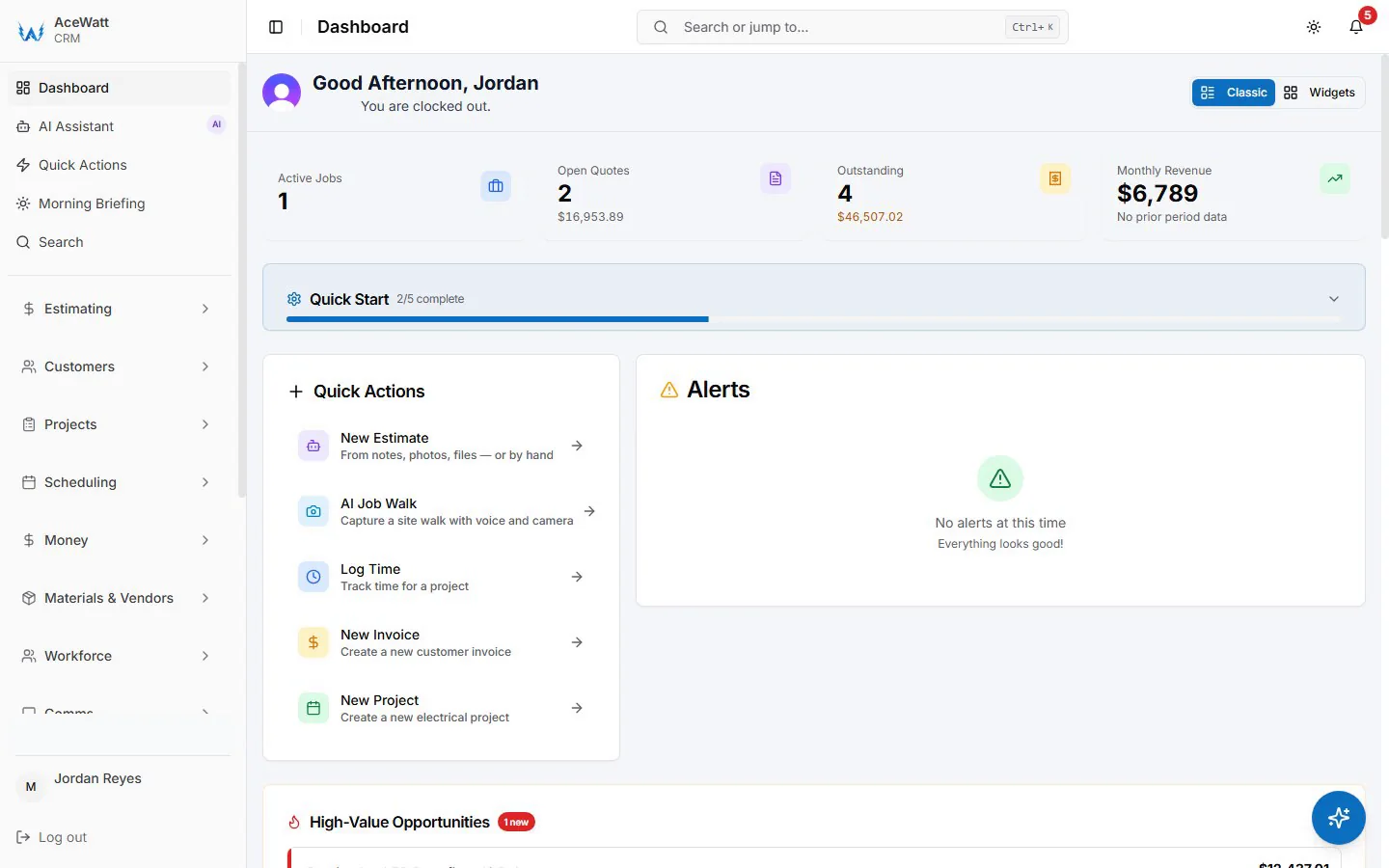
The solo-operator plateau
Many electrical contractors hit a wall when they cannot physically do more work themselves. You are already working 60-hour weeks. Taking on another job means either turning down existing work or hiring help, and hiring feels risky when margins are already thin.
The plateau is not a revenue problem. It is a systems problem.
Revenue is vanity; margin and systems are the real metric
A $500K electrical business running on paper estimates, text-message follow-ups, and memory-based scheduling is more fragile than a $300K business with repeatable estimating templates, a real CRM, and automated follow-up. Growth without systems just creates a bigger mess. If you haven't mapped your revenue goals, staffing milestones, and operational systems on paper, our electrical contractor business plan template gives you a structured starting point.
What separates shops that scale from shops that spin
Contractors who scale tend to share three traits:
- Repeatable estimating: they quote jobs consistently, not from memory
- Systematic follow-up: every proposal gets followed up, not just the ones they remember
- Software that connects the workflow: estimating, CRM, invoicing, and scheduling in one place, not scattered across spreadsheets, text messages, and sticky notes
8 Steps to Grow Your Electrical Business
1. Systematize Your Estimating
Stop quoting from memory. Build repeatable scope templates for your most common job types: service calls, panel upgrades, rewiring, EV charger installations, and commercial TI work.
Flat-rate vs time-and-materials for service work
Many growing electrical businesses shift to flat-rate pricing for service work because it protects margins and gives customers price certainty. Time-and-materials still works for large projects, but flat-rate eliminates the "how much will this cost?" objection on service calls.
AI-assisted quoting from job-walk notes
Modern electrical contractor software can convert job-walk notes into structured estimate drafts. Instead of typing line items from scratch, you dictate scope observations and the system builds a draft estimate you review and adjust. AceWatt's AI job walk feature supports this workflow: you walk the site, document conditions by voice, and generate a quote draft for review.
For deeper pricing strategy, see how to price electrical work and our electrical contractor pricing guide. For presenting estimates professionally, electrical proposal software can help you create tiered good-better-best quotes that close more jobs.
2. Follow Up on Every Proposal
The electrical trade has an open secret: a meaningful share of quotes never get a follow-up call. Contractor coaching programs such as CertainPath's electrical business coaching routinely point to follow-up discipline as a low-cost lever for residential close rates. Customers interpret silence as disinterest and call the next electrician on the list.
Automated follow-up sequences
Set up a workflow where every proposal automatically gets a follow-up within 48 hours. This can be as simple as calendar reminders or as sophisticated as CRM-triggered emails and texts.
Good-better-best options increase close rate
Presenting three pricing tiers (good, better, and best) gives customers a choice instead of a yes/no decision. Most customers pick the middle option, which is typically your target margin. Automated estimating tools can generate these tiered proposals from a single scope of work.
3. Hire Your First Field Electrician
When to hire (revenue signal)
Most electrical contractors should start thinking about hiring when they are turning down work or when revenue consistently exceeds what one person can produce, typically around $200K to $300K in annual revenue. The U.S. Bureau of Labor Statistics tracks median electrician wages and demand outlook in its Electricians occupational profile; use that data when modeling fully loaded labor cost before posting a job.
What to delegate first
Delegate field execution first, not office work. You should still be managing estimates, customer relationships, and cash flow, since those are the functions that drive growth. Send your new hire to handle physical installation while you focus on winning the next job.
Training and documentation systems
Before you hire, document your standard operating procedures for common tasks: how you wire a panel, how you handle a service call from start to finish, how you document completed work. Written or recorded procedures help new hires get productive faster, but every electrical task still depends on licensed-electrician judgment and your local code.
4. Shift Revenue Mix Toward Service and Repair
Service margins vs construction margins
Service and repair work typically carries higher margins than new construction because you are charging for responsiveness and expertise, not competing on bid price. A $400 service call that takes two hours generates more profit per hour than a $40,000 construction project with tight margins and long payment cycles.
Building a maintenance agreement program
Maintenance agreements create recurring revenue. Offer annual inspections, priority scheduling, and discounted service rates for agreement holders. A shop with 50 maintenance agreements at $150 to $300/year has a predictable revenue floor that covers overhead during slow seasons. Inspection scope and intervals should follow your AHJ and NFPA guidance, not a sales template. A digital electrical safety checklist app can standardize your inspection process across your entire team.
Emergency call readiness
Emergency electrical calls command premium pricing. If you can staff for after-hours response, even one or two nights a week, you capture revenue that most electrical shops leave on the table. Dispatch software helps manage emergency scheduling without disrupting planned work.
5. Build a Real CRM System
Why spreadsheets and text messages stop working at scale
Spreadsheets work fine when you have 20 active customers. They break at 200. Text messages work when you have 5 active jobs. They become chaos at 50. A CRM gives you one place to track every lead, estimate, job, follow-up task, and invoice, searchable and organized.
What to track: leads, estimates, jobs, follow-up, invoicing
Your CRM should capture:
- Every lead who contacts you (phone, email, website form)
- Every estimate you send, with status (pending, accepted, rejected, expired)
- Every active job with schedule, scope, and assigned technician
- Follow-up tasks with deadlines
- Invoices with payment status
AceWatt CRM for electricians handles all of these in one system designed for electrical contractors. For a broader comparison, see best CRM for electrical contractors.
6. Control Overhead and Job Costing
Know your real hourly cost per electrician
Your hourly cost is not just wages. It is wages plus workers' comp, liability insurance, vehicle costs, tools, fuel, phone, and benefits. For many electrical shops, the fully loaded cost is 1.5 to 2x the hourly wage. If you do not know this number, you cannot price profitably. Use a labor rate calculator to build a number you trust.
Track margin per job, not per month
Monthly profit tells you if the business is healthy. Per-job margin tells you which types of work are worth doing and which are eating your time. Job costing does not have to be complex; a simple spreadsheet tracking labor hours, material costs, and revenue per job reveals patterns quickly. For a deeper view, see electrical contractor profit margins.
7. Invest in Marketing That Compounds
Google Business Profile optimization
Your Google Business Profile is the single most important marketing asset for a local electrical contractor. Complete every section: services, service area, hours, photos, and regular posts. Respond to every review. Google's own Business Profile verification help and eligibility guidelines explain current verification and eligibility rules, so review them before publishing.
Reviews: ask on every completed job
The best time to ask for a Google review is immediately after you complete a job, when the customer is satisfied and the work is fresh. Train every technician to ask. Use a follow-up text message with a direct link to your review page. Shops that ask on every job build review counts that attract new customers organically.
Local SEO basics for electrical contractors
Your website should target your city + "electrician" and city + "electrical contractor." Create location pages for each service area. List services clearly. Internal links between service pages and blog content help search engines understand your expertise. See the electrical contractors overview for an example of how to structure service-focused content. For a deeper dive on where electrical jobs actually come from, our electrician lead generation guide covers the channels that compound over time.
8. Use Software That Scales With You
What to look for in electrical business software
- Trade-specific: generic business software does not understand estimates, job walks, or service calls
- Mobile-first: your field team needs to work from phones and tablets, not desktop computers
- Connected workflow: estimating, CRM, invoicing, and scheduling should talk to each other
- AI-assisted: features like voice documentation and AI-assisted quoting save admin time per week
Dispatch, estimating, invoicing, CRM in one system
Disconnected tools create data silos. When your estimating software does not connect to your invoicing software, someone has to re-enter data manually. When your CRM does not connect to your schedule, you double-book jobs. One connected system eliminates these gaps.
Growth Stage Playbook
Solo Electrician ($0 to $250K)
Focus: estimating speed, follow-up discipline, first-hire fund
At this stage, every hour you spend on administration is an hour you are not billing. Invest in software that speeds up quoting and handles follow-up automatically. Start setting aside cash for your first hire, a field electrician who can handle installation while you manage the business.
Small Shop ($250K to $750K, 1-3 trucks)
Focus: CRM system, hiring, service revenue mix
You have proven demand. Now you need systems to handle it. Implement a real CRM. Hire field electricians to increase capacity. Shift revenue mix toward service and repair, which carries higher margins and faster payment than new construction.
Growing Shop ($750K to $2M, 4-10 trucks)
Focus: dispatch efficiency, job costing, overhead control
At this size, inefficiency eats profit faster than anything else. Dispatch software keeps your trucks routed efficiently. Job costing shows which work types generate real profit. Overhead control keeps fixed costs proportional to revenue. A repeatable daily operations playbook for managing an electrical contracting business keeps the basics from slipping as you add trucks.
Growth stage checklist
| Growth Stage | Revenue Range | Trucks | Focus | Software Move |
|---|---|---|---|---|
| Solo | $0 to $250K | 1 | Estimating speed, follow-up discipline | Mobile quoting + CRM |
| Small Shop | $250K to $750K | 1-3 | First hire, service revenue mix | CRM + scheduling |
| Growing Shop | $750K to $2M | 4-10 | Dispatch, job costing | Connected CRM + dispatch + invoicing |
| Multi-Crew | $2M+ | 10+ | Reporting, ops discipline | Full ops stack + reporting |
How Software Accelerates Electrical Business Growth
Software is not a growth strategy by itself. But the right software removes the operational friction that keeps electrical contractors stuck at the solo-operator plateau.
- Estimating: quote faster, win more jobs, present good-better-best options consistently
- CRM: capture every lead, track every estimate, never lose a follow-up task
- Follow-up: automated proposal tracking keeps you from leaving money on the table
- Invoicing: send invoices from the field, accept payments online, reduce days outstanding
- Job costing: see real margins per job, not just monthly totals
- Dispatch: schedule more jobs per technician per day with efficient routing
How AceWatt Helps Electrical Contractors Grow
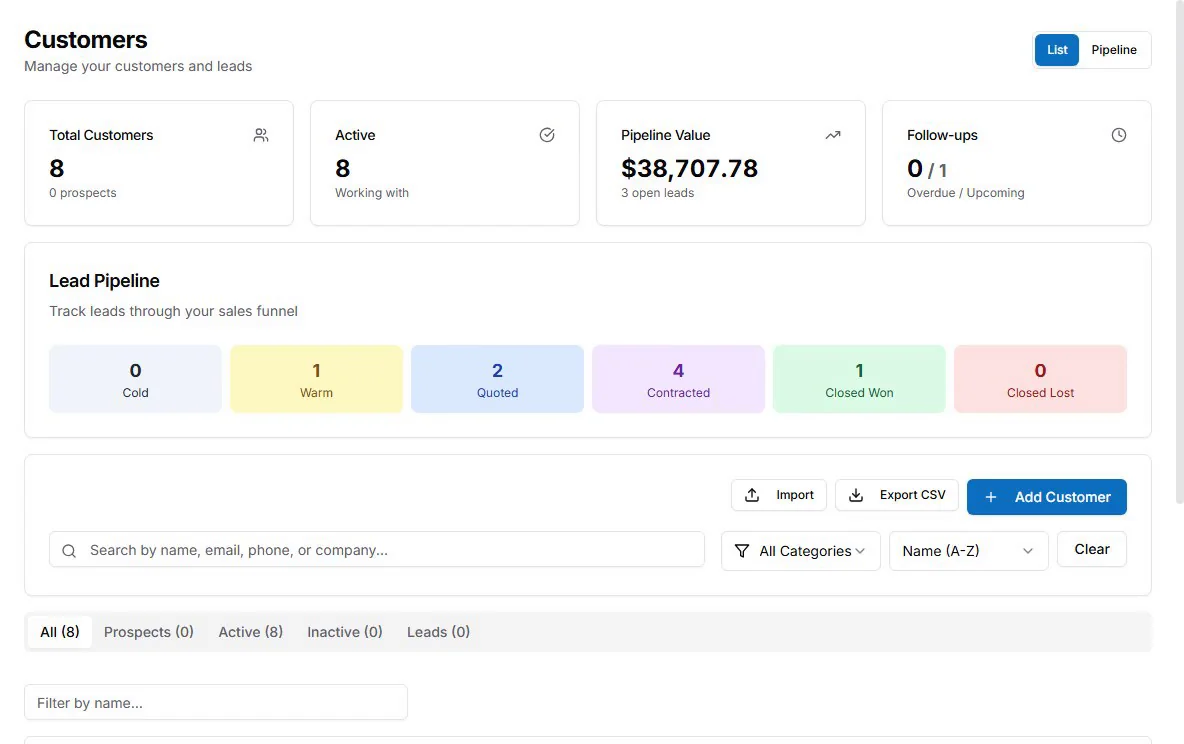
AceWatt is built specifically for electrical contractors who want to grow past the solo-operator stage. The platform connects the full workflow:
AI job walk → quote → invoice → follow-up
Walk a job site, document conditions by voice, generate a structured estimate draft, send the invoice, and let overdue-invoice reminders go out by email automatically, all from one system. See how AI job walks work.
Voice documentation for field teams
Your field electricians can document completed work by voice instead of typing on a phone screen. Notes are transcribed and attached to the job record for licensed-electrician review.
Follow-up on every proposal
Every estimate you send stays visible on the customer record, so you can see which ones still need a call; Automated Follow-Up covers overdue invoices (email reminders at 1, 7, 14 and 30 days late).
Job costing visibility
Track labor, materials, and revenue per job to see which types of work generate the best margins.
Mobile-first workflow
The entire system works from a phone or tablet. Your field team does not need to sit at a desk to update job status, document work, or send invoices.
Ready to see how AceWatt fits your electrical business? Start a free trial or contact us to learn more.
FAQs
How do I grow my electrical business from solo to multi-truck?
Focus on three things: systemize your estimating so quotes are consistent, implement automated follow-up so no proposal goes cold, and hire your first field electrician when you are consistently turning down work. Software like AceWatt connects estimating, invoicing and dispatch so you can manage the business while your team handles field execution (its automatic reminders cover overdue invoices, not proposals).
What is the biggest bottleneck for growing electrical businesses?
Follow-up discipline. Most electrical contractors spend hours on estimates and then never follow up. Customers interpret silence as disinterest and hire someone else. A CRM with automated follow-up is one of the highest-ROI investments for a growing electrical shop.
How much does electrical business software cost?
Trade-specific CRM software for electrical contractors typically ranges from free trials to roughly $50 to $199 per month depending on features and team size. Pricing changes, so verify current numbers on the vendor site. Compare options at AceWatt pricing.
When should an electrician hire their first employee?
Most electrical contractors should consider hiring when annual revenue consistently exceeds $200K to $300K and they are turning down work because they cannot physically do more themselves. Hire a field electrician first and delegate installation work while you keep managing estimates and customer relationships. Confirm wage benchmarks against the BLS Electricians profile for your region.
What software do successful electrical contractors use?
Successful electrical contractors use trade-specific software that connects estimating, CRM, follow-up, invoicing, and scheduling in one system. They avoid generic business tools that do not understand electrical work and disconnected point solutions that require manual data re-entry. See the guide to the best electrician apps, AI tools for electricians, and electrical contractor software for small business for category-by-category comparisons.
Does AceWatt replace licensed-electrician judgment or AHJ approval?
No. AceWatt assists with estimate drafting, job-walk notes, follow-up, and admin workflow. Code interpretation, design decisions, inspection responses, and final scope all remain with the licensed electrician and your local authority having jurisdiction. Any AI-generated estimate or note is a draft for human review.
Related Reading
- Browse the full AceWatt feature set: AI job walk, estimating, invoicing, scheduling.
When growth means adding trucks and crews, the constraint shifts from marketing to operations — how to scale an electrical contracting business from 1 truck to 10 walks through the estimating, dispatch, and invoicing systems that make each new hire profitable.