
If you handle this on a phone in the field, see our guide to the best systems playbook for running a profitable electrical business first — it covers the workflow end to end.
How to Manage an Electrical Contracting Business: The Daily Operations Playbook
Direct answer: Knowing how to manage an electrical contracting business means building six operational systems: lead intake and qualification, scheduling and dispatch, job documentation, estimating and quoting, crew and project management, and financial operations. The contractors who succeed at managing an electrical contracting business do not rely on memory or sticky notes. They build repeatable processes and use a CRM to connect leads, quotes, jobs, and invoices in one place.
You know the feeling. You spent ten hours on job sites today (pulling wire, troubleshooting panels, coordinating with inspectors), and now you're sitting in your truck at 8 PM, staring at 14 missed calls, three quotes you promised to send yesterday, and a crew that showed up at the wrong address this morning.
You're good at electrical work. The business side? That's where things fall apart. When you set out to manage an electrical contracting business, you quickly discover that the operational skills (scheduling, follow-up, documentation, cash flow) are a separate discipline from the trade itself, and most owners were never taught them.
This guide is the operational playbook most electricians never got in apprenticeship. If you're just getting started, check out our guide on how to start an electrical contracting business. If you're already running but want to scale, our how to grow your electrical business post covers strategy. And if you're still writing or revising your plan, our electrical contractor business plan template gives you a section-by-section starting point. This one covers the middle ground: the day-to-day systems that keep the lights on, the crews moving, and the invoices paid.
The Difference Between Doing Electrical Work and Running an Electrical Business
Here's the uncomfortable truth: being a great electrician and being a great electrical business owner are two completely different jobs. The first is about craft. The second is about systems. If you want to manage an electrical contracting business that outlasts your personal bandwidth, most owners discover they need to build operational infrastructure, not just keep doing the technical work themselves while the business side runs on sticky notes and memory.
Why Most Electricians Stay Stuck at a Certain Revenue Level
There's a ceiling that almost every electrical contractor hits. For many shops, it's somewhere between $500K and $1.5 million in annual revenue. You hit it when the owner can no longer personally touch every job, every quote, and every customer conversation, but hasn't built the systems to operate without them.
According to data from the U.S. Bureau of Labor Statistics, there are over 200,000 electrical contracting businesses in the United States, and the vast majority are small shops with fewer than five employees. These businesses don't stall because the work isn't there. They stall because the operational infrastructure can't handle more volume without breaking.
The bottleneck is management, not labor.
The 6 Systems Every Electrical Business Needs
If you want to manage an electrical contracting business systematically instead of reactively, you need six operational systems:
- Lead intake and qualification: how calls, emails, and form submissions become actionable opportunities
- Scheduling and dispatch: how your calendar stays full without emergencies blowing it up
- Job documentation: how you capture scope, changes, and completion from walk-through to close-out
- Estimating and quoting: how you turn job walks into sent quotes fast
- Crew and project management: how your electricians know what to do and when
- Financial operations: how you invoice, track costs, and protect your margins
Each one of these is a system: not a person, not a tool, but a repeatable process that works whether you're in the office or on a ladder. Here's how each one works.
System 1: Lead Intake and Qualification
Every job starts with a lead. But here's the problem: most electrical contractors treat every call the same. A $200 outlet repair gets the same attention as a $40,000 commercial panel upgrade. That's chaos, not a strategy. When you manage an electrical contracting business, lead qualification is where profitability begins.
Stop Losing Jobs to Voicemail
According to research by the National Association of Home Builders, contractors who respond to leads within five minutes are significantly more likely to win the job than those who take an hour or more. The first contractor to reach a homeowner usually gets the work.
Yet most electrical shops let calls go to voicemail during the day because everyone's on a job site. That's a systems problem, not a staffing problem.
Action items:
- Set up a dedicated business phone line that rings to multiple devices
- Use an after-hours answering service or a CRM with automated text-back
- Create a standard intake form so whoever answers captures the same information every time: name, address, type of work, urgency level, how they found you
- For more on organizing customer data, see our guide to CRM for electricians
For a complete lead-generation playbook, see our guide to electrician lead generation strategies. If you want customers to reach you through your website instead of only by phone, online booking software for electricians can collect structured job details before you ever pick up the phone.
Lead Scoring for Electrical Contractors
Not every lead deserves a site visit. Before you burn gas driving across town, qualify the opportunity:
- Job type: Is this a service call, a remodel, or new construction?
- Budget signals: Do they have a number in mind, or are they "just looking"?
- Timeline: Need it today, this week, or "whenever"?
- Decision-maker: Are you talking to the property owner, a tenant, or a general contractor?
Rank leads as hot (site visit within 24 hours), warm (schedule within the week), or cold (follow up monthly). This one habit alone can recover hours of wasted windshield time every week.
System 2: Scheduling and Dispatch
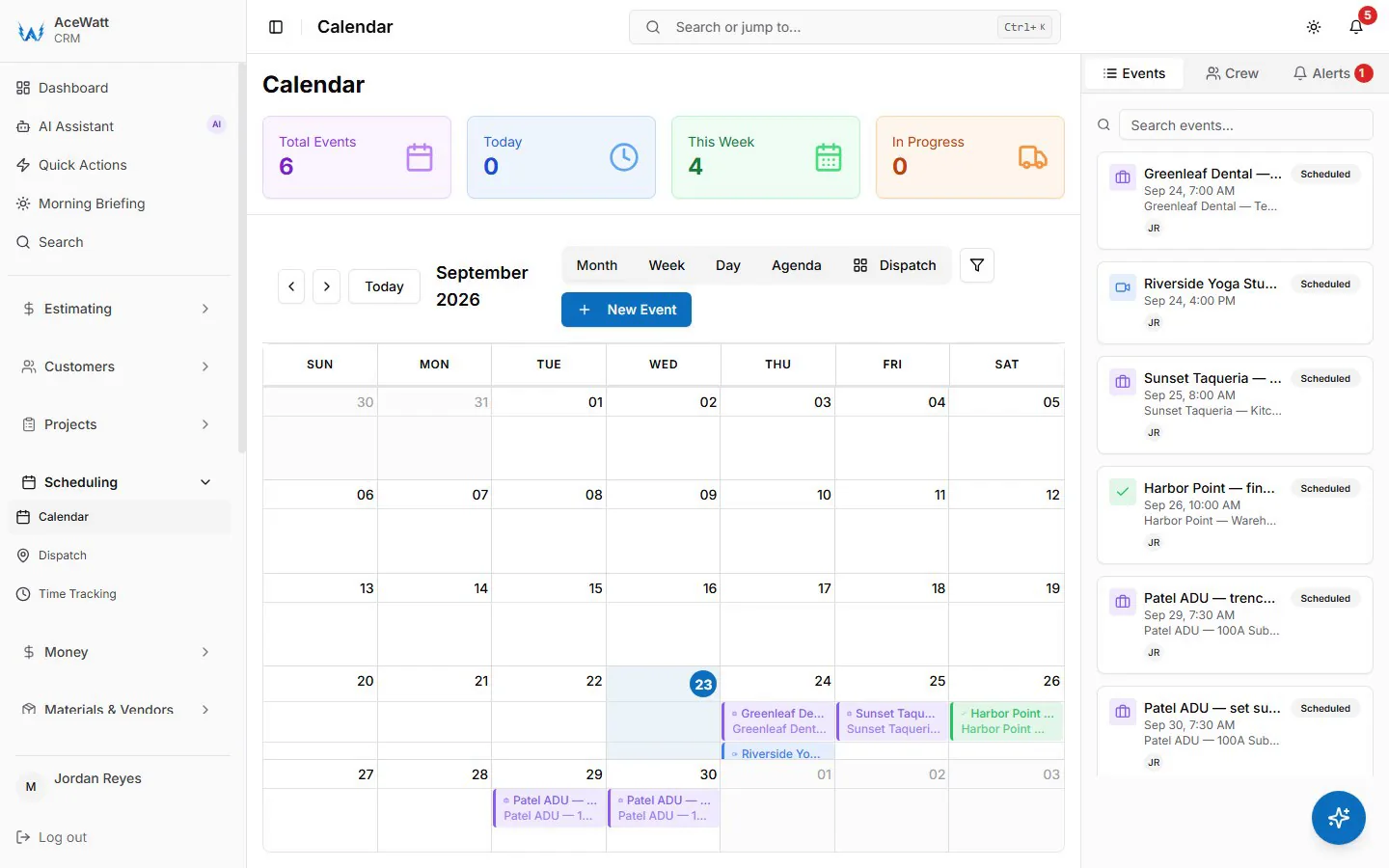
Your calendar is the heartbeat of your operation. When it's organized, everything flows. When it's not, crews show up late, customers get angry, and you spend your evening apologizing instead of relaxing. To manage an electrical contracting business well, effective scheduling is one of the hardest operational disciplines to master.
Calendar Management Without the Chaos
The biggest scheduling mistake electrical contractors make is keeping the calendar in their head. "I think Joe's at the Henderson job until noon, then we've got that panel swap on Elm Street." That works until it doesn't.
Build a shared calendar system:
- Use a digital calendar (Google Calendar, Outlook, or a field service CRM) accessible to everyone in the company
- Block travel time between jobs, and don't schedule back-to-back stops across town
- Reserve buffer time for callbacks and small repairs that inevitably come up
- Assign jobs to specific electricians, not just "the crew"
Emergency vs. Scheduled Work
Emergencies will always happen. A good scheduling system accounts for them instead of being derailed by them.
Framework:
- Reserve 20% of each day's capacity for emergency or same-day calls
- Assign one electrician as the "floating" responder for the day
- When an emergency comes in, don't reshuffle the entire board. Swap the float.
- For multi-day projects, build in a half-day of flex time per week
If you're constantly running behind because of emergencies, you're either underpricing them or overbooking your schedule. Track how many true emergencies you get per week for a month. The data will tell you how much capacity to reserve.
System 3: Job Documentation (From Walk to Close-Out)
If you had to go to court tomorrow over a job dispute, could you produce a complete record of what was agreed to, what changed, and what was completed? Most electrical contractors couldn't. That's a legal risk and a profit killer. To manage an electrical contracting business that survives an audit, documentation discipline is what separates systematic shops from those that operate on memory alone.
The Job Walk: What to Capture and Why It Matters
The job walk is where profitable projects are won or lost, even though no wire has been pulled yet. This is your chance to capture the full scope, identify complications, and set expectations.
Every job walk should capture:
- Customer's description of the problem or goal (in their words)
- Your professional assessment of what's actually needed
- Site conditions: access issues, panel location, existing wiring condition
- Permit requirements and inspection timelines
- Photos of everything relevant (before you start)
This documentation protects you when the customer says "I thought that was included" three weeks into the project. For more on modern documentation workflows, see our AI job walk documentation feature overview. If you're still using paper notes and scattered photos, a dedicated job walk app for electricians can capture everything in one place and feed it directly into your estimates.
Photos, Notes, and Permit Tracking
Get in the habit of taking photos at three stages: before work begins, during progress, and after completion. This isn't extra work. It's your insurance policy. When a homeowner claims you damaged their drywall, a timestamped photo from the job walk saves you thousands.
For permits, create a simple tracking spreadsheet or use your project management tool to log:
- Permit number and issuing authority
- Date applied
- Date issued
- Inspection date(s)
- Final sign-off
Missing a permit deadline doesn't just delay the job. It can also result in fines, failed inspections, and unhappy customers who leave bad reviews.
Why Verbal Agreements Cost You Money
"We talked about it on site, they said go ahead." That's a $5,000 mistake waiting to happen.
Verbal agreements are the enemy of profitability in electrical contracting. They lead to scope creep, misunderstandings, and unpaid invoices. Every change to the original scope, no matter how small, should be documented and acknowledged by the customer before work proceeds. A simple email confirmation is enough. The goal is a paper trail, not a legal document.
System 4: Estimating and Quoting
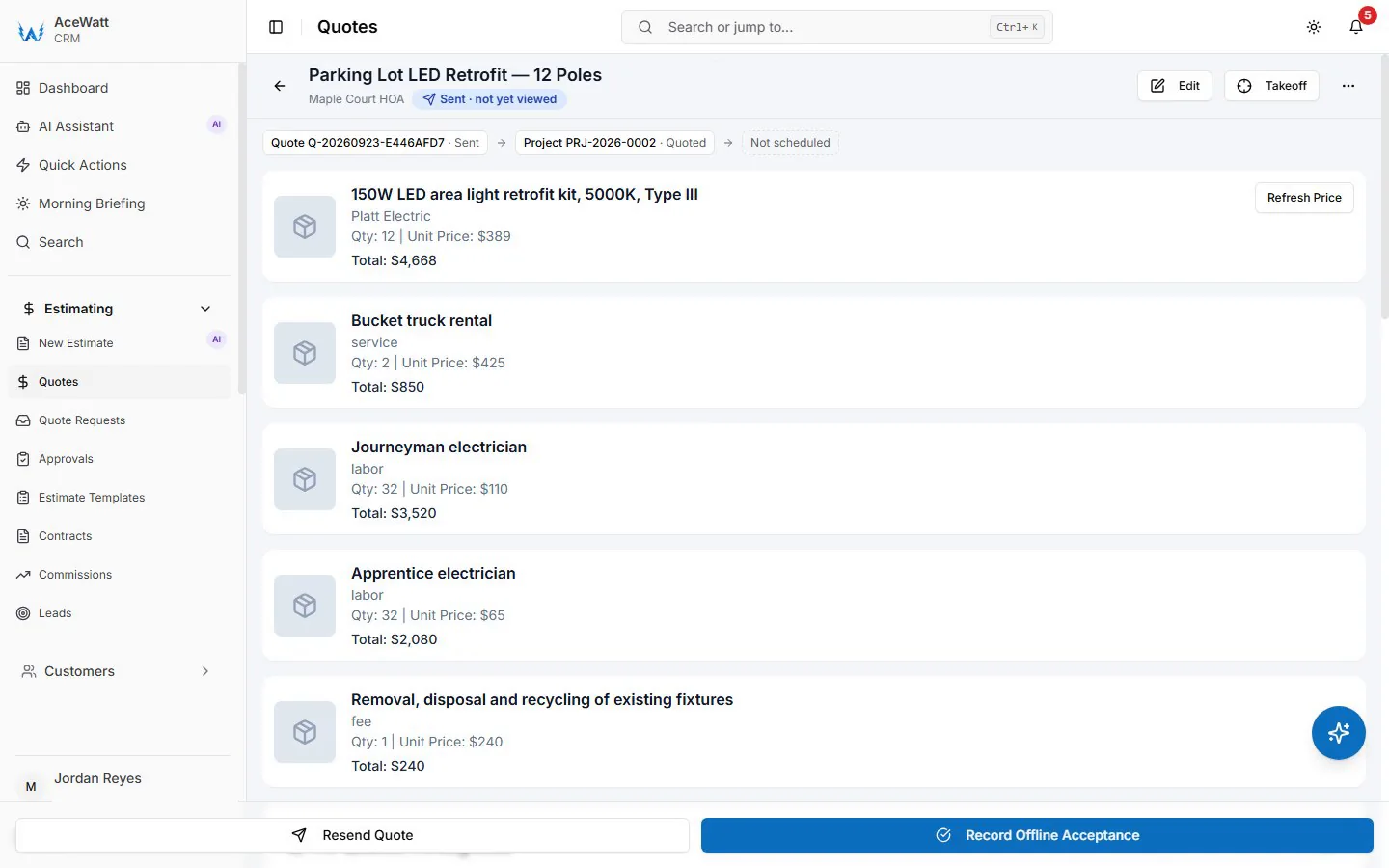
You did the job walk, you know what needs to happen. Now the clock is ticking. The faster you get an accurate quote in the customer's hands, the more likely you are to win the job. Owners who manage an electrical contracting business profitably know that quoting speed and accuracy are what separate winning shops from those that leave money on the table.
Flat-Rate vs. Time-and-Materials
This debate will never die in electrical contracting, so let's be direct about the trade-offs. When you manage an electrical contracting business, the pricing model you choose per job is one of your most consequential margin decisions:
| Pricing Approach | Best For | Risk Level | Customer Perception |
|---|---|---|---|
| Flat-rate | Standard service calls, common installations (panel swaps, outlet circuits) | Low (protected margin on fast jobs) | High: price certainty builds trust |
| Time-and-materials | Commercial work, large remodels, unpredictable conditions | Moderate (margin exposure if scope grows) | Lower: may feel nickel-and-dimed without clear communication |
| Hybrid | Growing shops managing an electrical contracting business across job types | Lowest: protects on both ends | Highest: you match the model to each job |
Flat-rate pricing:
- Easier to sell: customers know the price upfront
- Protects your margin on jobs that go faster than expected
- Requires solid historical data to price accurately
- Works well for residential service work
Time-and-materials pricing:
- Protects you on jobs with unknown conditions
- Customers may feel nickel-and-dimed
- Requires discipline on tracking hours and material receipts
- Works well for commercial projects and large remodels
Many successful electrical contractors use a hybrid approach: flat-rate for common service calls and standard installations, time-and-materials for custom or unpredictable work. For more on pricing strategy, read our guide on how to price electrical work.
How to Build a Quote in Under 10 Minutes
The secret to fast quoting isn't cutting corners. It's standardization.
Build a price book:
- Catalog your most common tasks with pre-built labor and material estimates
- Include units: "Install 200A panel: 6-8 hours labor, $X materials"
- Review and update quarterly as material prices change
Use a template:
- Company info, license number, and insurance details
- Scope of work in plain language
- Materials list with quantities
- Labor estimate
- Terms: payment schedule, warranty, change-order policy
- Expiration date (usually 30 days)
Once your price book and template are built, most standard quotes take minutes, not hours. For a ready-to-use format, grab our free electrician estimate template. It includes the seven sections every electrical estimate needs. For teams looking to speed this up further, our automated estimating tools can help generate quotes from job walk data.
Follow-Up: The #1 Revenue Leak
This is the single most important paragraph in this guide.
Industry research consistently shows that a large majority of sales go to the vendor who follows up first and most persistently. According to research published by the Harvard Business Review, companies that attempt to contact leads within an hour of receiving an inquiry are significantly more likely to qualify that lead than those who wait longer. Yet many contractors send a quote and never follow up.
Build a follow-up system:
- Day 1: Send the quote
- Day 3: Call or text: "Did you get a chance to review the quote? Happy to answer any questions."
- Day 7: Follow up again with a value-add: "I noticed your panel is a Zinsco. Here's some info on why those are a safety concern."
- Day 14: Final outreach: "We'd love to do this work. Should I pencil you in for next week?"
- Day 30: If no response, move to a quarterly nurture list
Most contractors give up after one follow-up. That's leaving money on the table. If you want to understand how this impacts your bottom line, see our breakdown of electrical contractor profit margins.
System 5: Crew and Project Management
Managing electricians is different from managing office workers. Your team is scattered across job sites, dealing with physical hazards, working in attics and crawlspaces. The management systems that work for a software company will fail in the field. To manage an electrical contracting business effectively, owners learn that crew communication is where the plan meets reality.
Communicating Scope to Your Electricians
The number one cause of rework in electrical contracting is miscommunication. Your electrician installs the wrong fixture, runs wire to the wrong location, or uses the wrong gauge because the scope wasn't clear.
Build a job packet for every project:
- Customer name, address, and contact info
- Scope of work with specific details (not "install outlets" but "install six 20A GFCI outlets in kitchen, see marked-up floor plan photo")
- Materials list: what's on site, what needs to be picked up
- Special instructions: access codes, pets, customer preferences
- Photos from the job walk
This takes five minutes to prepare and saves hours of rework every time.
Time Tracking That Doesn't Annoy Everyone
Nobody likes filling out timesheets. But you can't manage an electrical contracting business profitably without knowing how long jobs actually take.
Make it easy:
- Use a mobile app that lets electricians clock in and out of specific jobs from their phone
- Keep it to three taps: select job, clock in, clock out
- Don't require detailed notes for every entry. Save those for end-of-day summaries.
- Review time data weekly, not daily, and look for patterns, not gotchas
The goal isn't surveillance. It's job costing. If you think a panel swap takes four hours but your crews are averaging six, your pricing is wrong and you're losing money on every one.
Quality Control Checklists
Before your crew leaves a job site, they should run through a standard quality checklist. Here's a starting point:
- [ ] All work matches the scope of work document
- [ ] Devices are straight, plates are on, covers are clean
- [ ] Breakers are labeled in the panel
- [ ] Area is clean and debris is removed
- [ ] Photos of completed work taken
- [ ] Customer walk-through completed and any concerns noted
- [ ] Permit card signed if inspection is scheduled
This isn't about mistrusting your team. It's about consistency. The best electrical contractors have the most consistent output, not necessarily the most talented electricians.
System 6: Financial Operations
Money in, money out. If you can't see it clearly, you can't manage it. When you manage an electrical contracting business, financial operations come down to three things: invoicing speed, job costing accuracy, and overhead awareness.
Invoicing: Send It the Same Day
This should be non-negotiable: the invoice goes out the same day the job is complete, not tomorrow and not "when I get to it."
Why speed matters:
- The job is fresh in the customer's mind: they're happy, the work looks good
- The longer you wait, the longer they take to pay
- Late invoicing signals disorganization, which makes customers question the quality of your work
Build the habit:
- Train your crew to notify the office the moment a job is complete
- Use mobile invoicing so you can generate and send invoices from the field
- Include photos of the completed work with the invoice. It reduces disputes.
Our invoicing tools are built specifically for this workflow: accepted quotes are invoiced and emailed automatically, and the office builds any other invoice from the job record with a button the moment a job wraps up. For choosing the right tool, see our comparison of electrician invoice software and our breakdown of the best electrician invoicing apps.
Job Costing: Know Your Margin
Job costing is the practice of tracking every dollar that goes into a project (labor, materials, permits, subcontractors, equipment rentals) and comparing it to what you charged. Without job costing, you can't manage an electrical contracting business profitably because you're guessing at profitability.
What to track per job:
- Materials: Every piece of wire, every breaker, every box. Include waste.
- Labor: Actual hours worked by each person, multiplied by their loaded cost (hourly rate + taxes + benefits + workers' comp)
- Overhead allocation: A portion of your truck payment, insurance, office rent, phone bill, etc.
- Subcontractors: What you paid them vs. what you charged the customer
Compare actual costs to your estimate after every job. If you're consistently off, your estimating needs adjustment. For more on this process, see our guide to job costing software.
Overhead Allocation and Profit Tracking
Here's a number most electrical contractors don't know: their true hourly overhead cost. It's not just rent and insurance. It's the truck you bought, the tools that wear out, the software subscriptions, the accounting fees, the time you spend quoting jobs you don't win. If you want to manage an electrical contracting business profitably, overhead awareness is what separates owners who know their margins from those who guess.
Calculate your burdened labor rate:
- Add up all annual overhead costs (everything that isn't direct job materials or direct labor)
- Divide by the total billable hours your company works in a year
- That number is what you need to cover per billable hour before you make a single dollar of profit
If your overhead per billable hour is $35 and you're charging $85/hour, your true margin before materials is $50/hour, not $85. That's a very different number, and it changes how you think about pricing.
The Technology Stack for Managing an Electrical Business
The technology you choose to manage an electrical contracting business determines whether your six systems run smoothly or create more friction. According to the National Electrical Contractors Association, shops that adopt integrated software report faster quote turnaround and fewer lost leads than those still on paper and spreadsheets. The U.S. Bureau of Labor Statistics tracks electrician employment trends that show why operational efficiency increasingly separates growing shops from flat ones.
You've made it this far, which means you're serious about building systems. Now let's talk about the tools that make these systems easier to maintain.
What Software Actually Helps vs. Adds Complexity
Not all software is created equal. A tool that takes three hours to set up and requires a training manual isn't helping you. It's adding another job to your plate.
Good electrical business software should:
- Be usable from a phone in the field
- Reduce data entry, not increase it
- Connect your workflows (leads → quotes → jobs → invoices) in one place
- Give you visibility without requiring you to dig for it
Avoid software that:
- Requires a full-time administrator
- Doesn't integrate with your existing tools
- Was built for plumbers and "also works for electricians"
- Has more features than you'll use in a year
Spreadsheets vs. CRM: When to Make the Switch
If you're running your business on spreadsheets, you're not alone. Most electrical contractors start there. And honestly, spreadsheets work fine up to a point. The question every owner eventually faces when managing an electrical contracting business is when the spreadsheet stops being enough.
Switch to a CRM when:
- You're losing track of leads because the spreadsheet is too long
- Multiple people need access to customer info simultaneously
- You can't remember which quotes are outstanding
- Your follow-up process is "whatever I remember to do"
- You're spending more than 30 minutes a day on admin work
The transition from spreadsheets to a CRM is one of the highest-ROI moves a growing electrical business can make. When you manage an electrical contracting business with purpose-built software, leads, quotes, jobs, and invoices stay connected without manual data entry. For a detailed comparison, read our breakdown of CRM vs spreadsheets for electrical contractors.
How AI Changes Electrical Business Management
Artificial intelligence isn't replacing electricians. But it is changing how electrical businesses handle the operational side: automated follow-ups, quote generation from job walk notes, smart scheduling that accounts for drive time and crew skills, and invoice creation from completion photos.
The contractors who adopt these tools early aren't replacing their expertise. They're amplifying it. AI handles the repetitive admin work so you can focus on the technical work and customer relationships that actually require a human touch.
When you're ready to see what this looks like in practice, check out AceWatt pricing to find a plan that fits your operation.
Common Mistakes When You Manage an Electrical Contracting Business
These are the most common mistakes we see electrical contractors make when they manage an electrical contracting business:
- Doing everything yourself. You're the bottleneck. If every decision, quote, and customer conversation has to go through you, your business can't grow past your personal bandwidth.
- No follow-up system. As we covered earlier, this is the single biggest revenue leak. Sending a quote and hoping for the best isn't a strategy.
- Pricing based on what the guy down the street charges. Your costs, your crew, and your quality are different. Price based on your numbers, not your competitor's.
- Ignoring job costing. If you don't know your actual costs, you don't know your actual profit. You might be busy and broke.
- Hiring fast and training slow. A bad hire on a job site costs more than waiting for the right one. Invest in onboarding. It pays off.
- No documentation culture. Photos, notes, change orders, and signed approvals aren't bureaucracy. They're protection.
- Mixing personal and business finances. If you can't look at a bank statement and immediately know how the business is doing, your financial systems need work.
- Trying to manage from memory. Your brain is for thinking, not for storing job schedules and customer phone numbers. Write it down, put it in a system, and free up your mental bandwidth.
Putting It All Together
To manage an electrical contracting business well is to accept that the trade and the business are two separate disciplines. The six systems in this guide (lead intake, scheduling, job documentation, estimating, crew management, and financial operations) are the operational backbone that lets you grow past the point where your personal bandwidth tops out. You don't have to fix all six at once. Most contractors who manage an electrical contracting business successfully started with one: follow-up, documentation, or job costing. Pick the system that's leaking the most revenue right now, fix it this week, then move to the next. The goal isn't perfection; it's a repeatable operation that runs whether you're on a job site or taking a Friday off. For deeper coverage of each system, see the electrical contracting guides hub.
FAQ
How do I manage day-to-day operations in an electrical contracting business?
To manage day-to-day operations in an electrical contracting business, build six core systems: lead intake, scheduling and dispatch, job documentation, estimating and quoting, crew management, and financial operations. Each system should be a repeatable process, not dependent on any single person. Document your workflows so they run whether you're in the office or on a job site.
What's the most important system for an electrical contractor to build first?
When managing an electrical contracting business, start with lead intake and follow-up. Every other system depends on having jobs to do. If you're losing leads because calls go to voicemail or quotes sit unsent, fixing that first gives you the revenue to invest in the rest. A simple CRM and a follow-up schedule can transform a struggling electrical business in weeks.
How do I keep track of multiple electrical jobs at once?
Use a shared digital calendar for scheduling, a project management tool or CRM for job tracking, and daily check-ins with your crew leads. The key to managing an electrical contracting business with multiple concurrent projects is having one central place where every job's status is visible: what's scheduled, what's in progress, what's waiting on parts, and what's ready to invoice.
Should electrical contractors use flat-rate or time-and-materials pricing?
Most successful contractors use a hybrid approach. Flat-rate works well for standard residential service calls and common installations because customers prefer price certainty. Time-and-materials works better for commercial work, large remodels, and jobs with unpredictable conditions. Build a price book for your most common tasks so you can quote flat-rate quickly and accurately.
How do I improve cash flow in my electrical business?
Invoice the same day every job is complete, no exceptions. Offer multiple payment methods including credit cards and digital payments. Set clear payment terms on every quote and invoice (Net 15 or Net 30, not "whenever"). Track your accounts receivable weekly and follow up on overdue invoices immediately. Speed of invoicing is the single biggest lever you have to manage an electrical contracting business with healthy cash flow.
When should an electrical contractor switch from spreadsheets to a CRM?
Make the switch when you're losing track of leads, struggling to manage follow-ups, spending more than 30 minutes daily on admin work, or when multiple team members need simultaneous access to customer and job data. For most electrical contractors who manage an electrical contracting business seriously, this happens somewhere between $300K and $750K in annual revenue, though it depends more on complexity than revenue.
How do I manage electricians in the field effectively?
Give them clear job packets with scope, materials, photos, and special instructions. Use a mobile time-tracking app so they can log hours against specific jobs without paperwork. Implement end-of-day quality checklists. And communicate changes through a single channel (whether that's a group text, an app, or a daily briefing) so nothing gets lost in the shuffle. To manage an electrical contracting business well, clear job packets and daily checklists are the foundation of effective field communication.
What software do electrical contractors use to manage their business?
Most electrical contractors use a combination of scheduling tools, estimating software, and accounting platforms. An increasing number are adopting all-in-one platforms like AceWatt that combine CRM, estimating, job management, and invoicing specifically for electrical contractors. The best software to manage an electrical contracting business is the one your team will actually use, so prioritize mobile-friendly, simple interfaces over feature count.
How much should an electrical contractor allocate to overhead?
Overhead allocation varies widely depending on your market, crew size, and service mix. A common benchmark in the construction industry is to aim for overhead at 20 to 30% of total revenue. The key is actually calculating your number: add up all non-job costs for the year (insurance, truck payments, rent, software, admin salaries, marketing) and divide by total billable hours or total revenue. That tells you what you need to cover before earning a profit.
How do I handle emergency calls without disrupting my schedule?
Reserve about 20% of your daily capacity for same-day or emergency work. Assign one electrician as the daily "float" who handles incoming urgent calls. Price emergency work at a premium. It commands a higher rate and offsets the schedule disruption. Track your emergency call volume over time so you can right-size your reserved capacity. Owners who manage an electrical contracting business successfully treat emergency-call patterns as data, not surprises.
This post is part of AceWatt's electrical contractor operations series. If you're just starting out, read how to start an electrical contracting business. Ready to scale? Check out how to grow your electrical business. This guide covers the middle ground: the daily management systems that keep a healthy electrical business running.
Growth adds crews, not just revenue: our guide to scaling an electrical contracting business from 1 truck to 10 covers when to hire, how to protect billable hours with dispatching, and the cash flow controls scaling depends on.
Managing the business gets simpler when quoting, scheduling, and invoicing live together: start with the AceWatt features overview.