

EV Charger Job Management Software for Electricians: The 2026 Guide to Running Every Install From Lead to Final Payment
To manage EV charger installation jobs profitably, one system has to carry the job from lead capture through load calculation, permit, install, inspection, and final payment. The stages below show what that looks like in practice.
An EV charger install looks like a simple circuit addition until you run the load calculation. The same job can turn into a service upgrade, a permit hold, a trench across a driveway, or a rebate application that needs the charger serial number and a photo of the finished mount. Between the estimate and the final payment sit a dozen dependencies that a calendar app and a paper invoice were never built to track.
This guide walks the EV charger workflow as it runs in 2026, stage by stage, and covers what EV charger job management software for electricians has to handle at each step: capturing the lead, estimating the work, scheduling crews, documenting the job walk, tracking permits and materials, billing time and material work accurately, and following up after the check clears.
1. Why EV Charger Jobs Need Different Job Management in 2026
Plug-in vehicles accounted for roughly one in ten new light vehicles sold in the US in 2025, per Cox Automotive tracking, and the share runs higher in states like California and Washington, where CALGreen Section 4.106.4 already requires EV-ready spaces in new one- and two-family construction. Every one of those vehicles and buildings is a potential install, and the work arrives with strings attached: NEC Article 625 requirements, a load calculation under NEC 220.83 for existing dwellings, permit coordination with the local jurisdiction, and rebate applications that utilities reject when the serial number is missing.
Scope changes are built into this work. A 48-amp wall connector install fails the load calc and becomes a service upgrade. A full panel with no spare slots becomes a subpanel or a load management install. A ten-foot run across the garage becomes sixty feet of trench at eighteen inches of cover per NEC Table 300.5. Generic scheduling tools see one job with one date. Electrician job management software built for EV work has to model the dependencies: load calc before quote, permit before energization, utility appointment before panel swap, inspection before final invoice.
2. From Estimate to Invoice: The EV Charger Workflow Electricians Must Control
Every EV charger job moves through roughly ten stages: lead in, qualification, job walk, estimate, close, permit, schedule, install, inspection, and final billing with rebate documentation. Money leaks at the handoffs. The lead that never got a callback, the change order agreed to verbally at the trench, the rebate file missing a photo of the mounted unit, the invoice that went out two weeks after energization. Each handoff the software controls is margin the shop keeps.
An electrical contractor CRM captures the lead from a web form, a phone call, or a referral, then qualifies it by charger level, panel capacity, service size, and location before anyone drives out. Job tracking carries the record through permit and inspection. Invoicing and payment tracking close the loop with accounting. When all ten stages live in one system, a status change replaces three phone calls between the office and the truck, and nothing waits on a sticky note on the dash.
3. AI Estimating for EV Charger Installs: Load Calculations, Permits, and Panel Upgrades
Level 1 charging on an existing 120-volt receptacle rarely justifies a truck roll. Level 2 at 30 to 80 amps on 208/240V is the residential core of the market, with branch circuits sized at 125 percent of the charger's nameplate rating under Article 625. Commercial work adds three-phase distribution, demand charge exposure, make-ready trenching, and accessibility requirements that arrived with the 2024 ADA Standards, which added scoping for EV charging stations.
AI electrical estimating software turns job walk inputs into a priced, consistent quote. The estimator records service size, main breaker rating, spare slots, wire run length, trench feet, and wall type. The system prices labor, materials, and the permit fee, which commonly runs $75 to $300 for a residential EVSE permit depending on the jurisdiction, then adds the conditional line items the walk data triggers: a listed EV energy management system under NEC 625.42 that caps charging current and can keep an existing 100A service compliant ($300 to $600 installed), a panel upgrade ($2,000 to $4,000), or a full 200A service upgrade ($2,500 to $5,000 and up depending on utility coordination and region).
Two things happen when quoting works this way. Speed: the homeowner collecting three bids gets yours the same day while competitors take four days to type one up. Consistency: two techs entering the same walk data produce the same price, so margin stops depending on whoever wrote the quote. That consistency is what separates dedicated EV charger estimating software from a spreadsheet template.
4. Scheduling and Dispatching Crews for Residential and Commercial EV Charger Jobs
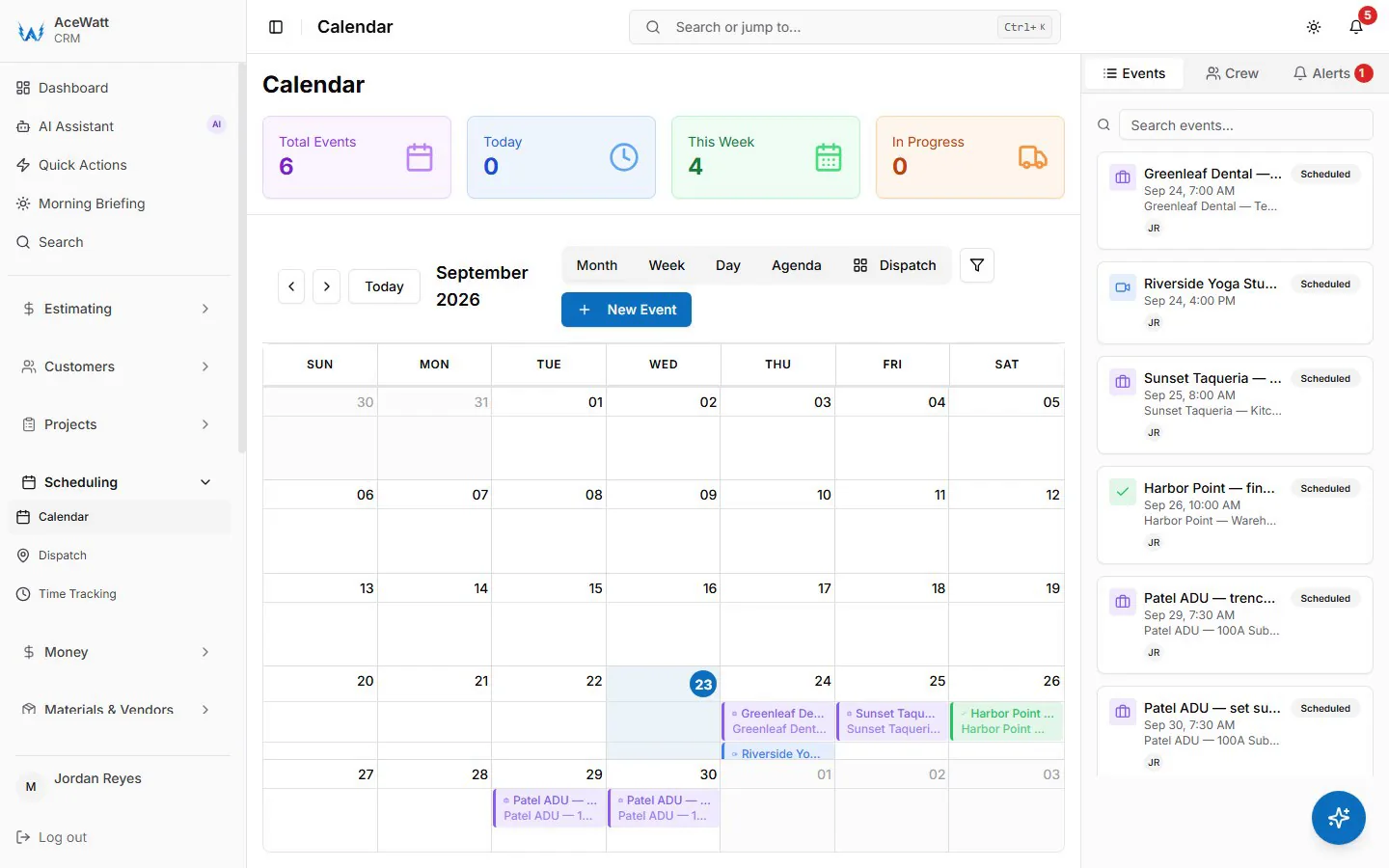
Dispatch for EV work has to match more than a date. A service upgrade needs a licensed electrician comfortable coordinating a utility disconnect, and those meter appointments can carry one to three week lead times the schedule has to hold. A basic Level 2 circuit suits most techs. Commercial pedestal mounts may need a trencher or a lift in addition to the crew.
Electrical dispatch software earns its keep on sequencing. Cluster residential installs by ZIP to cut windshield time. Book installs so the inspection request lands inside the same week, since many jurisdictions turn EVSE inspections around in two to five business days. On federally funded corridor projects, FHWA rules attach a 97 percent uptime requirement, which makes commissioning and follow-up visits part of the schedule from day one. A solo electrician gets the same benefit in miniature: inspection days blocked, install days clustered, and the next open slot offered to a hot lead while they are still on the phone saying yes. The dispatch board holds the slot, sends the confirmation, and the job is on the calendar before the call ends.
5. Job Walk Documentation and AI Voice Notes for Site Conditions and Change Orders
The job walk decides whether the estimate holds. Panel brand and condition matter: a 200A panel with open slots and a sound bus is a two-slot add, while a Zinsco or Federal Pacific Stab-Lok panel, brands associated with breaker trip failures, converts the job into a panel replacement and a repriced quote. Wall construction changes labor: mounting on drywall in an open garage takes minutes, while stucco or brick on an exterior wall with conduit run takes hours.
AI voice and job walk documentation lets the electrician capture all of this hands-free. Talk through the findings while walking the site, and the transcript lands on the job record with the photos: main breaker rating, spare slots, meter location, proposed conduit route, trench feet, and how the customer wants the cable managed. Customer requests get recorded in their words. When the homeowner later asks why the charger sits on the far wall, the dated voice note answers: that was the only route that avoided the finished ceiling.
Change orders follow the same path. The trench hits ledge rock, the customer upgrades from a 40-amp to a 48-amp unit on the spot, and the verbal agreement becomes a documented change order with a timestamped voice note, photos, and customer approval captured in the app. That record settles disputes, and it doubles as the documentation bundle most utility rebate programs ask for: serial number, install date, photos of the mounted unit and the panel, and in some jurisdictions a copy of the load calculation worksheet.
6. Tracking EV Charger Jobs in Real Time: Materials, Inspections, and Customer Updates
Between permit submittal and final inspection, an EV job touches a permit office, an equipment supplier, sometimes a utility, and the homeowner, and every one of them can stall it. Job tracking keeps each dependency visible on one screen: permit submitted, permit issued, charger ordered, charger delivered, utility disconnect scheduled, inspection requested, inspection passed.
Materials deserve their own status. Wall connectors and pedestals run in and out of stock, and a job scheduled before the equipment is confirmed on the truck burns a slot. The job record should show the order date, the promised ship date, and who received it, so the dispatcher reschedules around reality instead of discovering an empty shelf the morning of the install.
Customer updates are part of tracking, and they cut inbound calls. Automated status messages at permit issue, equipment delivery, and scheduled inspection answer the questions that otherwise arrive as phone calls during working hours. On commercial make-ready work, the same updates go to the general contractor and the site owner, which keeps milestone billing anchored to documented completion dates.
7. Time and Material Billing, Invoicing, and QuickBooks Sync for EV Charger Work
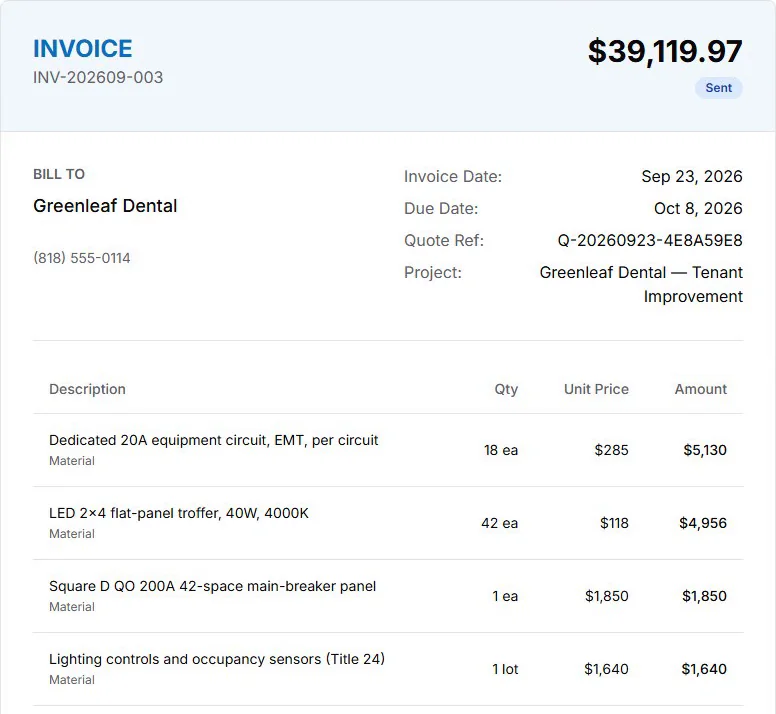
EV work bills in two modes: flat-rate for the clean Level 2 circuit, and time and material for everything the walk uncovered. The service upgrade, the unexpected trench, and the panel replacement found mid-job all belong on a T&M ticket with hours and materials priced at your published rates.
Electrical time and material billing software captures both inputs at the source. Techs clock in and out on the job, so drive time, install time, and inspection wait time sit on separate lines. Material receipts are photographed and attached, priced with your markup, and tied to the job cost record. An electrician invoice app then builds the ticket while the tech is still on site, sends it to the customer's phone before the truck leaves, and takes payment by card the same day instead of in forty-five days.
Deposits and progress billing follow the job type. Residential service upgrades warrant a deposit, commonly 50 percent, before the panel and charger are ordered, since that equipment is special order in many markets. Commercial make-ready projects bill by milestone, and many carry 10 percent retainage held until final acceptance, which the system tracks as an open balance separate from an unpaid invoice.
QuickBooks integration for electrical contractors keeps the accounting side honest. Invoices, payments, deposits, and job costs sync without re-entry, so revenue in the software matches revenue in the books, and the margin on each EV job is computed from actual labor hours and actual material costs instead of the estimate alone.
8. Automated Follow-Up That Turns EV Charger Leads into Repeat and Referral Work
The EV market feeds itself. The customer who bought a charger for one EV buys a second unit two years later, adds a battery, upgrades the panel for a heat pump, or refers a neighbor who just took delivery. Property managers with EV-ready requirements under CALGreen or local ordinance install in phases, and fleet operators build out depot charging one bay at a time. Every completed install sits at the top of a list of future ones.
Automated follow-up works the list on a schedule. A three-touch sequence on open quotes, typically day one, day three, and day seven, catches the homeowner comparing three bids. Rebate deadline reminders push the hesitant lead to sign before the utility program's install-by date lapses. After energization, the sequence asks for a review once the inspection passes, checks in at the twelve-month mark while the charger warranty runs, and offers an annual inspection of terminations and grounding, a recurring service the same customers already trust you to perform.
None of this runs on memory. The CRM fires each touch from the job stage, so follow-up happens at the same standard whether the shop is running five EV jobs a month or fifty.
9. Choosing EV Charger Job Management Software Built for Electrical Contractors
EV charger installation software should be judged on trade fit, and the fastest test is what happens at the estimate. A tool built for electrical contractors carries Article 625 line items, triggers the 220.83 load calculation question, prices panel upgrades and EVEMS options, and attaches the load calc to the permit package. A generic tool asks for a job description and a price.
Beyond estimating, evaluate five things. First, documentation: voice notes, photos, and change orders must live on the job record with timestamps rather than in a separate folder. Second, dependency tracking: permit status, utility appointments, equipment delivery, and inspection dates need their own fields and alerts. Third, billing: the system must handle flat-rate quotes, T&M tickets, deposits, retainage, and card payments taken on site. Fourth, QuickBooks support: QuickBooks-ready exports of the invoice list and payroll hours — not a native two-way sync; confirm the exact sync behavior with any vendor during the trial. Fifth, field usability: the app has to work in a garage with one bar of signal, with offline entry that syncs later.
Then run a pilot. Put the next five EV jobs through the software end to end, from web form lead to exported invoice, and measure the two numbers that matter: quote turnaround time and days to payment. Those two intervals are where field service management for electricians shows whether it is worth the subscription for your shop — the right system earns it in the first month, but verify on your own jobs.