

What Software Helps Electricians Manage EV Charger Jobs? A 2026 Module-by-Module Guide
EV charger work has become a dependable revenue line for electrical contractors across the US, but it does not run like a service call or a panel swap. Between NEC Article 625 requirements, panel capacity surprises, utility rebate paperwork, and commercial projects that stretch across months, EV work stresses estimating, dispatch, documentation, billing, and follow-up all at once. Contractors asking what software helps electricians manage EV charger jobs usually find the answer the hard way, after a generic work-order tool fails its first permit-driven project. The right answer is a platform built for electrical contractors, where the job runs through named modules: an AI-powered CRM, AI Estimating, Crew Scheduling and Dispatching, Job Tracking with AI Voice and Job Walk Documentation, Invoicing and Payment Tracking with QuickBooks-Ready Exports, and Automated Follow-Up. Generic field service software treats a Level 2 install as one more ticket. EV work is a permit-driven, rebate-documented project, and it needs to be managed like one.
1. Why EV Charger Jobs Are Different From Standard Electrical Work in 2026
Most residential Level 2 installs land in a narrow technical band: a 7.7kW to 11.5kW charger drawing 32A to 48A on a dedicated 240V circuit protected at 40A or 50A. Article 625 treats EVSE as a continuous load, so branch-circuit conductors and overcurrent protection are sized at 125% of rated current. The job starts with a load calculation on an existing service, not with pulling wire.
Four realities separate EV work from standard residential electrical:
- Panel capacity is the deciding variable. Site walks routinely uncover a 100A or 125A service with no headroom, turning a $1,200 charger install into a $2,500 to $4,500 service upgrade with utility coordination attached.
- Code keeps shifting. The 2023 NEC requirement for GFCI protection on EV charging receptacles (625.54) pushed many installs toward hardwired connections, which changes materials, labor, and quoting. State adoption and local amendments vary, so the system of record needs to hold jurisdiction-specific requirements, not national assumptions.
- Documentation is a paid deliverable. Homeowners pursue utility rebates worth $500 to $1,500, and commercial customers pursue the federal 30C credit, which is scheduled to sunset for property placed in service after June 30, 2026. Both demand clean, itemized paperwork from the contractor, filed on time.
- Timelines split in two directions. A residential install can move from inquiry to inspection in one to two weeks. A commercial or multi-unit job runs six weeks to six months with utility approvals, load letters, trenching, and phased inspections in between.
That combination is exactly where generic tools break down, and it is why purpose-built EV charger installation software for electricians exists as its own category.
2. The Full EV Charger Job Lifecycle: From First Inquiry to Final Inspection
For the same lifecycle broken into ten concrete stages with the money leaks at each handoff, see how to manage EV charger installation jobs end to end.
Every EV charger job passes through the same milestones, whether it takes ten days or ten months:
- Inquiry captured in an AI-powered CRM (referral, web form, fleet RFP)
- Site walk scheduled, performed, and documented
- Estimate built from templates and job walk data
- Proposal accepted, deposit collected
- Permit pulled with the local AHJ
- Charger unit and materials ordered against the deposit
- Install scheduled around permit approval, delivery, and utility work
- Installation completed, inspection passed
- Rebate and tax credit documentation package delivered
- Final payment collected, follow-up scheduled
The software must surface every EV install as a milestone-based pipeline rather than a flat status flag, so the office can see at a glance which jobs wait on a utility, which wait on a deposit, and which are ready to schedule. This staged visibility is the workflow gap behind most searches for job management software for electricians, and EV work exposes it faster than any other job type because so many steps sit outside your control.
3. AI Estimating: Quoting 240V Circuits, Load Calculations, and Panel Upgrades Accurately
Ad-hoc quoting kills EV margins because the variable costs are easy to miss. Electrical estimating software built for this trade should already contain templated line items for EV work:
- Charger unit, with residential 48A hardwired units typically running $400 to $900 supplied
- Circuit materials: 8/3 NM-B on a 40A circuit, 6/3 where a 50A receptacle or 48A hardwired unit requires it, or #6 THHN in EMT with a two-pole breaker
- Hardwired whip or NEMA 14-50 receptacle, mounting, and circuit labeling
- The load calculation itself, using NEC 220.57 (7.2kVA per charger for service sizing) and the 220.83 optional method for existing dwellings
- Panel or service upgrade priced as a separate option with its own materials list: 200A meter-main, new grounding electrode system, feeder replacement, and the utility's disconnect and reconnect appointments
AI Estimating earns its keep at the point where the job walk meets the template. Because the walk was documented with voice notes and photos, the estimate starts from facts: the actual main breaker rating, the actual open slots, the actual conduit routing. Templates apply consistent markup instead of gut-feel pricing, and recurring soft costs like permit fees, torque verification per 110.14(D), and inspection time stop disappearing from quotes. Presenting the service upgrade as a priced Option B rather than a surprise change order also protects close rates on the $1,200 jobs that turn into $4,000 jobs.
4. Crew Scheduling and Dispatching for Site Assessments, Installs, and Utility Coordination
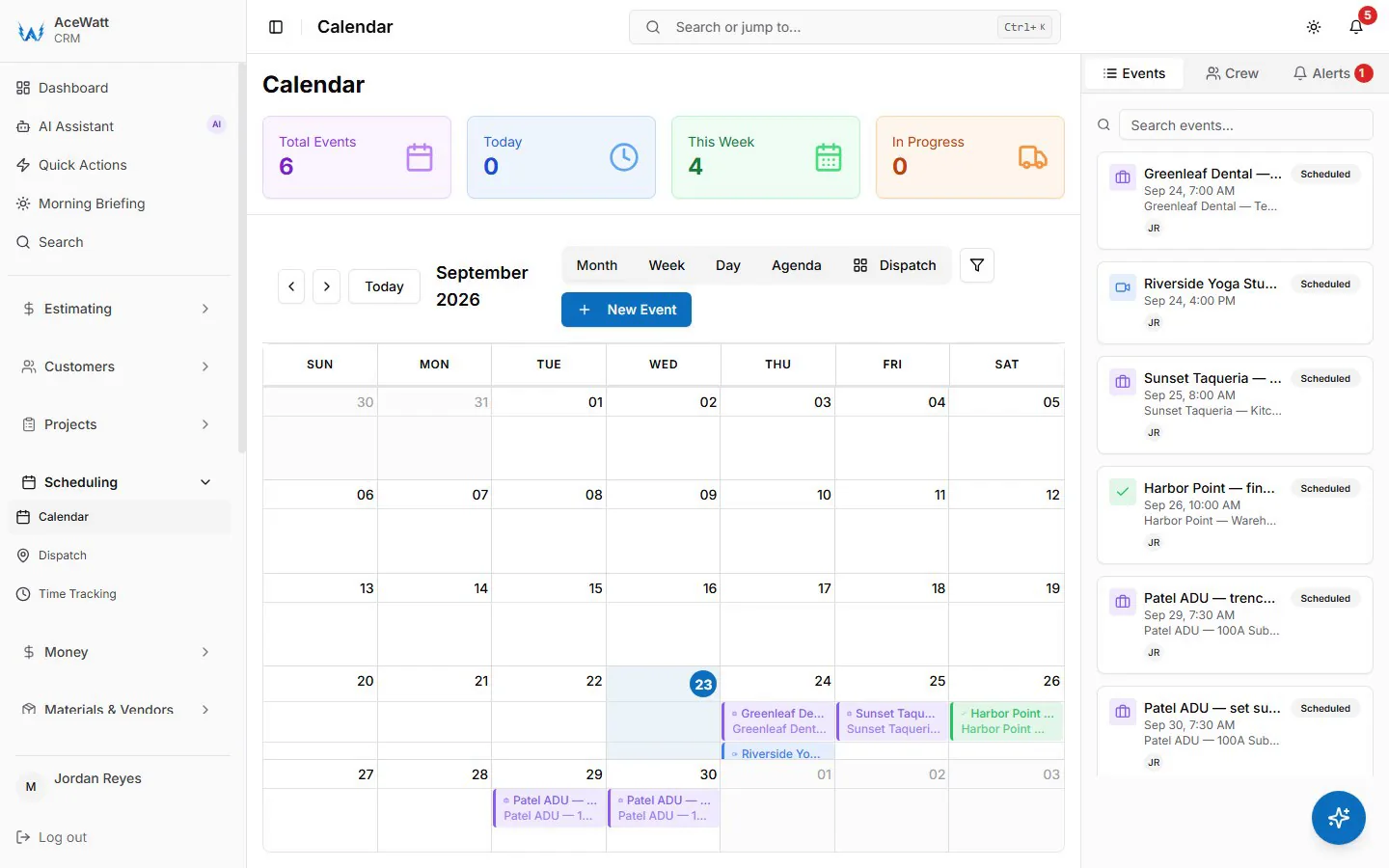
EV work creates three distinct schedule demands that a shared calendar cannot handle:
- Site assessments are short and dense. They run 20-40 minutes, so they belong in route-efficient blocks rather than scattered across the week. Electrician dispatch software groups them geographically so one morning covers five leads instead of two.
- Installs depend on external events. An install should only book once the permit is approved, the charger has shipped, and any utility appointment (meter swap, service disconnect and reconnect) has a confirmed window. EV charging installation scheduling software ties booking to those upstream milestones automatically, which eliminates the reschedule churn that eats a full day every time a unit arrives late.
- Skills and certifications gate eligibility. Some utility and state rebate programs require EVITP-certified electricians on the install, and manufacturers often require certified installers for warranty terms. Skill-based suggestions on the dispatch board help put the right tech on the job, but checking EVITP certification stays with you.
For solo electricians, the same logic compresses: assessment slots on two afternoons, install days blocked a week out, and no install booked until the permit and the charger are physically in hand. For shops running commercial work, dispatch has to coordinate two-person crews, trenching contractors, and phased inspections across a multi-week timeline without anything falling through a crack between spreadsheets.
5. Job Tracking and AI Voice Job Walk Documentation for Permits, Photos, and Panel Notes
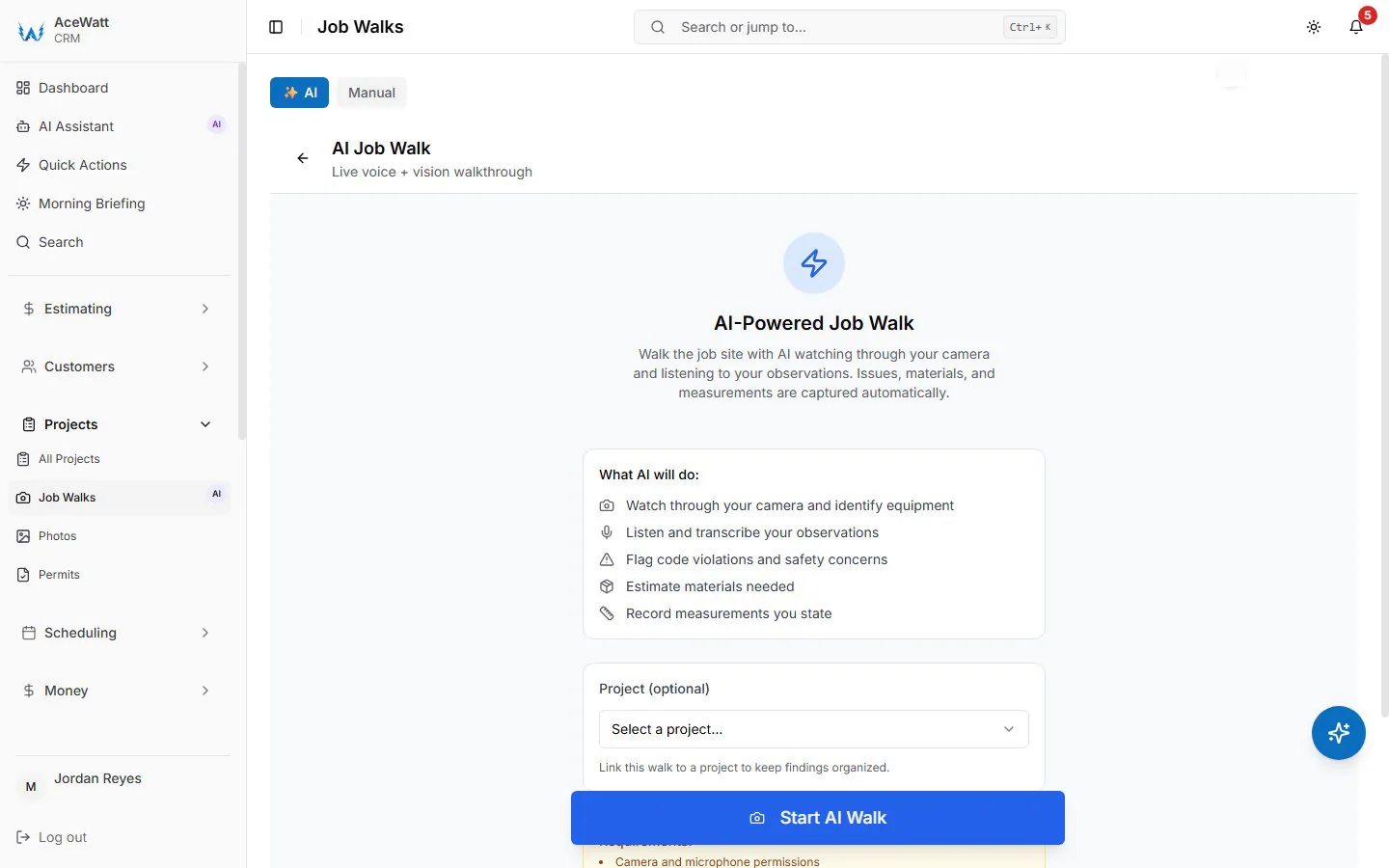
EV charger job tracking for electrical contractors lives or dies on the quality of the site record. AI Voice and Job Walk Documentation is the differentiator here. During the walk, the tech taps record and speaks the findings: "Main breaker 100A, Siemens panel, six open slots, meter-main on the north wall, roughly 60-foot run to the garage, will need upsized conductors for voltage drop at 48A." The transcription, the panel label photo, and the mounting location photos attach directly to the job record.
That single factual record then feeds everything downstream:
- The estimate starts from actual breaker slots and panel brand, so the materials list specifies the correct breaker series instead of a second trip to the supply house.
- The schedule reflects real complexity, like a long run that adds wire cost and time.
- The install crew arrives knowing the routing, the mounting surface, and whether GFCI requirements push the job to hardwired.
- Permit and inspection tracking holds the AHJ reference number, the permit issue and expiration dates, the inspection appointment, and any correction items from a failed inspection, visible on the same board as every other job stage.
On commercial jobs, the same tracking carries load letters, utility approval documents, and phased inspection sign-offs. When the whole project history sits in one job record, the office answers an inspection question or a rebate dispute in seconds instead of digging through texts and truck folders.
6. Invoicing, Deposits, and Payment Tracking With QuickBooks-Ready Exports for Per-Install Job Costing
EV charger pricing should be deposit-based, commonly 30-50% down covering materials, with the charger unit itself ordered only after the deposit clears. An electrical invoice app built for this workflow handles that structure natively: deposit invoice at proposal acceptance, materials ordered against it, progress draws on commercial jobs at rough-in and equipment delivery, and the final invoice released the day the inspection passes.
The invoicing requirement goes beyond getting paid, because EV invoices are rebate documents:
- Homeowners submit the paid invoice to their utility for rebates of $500 to $1,500, and many programs require filing within 60 to 90 days of installation.
- Businesses claiming the federal 30C credit before the June 30, 2026 placed-in-service sunset need itemized documentation tied to the qualifying location and equipment.
A rebate-ready invoice carries the installation address, the completion date, the permit number, and line items that match the rebate form's language, such as "supply and install 48A hardwired EVSE," "6/3 NM-B dedicated 240V branch circuit," and "50A two-pole breaker." Vague one-line invoices are the most common reason rebate submissions bounce back to the customer, and the customer blames the contractor.
Payment tracking shows at a glance who owes a deposit, who owes a final payment, and which commercial job has a draw outstanding. With QuickBooks-ready exports, every invoice lands on the invoice-list spreadsheet for your bookkeeper, with deposits and payments reflected in its balance; full sync is in development. The payoff is per-install job costing: charger cost, wire and breaker cost, logged labor hours, and permit fees roll up against the invoice total, so you see actual margin on every EV job and adjust the estimating templates before the next one.
7. Follow-Up: Converting EV Leads, Rebate Deadlines, and Fleet Repeat Work
EV buyers have a long consideration cycle. Homeowners often research chargers for months, wait for a new car delivery, or time the purchase around a bonus. Automated Follow-Up covers overdue invoices, with email reminders at 1, 7, 14 and 30 days late, so keeping EV leads warm after the first inquiry and after the site walk is a follow-up you make yourself. The contractor who stays present wins the job when the customer is finally ready, not the one who called once.
Follow-up also protects the rebate promise you made at the estimate:
- Remind customers to file utility rebate paperwork inside the filing window, using the paid, itemized invoice from the job record.
- After the rebate lands, a review request goes out while goodwill is at its peak.
- Annual check-ins reactivate past EV customers for a second charger when a household adds a vehicle, a maintenance and torque verification visit, or