

Electrical Contractor Estimating Software in 2026: From Accurate Bids to Faster Payments
Most electrical shops do not lose money on the wire they pull. They lose it in the gaps between systems: the estimate built on a six-month-old price sheet, the change order agreed to verbally under a panel never added to the invoice, the job walk finding that reshaped the scope but never reached the bid. Electrical contractor estimating software in 2026 is judged by how well it closes those gaps, from the first customer call to the payment that clears the bank. Here is what that looks like in practice, and what to demand from any platform you put in front of your crews.
1. Why Electrical Estimating and Work Order Management Break Down Without the Right Tools
The typical breakdown starts with stale data. A spreadsheet estimating template is only as current as the last time someone updated material pricing, and copper conductor pricing can move by double-digit percentages within a single quarter. A 200A service upgrade bid from a price book last touched in the fall can lose real margin on the wire, breakers, and meter socket alone by spring.
Labor is the second failure point. Gut-feel labor numbers ignore variables the trade deals with every day: old work versus new construction, working from a ladder in a finished ceiling, or driving ground rods in rocky soil. Industry references like the NECA Manual of Labor Units exist precisely because labor hours vary with conditions, and estimates that skip condition-based adjustments systematically underprice jobs.
The third failure point is disconnection. The estimate lives in Excel, the schedule on a whiteboard, the work orders in text messages, and the invoices in QuickBooks, all re-keyed by hand. Every re-entry is a chance to drop a line item. And the change order the homeowner approved in the driveway, or the Federal Pacific Stab-Lok panel discovered during the job walk, never gets folded back into the original bid. On the commercial side, add 5 to 10 percent retention and net-30 to net-60 terms, and any documentation gap becomes a dispute you will likely lose. We break down how the major platforms handle offline work order capture and syncing in our <a href="/blog/best-work-order-apps-for-electricians-with-mobile-syncing">work order apps with mobile syncing comparison</a>.
2. What Electrical Contractor Estimating Software Must Do in 2026
A modern electrical estimating platform has to do more than produce a printable number. At minimum, it should:
- Price from current data. Material costs should reflect what your suppliers are charging now, not a static price book.
- Apply structured labor units. Labor hours should come from a defensible reference and adjust for job conditions, so your bid holds up when the customer pushes back.
- Track the code cycle. Jurisdictions enforce different NEC editions, and while some states move quickly, others are still working through the 2020 NEC as the 2026 edition rolls out. Your estimate template should reflect the requirements you actually have to meet, whether that is expanded GFCI coverage under NEC 210.8 or load calculation documentation for an EV charger circuit under Article 625.
- Carry permit and inspection data. Permit numbers, inspection sign-offs, and AHJ requirements belong on the work order, not in someone's memory.
- Connect downstream. The estimate should convert into a work order, schedule, invoice, and accounting entries without re-typing.
This is where generic field service apps fall short. Plumbing and HVAC work is labor-dominant with modest material lists. Electrical bids are material-heavy stacks of dozens of line items, each with pricing, labor, and code context. Electrical contractor software in 2026 has to be built for that reality.
3. AI-Powered Estimating: Turning Material Lists into Accurate Bids Faster
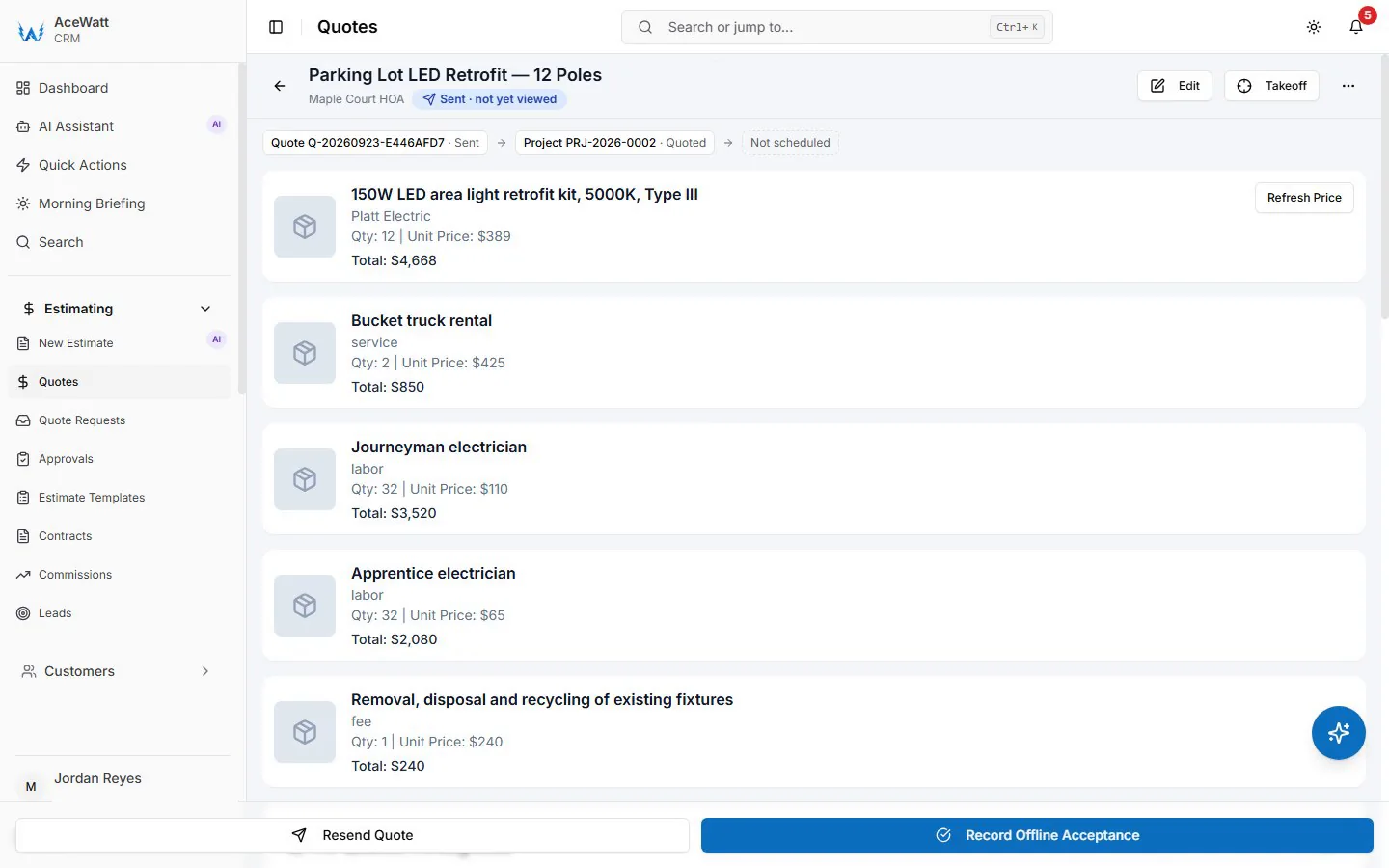
AI electrical estimating software changes the economics of the bid itself. Instead of manually keying a takeoff line by line, you feed in your material list, scope notes, or job walk findings, and the AI maps each line to a catalog item with current pricing and an appropriate labor unit. What took an evening at the kitchen table takes minutes.
The bigger value is consistency and gap detection. A well-built estimator does not forget the little things that eat margin: the breaker for the new subpanel, the GFCI receptacles now required in locations covered by NEC 210.8, the torque requirements under NEC 110.14(D) that mean calibrated tools and real time on terminations. When every estimate follows the same structure, your win rate and your margin stop swinging with how tired you were when you priced the job.
Speed also wins work. A customer who calls three shops and gets your itemized bid the same afternoon is comparing everyone else against you, not the other way around.
The right model keeps you in control. AI drafts the estimate, applies pricing and labor units, and flags anomalies, but a licensed electrician reviews and approves before anything goes out the door. The tool makes your judgment faster, not obsolete.
4. Work Order Management: From Job Creation to Crew Dispatch
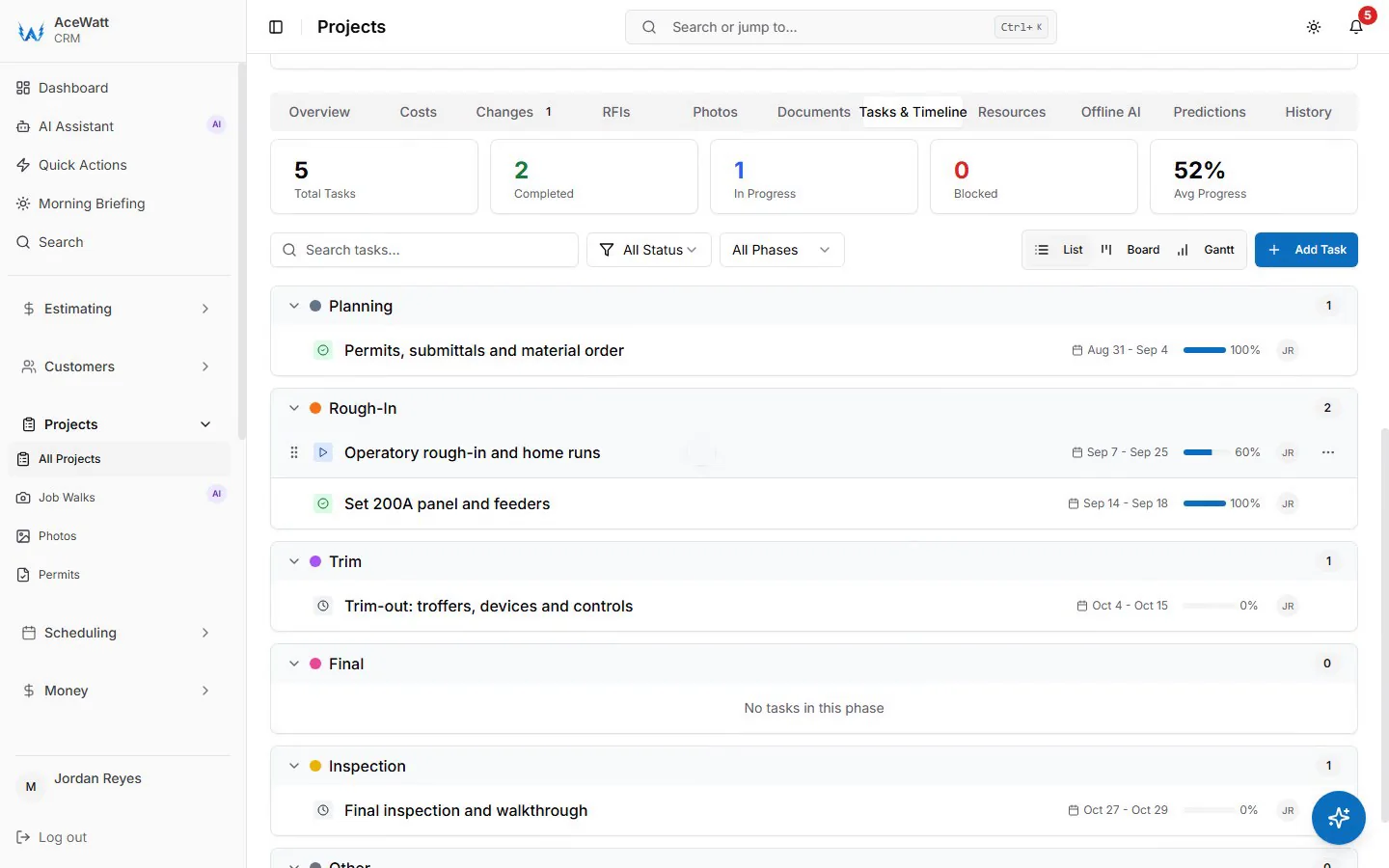
An accepted estimate should become a work order automatically, carrying every line item, note, and attachment forward. That single conversion is where most shops leak data, and electrical work order software exists to stop it.
From there, scheduling and dispatch take over. For a solo electrician, that means seeing the week on one screen and slotting an emergency no-power call without double-booking a panel upgrade. For a growing shop, dispatch means matching the job to the right license level and skill set: a Master electrician pulling the permit and handling the service change, a journeyman and apprentice on the rough-in, and the nearest qualified tech on the after-hours call. It also means route logic that stops sending someone across the county twice in a morning.
Job tracking keeps the office and the field on the same page. Every work order shows status from dispatch through completion, with photos, inspection results, and customer signatures attached.
This is also where field documentation earns its keep. With AI voice and job walk documentation, a tech narrates findings while standing at the panel, and the note lands on the work order structured and searchable: existing conditions, the corroded grounding electrode conductor, the prior owner's questionable splices. Before and after photos of the panel directory and terminations take seconds and end arguments later. Electrical field service management software that slows crews down gets abandoned, so capture has to be this fast.
5. Connecting Estimates to Job Tracking, Invoicing, and Payment Tracking
When the work order closes, the invoice should already be 90 percent built. Materials from the estimate, logged labor hours, and every approved change order flow onto the document without re-entry. That is the difference between billing the day the job finishes and billing two weeks later, and it is the core function of a serious electrician invoice app: itemized, professional, and ready to collect payment by card or ACH on site.
Deposits belong in this workflow too. Long lead times on switchgear, transformers, and generator transfer switches make deposits and documented scope essential on bigger jobs. If the customer has paid a deposit against a specific equipment list, disputes over substitution or delay get resolved by the record, not by negotiation.
Payment tracking then does the quiet work. The platform should show aging at a glance, automate reminders so you are not making awkward collections calls, and track retention separately on commercial jobs so released retainage does not quietly disappear. Automated follow-up has a second life after the invoice clears: recall reminders for panel inspections, review requests after residential work, and seasonal offers like whole-home surge protection or EV charger circuits for customers you have already served.
6. QuickBooks Sync and Electrical Accounting: Closing the Back-Office Gap
QuickBooks for electrical contractors works when the data flowing into it is accurate, and breaks when it is not. Job costing, receivables, and tax reporting all depend on the chain from estimate to invoice to payment staying intact. If your office manager re-keys invoices and applies payments by hand, that chain breaks somewhere every week.
Real QuickBooks accounting sync means customers, items, invoices, and payments flow between systems, with payments posted against the right customer and job. Materials map to Cost of Goods Sold, labor posts to the right accounts, and job-level tracking lets you answer the question every contractor should be able to answer: which job types actually made money last quarter? That is electrical accounting software doing its job: turning field activity into books your accountant can trust without you becoming a bookkeeper.
7. How AceWatt Supports Electrical Shops from Bid to Payment
AceWatt connects the entire bid-to-payment cycle in one platform built for electrical work:
- AI-powered CRM captures every lead on one customer record, so a missed call does not become a missed estimate.
- AI Estimating drafts a quote for your review from material lists and scope notes, priced from your company pricebook and assembly templates.
- Crew Scheduling and Dispatching puts jobs on a drag-and-drop dispatch board with skill-based suggestions, and handles emergency calls without blowing up the day's plan.
- Job Tracking gives the office live visibility from dispatch through completion.
- AI Voice and Job Walk Documentation captures field conditions, notes, and photos without slowing crews down.
- Invoicing and Payment Tracking invoices accepted quotes automatically, lets the office build itemized invoices from closed work orders with a button, and collects card payment online through a pay link.
- Automated Follow-Up emails reminders on overdue invoices at 1, 7, 14 and 30 days late.
- QuickBooks-Ready Exports hand your bookkeeper the invoice list and payroll hours; job costing and receivables stay accurate in AceWatt.
For a solo electrician, it replaces a stack of disconnected subscriptions with one login. For a growing shop, it gives the office and the field a single source of truth from the first call to the final payment.
8. Choosing the Best Tool Stack for Solo Electricians and Growing Electrical Contractors
Whether you are evaluating the best CRM for electrical contractors or a full electrical job management software replacement, apply the same test:
- Is it trade-specific? Generic apps stumble on material-heavy estimates, permit-driven job details, and license-based dispatch.
- How deep is the estimating? Look for current material pricing, structured labor units, and AI drafting with human review.
- Does data flow all the way through? Estimate to work order to invoice to QuickBooks, with no re-keying at any step.
- Can the field actually use it? Documentation that takes more than a voice note and a photo will not survive contact with a real jobsite.
- What is the total cost? Five narrow subscriptions at $20 to $70 a month each often cost more than one connected platform, with none of the integration.
Solo electricians should prioritize one system that runs everything from their phone. Growing contractors should add reporting depth, a dispatch board the office can run, and user permissions that scale with headcount. Either way, the goal is the same: accurate bids, documented work, faster payments, and clean books. The shops that get there in 2026 will be the ones whose software connects every step, not just the ones with the nicest estimate template.