

Why Slow Bidding Is Quietly Killing Margins for Electrical Contractors in 2026
The math is brutal: every hour you spend hunched over blueprints counting 4-square boxes and measuring conduit runs is an hour you're not running jobs, not managing crews, and not collecting checks. In 2026, the electrical contractors winning commercial build-outs, service agreements, and tenant improvement work aren't the ones with the sharpest pencils. They're the ones who submit accurate bids before the GC's deadline while their competitors are still highlighting PDFs.
The margin erosion happens in three places: missed line items on takeoffs, stale material pricing between bid submission and approval, and follow-up that never happens because you're buried in the next estimate. Electrical estimating software that combines AI takeoff, live material databases, and automated follow-up doesn't just save time. It plugs the leaks where profit disappears.
How AI Estimating Turns Blueprints and Job Walk Notes Into Line Items
Manual takeoff is where bids go wrong. Counting 150 recessed can lights across 40 sheets of architectural drawings, tracing 2,400 linear feet of ¾" EMT through ceiling spaces, identifying every 20A GFCI receptacle in a hospital renovation: one missed sheet or miscounted symbol cascades into labor overruns and material shortages.
Modern AI estimating changes the workflow. Upload the PDF plan set and AI Estimating drafts a quote for your review, priced from your company pricebook and assembly templates. It gives you a starting list, not a finished count: symbol counts from plans are not reliable yet, so check fixture, device, and conduit quantities against the drawings before the bid goes out.
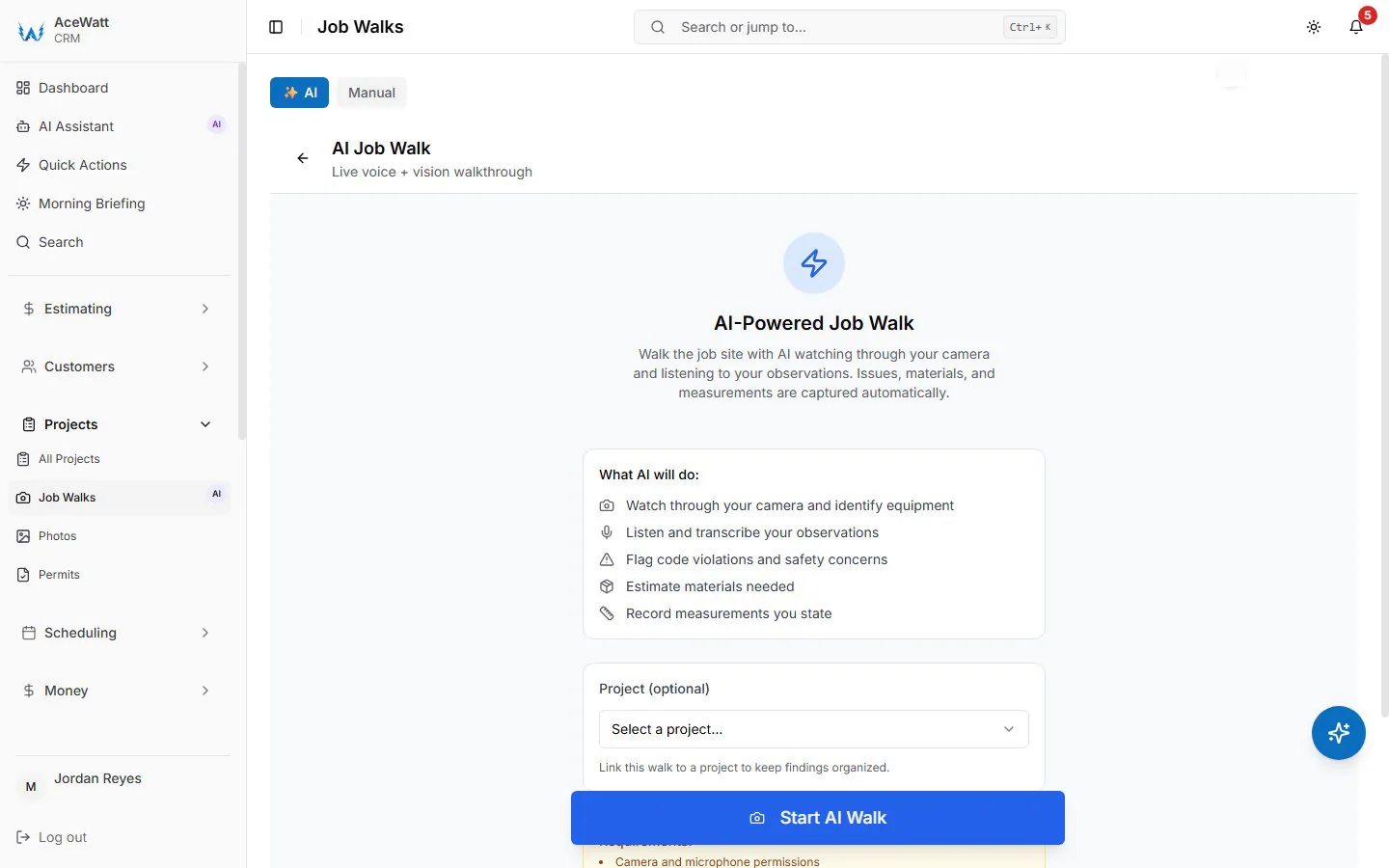
But plans never tell the whole story. That's where AI Voice and Job Walk Documentation comes in. Walk the site, dictate observations ("existing 200A panel at west wall needs 42-circuit subpanel, 3-phase, 4-wire") and the system transcribes, parses, and converts those notes into line items: (1) 42-circuit 200A 3-phase panelboard, (4) 3/0 THHN, (1) 2" PVC conduit, (2) 2" PVC 90° elbows, (4) 2" PVC couplings, labor units for panel swap and feeder pull.
No re-keying. No "I'll enter this when I get back to the office." A draft estimate is ready for your review while you're still on site.
Electrical-Specific Assemblies: Conduit, Wire, Panels, Devices, and Fixtures
Generic construction estimating software forces you to build assemblies from scratch, or worse, use residential defaults that don't match commercial specs. Electrical estimating software built for the trade ships with pre-configured assemblies that reflect how electricians actually work:
Conduit assemblies: ½" EMT with set-screw connectors and straps every 10 feet, ¾" PVC Schedule 40 with glue joints and expansion fittings every 50 feet, 1¼" RMC with threaded couplings and grounding bushings. Each assembly includes the correct labor units from NECA standards: 0.18 hours per 10 feet for ½" EMT, 0.25 hours for ¾" PVC, 0.45 hours for 1¼" RMC.
Wire pulls: #12 THHN in ½" EMT (9 wires max per NEC 358.22), #10 THHN for 20A circuits with voltage drop calculations baked in, #4/0 AL for 200A feeders with anti-oxidant compound and torque specs.
Panel assemblies: 42-circuit 200A 3-phase panelboard with main breaker, ground bar, and 25% spare capacity. The assembly auto-populates: panel, breakers (15A, 20A, 30A, 2-pole 40A, 2-pole 60A), ground bar kit, directory card, and labor for mounting, terminating, and labeling.
Device packages: Hospital-grade 20A GFCI receptacles with stainless plates, 3-way switch combinations, occupancy sensors with relay packs, USB-C outlet combinations. Each includes the box, mud ring, device, plate, and pigtails.
Fixture packages: 2×4 LED troffers with emergency battery packs, 6" downlights with IC-rated housings, high-bay fixtures with motion sensors and 0-10V dimming drivers. Voltage, wattage, and control wiring all accounted for.
You drag the assembly onto the takeoff, adjust quantities, and the bid updates: material cost, labor hours, and crew-day calculations all recalculate instantly.
Keeping Up With Copper, Conduit, and Material Price Volatility Across Active Bids
Copper hit $4.85/lb in Q1 2026. EMT pricing swung 18% between January and March. PVC conduit fittings are still allocating from two major manufacturers. If you bid a $180K tenant improvement on March 1st using February pricing, and the GC doesn't award until April 15th, you're eating the difference, or submitting a change order before you've even mobilized.
The solution isn't a spreadsheet you update manually. It's a live material database integrated with distributor APIs (CED, Graybar, Rexel, local supply houses) that pushes current pricing into every open estimate. When #10 THHN jumps from $1,240/M to $1,420/M, every bid containing that wire updates automatically. You see the impact on gross margin in real time: "Bid #2347: margin dropped from 28% to 22% on copper escalation alone."
You can lock pricing at bid submission, set escalation clauses tied to published indices (COMEX copper, PPI for conduit), or build contingency lines that the system tracks separately. When the GC asks for a breakdown, you export a clean material escalation report, not a handwritten note on a yellow pad.
Follow-Up: Stop Losing Bids Because You Forgot to Call Back the GC
The bid is submitted. The GC says "we'll review next week." Three weeks later, you learn they awarded to a competitor who followed up twice, answered an RFI in four hours, and sent a revised breakdown when the owner value-engineered the lighting package.
Automated Follow-Up in the CRM covers overdue invoices, not open bids, so bid follow-up is a cadence you run yourself. One that works once an estimate is submitted:
- Day 1: Email to estimator and PM with bid summary, exclusions, and link to view the estimate online
- Day 3: Email to GC: "Following up on Bid #2347, 42nd Floor TI. Happy to walk through any questions on the electrical scope."
- Day 7: Reminder to your PM: "Bid #2347, no response from GC in 7 days. Recommend call."
- Day 14: Email with value-engineering options: "If budget is tight, we've priced alternate fixture package (Lithonia vs. spec'd Cooper) saving $18K."
- Day 21: Final check-in: "Assuming direction by Friday. Holding pricing through 4/30."
Log each touch on the customer record. The GC sees professional persistence, not desperation, and you see which bids are stale, which need a call, and which are dead so you can reallocate estimating bandwidth.
From Approved Estimate to Dispatched Crew: Job Tracking, Scheduling, and Invoicing
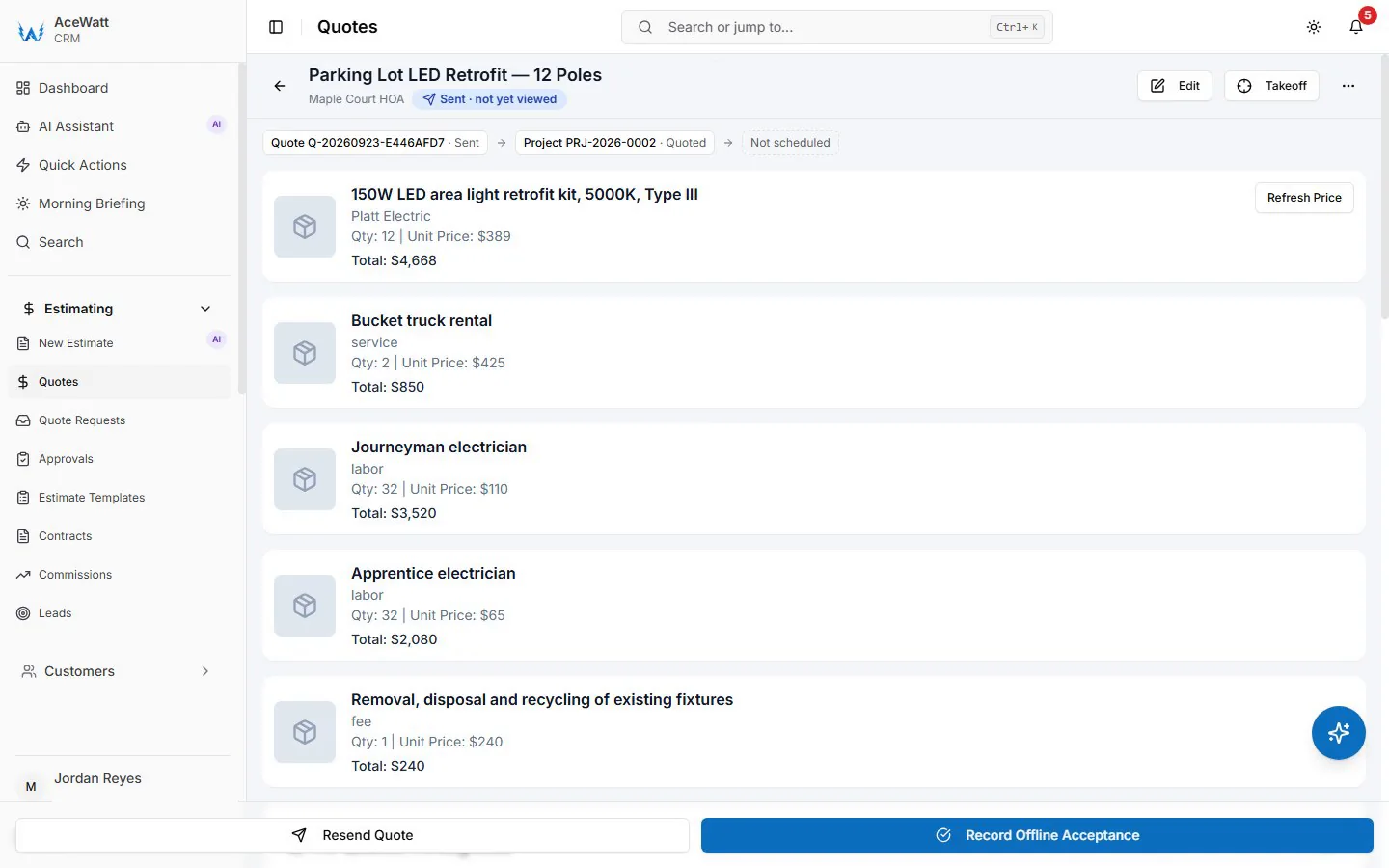
The bid is approved. Now the disconnect begins: the estimator hands off a PDF, the PM re-enters line items into a project schedule, the foreman gets a paper packet missing the fixture schedule, and accounting chases deposit checks against a contract they've never seen.
Approved estimates should flow directly into execution, with no re-keying or translation errors. When the GC signs, the system:
- Creates the job with all phases, tasks, and labor budgets intact from the estimate
- Generates the material pull list sorted by vendor, with PO numbers ready to send
- Loads Crew Scheduling and Dispatching with crew-day allocations: "Phase 1, Rough-in: 3 JWs + 1 Apprentice × 8 days starting 5/6"
- Populates Job Tracking with budget vs. actual: labor hours, material costs logged at cost, change orders, daily reports
- Triggers Invoicing and Payment Tracking: the invoice emailed with a pay link at acceptance (a deposit invoice first, if you take one); a project billed by milestone (percentage of completion) instead gets each milestone's invoice drafted and sent by you
The foreman opens the mobile app on day one and sees: today's tasks, material deliveries scheduled, redline drawings, and the exact fixture count per room. The PM sees real-time labor burn: "Rough-in at 62% of budgeted hours, 55% complete, trending 7% over." Accounting sees the deposit hit the bank and the milestone invoice go out at 50% completion.
QuickBooks-ready exports give your bookkeeper the invoice list, progress invoices included, as a spreadsheet and payroll hours as a QuickBooks-format CSV (full sync is in development), and year-end WIP reporting pulls from live job data, not a frantic spreadsheet reconstruction in January.
Choosing Electrical Estimating Software That Scales From Solo Electrician to Multi-Crew Shop
A solo electrician running service calls, panel swaps, and small TIs needs something different than a 15-truck shop bidding $2M commercial projects. But both need the same core: accurate takeoffs, current pricing, and a path from bid to invoice that doesn't require three separate logins.
For the solo electrician: AI takeoff on a tablet at the kitchen table. Voice notes from the job walk. Assemblies for the 20 jobs you actually run: 200A panel swaps, EV charger installs, recessed lighting retrofits, service upgrades. Automated follow-up that feels personal ("Hey, just checking in on that panel swap quote"), not robotic. QuickBooks Sync so Saturday bookkeeping takes 20 minutes, not three hours.
For the growing shop: Multi-user estimating with role permissions (estimator, PM, owner). Bid packages with cover sheets, scope letters, and alternates formatted for GC submission. Crew scheduling that handles union rules, apprenticeship ratios, and prevailing wage tiers. Job costing that rolls up to division-level P&L so you know which work types make money. API access for integration with Procore, Autodesk Construction Cloud, or the GC's portal.
The trap to avoid: Software built for general contractors that "has an electrical module." Those modules don't know the difference between MC cable and AC cable, or that 350 MCM AL needs different lug torque than 350 MCM CU. They don't have NECA labor units. They don't sync with your supply house pricing.
Electrical estimating software built by electricians, for electricians, speaks the language: pipe, wire, boxes, gear, trim. It respects the trade.
The Bottom Line
In 2026, the contractors growing their backlog and protecting their margins aren't working harder at estimating. They've changed how they estimate. AI takeoff eliminates the counting errors. Live pricing eliminates the material surprises. Automated follow-up eliminates the silent losses. Integrated job execution eliminates the handoff friction.
The result: bids go out in hours, not days. Margins are visible at submission, not discovery at closeout. Crews show up with the right material, the right plan, and the right budget. Books reconcile monthly, not annually.
That's not a productivity tool. That's a business model.