

CRM for Electrical Contractors With Dispatch Integration: One Job Record, Zero Re-Keying
The Double-Entry Tax on Electrical Shops in 2026
In most two- to six-truck electrical shops, the same job gets typed into software between two and four times before the check clears. It goes into the CRM (or a spiral estimate pad) when it is sold, onto the dispatch board the next morning, into the invoice app when the work wraps, and into QuickBooks at the end of the week. Every one of those keystrokes is a chance for the job to drift.
Here is how the drift actually happens. You sell a 200A service upgrade over the phone on Tuesday. The estimate specifies 3/0 THHN copper, a 2-inch riser, and a meter main to satisfy the exterior emergency disconnect requirement under NEC 230.85, with the dwelling load calc run to NEC 220.82. The customer approves. Wednesday morning the office rebuilds the job from scratch on the scheduling board: the scope shrinks to "200A upgrade," the material list drops off, the load calc disappears entirely. The tech arrives with incomplete specs, the permit set does not match the estimate, and the invoice gets built partly from memory. Now you are renegotiating a line item you already priced correctly once.
The math on this is not abstract. A two-truck shop running 20 jobs a week, with two to three manual passes per job at 8 to 12 minutes each, burns roughly 6 to 10 hours a week on pure transcription. A six-truck shop at 60 jobs a week loses 20 to 30 hours. That is a part-time office hire, or every Sunday night, spent moving data between systems that should already be talking to each other.
What CRM-Dispatch Integration Actually Means for an Electrical Contractor
Integration is not a Zapier workaround or an export button. A true CRM for electrical contractors with dispatch integration means the job has one record from the first phone call to the final invoice. Scheduling becomes a status of the sale, not a separate database.
The test is simple. When your dispatcher opens a job on the schedule, can they see the approved estimate, the load calculation, the permit number, panel photos, and payment history without leaving that screen? Generic sales CRMs stop at Closed Won. Standalone dispatch boards track trucks but have never heard of the customer. Electrical contractor software that carries both, on one record, is what eliminates the double-entry tax at the source.
From Won Estimate to Dispatched Crew
When a customer approves an estimate built in AI Estimating, the job appears automatically in Crew Scheduling and Dispatching with the customer name, service address, contact number, materials list, and quoted scope already loaded. The dispatcher drags it onto a truck and moves on. Nobody rebuilds the job.
Take a common EV charger install. The estimate carries a 48-amp EVSE on a 60-amp breaker sized for a continuous load under NEC 625, a 6 AWG copper home run, 50 feet of 3/4-inch EMT, and the permit fee. The moment the customer approves, all of it rides onto the ticket. If the homeowner later adds a load-management module, the change order attaches to the same record and the schedule entry reflects the revised scope, not a dispatcher's abbreviation of it.
For the solo electrician, the workflow compresses further. You approve the estimate from your truck between calls and the job lands on your own calendar with the material list attached. Your truck stock list is accurate before you leave the driveway.
The Job Walk Without the Notepad
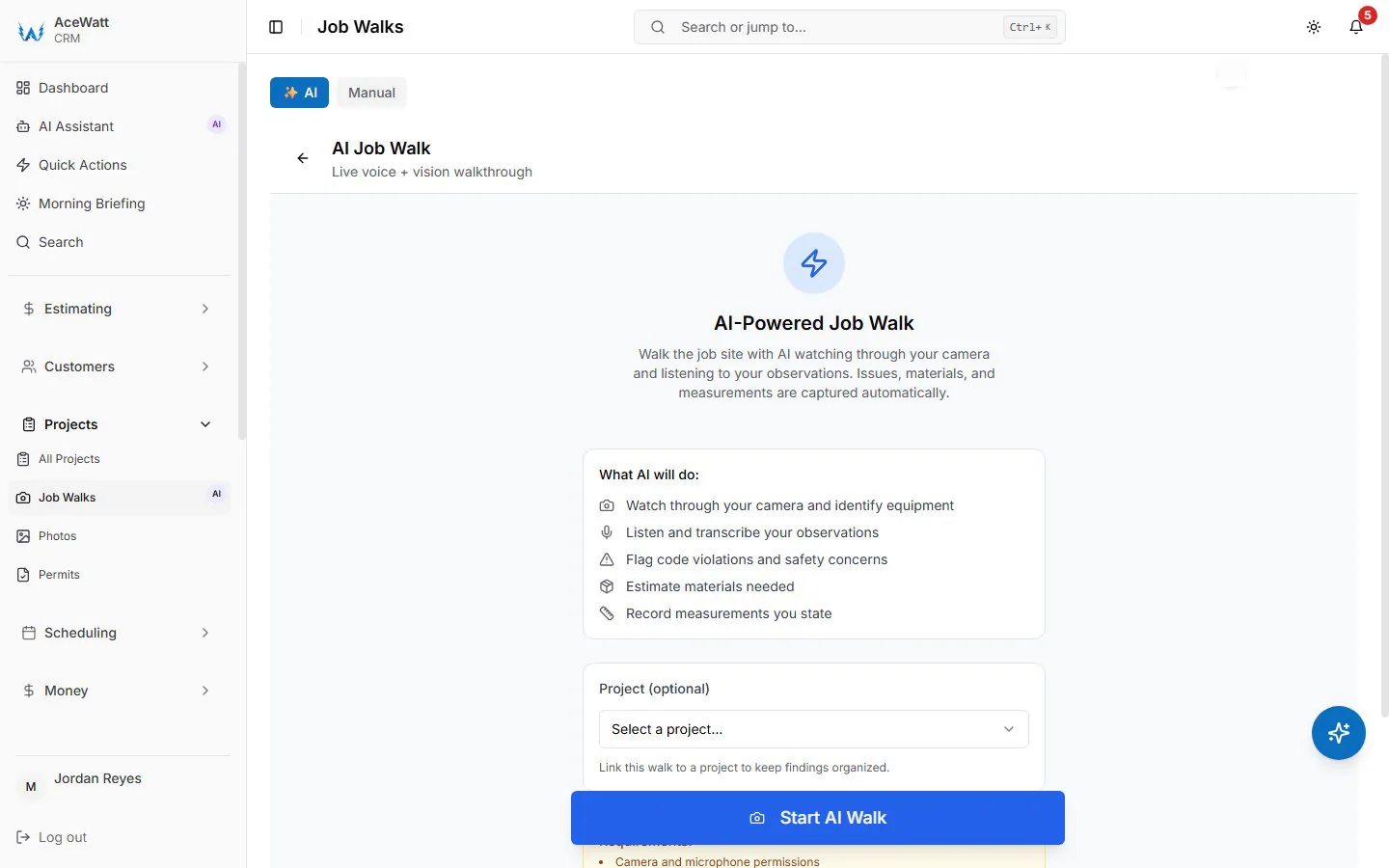
AI Voice and Job Walk Documentation closes the loop from the field side. Standing at the panel, the tech opens the job on a phone, hits record, and talks through findings the way they would to another electrician: existing 200-amp load center, Stab-Lok breakers, scorching visible on the 30-amp two-pole, no grounding electrode conductor visible at the meter, recommend replacement. The transcript lands on the job record in real time, alongside photos of the panel interior, the meter can, and the existing service conductors.
The office sees the findings before the tech leaves the property. No texting photos to a personal number, no voice memos transcribed at the kitchen table at night. That documentation serves three purposes at once: it justifies the T&M invoice, it builds the permit and inspection file, and it protects the shop when a pre-existing condition becomes a dispute months later.
Job Tracking and T&M Billing: Field Entries Become the Invoice
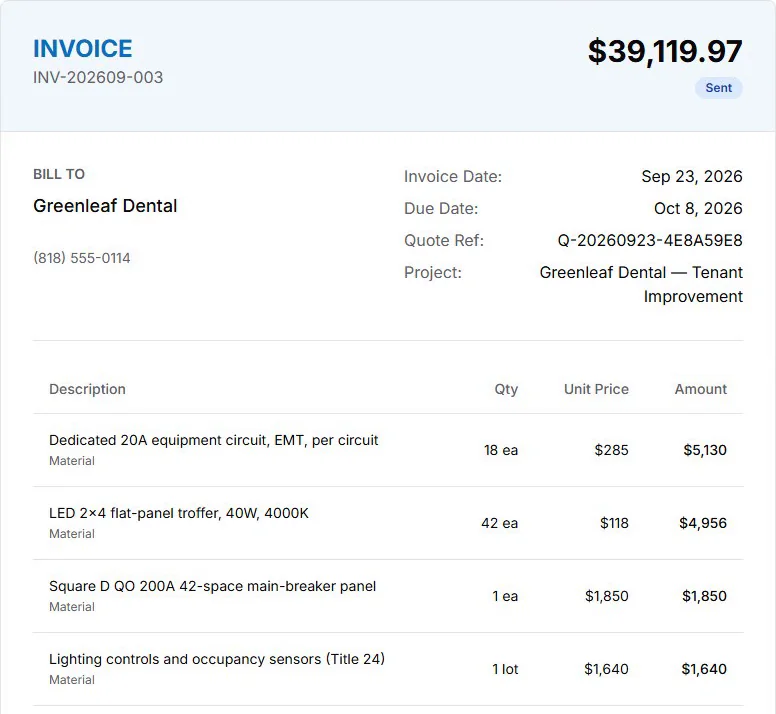
Electricians bill two ways, and a system that only supports one of them forces manual work for the other.
Fixed-bid work, like service upgrades, EV charger installs, and recessed lighting retrofits, invoices straight from the approved estimate. Change orders are approved internally and append to the same record.
Time-and-material service calls invoice from Job Tracking entries. The tech clocks in at the site, logs labor against the job, and pulls materials from truck stock in the app. A three-and-a-half-hour troubleshooting call with two breakers and a receptacle from the van invoices itself, with every billed hour backed by a timestamp and every part backed by a photo. At a $135 per hour truck rate with a two-hour minimum, that accuracy is the difference between a paid invoice and a negotiated one. Payment Tracking then shows deposits collected and balances outstanding without anyone opening a spreadsheet.
Invoicing, Payment Tracking, and QuickBooks-Ready Exports: The Last Manual Handoff
The invoice should go out from the field, before the tech pulls out of the driveway, because invoices sent same-day collect measurably faster than ones batched Friday afternoon. Payment Tracking flags what is still open: the $3,800 panel replacement with a $1,900 deposit collected shows $1,900 outstanding, on the job record, without a receivables tab you have to maintain.
QuickBooks-ready exports are the final link: the invoice list exports as a spreadsheet and payroll hours as a QuickBooks-format CSV for the bookkeeper, or the owner reconciling on Sunday night; full sync is in development. Because labor and materials hit the same job number from estimate through invoice, real job costing finally becomes possible. You learn what a service upgrade actually earns per truck hour instead of guessing.
Follow-Up: The Sales-Side Payoff
A completed job is the cheapest sales opportunity you will ever have, and it is the one most shops never touch because nobody has time.
Automated Follow-Up handles the collections side on its own: overdue invoices get email reminders at 1, 7, 14 and 30 days late. After a job is marked complete, AceWatt also emails the customer a short satisfaction survey. The rest of the sales side is outreach you send yourself: a check-in 30 days after a new panel is energized, the 11-month maintenance reminder for a generator customer, an inspection nudge for the EV charger customer, and a periodic check-in with homes on Stab-Lok or Zinsco panels that declined replacement, so a $2,500 to $4,500 panel replacement stays in the pipeline instead of in your memory.
How to Evaluate a CRM With Dispatch Integration: The AceWatt Buyer's Checklist
If you are comparing the best CRM for electrical contractors, or sorting through job management software for electricians and electrician scheduling apps, here is the checklist that separates an integrated platform from a stitched-together stack:
- One job record from first call to final invoice, visible to office and field
- Native dispatch built into the CRM, not bolted on as a second login
- Approved estimates that flow onto the schedule with materials and scope attached
- Voice documentation and photos that attach to the job in real time
- Fixed-bid and T&M billing from the same record, with payment tracking included
- A clear QuickBooks handoff for invoices and payments
- Automatic email reminders on overdue invoices, with reviews, maintenance reminders, and replacement upsells worked from the same customer record
- Pricing and setup a two-truck shop can actually absorb
The alternative is a sales CRM, a scheduling app, an invoice app, and a bookkeeping import tool, each holding a partial copy of the same job. AceWatt was built to replace that stack with one record. In a trade where your license, your load calcs, and your pricing are all already precise, your software should not be the place where the details get lost.