

CRM for Electrical Contractors: Choosing a System That Runs the Whole Job in 2026
Most electrical contractors do not lose work because of bad wiring. They lose it in the gaps between the wiring: the estimate that took nine days to send, the service call that went to voicemail while the tech was pulling wire, the change order that was never written down, the invoice that sat unpaid for six weeks. A CRM for electrical contractors exists to close those gaps. But not just any CRM will do. Systems built for software salespeople track pipelines. Systems built for the trade have to track panels, permits, crews, material costs, and time and material billing, all the way from first phone call to final payment.
Here is how to evaluate one in 2026, and what a connected platform should actually do for a solo electrician or a five-truck shop.
1. Why Electrical Contractors Need a CRM Built for the Trade in 2026
Generic CRMs assume a sales rep sits at a desk, works a lead list, and closes deals over email. Electrical contracting does not work that way. The person who needs to respond to the customer is often standing on a ladder, and the "product" is a scope of work governed by the National Electrical Code, permit schedules, and material pricing that shifts with the copper market.
Three realities make 2026 a turning point for trade-specific software. First, the 2026 NEC cycle is working through state adoption, and recent cycles have repeatedly expanded GFCI and AFCI requirements in dwellings. Scope conversations now routinely involve code-mandated upgrades, and a CRM needs to store that context against the customer record, not in a text thread. Second, customers expect a contractor-grade experience: text updates, digital estimates, tap-to-pay invoices. Second-place bidders look unprofessional when the first bidder sends a clean quote from the driveway. Third, labor and material costs have stayed volatile. Copper wire pricing can move 10 to 15 percent in a quarter, which means a price book last touched a year ago is quietly eating margin on every branch circuit you sell.
2. The Core Problem: Disconnected CRM, Estimating, and Dispatch Workflows
Walk into most growing electrical shops and you will find the same stack: QuickBooks doubling as a customer database, an Excel price book, a whiteboard or Google Calendar for scheduling, and a phone full of job photos that never make it into anything. Each tool does its job. The problem is the seams between them.
A typical failure looks like this. A customer calls about a 200A service upgrade. The quote takes a week because the estimator has to rebuild it from scratch, then the customer shops it against three other bids and approves it three weeks later. By then copper has moved, the crew is double-booked, and nobody recorded that the existing meter can is corroded. Halfway through the job, the tech finds the panel clearance does not meet NEC 110.26, which requires 30 inches of width and 3 feet of working depth, and the relocation becomes a verbal change order. The invoice goes out late, without the change order, and payment lands 45 days later.
No single tool caused any of that. The disconnection did. When customer records, estimates, schedules, and invoices live in separate systems, every handoff is a chance to lose data, margin, or the customer entirely.
3. What to Look for in a CRM for Electrical Contractors
Evaluating the best CRM for electrical contractors comes down to one question: does data entered once flow all the way through the job? Use this checklist.
- Unified customer record. Every location should carry its history: panel schedule, service size, past invoices, photos, permit numbers, and scope notes from previous visits.
- Lead capture and missed-call handling. Web forms, texts, and unanswered calls should create a contact automatically and trigger an instant response, because most callers who hit voicemail simply dial the next electrician.
- Native estimating. The estimate should build from a maintained price book with electrical assemblies, not a blank document.
- Dispatch tied to job status. Scheduling should know whether a job is quoted, approved, roughed in, awaiting inspection, or ready to invoice.
- Field-first mobile app. Techs need to clock in, capture photos, log materials, and record notes from the job site without driving to the office.
- Invoicing and payments. Deposits, time and material billing, and card capture belong inside the same system that tracks the job.
- QuickBooks sync. Accounting data should flow both ways without double entry.
Job management software for electricians fails when any of these is bolted on. The value is in the connections.
4. How AI-Powered CRM and Estimating Work Together
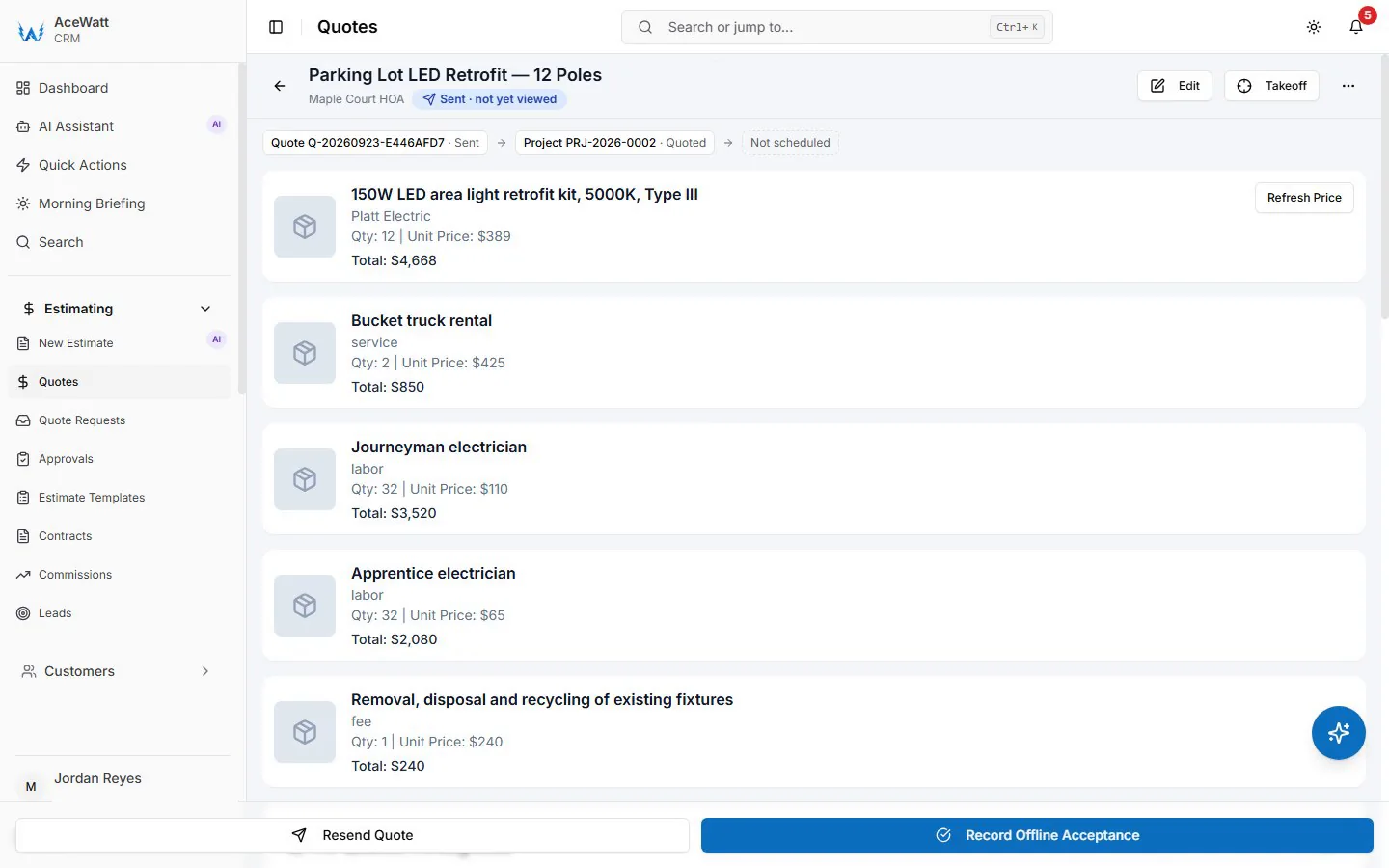
Estimating is where most electrical shops bleed time. AI electrical estimating software changes the math. Instead of rebuilding every quote line by line, the estimator selects assemblies: a 20-amp branch circuit carries the 12 AWG NM-B, single-gang box, duplex receptacle, plate, breaker, and labor units as one package. A 200A service upgrade bundles the meter socket, 40-space main breaker panel, grounding electrode system per NEC 250.53, and the permit and inspection line items.
The AI layer does three things a spreadsheet cannot. It pulls current material pricing so a quote written in March does not ship with January copper prices. It flags code-driven scope, so an EV charger proposal automatically reflects the continuous load rules in NEC 625, meaning a 48-amp wall unit requires a 60-amp circuit. And it produces consistent, professional quotes with tiered options, which matters when the homeowner across the table is collecting three or more bids.
The connection back to the CRM is what makes it powerful. Because the estimate lives against the customer record, a click converts an approved quote into a scheduled job, a materials list, and eventually an invoice. No re-keying, no transcription errors, no version confusion over which quote the customer actually signed.
5. Automated Follow-Up and Job Tracking That Keep Crews and Customers Aligned
Speed to quote wins residential and light commercial work, but follow-up closes it. Automated follow-up means the system handles the chasing: an instant text when a call is missed, an acknowledgment the moment an estimate request lands, a check-in two days after a quote is sent, and a nudge at day seven. These are the touches owners intend to make manually and rarely do once the day fills up.
Job tracking then keeps both sides aligned after the yes. A status pipeline that moves a job through scheduled, en route, on site, rough-in, inspection, and complete gives the office a live picture of every crew without radio calls. It also feeds the customer. An automated text that the crew is 30 minutes out, or that rough-in passed inspection, eliminates the majority of "when are you coming" calls that eat office hours.
For electrical dispatch software, this linkage is the whole point. Dispatchers assign work against real job status instead of guesswork, so a tech who finished a panel replacement early can be routed to the next service call without a phone call.
6. Invoicing, Payment Tracking, and QuickBooks Sync for Electrical Shops
Electrical billing is rarely simple. Service work runs on time and material. A job-site clock-in becomes billable hours, photographed receipts become billable material at your standard 20 to 35 percent markup, and the invoice assembles itself instead of waiting for someone to decipher a week of notes on Sunday night. That is what separates electrical contractor time and material billing software from a generic invoice template.
Deposits matter just as much. Long-lead items like generators, 400A gear, and load centers should never be ordered without a collected deposit, and an invoice with a pay link makes both the deposit and the final balance easy to pay by card.
Finally, the accounting side. Electrical accounting software should not replace your bookkeeper. It should sync with QuickBooks: customers, invoices, payments, and item mappings flowing both directions, with job types mapped to classes for clean job costing. When the field data and the books agree, tax season stops requiring a forensic investigation.
7. AI Voice and Job Walk Documentation for Field Accuracy
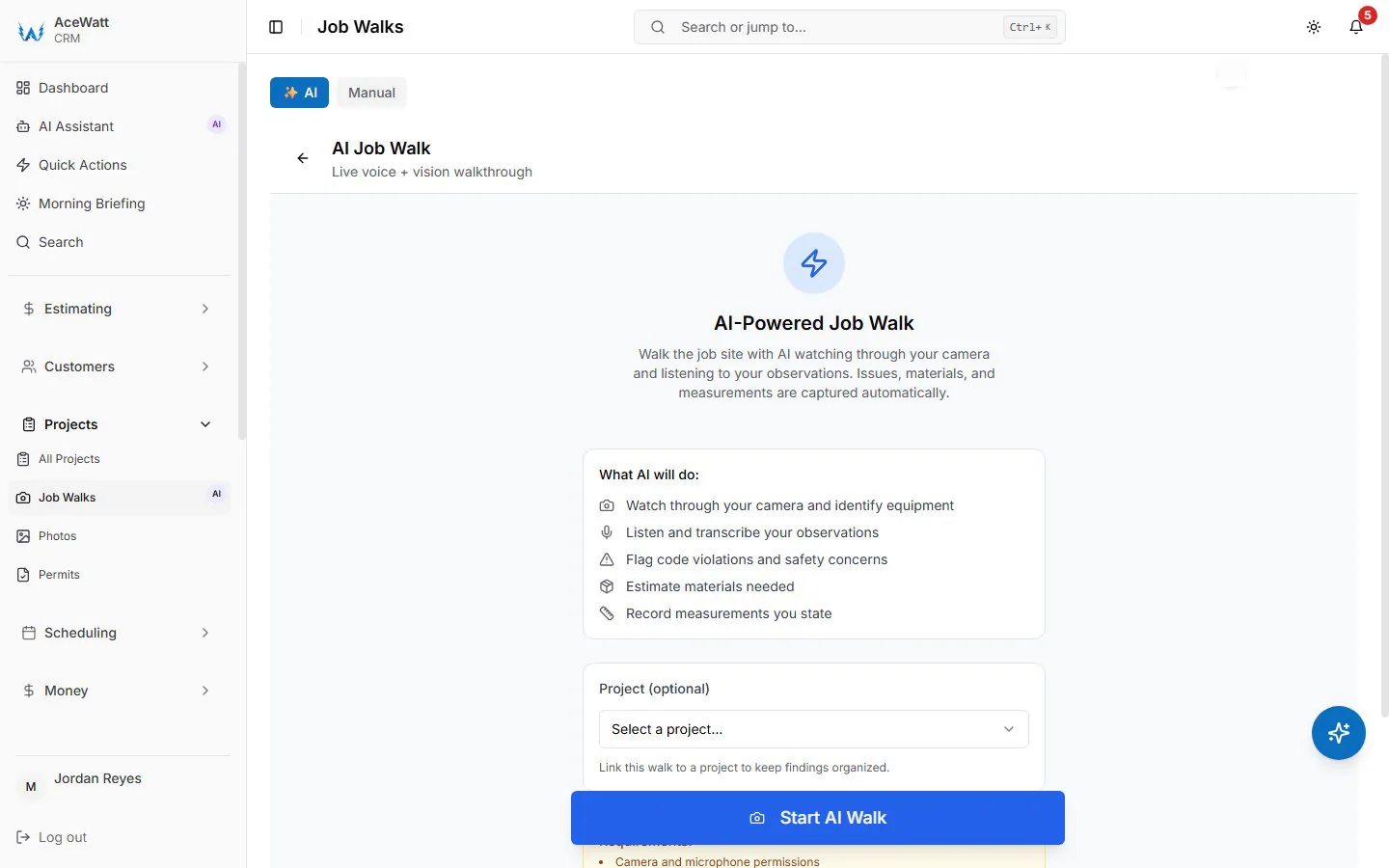
The most valuable data in an electrical business is captured standing in a basement, and it usually evaporates. AI voice documentation fixes that. A tech opens the app, speaks naturally, and the system transcribes and structures the note: "Existing panel is a 100-amp Federal Pacific, two double-tapped breakers, rust at the bus. Recommend replacement." That note lands on the customer record, timestamps itself, and becomes the evidence base for the quote.
Job walk documentation works the same way. Photos of the panel, the attic wiring, the knob and tube in the basement, and the corroded meter can, captured during the walk-through and tied to the estimate, protect the shop twice. First, they justify scope: the customer sees the double-tap and the rust, not just a dollar figure. Second, they defend change orders. When opening a wall reveals conditions the walk documented, the conversation is a review of records, not a negotiation from memory. Field service management software for electricians is only as good as what the field actually records, and voice is the lowest-friction way to get techs recording.
8. Choosing the Right CRM for Solo Electricians and Growing Electrical Teams
The right choice depends on scale. A solo electrician needs one system that answers calls by text, quotes a panel upgrade from the truck in under an hour, collects payment before leaving the driveway, and syncs to QuickBooks without a bookkeeping degree. Complexity is the enemy. Every feature that adds office overhead for a one-truck operation is a feature that will be abandoned by April.
A growing shop has different math. Multiple crews mean you need a dispatch view that shows capacity across techs, territories, and multi-day remodel jobs. Recurring maintenance agreements, lighting retrofits, and inspection scheduling across jurisdictions all require a system that treats job status as the source of truth. Leadership also needs reporting: quote-to-close rate, revenue per tech, and average days to pay.
Whichever category you fall into, test the platform on a real job before committing. Run a live 200A service upgrade through it, from missed call to estimate to dispatch to T&M invoice to QuickBooks entry. If any step requires a workaround, you have found a gap that will cost you money for years.
The Bottom Line
Disconnected tools are not a small business quirk. They are a leak in the boat, and every quote delayed, change order undocumented, and invoice unpaid is water coming in. A platform that connects CRM, AI estimating, automated follow-up, dispatch, job tracking, invoicing, and QuickBooks in one system turns that leak into a pipeline.
If you are evaluating options for 2026, book a walkthrough with our team and bring your hardest job to quote. We will show you how the whole cycle runs, from first call to cleared payment, without a spreadsheet in sight.