

The Easiest Electrical Estimation Program for Beginners: A 2026 Comparison Ranked by Learning Curve
Most electricians did not get into the trade to learn databases. You got in to pull wire, land panels, and pass inspection. If you are still quoting jobs off a notepad, a spreadsheet, or memory, you are underpricing some work and losing other work to contractors who respond faster with cleaner numbers. The problem is usually not you. It is the mismatch between the tool and the work you actually do.
This guide ranks the real options available in 2026 by a single measure: how fast a beginner gets from signup to a signable, electrically credible quote. That is our working definition of the easiest electrical estimation program for beginners, and it is stricter than a feature list. We build AI estimating software for electrical contractors, so weigh our bias accordingly. Every tool below is judged on the same criteria, including ours.
Why Most Electrical Estimating Tools Feel Hard to Learn
Traditional electrical estimating software was designed for professional estimators bidding commercial and industrial work, not for a solo electrician pricing a 200A service upgrade on a Monday morning. Three barriers show up over and over.
Assembly overload. Pro-grade systems like McCormick and Trimble Accubid are built around assemblies. Before you can price a single 200A meter main, you are expected to build a bill of materials covering the enclosure, breakers, grounding electrode conductors, connectors, and labor for each component. That structure produces accurate bids once configured, but the configuration itself can consume weeks.
Labor unit databases. Tools calibrated to the NECA Manual of Labor Units assume you already know that a residential receptacle typically runs 0.3 to 0.4 labor hours including rough-in and trim, and that a 200A panel swap runs 8 to 12 hours with permit and utility coordination. If you do not know those numbers cold, the database does not teach them. It just multiplies your gaps.
Accounting prerequisites. Some platforms make you configure chart of accounts mappings, item classes, and tax groups before you can print a quote. That is why so many contractors abandon estimating tools inside the first month: the tool demanded accounting knowledge before it produced a usable number.
Add cost to the list. McCormick and Accubid seats commonly run several thousand dollars plus annual support and paid training classes. Reasonable for an estimating department. Painful for a two-truck shop.
What Makes an Estimating Program Easy for Beginners
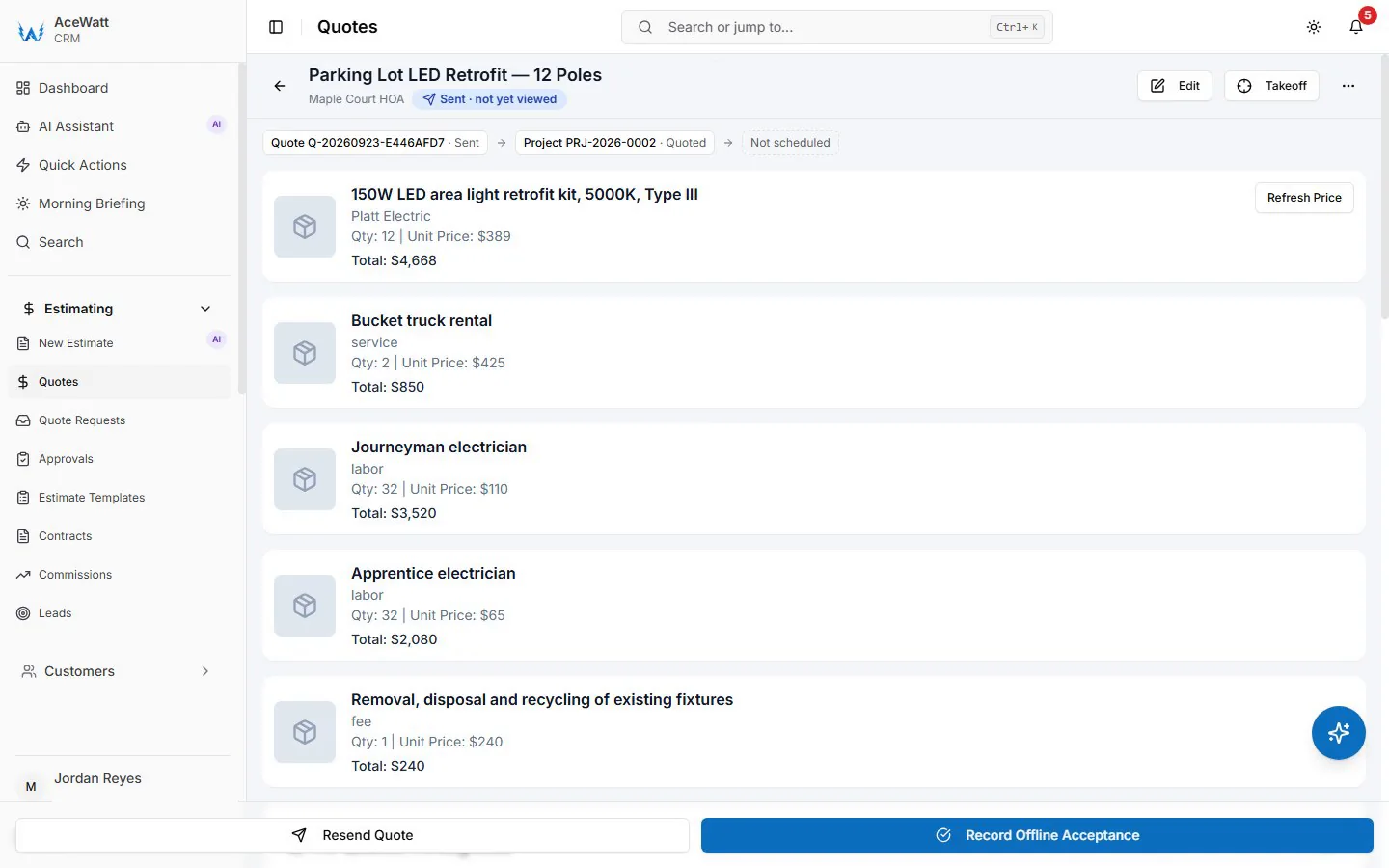
Judge any electrical estimation program against six criteria:
- Pre-built electrical line items. Receptacles, switches, fixtures, panels, breakers, THHN by the foot, EMT and fittings should already be in the catalog with editable material and labor costs.
- Fast quantity entry. Count devices off a plan with tap or drag-and-drop takeoff, or describe the job in plain English. Typing quantities into a blank grid is where most beginners stall.
- Clear labor and material fields. You should see what each line pays in labor and change it in one tap, because your helper is not a second-year apprentice forever.
- A customer-ready quote. The output should look professional to a homeowner or GC without exporting to Word.
- Support for both pricing models. Fixed price for quoted work, and time and material billing for discovered work, from the same price book.
- A clean handoff after the yes. The estimate should become the job record, the invoice, and your accounting entry without re-typing.
The Easiest Electrical Estimation Programs for Beginners in 2026
Pricing reflects listed rates at the time of writing and moves often. Confirm before you buy.
1. Our platform: AI estimating with the office attached. Best for solo electricians and shops up to about 10 techs doing residential and light commercial work. Describe the job in plain English, or let the AI transcribe your recorded job walk, and it drafts a bill of materials with labor attached, drawn from an electrical catalog that already knows what a dual-function breaker costs. The branded quote goes out from your phone, the customer can e-sign it online, and a signed estimate converts directly into job tracking, invoicing, payment tracking, and QuickBooks-ready exports for your bookkeeper, not a native two-way sync. Time to first quote: under an hour for common service work. Bias disclosed: we built it, and we built it because nothing else on this list did all of the above for a one-truck operation.
2. Best Bid Hybrid. Best for a low one-time cost. A few hundred dollars, once, for a Windows desktop electrical estimator with a built-in residential and commercial database. You can learn it over a weekend and produce a defensible quote by Monday. The tradeoffs: no mobile app, no cloud access from the truck, no QuickBooks sync, and no follow-up automation. When the customer signs, you retype the numbers into whatever you use for invoicing.
3. Electric Ease. Best for shops that want a flat-rate price book first. A browser-based electrical contractor software with estimating, flat-rate pricing, and job management built in, plus QuickBooks integration on higher tiers. Monthly subscription priced per user. Learning curve: one to two weeks to get your price book tuned. Estimating depth is lighter than dedicated takeoff tools, which is exactly the point for service work.
4. TurboBid. Best stepping stone to commercial bidding. Electrical-specific estimating with residential, commercial, and industrial databases, panel schedules, and labor units you can adjust. One-time license in the low four figures with training available. Learning curve: two to four weeks before you trust your numbers. Worth it if plan takeoff work is coming, heavy if your week is service calls and panel swaps.
5. PlanSwift and similar PDF takeoff tools. Best for counting off plans. Drag over branch circuits, count recessed fixtures, measure EMT runs directly from PDF drawings. The catch for beginners: the electrical item library is largely your job to build, so you learn takeoff in days but spend weeks creating a price book that an electrician estimating tool would have shipped with. Around a thousand dollars a year.
6. McCormick and Trimble Accubid. Best for estimating departments, ranked last for beginners. Extremely capable, industry standard on large commercial and industrial bids, and calibrated for teams with a dedicated estimator. Weeks of setup, paid training classes, and four- to five-figure costs. If you are bidding $2 million design-build packages, this tier earns its keep. For everything smaller, it is a spreadsheet on steroids with a graduate program attached.
How AI Estimating Reduces the Learning Curve
The hard part of estimating was never arithmetic. It was recall: knowing every component a scope touches and what each one costs. AI estimating attacks exactly that gap.
In our platform, you describe the job the way you would explain it to your supplier, or you record the job walk and let the voice documentation build the scope notes. The AI drafts the bill of materials with labor attached, and it includes the items beginners drop: dual-function breakers where 210.8 and 210.12 both apply, 2/0 copper or 4/0 aluminum service conductors for a 200A dwelling service per 310.12, the ground rod and #6 AWG grounding electrode conductor per 250.66(A), box fill devices per 314.16.
Then it learns from you. When you delete a line, it stops suggesting it. When you change a labor number, your correction becomes the default. The learning curve flattens because the software starts where a first-year apprentice would: taught on the job, corrected in seconds, instead of handed a blank database.
One rule does not change: the license holder signs the quote. AI drafts, you verify against your local labor market and your supplier pricing. That division of labor is what makes it safe to estimate fast.
Connecting Estimates to Invoicing, Job Tracking, and the QuickBooks Handoff
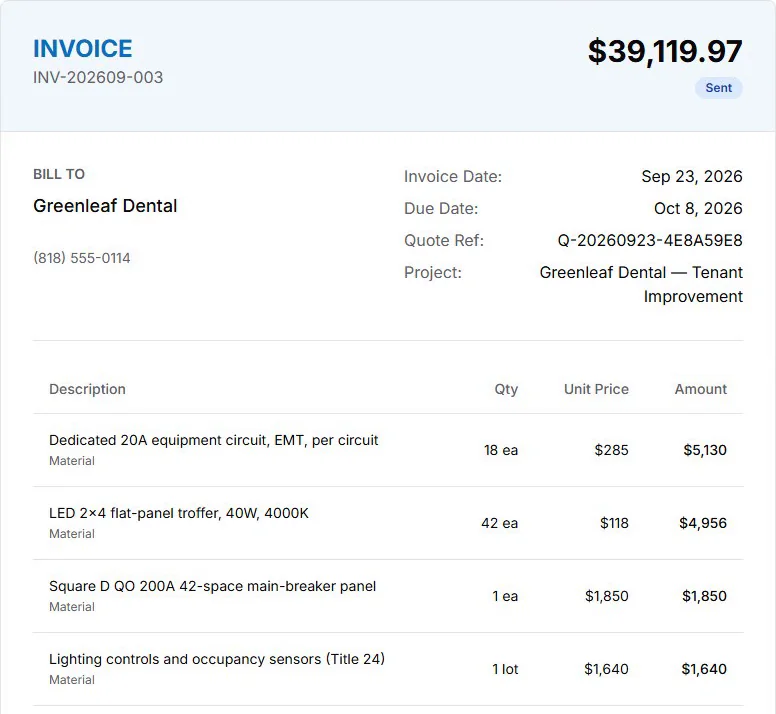
An estimate that dies in a PDF folder is only half a tool. The easiest programs treat the signed quote as the start of a pipeline, and this is where job management software for electricians separates itself from standalone estimators.
When the customer signs in our platform, the estimate becomes the job record with no re-entry. The material list becomes a shopping list. The job hits the dispatch board for crew scheduling, moves through statuses like scheduled, in progress, waiting on inspection, and invoiced, and lands in payment tracking so you can see which checks are actually in the mail. Deposits, progress invoices, and card payments attach to the job they belong to.
The QuickBooks accounting handoff matters more for beginners than most expect. Our QuickBooks-ready exports give your bookkeeper the invoice list as a spreadsheet and payroll hours as a QuickBooks-format CSV. There is no native, real-time, bidirectional sync today; full sync is in development. You get job costing that reflects reality, and quote-to-cash time drops from weeks to days. Discovered conditions convert to a time and material ticket or a change order from the same price book, priced the way you quoted the original work, and approved by you or your office before the crew proceeds.
Best Software Picks for Solo Electricians vs Growing Electrical Shops
Solo electricians should optimize for speed and mobile quoting. Your truck is your office, so the estimate has to be built and sent from your phone between jobs. That points to our platform, where an AI voice job walk on Tuesday becomes a signed quote Wednesday morning without touching a desk, or to Best Bid Hybrid if a one-time cost matters more than cloud access. General field service apps like Jobber and Housecall Pro handle scheduling well but carry generic catalogs, so you will rebuild electrical content yourself.
Growing shops running two to ten trucks have a different bottleneck: coordination. You need multi-user access, crew scheduling and dispatching, job walk documentation your techs can see in the field, and QuickBooks sync your accountant can live with. Our platform covers that span, from AI estimating through invoicing, in one system, with QuickBooks-ready exports for your bookkeeper rather than a native two-way sync. Electric Ease fits if flat-rate service work dominates. ServiceTitan is powerful at enterprise scale, but its per-technician pricing and implementation weight are overkill for a shop still under ten techs. The general rule: buy for the shop you are staffing today, not the one you imagine in five years.
Common Beginner Mistakes to Avoid
Estimating with your wage instead of your burdened cost. A $35 hourly wage is not your labor rate. Workers comp for electricians, general liability, payroll taxes, the truck, tools, and insurance push the real number 25 to 40 percent higher. Price below that and every busy week loses money.
Forgetting non-installation labor. Permit runs, patching drywall around a panel swap, testing, cleanup, and waiting on the utility do not install themselves. Add them as line items.
Quoting with no T&M or change-order language. Old work hides problems: Federal Pacific and Zinsco panels, knob and tube, undersized grounding, boxes stuffed past fill. A signed rate card and a change-order workflow priced from your estimate keep discovered work profitable instead of free.
Stale material pricing. Breaker and copper prices move. Update your supplier pricing quarterly at minimum, and before any quote over $2,500 in materials.
Letting quotes go silent. Most residential bids are won by the second or third touch, and most contractors never follow up. Automated follow-up exists precisely because you are on a ladder when the customer reads the email.
How to Choose the Right Estimating Tool for Your Electrical Business
Run the last job test. Take the most recent job you quoted and re-estimate it inside each trial. You already know what you charged, what you missed, and what the job actually took. The tool whose numbers land closest, fastest, with the least training, is the one that will survive past the first month.
Then check the handoff: does the signed estimate become the job, the invoice, and the QuickBooks entry, or does the data die at the PDF? Check access: phone, tablet, or office only. Count your users and your budget honestly, including training time, not just subscription cost.
For most solo electricians and small shops in 2026, the answer is the tool that starts with pre-built electrical content, drafts the first quote in under an hour, and keeps working after the customer signs. That is the bar we designed our platform against, and it is the bar any electrical estimating software should have to clear before it earns your credit card. Take your last job, run it through a trial, and let the numbers decide.