
Vision InfoSoft Electrical Bid Manager vs. AceWatt in 2026: Which Electrical Estimating Tool Fits Your Shop?
Most electrical contractors do not lose money on the wiring. They lose it in the gaps between tools: the estimate that never made it onto the schedule, the change order agreed to on a job walk but never documented, the T&M ticket written on the truck seat that never became an invoice. So when you compare Vision InfoSoft Electrical Bid Manager against a newer AI estimating option like AceWatt in 2026, the real question is not just which one produces the better bid. It is which one fits the workflow that starts at the first phone call and ends when payment clears the bank.
This comparison looks at both tools honestly, names the category-wide gap neither one closes, and explains when an end-to-end electrical contractor software platform like AceWatt is the smarter buy.
Why Electrical Contractors Are Comparing Estimating Tools More Carefully in 2026
Four pressures are forcing the issue.
Material volatility. Copper conductor pricing tracks the COMEX market, and it can move enough in a single quarter to erase the margin on a branch wiring package. An estimate built on last quarter's #12 THHN or MC cable pricing is a losing estimate before the first strap goes up. Frequently updated material pricing is now a core requirement, not a nice-to-have.
Code cycle churn. The 2026 NEC arrives on the NFPA's three-year cycle, and states adopt on their own schedules. Expanded GFCI protection under 210.8, EV charging provisions in Article 625, and revised optional load calculation methods under 220.82 all change device counts and labor hours. An estimating system that cannot be updated quickly turns every code cycle into a manual rework project.
Labor cost and scarcity. With journeyman labor tight and rates climbing, the difference between 0.6 and 0.9 labor units per device compounds fast across a 200-unit multifamily takeoff. Contractors want estimating tools that let them tune labor to their actual crew performance rather than accept a fixed national average.
Customer expectations. General contractors and homeowners alike expect faster bids, digital invoices, and card or ACH payment. The estimate is now the front door to a customer experience that runs all the way through scheduling, invoicing, and payment tracking.
What Vision InfoSoft Electrical Bid Manager Does Well for Bid-Focused Electrical Work
Electrical Bid Manager has been a fixture in electrical estimating software for decades, and it earned that position. For shops whose bottleneck is bid volume on residential, commercial, and light industrial work, it does the core job well.
Purpose-built electrical takeoff. Bid Manager counts and extends devices, fixtures, conductor, conduit, and fittings the way electricians actually think about them. Assemblies let you build a typical 20-amp branch circuit, a two-gang switch bank, or a panel feed as a unit instead of line by line, which is the difference between a two-day takeoff and a two-week one on a mid-size commercial package.
Material pricing infrastructure. The platform is built around subscription-based material price updates so your extension math reflects current supplier costs instead of a stale spreadsheet from the last job you bid.
Labor control. Labor values can be aligned to industry standards such as the NECA Manual of Labor Units and adjusted for job conditions. That matters, because a commercial fitout with a 20-foot deck will not run at residential production rates, and bidding it that way guarantees a loss.
Bid breakdowns. You can break a bid out by floor, phase, or system and hand a GC a summary they can actually evaluate against competing numbers.
Where it stops: it is estimating software. Job walk documentation, bid follow-up, crew dispatch, job tracking, invoicing, and QuickBooks sync live somewhere else. It is also a desktop-first Windows product, which suits an estimator at a desk far better than a solo electrician working out of a van.
Where AceWatt Fits for Electrical Estimating and Job Costing
AceWatt approaches the same problem from the AI direction. You upload a PDF plan set (or a job walk, photos, or a typed description), and AI Estimating drafts a first-pass quote from your pricebook and assembly templates that a human then reviews and corrects.
Speed on the first pass. For residential service changes, multifamily rough-ins, and light commercial tenant fitouts, a draft quote in minutes changes what a small shop can bid on a Monday morning, even though device counts from plans still need your own check.
Low barrier to entry. Browser-based tools that price per project, rather than requiring a full workstation license, put real estimating capability within reach of contractors who never had a dedicated estimator.
Job costing orientation. AceWatt is aimed at estimating and job costing, which means comparing estimated hours and material against what the job actually consumed.
Two honest caveats. First, every AI count needs verification. Box fill under NEC 314.16, multi-gang configurations, and devices shown at unusual elevations are exactly where automated counts drift from reality, so budget review time into every AI takeoff. Second, before you buy any AI estimating tool, evaluate what happens after the estimate: can the data flow into scheduling, dispatch, job tracking, invoicing, and accounting, or does it get exported into a spreadsheet and re-keyed into three other systems?
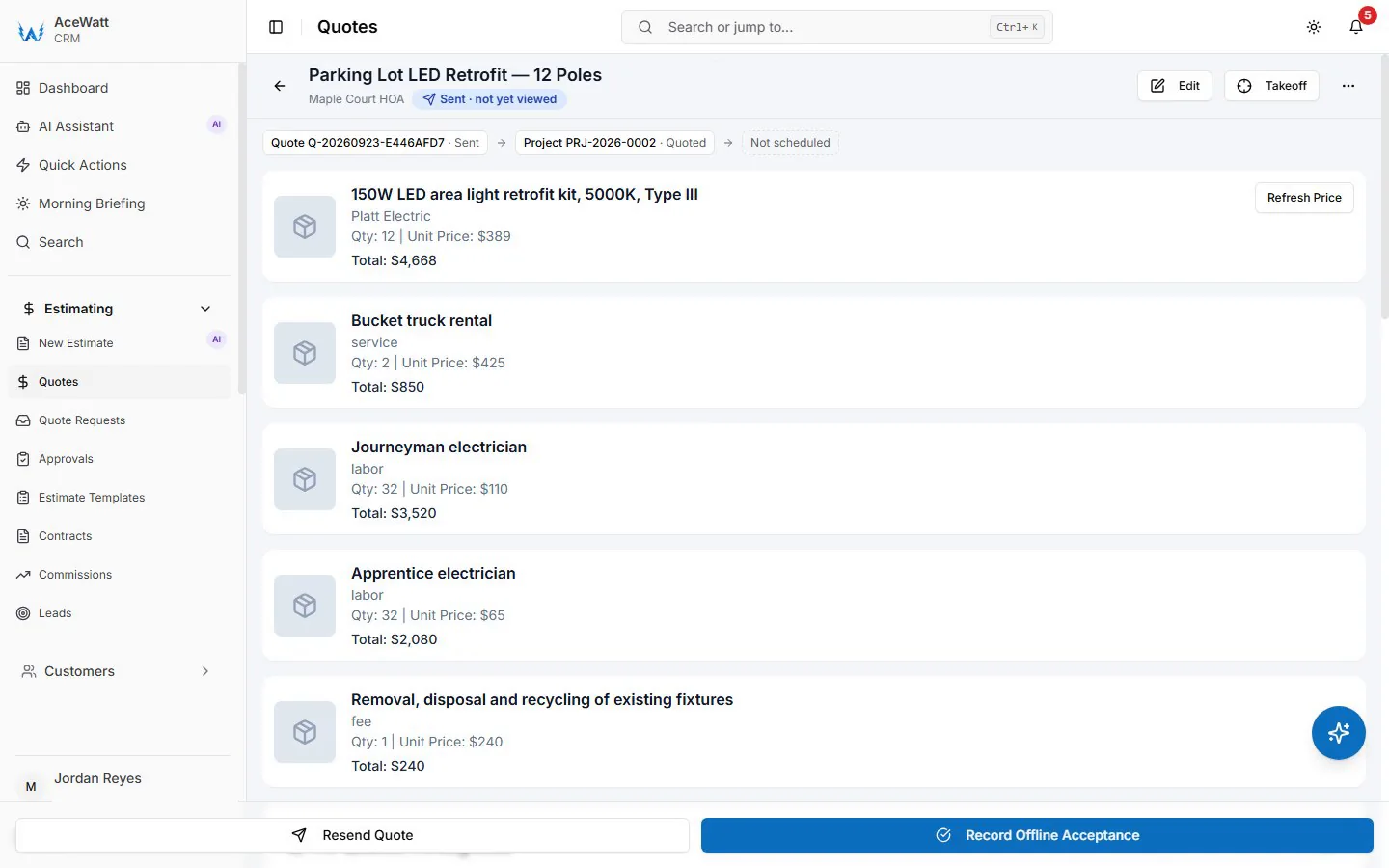
The Biggest Limitation: Estimating Alone Does Not Run an Electrical Contracting Business
This is the gap that defines the whole category. Estimating tools stop at the bid. The business keeps going, and every stage past the bid is a place margin leaks out.
- Follow-up. Bids die quietly. A quote that never gets a second touch is a job someone else won with a phone call.
- Job walk documentation. Change orders worth thousands get waved through because existing conditions were never documented: an undocumented panel schedule, undocumented knob-and-tube or cloth wiring, an undocumented wet location that turns a straightforward fixture swap into a GFCI and bonding conversation.
- Scheduling and dispatch. Without electrical dispatch software, jobs get assigned by text message, emergency calls blow up the day's plan, and drive time between service calls goes unmanaged.
- Job tracking. Change orders, T&M additions, and percent complete get tracked in someone's head until closeout, when they get partially remembered and mostly written off.
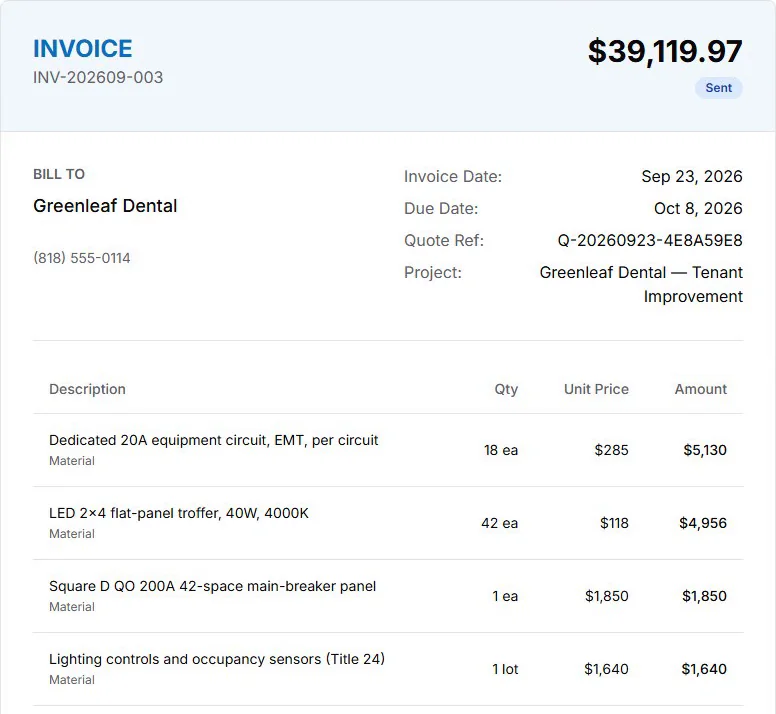
- Invoicing and payments. Deposits, progress billing with retainage on commercial work, and time and material tickets all need an electrical invoice app that turns field records into bills the same day, not a Word template at the end of the month.
- Accounting. Without a real QuickBooks connection, every invoice gets entered twice, and reconciliation becomes a weekend project.
This is why searches for electrical estimating software increasingly overlap with searches for job management software for electricians, electrician invoice app options, and accounting software for electrical contractors. Contractors are not shopping for a fifth disconnected tool. They are shopping for a way to stop rebuilding the same job data in four different places.
How AceWatt Covers the Full Workflow from AI Estimating to Invoicing and QuickBooks-Ready Exports
AceWatt is built as one system for the entire chain, and the fastest way to see it is to follow a job from first contact to final payment.
- The lead arrives. The AI-powered CRM captures it, tracks the pipeline, and makes sure nobody falls through the cracks between the first call and the estimate.
- The estimate gets built. AI Estimating assembles material and labor from the job details, supports fixed-price and T&M formats, and produces a quote fast enough to win work in competitive residential and light commercial markets.
- The bid stays visible. The CRM keeps the open quote on the customer record until it is won or lost, so your team knows who to call, which is where a large share of estimates are actually decided; Automated Follow-Up itself chases overdue invoices, not bids.
- The crew gets assigned. Crew Scheduling and Dispatching suggests the right electrician by skill on a drag-and-drop board, handles same-day emergency calls, and shows crews on a live map while their app is open.
- The work gets tracked. Job Tracking shows percent complete, captures change orders the day they happen, and feeds T&M time and material into billable records instead of goodwill.
- The job walk gets documented. AI Voice and Job Walk Documentation turns what the electrician sees on site, existing conditions, panel schedules, needed extras, into documented records that support change orders and protect margin.
- The invoice goes out. Invoicing and Payment Tracking handles deposits, milestone billing, and T&M billing with card collection through a pay link (ACH if enabled in your Stripe account), so cash arrives in days rather than net-whenever.
- The books stay in QuickBooks. QuickBooks-ready exports hand your bookkeeper the invoice list as a spreadsheet and payroll hours as a QuickBooks-format CSV, so your accountant keeps the system they already know; full sync is in development.
The point is not that any single feature is revolutionary. It is that the estimate, the schedule, the field documentation, the invoice, and the ledger all live in one record from call to payment.
Feature Comparison: Estimating, Follow-Up, Dispatch, Job Tracking, and Payment Tracking
| Capability | Vision InfoSoft EBM | AI estimating tools | AceWatt platform |
|---|---|---|---|
| Dedicated electrical estimating | Core strength | Core strength | Included (AI Estimating) |
| Deep assemblies and labor tuning | Yes | Limited | Yes |
| Subscription material price updates | Yes | Varies | Yes |
| AI plan reading and auto-counts | No | Core feature | Drafts from PDF plans; counts need verifying |
| CRM with automated bid follow-up | No | No | CRM included; automatic reminders on overdue invoices only |
| Crew scheduling and dispatching | No | No | Included |
| Job tracking and change orders | No | Not the focus | Included |
| T&M billing | Via export | Not the focus | Included |
| Invoicing and payment tracking | No | No | Included |
| AI voice and job walk documentation | No | No | Included |
| QuickBooks accounting sync | Third-party only | Verify before buying | Exports |
Which Tool Is Right for Solo Electricians, Small Shops, and Growing Electrical Contractors?
Solo electricians. Electrical Bid Manager is more estimating depth than a one-van operation bidding service work and occasional small remodels needs. AceWatt can help if plan-based residential bids are a real part of your mix, but it still leaves follow-up, invoicing, and payments unresolved. For most solo electricians, an all-in-one system with estimating, an invoice app, and on-site payment collection solves more problems per dollar.
Small shops with 2 to 10 techs. The bottleneck has shifted from estimating to coordination. You need electrician dispatch software, job tracking, and same-day invoicing more than you need another decimal of takeoff precision. This is where the estimating-only tools stop and where end-to-end platforms start paying for themselves.
Growing contractors bidding commercial work. If you regularly bid design-build and plan-spec packages, Electrical Bid Manager's assembly depth and material database can still earn a seat next to an operations platform. The common pairing is a dedicated estimating seat for the estimator plus AceWatt for CRM, dispatch, job tracking, and QuickBooks-ready exports. If speed to bid matters more than deep assembly libraries, AceWatt AI Estimating alone may be enough.
Final Verdict: Choose Vision InfoSoft for Bid Depth or AceWatt for End-to-End Electrical Operations
Vision InfoSoft Electrical Bid Manager remains a strong choice when bidding is the bottleneck and you need deep, electrician-specific takeoff and assembly tooling for competitive commercial and industrial work. AceWatt is worth a look for fast AI-drafted first-pass quotes, provided you verify the counts and confirm what happens to the data after the bid.
But if what is actually slowing your shop down is the space between the bid and the deposit, the change order nobody wrote down, and the schedule held together by text messages, then the estimating tool is not the fix. AceWatt covers the full workflow: AI-powered CRM, AI Estimating, Automated Follow-Up, Crew Scheduling and Dispatching, Job Tracking, Invoicing and Payment Tracking, AI Voice and Job Walk Documentation, and QuickBooks-Ready Exports in one electrical contractor software platform. Book a demo and bring your last three jobs. That is the fastest way to see where your current tool stack is costing you money.