

The Real Cost of Lead Leakage in Electrical Contracting (2026 Outlook)
Electrical contractors across the U.S. lose an estimated 18 to 22 percent of potential revenue every year because leads stall between the first site walk and the signed work order. With a residential panel upgrade averaging $3,200 to $4,800 and a commercial tenant improvement routinely exceeding $75,000, even a handful of stalled estimates adds up to a six-figure annual leak for a growing shop.
The problem is rarely a shortage of leads. It is the fragmented handoff between estimating, scheduling, field execution, and accounting. Most shops still run on a patchwork of spreadsheets, text threads, paper job folders, and generic CRM tools that were never built for electrical work. They do not track NEC 2023 Article 210.12 arc-fault requirements on a kitchen remodel. They do not flag when a permit delay pushes a rough-in. They do not re-engage a homeowner who went quiet after receiving a $4,200 rewire quote.
An electrical contractor CRM estimate to service workflow built for the trade closes that gap. AI-powered estimating, automated follow-up, crew dispatching, field documentation, and a QuickBooks-ready export run in one system, so every lead moves from first call to paid invoice without falling through the cracks.
How AI Estimating Turns First Calls Into Booked Work
Speed and accuracy win bids. When a homeowner calls about a flickering panel, or a GC requests pricing on a 40,000-square-foot warehouse build-out, the contractor who sends a detailed, code-compliant quote within hours (not days) usually wins the job.
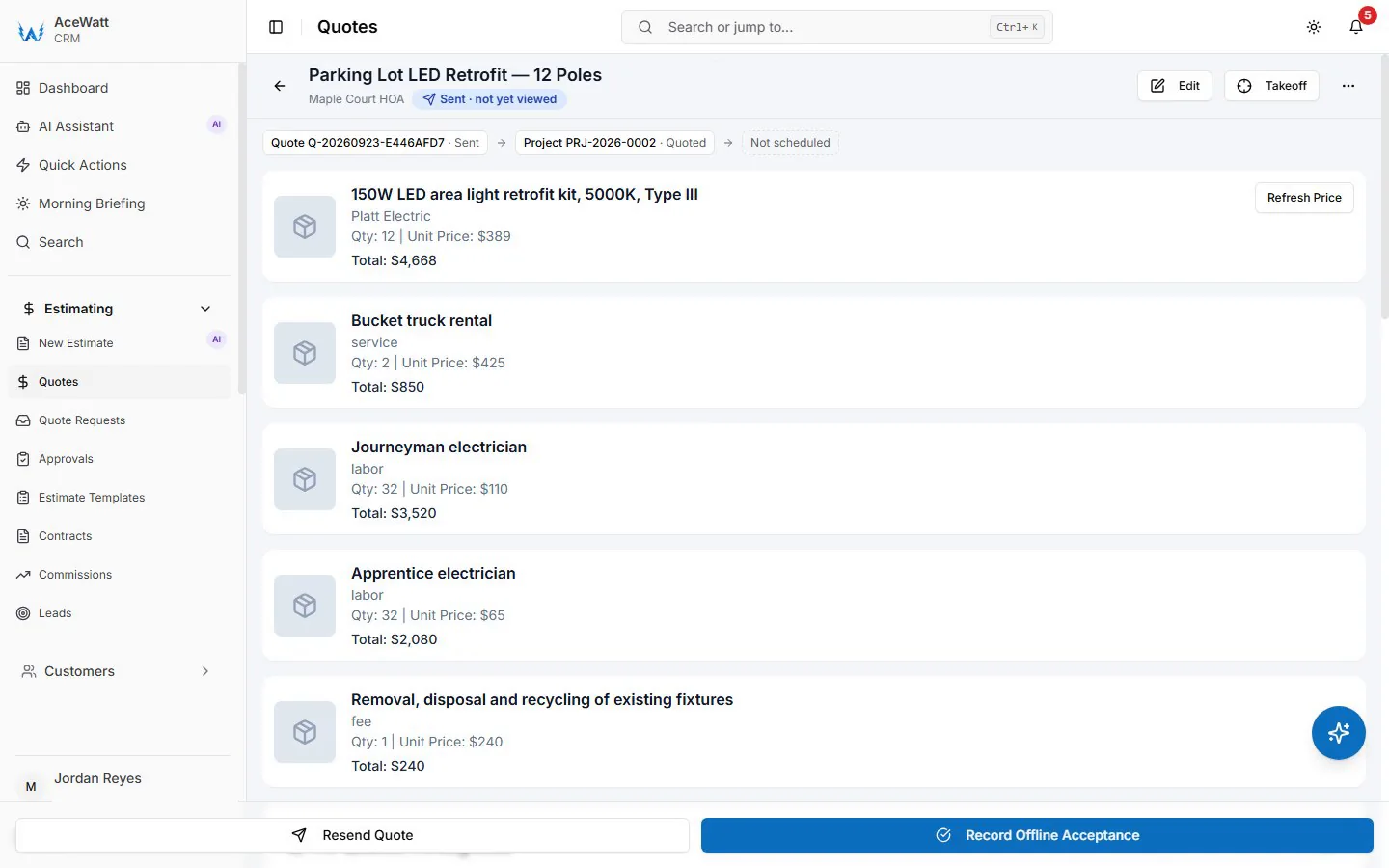
AI Estimating ingests the scope: panel size, circuit count, conduit runs, AFCI and GFCI requirements, EV charger provisions, and local amendment nuances. It applies your shop's labor rates (journeyman at $85 per hour, apprentice at $45 per hour), material markups (15 percent on wire, 20 percent on fixtures), and municipal permit fees. The output is a line-item quote that references NEC 210.52 dwelling receptacle spacing, 220.87 load calculations, and 250.118 grounding conductor sizing without the estimator cross-referencing code books by hand.
For a solo electrician, that means generating a $3,800 service upgrade estimate from the truck between calls. For a 12-person shop, it means turning around five commercial bids in a morning instead of two. Quotes land in the customer's inbox while the problem is still top of mind, which is why AI estimating for electricians consistently lifts win rates on rewires, panel upgrades, and commercial work.
Keeping Estimates Alive Until the Customer Says Yes
The average homeowner sits on an electrical estimate for 9 to 14 days before deciding. General contractors often wait on owner approvals or value-engineering rounds. Without systematic follow-up, those estimates go cold and the shop never learns why.
Here the follow-up stays with your estimator: the quote goes out with a customer portal link where the homeowner can review and e-sign it, and your team makes the check-in calls, stretching the timeline when the estimate includes a permit-dependent item such as a new 200A service requiring utility coordination. Automated Follow-Up covers overdue invoices, not open quotes.
Commercial bids shift the workflow: GC project managers move on bid-leveling milestones, so your estimator times the call to the milestone, with addenda and revised load calculations in hand. That is electrician lead management running on a system instead of sticky notes on a monitor. If the gap is sales-stage visibility itself, compare electrician sales pipeline software.
Shops applying this kind of follow-up to electrical estimating recover 27 to 35 percent of stalled quotes, which translates to $40,000 to $120,000 in added annual revenue for a mid-size operation.
Crew Scheduling and Dispatching: From Signed Estimate to Service Call
Once the customer approves, the clock starts. A signed $12,000 kitchen remodel estimate means materials must be ordered (MC cable, recessed cans, dimmers), permits pulled, and a crew scheduled, all without the project manager re-entering data into a whiteboard or shared calendar.
Crew Scheduling and Dispatching puts the approved job on a drag-and-drop dispatch board with skill-based suggestions, so the dispatcher can see who fits each phase (rough-in, trim-out, final inspection).
The dispatcher works a drag-and-drop board: Phase 1 rough-in assigned to J. Martinez (journeyman) and A. Chen (apprentice) on Tuesday from 7 a.m. to 3 p.m., with material delivery confirmed Monday at 3 p.m. Phase 2 goes on the board for the following Thursday pending inspection. If a crew member calls out sick, the board's skill-based suggestions point to the next electrician who fits, and the office lets the customer know about any timing shift.
No double entry. No missed permit windows. No guessing which electrician fits the job.
Job Tracking and AI Voice Documentation for the Field
Field execution generates the data that protects margin and defends against callbacks, but electricians do not carry clipboards up ladders or type on phones in crawlspaces.
AI Voice and Job Walk Documentation lets the foreman narrate site conditions hands-free: "Panel location shifted 18 inches left per GC request. Need 10 more feet of 4/0 SER. Existing feeder is aluminum and requires Al/Cu lugs per 110.14. Homeowner added two under-cabinet lighting circuits outside the original scope." The AI transcribes the entry, tags it to the job phase, flags the scope change, and updates the material takeoff in real time.
Photos attach by voice command: "Photo: existing panel label." "Photo: conduit path through joist bay." Each entry is timestamped, geotagged, and linked to a specific line item in the estimate. When the inspector asks for evidence of AFCI protection on the new bedroom circuits, the foreman pulls the voice note and photo from the mobile app in seconds.
Back at the office, Job Tracking delivers live electrical service call tracking: rough-in 80 percent complete, two change orders pending approval, material overage at 3 percent (within tolerance). No end-of-week paperwork crunch. No "I told the guy on site" disputes.
Invoicing, Payment Tracking, and the QuickBooks Handoff After the Job
The job is not done until the money hits the bank. Invoicing and Payment Tracking builds the final invoice from the approved estimate plus approved change orders, with milestone (percentage-of-completion) billing on projects.
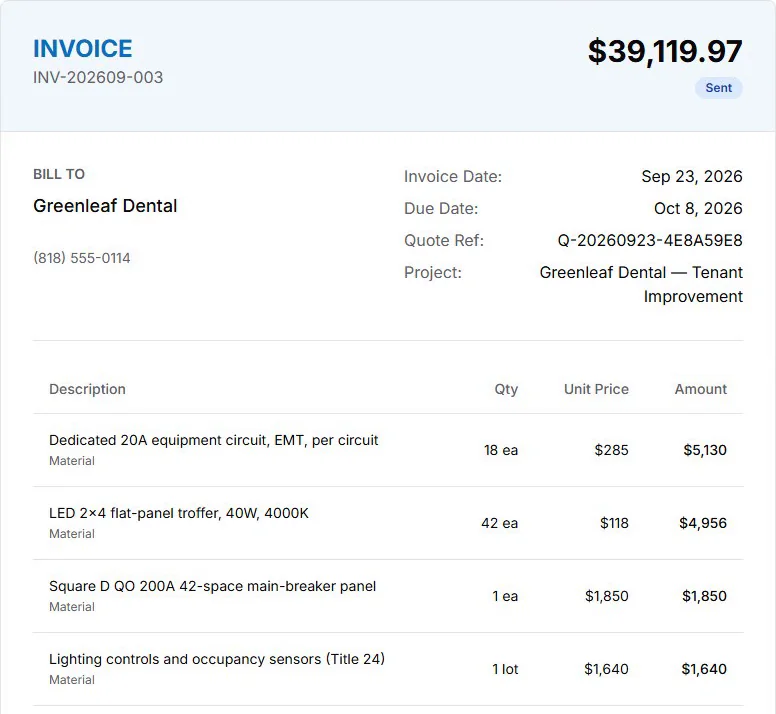
The customer receives a branded invoice with a secure payment link to pay by card (or by ACH, if your Stripe account has it enabled). The system tracks payments and overdue status, and overdue invoices get automatic email reminders at 1, 7, 14 and 30 days late.
A CRM built for contractors cuts the duplicate entry that plagues shops piecing together generic tools. Our QuickBooks-ready exports give your bookkeeper the invoice list as a spreadsheet and payroll labor hours as a QuickBooks-format CSV. There is no native, real-time, bidirectional sync today; full sync is in development. Your bookkeeper can still post them to an electrical-specific chart of accounts: 4100 Residential Service Revenue, 4200 Commercial Construction Revenue, 5100 Direct Labor, 5200 Materials, 5300 Equipment Rental, 5400 Permits and Fees.
Why Purpose-Built Electrical Contractor CRM Beats Generic Software
Generic field service platforms treat a panel upgrade like an HVAC tune-up. They do not handle bid-bond tracking, addenda management, or prevailing wage compliance on commercial work. They do not know that a residential rewire triggers AFCI and GFCI requirements that vary by municipality. They do not map labor phases to NEC inspection sequences.
Electrical contractor CRM software in 2026 that is built for the trade embeds that knowledge:
- Code-aware estimating references NEC articles and local amendments automatically.
- Permit workflow tracks submission, fees, expiration, and inspection scheduling per jurisdiction.
- Material takeoff uses electrical-specific assemblies such as "20A kitchen countertop circuit: 12/2 MC cable, 20A AFCI breaker, two GFCI receptacles, connectors, straps."
- A crew qualification matrix tracks licenses, certifications, and apprenticeship ratios by state.
- Change order logic enforces scope, price, and schedule approvals before work proceeds.
- Lien rights management calculates preliminary notice deadlines and mechanics lien filing windows by state.
That is the difference between a generic tool and field service software for electrical contractors. The system speaks the trade's language, follows the electrical contractor workflow from estimate to service call, and protects margin from the first inbound call to the final reconciled deposit.
Contractors who adopt an integrated, trade-specific workflow in 2026 do more than save administrative hours. They capture the revenue that used to slip away between estimate and invoice. They win more bids because they respond faster and more accurately. They finish jobs with fewer callbacks because field documentation is complete and searchable. And they get paid faster because estimating, dispatch, invoicing, and accounting finally run as one process.