

How to Turn Electrical Service Agreements Into Predictable Revenue
Service agreements separate electrical contractors who scramble from those who plan. A well-structured maintenance program fills the calendar during slow seasons, keeps crews productive between big projects, and creates a recurring revenue base that does not depend on the next emergency call. Yet most electrical shops still track these contracts the same way they did a decade ago: spreadsheets, paper files in a truck folder, or a service manager's memory.
There is a better path. A CRM built for electrical work brings service agreements, renewals, scheduling, billing, and documentation into a single system. This guide breaks down how that works in practice, from the first thermal scan to the automated renewal reminder, and why shops making the switch in 2026 are pulling ahead of competitors still running contracts on clipboard logic.
Why Service Agreements Drive Predictable Revenue for Electrical Contractors
Electrical service agreements cover the work that keeps buildings safe, compliant, and operational: panel inspections, infrared thermal scans on switchgear, generator load testing, lighting system checks across parking lots and common areas, and EV charger servicing for commercial properties and fleet operators. These are not one-off jobs. They are recurring obligations tied to equipment lifecycle, manufacturer warranty requirements, and insurance expectations. NFPA 70B, which changed from a recommended practice to an enforceable standard in 2023, now gives facility owners formal grounds to require documented preventive maintenance, and generator manufacturers typically require annual documented service to keep warranty coverage intact.
For a growing electrical shop, that recurring work is financial ballast. A portfolio of 80 commercial maintenance contracts at an average of $2,400 per year generates $192,000 in baseline revenue before a single new call comes in. That revenue lands in predictable cycles, which means you can schedule around it, staff around it, and quote new projects without wondering whether next month's payroll is covered.
Agreements also deepen client relationships. The contractor performing quarterly preventive maintenance on a property's distribution panels is the same contractor who gets the call when the owner wants a 400-amp service upgrade. Service agreements keep your name in front of facility managers, property owners, and general contractors through consistent presence, not marketing spend.
Where Manual Renewal Tracking Fails Electricians and Growing Shops
The failure point is rarely the agreement itself. It is the tracking. Most electrical shops manage renewals through a combination of Outlook calendar reminders, a shared spreadsheet nobody has updated since March, and a filing cabinet in the back office. When a contract expires, nobody notices until the client calls a competitor for an emergency panel repair.
Manual tracking creates three specific problems:
Lapsed contracts go unnoticed. A facility manager rarely calls to renew; they assume the relationship is ongoing. When nobody follows up, the agreement lapses silently, and the next contractor who walks the site wins the work.
Upsells get missed. A thermal scan that reveals a loose termination on a 200-amp breaker is the perfect opening to recommend surge protection, thermal monitoring, or a load balancing review. Without a system to flag those recommendations and tie them back to the renewal cycle, the opportunity disappears into a handwritten note on a work order.
Relationships turn reactive. Without preventive visits on the calendar, the only time the client hears from you is during an outage. That positions your shop as an emergency responder rather than a trusted electrical partner, and emergency responders compete on speed, not value.
AI-Powered CRM: Centralizing Electrical Service Agreements in 2026
A purpose-built CRM for electrical contractors service agreements eliminates the tracking gap. Instead of scattered files and memory-based follow-up, every agreement lives in a centralized system with structured data attached: agreement type, covered equipment, service intervals, expiration date, billing terms, and site location details.
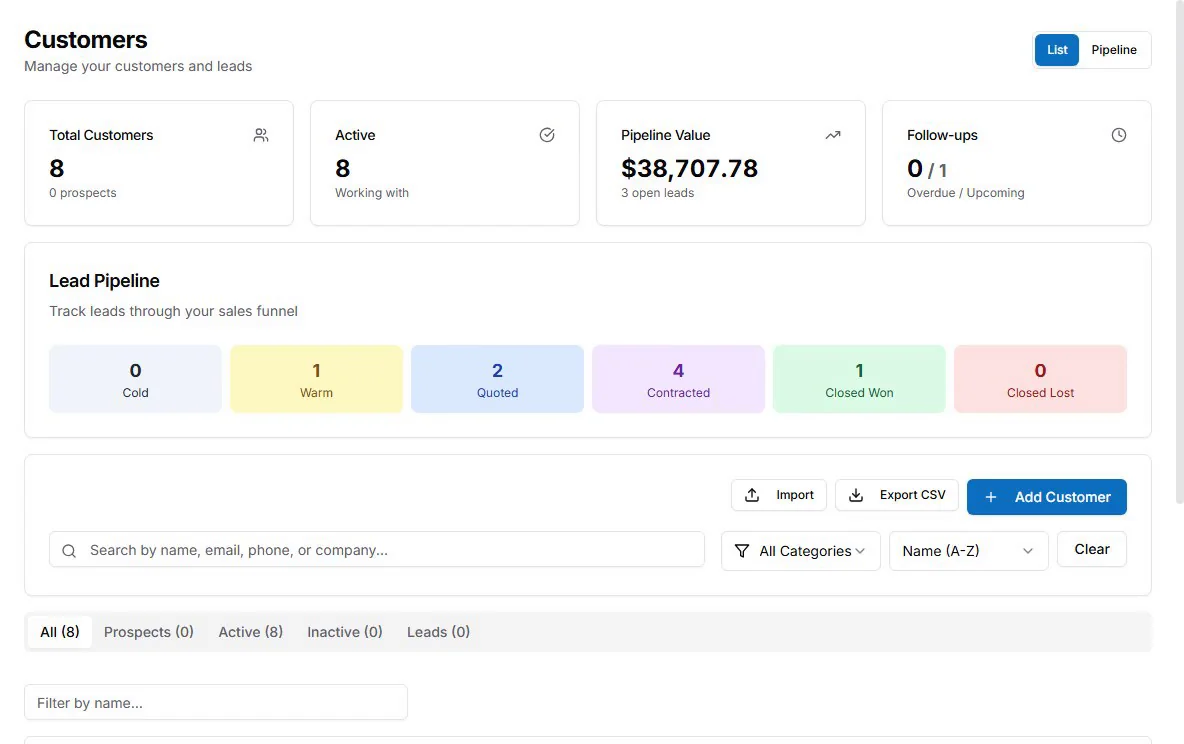
The AI-powered CRM takes this further by auto-tagging agreement records as they are created. When a technician closes out a panel inspection job, the system recognizes the service type and links it to an existing agreement or flags it as a new agreement opportunity. Expiration dates populate automatically based on contract terms. Equipment locations tie back to site records so a dispatcher can see every covered asset at a given property without digging through past work orders.
For electrical shops managing mixed portfolios (residential generator maintenance alongside commercial lighting retrofits and industrial switchgear inspections), this structure matters. An AI CRM for electrical contractors categorizes agreements by type, client, and location, giving ownership a clear renewal pipeline instead of a vague sense that some contracts are coming due.
Follow-Up Cadence for Renewal Windows That Don't Slip
The renewal conversation is time-sensitive. Start too early and the client defers. Start too late and they have already moved on. Effective electrical maintenance contract automation follows a three-touch sequence tied to the expiration date:
- 60 days out: a reminder with the current agreement summary, covered services, and a note about any recommended upgrades flagged during the last visit.
- 30 days out: a follow-up with a renewal quote and optional add-ons, such as adding surge protection to an existing panel maintenance plan.
- 14 days out: a final notice with a direct call to action and a link to review and approve.
Automated Follow-Up covers overdue invoices, emailing reminders at 1, 7, 14 and 30 days late; the renewal cadence itself is yours to run. Each touch should use trade-specific messaging, not generic "your contract is expiring" language. A 60-day reminder for a commercial lighting maintenance agreement references the last photocell replacement and fixture audit. A renewal notice for a generator service plan references the last load bank test date and transfer switch inspection. That is what service agreement renewal reminders look like when they are built for electricians instead of adapted from a generic sales template.
Connecting Renewals to Crew Scheduling, Dispatching, and Job Tracking
A renewed agreement is not just a billing event. It is a series of future service visits that need to be scheduled. Too often, the office team learns about a renewal and then manually creates work orders, assigns technicians, and blocks time on the calendar. That is double entry, and it creates gaps.
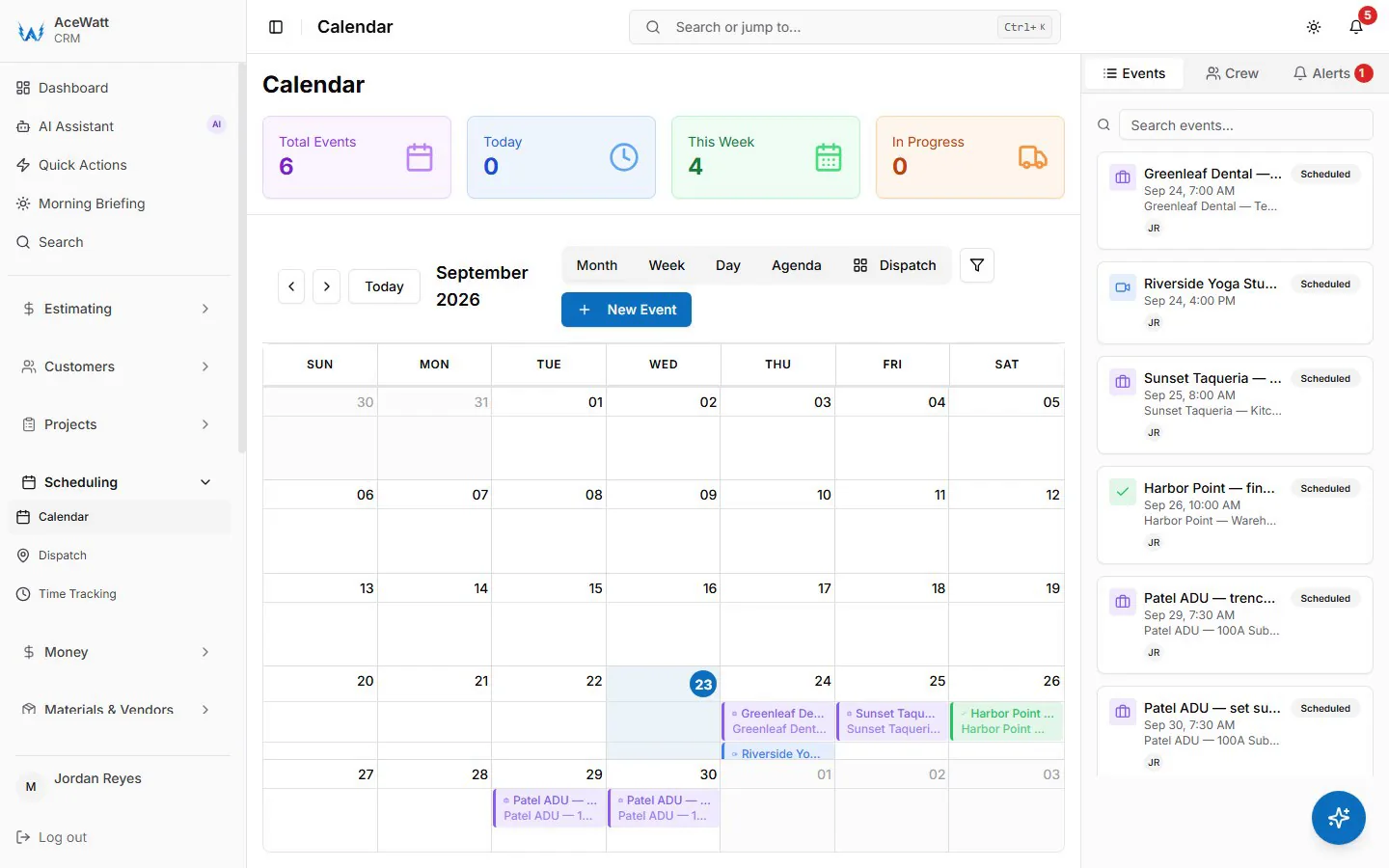
When the CRM handles the renewal, it feeds directly into Crew Scheduling and Dispatching. A renewed quarterly preventive maintenance agreement automatically generates four scheduled visits across the year, placed on the drag-and-drop board with skill-based technician suggestions. Job Tracking picks up each visit as a distinct job with status updates from dispatch through completion.
For preventive maintenance scheduling for electricians, this integration means dispatchers are not re-entering job details every quarter. The system knows what equipment is covered, what checklist applies, and how long the visit typically takes based on historical job data.
Maintenance Billing with Invoicing, Payment Tracking, and QuickBooks-Ready Exports
Recurring billing is where many field service platforms fall short. The agreement renews, but nobody tracks which plans are due for billing, and payment status lives in a separate system from the agreement.
In AceWatt, maintenance billing happens in the same platform that manages the agreement: the Maintenance Billing page drafts every plan's due invoices in one click, you review and send them, and the customer pays each one online by card. Nothing is billed or charged automatically, and the aging report shows which invoices still carry a balance.
QuickBooks-ready exports give your bookkeeper the invoice list as a spreadsheet and payroll hours as a QuickBooks-format CSV — no native, real-time sync today, and full sync is in development — and overdue invoices get automatic email reminders at 1, 7, 14 and 30 days late, so a maintenance invoice that was sent does not quietly age.
Using AI Voice and Job Walk Documentation to Strengthen Renewal Conversations
The strongest renewal conversations are grounded in what the technician observed on-site. AI Voice and Job Walk Documentation captures that intelligence during every service visit. As a technician walks a facility, they dictate observations: a corroded neutral bar in a subpanel, a dry-type transformer running hot, a panel schedule that no longer matches the installed loads. The system transcribes and structures those notes, attaching them to the site record and the agreement.
When the 60-day renewal reminder goes out, those observations become the proof points. Instead of a generic renewal pitch, the client receives a message that references specific conditions documented during the last inspection: the thermal scan that showed a 15-degree rise on a breaker termination, the circuit directory too faded to read and no longer compliant with NEC 408.4, the surge protection recommendation that was deferred last cycle.
This is how electrical contractors justify renewal pricing. The documentation is already in the system, so estimators and service managers do not chase handwritten notes or scroll through old work orders. When those findings call for new work, AI Estimating turns them into priced recommendations in minutes, whether that is a Type 2 surge protective device at a distribution panel or a full panel replacement supported by photos and thermal images.
Turning Service Agreements Into a Growth Engine for Your Electrical Shop
Electrical service agreements are not just a retention tool. They are a growth engine, but only when the systems supporting them are built for the way electrical work actually happens.
Field service management for electricians must connect the full lifecycle: agreement creation, renewal automation, scheduling, dispatch, documentation, estimating, invoicing, and accounting sync. When those pieces work together inside a CRM designed for electrical contractors, service agreements stop being administrative overhead and become the most reliable revenue stream on the books.
Shops that centralize agreement management, automate the renewal cadence, and tie everything back to real job-site documentation are the ones winning long-term relationships. The contractors still tracking contracts on paper are the ones wondering why their best clients quietly switched providers.