
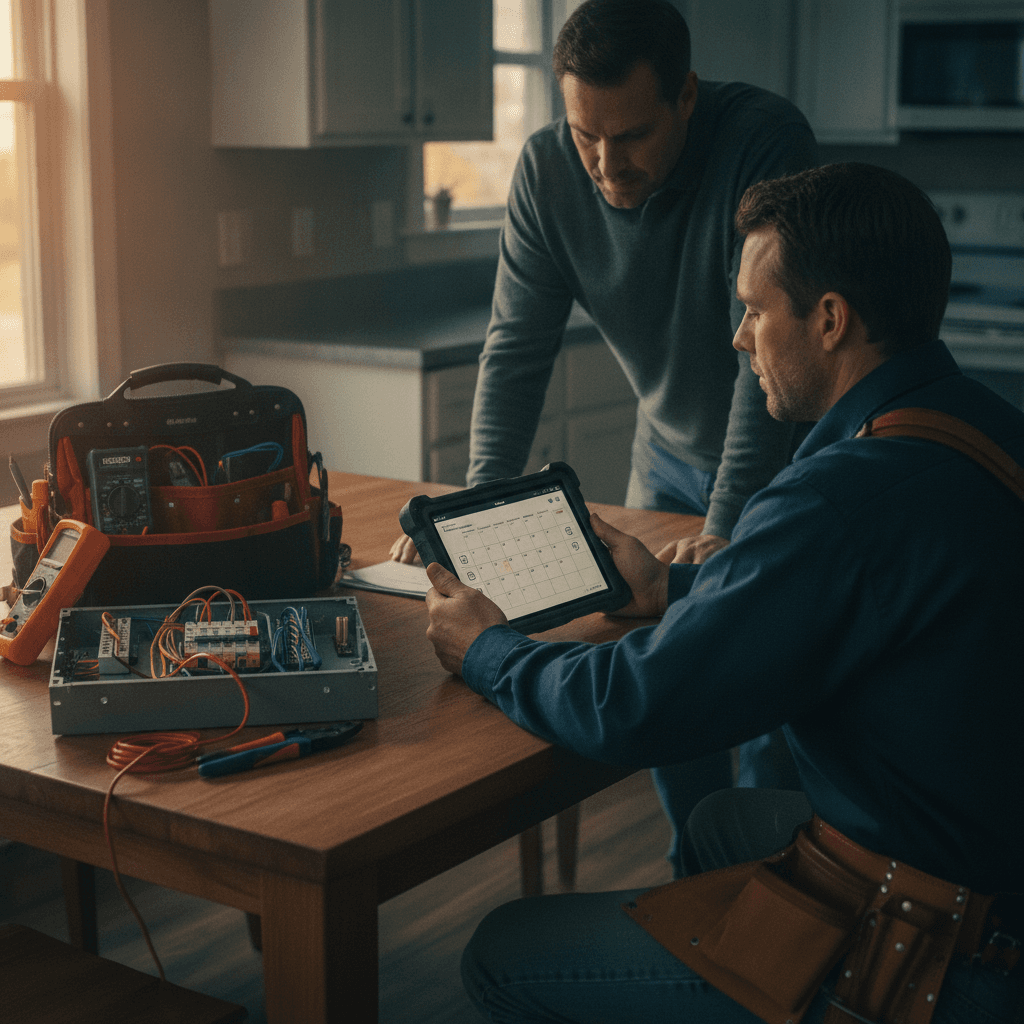
The 2026 Guide to Choosing a CRM for Electrical Contractors Service Agreements
Why Service Agreements Are the Recurring Revenue Engine for Electrical Contractors in 2026
The electrical contracting market is unpredictable. Emergency calls, new construction delays, and supply chain volatility make revenue forecasting difficult. In 2026, the most stable electrical shops across the United States are leaning on service agreements to anchor their cash flow.
Service agreements provide predictable monthly revenue by covering recurring, preventative work. For electrical contractors, this includes thermal imaging on 400-amp switchgear, torque verification on panel lug connections, generator load bank testing, lighting system retrofits, and whole-home surge protection checks. Instead of waiting for a customer's electrical system to fail, you are proactively managing it. Transitioning from a break-fix model to a preventative maintenance model stabilizes your backlog, keeps journeyman electricians productive during slow seasons, and builds enterprise value for your shop.
What an AI-Powered CRM Built for Electricians Actually Does for Service Agreements
Managing dozens or hundreds of maintenance contracts requires rigorous tracking. A generic customer relationship management system forces you to adapt your workflow to fit software built for software companies or plumbers. An AI-powered CRM tailored specifically for electricians tracks contract renewal dates, customer equipment history, and service-level commitments in one centralized platform.
Instead of relying on whiteboards, paper files, or disjointed spreadsheets, an electrical service agreement CRM maintains a complete digital profile for every site. If a commercial client has a Square D switchgear and an Eaton panel, your CRM logs the exact model numbers, installation dates, and NFPA 70E compliance requirements. When a customer calls, your team instantly sees their active agreement, their equipment specs, and their service history without putting them on hold.
Selling Maintenance Contracts Faster with AI Estimating and Automated Follow-Up
Pricing preventive maintenance profitably is one of the hardest parts of running an electrical shop. If you guess too low, you lose money on truck rolls and labor. If you guess too high, you lose the bid. AI Estimating helps by drafting the quote for your review from a typed description, job-walk notes or photos, priced from your company pricebook and assembly templates.
By using electrical maintenance contract management tools, you can draft quotes in minutes. Once a proposal is sent, the customer can review and e-sign it from a portal link. Following up on an unsigned proposal is still your call, since Automated Follow-Up emails reminders on overdue invoices (1, 7, 14 and 30 days late) rather than on proposals.
Keeping Recurring Visits on Schedule with Crew Scheduling and Dispatching
A packed maintenance schedule can quickly become a logistical nightmare without the right dispatch infrastructure. Crew Scheduling and Dispatching puts recurring maintenance visits on a drag-and-drop dispatch board, with skill-based suggestions for the right electrician.
If a service call requires arc-flash boundary assessments or work on medium-voltage equipment, the board suggests techs with that skill; confirming the Master license or safety certification stays the dispatcher's call. The board helps prevent double-booking, the Scale plan adds straight-line route optimization (no drive-time or traffic-aware routing), and the live dispatch map shows where techs are while their app is open.
Proving the Work Was Done with AI Voice and Job Walk Documentation
Preventive maintenance relies on trust, but it also requires defensible documentation. When your team performs a tightness check on branch circuit breakers or replaces a worn contactor, you need proof of the site condition and the completed work.
AI Voice and Job Walk Documentation allows field electricians to record audio notes and capture video of the site hands-free. The AI automatically transcribes these notes, converting spoken measurements and observations directly into the job file. If a customer questions whether a thermal scan was performed on their switchboard, or if an OSHA inspector requires proof of an equipment lockout/tagout procedure, you have time-stamped, geolocated documentation readily available in the system.
Getting Paid Predictably: Invoicing, Payment Tracking, and the QuickBooks Accounting Export
Cash flow bottlenecks often occur in the back office. When maintenance visits are completed, the billing cycle needs to start immediately. Recurring billing software for electricians integrates your field operations directly with your accounting department.
With built-in Invoicing and Payment Tracking, the Maintenance Billing page drafts each plan's due invoices in one click, and project work is billed from the accepted quote or by milestone. If you are shopping for QuickBooks sync for electrical contractors, here is exactly what AceWatt does today: every invoice, maintenance invoices included, lands on an invoice-list spreadsheet (number, customer, status, total, balance, due date), and payroll hours export as a QuickBooks-format CSV for your bookkeeper, while line items like a flat-rate maintenance fee or a time-and-materials upcharge for a failed component stay on the invoice. There is no native, real-time, bidirectional sync today; full sync is in development.
Turning One-Time Panel Upgrades and Generator Installs into Long-Term Service Agreement Customers
Every service call is an opportunity to build recurring revenue. When a customer requests a 200-amp panel upgrade or a Generac standby generator installation, they are making a significant capital investment in their property. However, if your shop only performs the one-time installation and walks away, you leave continuous revenue on the table.
Your CRM should automate the transition from one-time projects to ongoing relationships. Once the generator commissioning is complete, the system can automatically trigger a sequence offering a yearly maintenance plan. The software highlights the specific needs of their newly installed equipment, such as battery checks, oil changes, and transfer switch exercising, proving the immediate value of signing up for an ongoing service agreement.
Building a Service Agreement Program That Scales Beyond Solo Electrician Status
Solo electricians often hit a revenue ceiling because they are limited by the number of hours in a day. Growing from an independent operator to a multi-truck electrical shop requires systemic changes to how you manage data, customers, and field labor.
Implementing dedicated electrical contractor software is the catalyst for this growth. As your service agreement portfolio expands, the software scales right alongside you. The AI handles the heavy lifting of estimating, follow-ups, and documentation, freeing you up to focus on business development, safety training, and hiring. By securing predictable monthly income through proactive maintenance contracts, you guarantee that your growing shop stays highly profitable, efficient, and competitive in the modern electrical industry.
Related reading: Dispatch + CRM Playbook: Turning Emergency Service Calls into Recurring Maintenance Contracts. Related reading: CRM for Electrical Contractors That Automates Service Agreement Renewals & Recurring Revenue Tracking.