
Electrician Sales Pipeline Software: Track Leads to Quotes
You sent the panel-upgrade quote three weeks ago. The customer seemed serious, the scope was clear, and then service calls took over the day. No follow-up went out. By the time you remember, another electrician has the job. Electrician sales pipeline software is how electrical shops stop losing work to silence: every lead, quote, follow-up, win, loss, and scheduled job stays tied to one customer record.
What a sales pipeline means for an electrical contractor
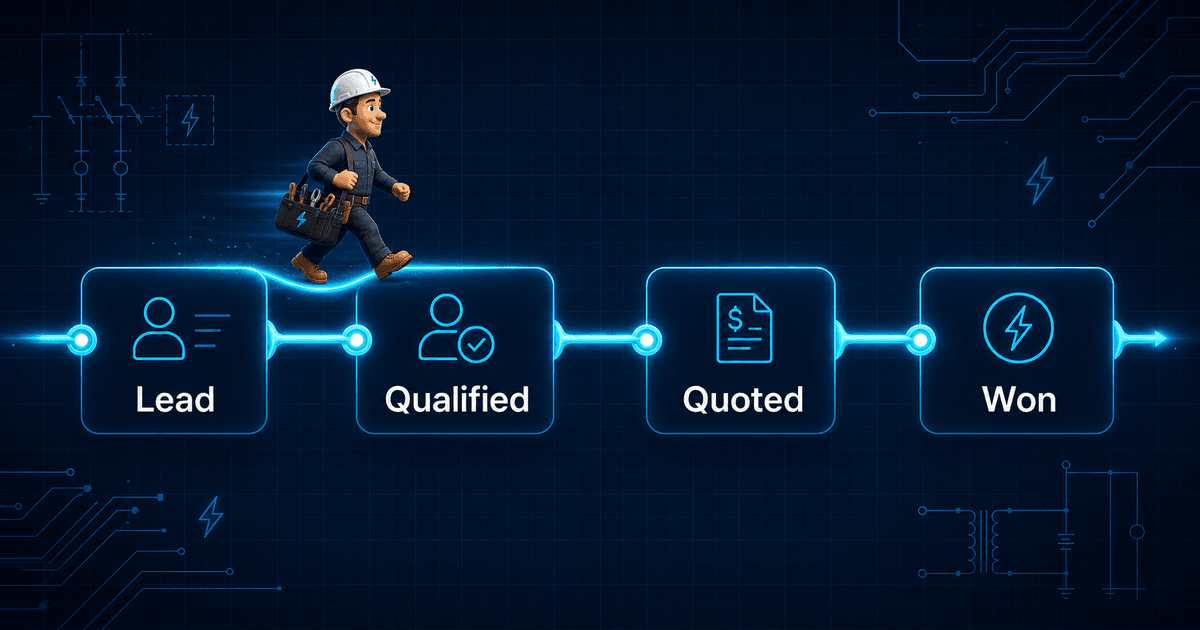
A sales pipeline for an electrical contractor is not a Silicon Valley funnel. It is the practical path from first contact to booked work: Lead → Qualified → Quoted → Follow-up → Won/Lost → Job. A homeowner calling about a breaker issue may move through that path in one day. A commercial lighting retrofit may sit in follow-up for weeks while a property manager, GC, and building owner review budget.
The value is visibility. You can open the CRM and see which jobs still need a quote, which quotes are waiting on the customer, which jobs are ready to schedule, and which opportunities were lost because of price, scope, timing, or fit. For more context on getting enough opportunities into the front of that process, see our guide to electrician lead generation.
A good pipeline also respects professional judgment. Software can organize intake, scope notes, estimate drafts, and follow-up history. It should not decide whether a panel is safe, whether a bid is profitable, or whether a code assumption is acceptable. Those decisions stay with licensed electricians, estimators, and the AHJ where applicable.
The cost of no pipeline
Most shops do not lose revenue in one dramatic failure. They leak it in small gaps: a referral written on a sticky note, a quote buried in email, a customer waiting for a callback, a lost bid with no reason recorded.
The first leak is the unfollowed quote. Electrical customers often compare two or three contractors. If your estimate is solid but your follow-up is inconsistent, the customer may pick the company that simply stayed visible. A pipeline makes "quoted but not followed up" a visible status instead of a memory test.
The second leak is no win/loss learning. If five service-upgrade quotes are lost to timing, that is different from five lost to price. If EV charger leads close but small troubleshooting calls do not, your marketing and qualification process should reflect that. Without a simple reason attached to lost opportunities, you keep guessing.
The third leak is owner dependency. When the owner alone knows which GC needs a revision, which homeowner approved a change, or which property manager asked for a maintenance quote, sales cannot be delegated. A CRM-backed pipeline lets the office, estimator, and field team work from the same record.
The 6-stage electrician sales pipeline
1. New lead
A new lead can come from a phone call, web form, referral, job board, repeat customer, or self-quoting flow. Capture the name, contact details, location, job type, urgency, and source before the day gets busy. If customers want to start online, customer self-quoting software for electrical contractors can collect structured information before your team calls back.
2. Qualified
Qualified means the work is real enough to spend estimating time on. Confirm the scope, site access, budget range, decision-maker, timeline, and whether the job fits your license, service area, and crew capacity. Qualification is not about pushing every lead forward; it is about keeping your estimator focused on work the shop can responsibly perform.
3. Quoted
Quoted means the customer has received a clear estimate or proposal. AceWatt's AI Quote Builder for electrical contractors helps turn job notes, scope, and line items into a draft quote for review. The important boundary: AI helps draft and organize; a qualified person still reviews labor, materials, exclusions, permits, and final price before anything goes out.
4. Follow-up
Follow-up is where many electrical quotes go cold. The customer may need a financing conversation, a revised fixture count, or a second look at a panel upgrade. The pipeline should show which quoted leads need a touchpoint. In AceWatt, open quotes stay visible on the customer record, and the follow-up itself is your team's call: timing, tone, and whether the scope has changed.
5. Won to job
Won means the customer approved the quote and the work needs to move into operations. That handoff matters. The job record should carry the customer history, approved scope, quote details, notes, and scheduling context so the crew is not guessing from a text thread. If scheduling is your next bottleneck, see our guide to electrical contractor scheduling software.
6. Lost
Lost does not mean useless. Record the reason: price, timing, competitor, out-of-area, unclear scope, no response, or customer decided not to proceed. Over time, those reasons show whether you need better qualification, faster quoting, clearer scope language, or a different lead source.
How AceWatt runs the electrical sales pipeline
AceWatt does not have a separate product page called "Pipeline," and this post is not claiming a drag-and-drop pipeline board. The honest framing is simpler: AceWatt runs the pipeline through the CRM's connected lead, quote, follow-up, schedule, job, and invoice workflow. Quote status and customer activity move the record from Lead to Quoted to Won/Lost to Job.
Start with the lead. AceWatt's core CRM keeps customer, job, quote, invoice, and scheduling context together. Intake can come from calls, forms, referrals, or lead-generation campaigns. Voice and AI features on higher plans help structure notes, but the contractor still qualifies the opportunity.
Next comes the quote. The AI Quote Builder is included in the Starter plan and helps prepare quote drafts from job context. The quote becomes the pipeline marker: waiting for review, sent to the customer, revised, accepted, or declined. That is the organizing layer electricians actually need.
Then comes follow-up. AceWatt does not draft follow-up messages for you; its AI Assistant answers quick plain-English questions from a summary of your recent customers, quotes, invoices, and projects, and the follow-up message itself is written by your team.
Once a quote is won, the workflow continues into scheduling, job notes, invoicing, payment tracking, customer portal, and QuickBooks-ready exports where the plan supports it. Starter begins at $49/month with core CRM, jobs, quotes, invoices, scheduling, and AI quote builder; Growth adds up to 5 users, AI copilot and voice, AI job walk, QuickBooks-ready exports, and customer portal; Scale adds unlimited users and advanced reports and analytics.
> See how AceWatt CRM works → Compare electrician CRM workflows before you move another quote spreadsheet into the new year.
Service vs. bid work: two pipelines, one CRM
Service work moves fast. A homeowner calls because lights are flickering, a breaker keeps tripping, or a ceiling fan needs installation. The pipeline may be Lead → Qualified → Quoted → Won in a single visit. Speed and clean handoff matter: capture the intake, quote quickly, schedule the tech, invoice when the work is done.
Bid work moves differently. A tenant improvement, generator install, service upgrade, lighting retrofit, or commercial maintenance proposal can involve a walk-through, revised scope, multiple decision-makers, and change-order risk. The same CRM should hold job-walk notes, proposal versions, customer messages, and any approved changes. For larger scopes, our electrical contractor change order guide explains how to keep scope changes from becoming invoice disputes.
The point is not to force every opportunity into the same pace. It is to keep both paths visible in one CRM so the office can tell the difference between today's service call and next month's commercial bid.
What to look for in electrician sales pipeline software
Look for trade-native stages. If the software talks in generic deal stages, you will spend time translating. Electricians need Lead, Qualified, Quoted, Follow-up, Won/Lost, and Job because those match the way service calls and estimates actually move.
Look for quote-to-pipeline connection. The quote should not live in a separate tool with no customer history. When a quote is sent, revised, approved, or declined, that status should update the record your team uses for follow-up and scheduling.
Look for field-ready capture. Mobile notes, voice capture, job-walk photos, and customer history matter because estimates are built from what the electrician saw on site. A pipeline that ignores field context becomes another office spreadsheet.
Look for follow-up support you can verify. Some vendors advertise alerts or automation; check those in a trial before assuming they fit your process. AceWatt's current honest fit is connected CRM context and an AI Assistant for business questions, not AI-drafted messages or a standalone stale-quote alert module.
Look for reporting that helps you improve. At minimum, you should know how many leads became quotes, how many quotes became jobs, and why reasonable opportunities were lost. If you are still building the basics, our guide on how to grow your electrical business covers the broader operating rhythm around lead flow, quoting, and follow-up.
Sales pipeline software vs. generic CRM
Generic CRMs are powerful contact databases, but they are not built around electrical work by default. You can customize stages, add quote fields, and connect outside tools, but the burden is on your shop to design the process, maintain the integrations, and teach the team what each field means.
Electrician sales pipeline software should reduce that translation layer. Leads should connect to job types, quotes, schedules, invoices, and customer history. Follow-up should be tied to the estimate, not floating in a salesperson's inbox. Won work should become a job with usable field context, not a copy-and-paste task.
AceWatt's fit is the connected electrical CRM workflow: lead capture, AI-assisted quote drafts, follow-up drafting, scheduling context, invoicing, customer portal, and QuickBooks-ready exports on the relevant plans. For a broader comparison of electrician CRM options, see Best CRM for Electricians 2026.
Frequently Asked Questions
What is a sales pipeline for electricians? A sales pipeline for electricians is the path from first inquiry to booked work: Lead → Qualified → Quoted → Follow-up → Won/Lost → Job. It helps a shop see which electrical leads need quotes, which quotes need follow-up, and which approved jobs need scheduling.
Does AceWatt have a dedicated pipeline view? AceWatt runs the pipeline through the CRM's lead, quote, and follow-up stages, quote status drives the lead through Quoted → Won/Lost → Job. It is not currently framed here as a separate drag-and-drop pipeline product.
How do I track electrical quotes without a spreadsheet? Use a CRM where each quote is tied to the customer, job notes, follow-up history, and final outcome. In AceWatt, AI quote drafts, CRM records, scheduling context, and invoices stay connected so the quote is not isolated in email.
Do electricians need a CRM for pipeline tracking? If you handle more leads than one person can remember, a CRM helps. It creates a shared record for calls, scopes, quotes, follow-ups, jobs, invoices, and lost reasons. Smaller shops can start simple, then add reporting as volume grows.
Can AI follow up with electrical customers automatically? AI can draft follow-up and proposal language, but the shop should review the message before it goes out, especially when scope, pricing, safety, or code assumptions are involved. AceWatt uses AI to assist the workflow, not replace licensed judgment.
Stop losing quotes you forgot to follow up
A sales pipeline is not a buzzword when you run an electrical shop. It is the list of leads waiting for a call, quotes waiting for a decision, jobs waiting to be scheduled, and lost opportunities that can teach you what to change next month. AceWatt organizes that path inside a trade-native CRM with AI quote drafting, follow-up support, scheduling context, invoicing, customer portal, and plan-based reporting features.