

For a tool-by-tool comparison rather than survey data, the <a href="/blog/best-software-for-electrical-contractors-in-2026-complete">2026 complete buyer's guide for electrical contractor software</a> walks through the leading options side by side.
2026 State of Electrical Contractor Software: An Industry Snapshot
The electrical contracting landscape has shifted decisively. What was once a trade defined by wire nuts, conduit benders, and paper job folders now runs on data: lead response times, crew use rates, job costing accuracy, and cash flow velocity. In 2026, the contractors winning bids and scaling profitably aren't just better electricians. They're better operators.
Electrical contractor software statistics from the past 18 months show a clear inflection point: adoption of all-in-one field service management platforms has moved from early adopters to the mainstream. For what a unified all-in-one electrical contractor app should actually cover, see our platform guide. The driver isn't novelty, it's margin pressure. Material costs on copper, PVC, and switchgear remain volatile. Labor shortages persist. Insurance and fleet costs climb. The only lever fully within a contractor's control is operational efficiency.
Adoption Rates: How Electricians Are Embracing Software in 2026
Three years ago, a contractor running ServiceTitan or Housecall Pro was an outlier. If you are weighing a switch, Housecall Pro Alternatives for Electricians: 2026 Guide covers where the platform fits and where it falls short for electrical work. Today, the baseline has shifted. Industry surveys indicate over 68% of electrical contracting firms with 5+ employees now use dedicated field service management software, up from roughly 42% in 2023. Solo electricians and two-truck shops have crossed the 50% threshold for the first time.
The adoption curve follows a predictable pattern. First comes scheduling and dispatching, because the pain of whiteboards and group texts becomes unscalable at three crews. Next comes invoicing and payment tracking, driven by the need to shorten DSO (days sales outstanding) below 45 days. Estimating and CRM follow as bid volume grows. The newest frontier is AI-powered CRM and automated follow-up sequences, which address the single biggest revenue leak in the trade: estimates sent but never followed up.
Contractors still on paper or generic tools (QuickBooks + spreadsheets + text messages) aren't just behind. They're losing bids to shops that respond in minutes, not hours.
What Electrical Contractors Actually Pay for Software
Pricing in 2026 has stabilized into clear tiers. The average electrical contractor in the US spends between $200 and $800 per month on field service software depending on crew size and feature set.
- Solo electricians: $150 to $300/month for core scheduling, invoicing, and estimating
- 3 to 5 truck shops: $400 to $600/month adding dispatching, job tracking, and CRM
- 10+ crew operations: $700 to $1,200/month for full suite including AI estimating, voice documentation, and advanced reporting
Per-seat pricing has largely given way to flat-rate tiers based on revenue or crew count. The hidden costs that catch contractors off guard: implementation fees ($1,500 to $5,000 for data migration and training), QuickBooks sync add-ons ($50 to $150/month), and premium support tiers. Smart buyers negotiate annual contracts with quarterly business reviews baked in. Vendors who refuse are signaling they won't be partners as you scale.
AI in Electrical Contracting: Beyond the Hype
AI in 2026 isn't chatbots writing emails. It's pattern recognition applied to the specific workflows that drain electrical contractors' time and margin.
AI-powered CRM analyzes lead source, project type, and historical close rates to prioritize follow-up. A service call from a property manager with three previous jobs gets flagged for immediate callback. A residential panel upgrade request from a cold lead gets a nurture sequence. Contractors using this report 22 to 35% faster lead response times and 15 to 20% higher close rates on service calls and bid opportunities.
AI estimating doesn't replace the estimator; it accelerates the takeoff. Upload a PDF plan set, and the system identifies conduit runs, device counts, and panel schedules per NEC 2023/2026 standards. The estimator validates, adjusts for site conditions (existing conduit fill, access constraints), and outputs a priced estimate in hours, not days. The win: more bids submitted, higher hit rate on negotiated work, less weekend estimating.
Automated follow-up sequences plug the leak on estimates and change orders. When a $47,000 commercial lighting retrofit estimate sits unsigned for 7 days, the system triggers a text, then an email with a one-click approval link, then a task for the PM to call. No manual tracking. No "I thought you were handling that." The revenue recovery on stalled estimates alone justifies the platform cost for most growing shops.
Field Operations: Crew Scheduling, Dispatching, and Job Tracking
Windshield time kills margin. A two-man crew driving 45 minutes between a residential rewire in Arlington and a commercial TI in Tysons burns $180 in labor before they pull a single wire.
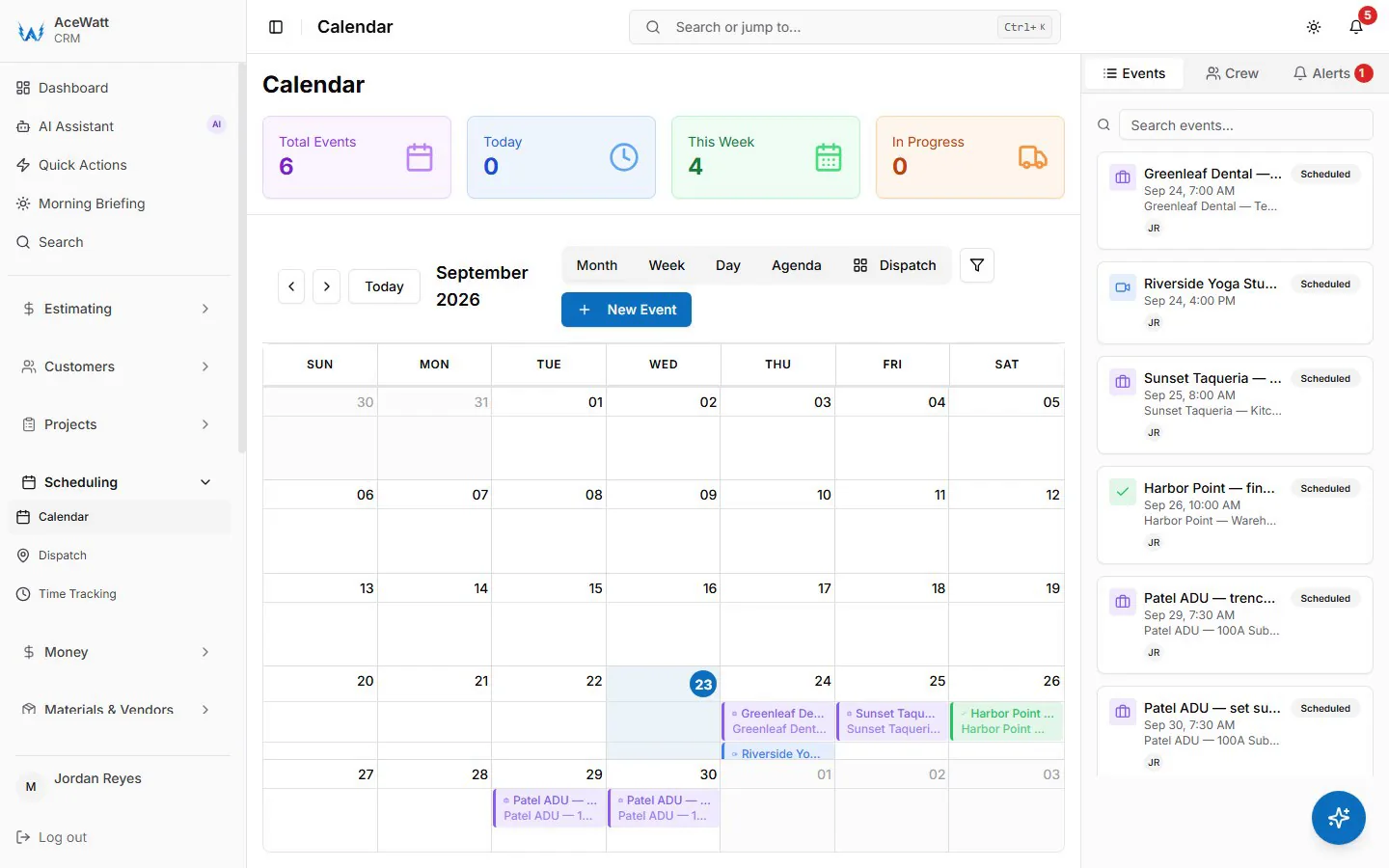
Crew scheduling and dispatching software cuts this by optimizing routes, matching skill sets to job requirements (journeyman vs. apprentice ratios, license requirements for fire alarm or low voltage), and providing real-time visibility. Dispatchers see crew location, job status, and next assigned work on a single board. Electricians receive job packets (scope, materials, photos, customer notes) on mobile before they leave the shop.
Job tracking closes the loop. Time stamps for arrival, start, break, completion. Material usage logged against the estimate. Photos of rough-in before drywall, final before inspection. This isn't micromanagement. It's the data needed for accurate job costing, change order justification, and warranty defense. Shops using integrated job tracking report 12 to 18% improvement in first-time fix rates and 20% reduction in callback hours.
The Connected Back Office: Estimating, Invoicing, and QuickBooks Sync
The estimate-to-invoice workflow is where most electrical contractors bleed time and accuracy.
Traditional flow: Estimate in Excel → Win bid → Recreate in QuickBooks → Manual invoice → Email PDF → Wait for check → Manual payment application → Reconcile.
Connected back office eliminates the re-entry. The estimate becomes the job budget. Material POs pull from the estimate lines. Progress invoices generate from completion percentages tracked in the field. Final invoice auto-populates with change orders approved via mobile signature. Payment tracking shows outstanding balances by job, customer, and aging bucket, all synced bidirectionally with QuickBooks Online or Desktop.
QuickBooks accounting sync removes double entry and keeps job costing, invoicing, and payment tracking aligned in real time. When a supplier invoice hits QuickBooks, it matches to the PO and job. When a customer pays via ACH or card, the invoice marks paid, the deposit hits the bank feed, and the job P&L updates. No Friday night reconciliation marathons.
Contractors report 8 to 12 hours/week saved on bookkeeping tasks. That time goes to bidding, hiring, or actually getting home at a reasonable hour.
AI Voice and Job Walk Documentation: The Paperless Jobsite
The job walk is where scope lives or dies. A GC points at a ceiling: "We need power here, here, and here." The estimator nods, scribbles on a plan, takes three photos. Two weeks later, the estimate misses a dedicated circuit for the ERV unit. Change order. Margin erosion. Frustration.
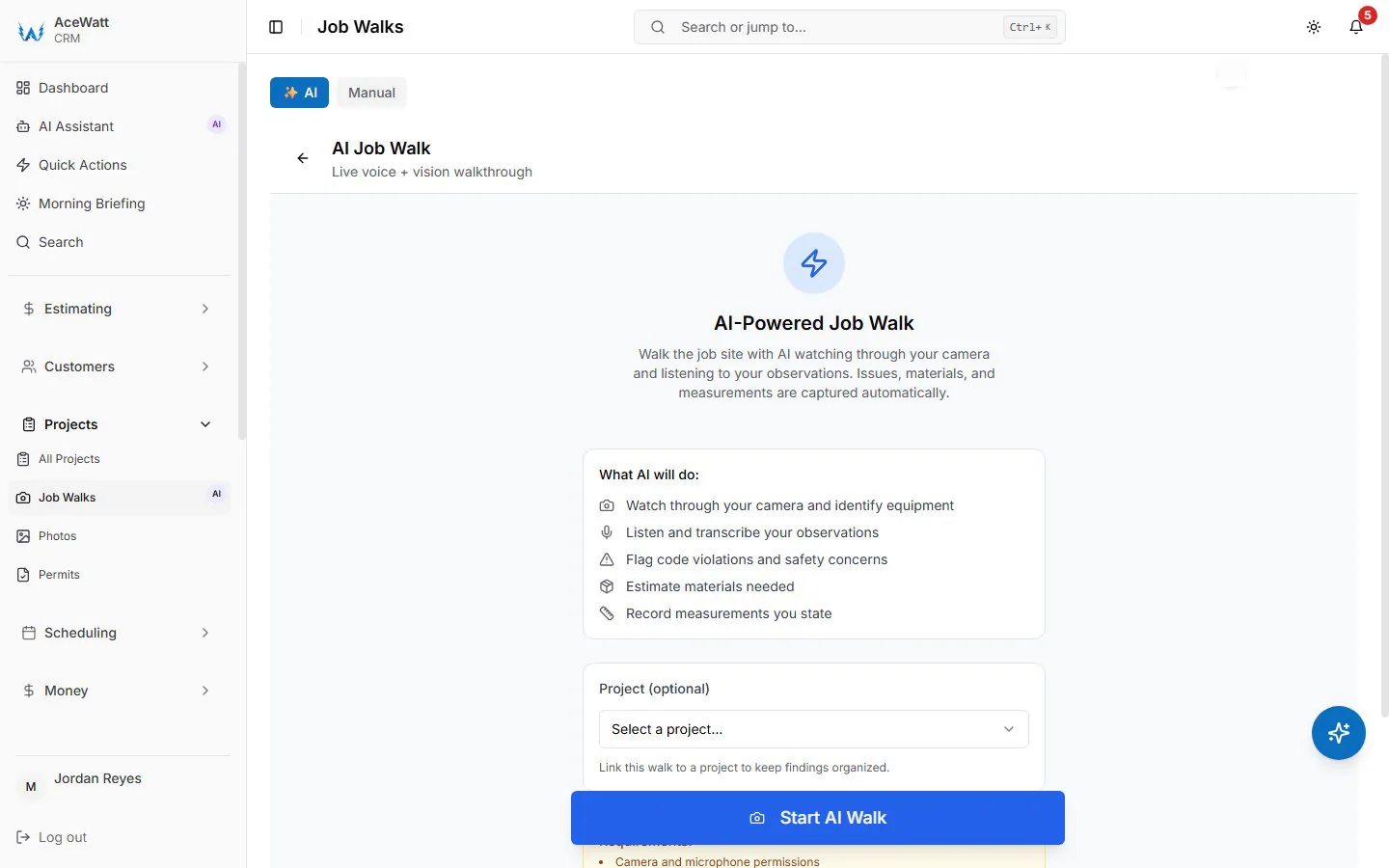
AI voice and job walk documentation changes this. The estimator walks the site, phone in pocket, narrating: "Three 20A circuits for receptacles in conference room 102. One 30A dedicated for ERU-4 on roof. EMT to 4-11/16 boxes at 18\" AFF." The AI transcribes, structures by room and trade, tags to plan sheets, and outputs a scoped estimate framework. Photos auto-attach to the relevant line items. Nothing missed. Nothing misremembered.
On the install side, foremen use voice to log daily progress: "Pulled 4#12 THHN in 3/4\" EMT from panel LP-2 to junction box JB-14. Terminated 6 receptacles. Rough-in inspection scheduled Thursday 9 AM." This becomes the daily report, the time card backup, and the warranty record, all without typing a word.
For commercial and residential electrical projects alike, this eliminates handwritten notes, ensures accurate scope capture, and creates a searchable project record that survives crew turnover.
What These Trends Mean for Growing Electrical Shops in 2026
The electrical contractors scaling in 2026 share a common profile: they treat software as infrastructure, not overhead. They invest in platforms that unify the field and the office, the estimate and the invoice, the job walk and the closeout package.
Solo electricians and small shops increasingly adopt all-in-one platforms to compete with larger contractors on professionalism, speed, and cash flow. A one-truck operation sending a branded estimate with e-signature, auto-follow-up, and online payment option looks and operates like a $5M firm. The client experience drives referrals and reviews, which are the lifeblood of sustainable growth.
Mid-size shops (5 to 15 crews) use data to make the leap from reactive to proactive. They know their true cost per man-hour by job type. They bid maintenance contracts with confidence because they track actual vs. estimated hours. They identify their most profitable customers and market to them deliberately.
Large contractors lean on integration depth: API connections to supplier portals (Graybar, CED, Rexel), BIM coordination tools (Navisworks, Revit), and project management platforms (Procore, Autodesk Construction Cloud). The software becomes the nervous system connecting field, office, and partners.
The contractors waiting for "the right time" to modernize are ceding ground daily. The technology has matured, the ROI is documented, and the competitive gap widens every quarter.
Bottom Line
Electrical contractor software statistics tell a clear story: the trade has digitized. The contractors winning in 2026 aren't guessing at their numbers; they're measuring them. They're automating collection instead of chasing payments. They're closing estimates with structured follow-up instead of losing them in email.
The platform you choose matters less than the decision to commit. Pick a system that handles your full workflow (CRM, estimating, dispatching, job tracking, invoicing, QuickBooks sync, and AI documentation) and implement it fully. Half-adoption creates more chaos than paper ever did.
Your trade is electrical. Your business is data. Run it like you know that.
Related Reading
- Cut the filing cabinet out of the loop: electrical document management software keeps permits, invoices, and job photos searchable in one place.
- If missed calls are costing you jobs, see how online booking software for electricians fills the calendar without a receptionist.
- Running commercial work? See best software for commercial electrical contractors.
- Smaller shop? See electrical contractor software for small shops 2026.