

Evaluating Electrical Dispatch Software and QuickBooks Integration in 2026
Electrical contractors running lean operations know the cost of a missed dispatch, a duplicated invoice, or an estimate built on stale material pricing. In 2026, the gap between shops using disconnected point solutions and those running unified field service management for electricians has widened into a competitive divide. The contractors winning bids and protecting margins are not working harder. They are running on integrated systems that connect the truck to the office in real time.
This guide looks at how electrical dispatch software with QuickBooks integration changes daily operations for solo electricians and growing shops across the US.
Connecting the Office and the Field: Crew Scheduling and Dispatching
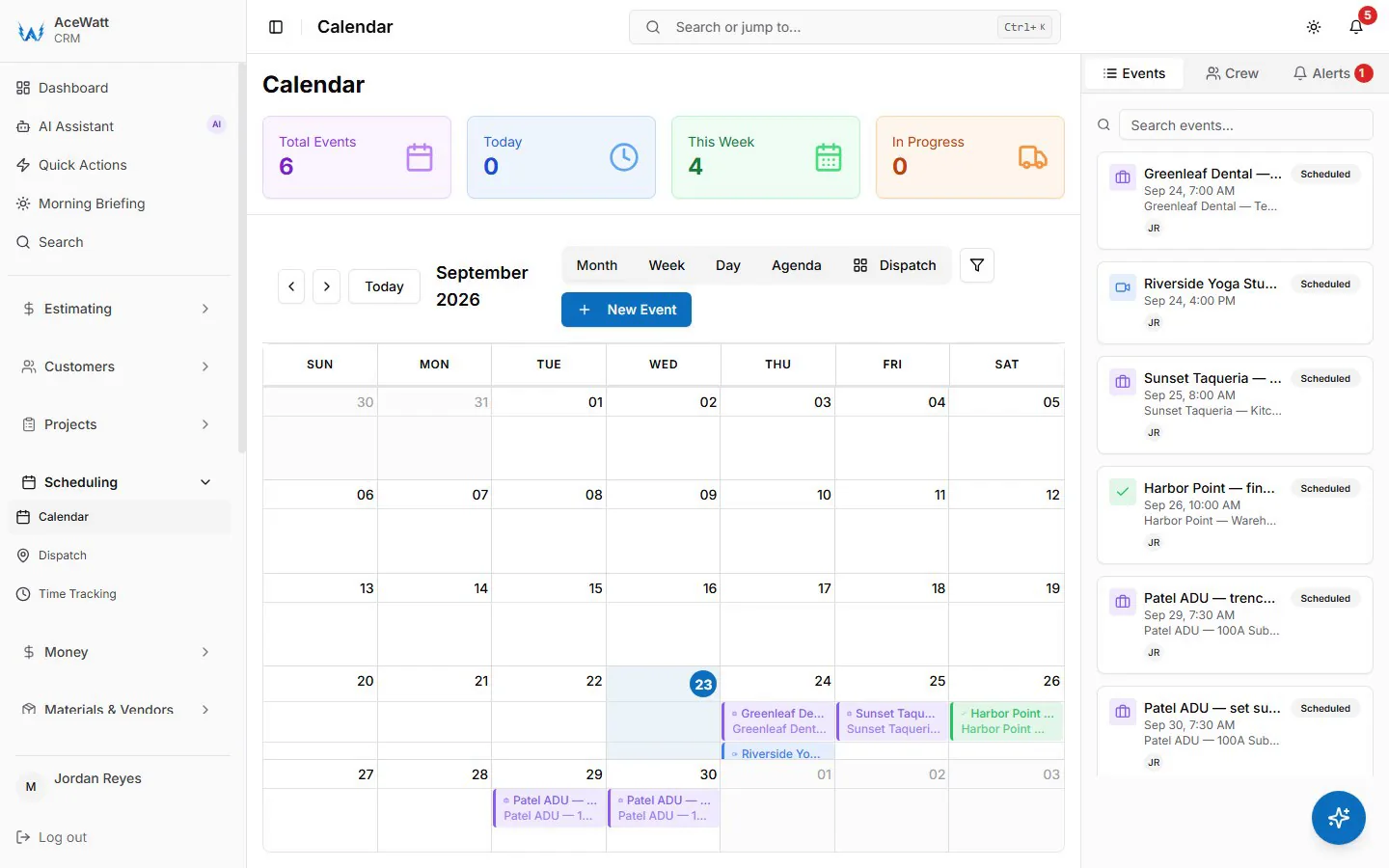
The average electrical service truck logs 18,000 to 22,000 miles annually. Every unnecessary trip costs roughly 70 cents per mile under the IRS standard mileage rate, plus unbillable labor hours. Manual scheduling on whiteboards or spreadsheets creates three predictable profit leaks: double-booked techs, wrong materials loaded, and emergency calls blowing up planned routes.
Crew Scheduling and Dispatching fixes this with a drag-and-drop dispatch board and skill-based suggestions. When a service call comes in for a 200-amp panel swap on a 1970s ranch, the job likely triggers AFCI and GFCI protection updates under NEC 210.12 and 210.8. The board suggests techs with panel swap experience, and the dispatcher checks who carries the correct breakers and sits closest to the zip code.
Dispatchers see crew locations on the live dispatch map while techs have the app open. If a tech finishes a rough-in early, the dispatcher can reassign a nearby troubleshooting call instead of a deadhead back to the shop, and on the Scale plan, straight-line route optimization helps order the stops (there is no drive-time or traffic-aware routing).
Solo electricians benefit differently. The mobile dispatch view replaces the clipboard. Job details, customer history, and required materials appear on the phone before arrival, so nobody calls the office from the driveway to ask which breaker the customer needs.
Real-Time Financial Accuracy: Getting Field Invoices Into QuickBooks and Sage
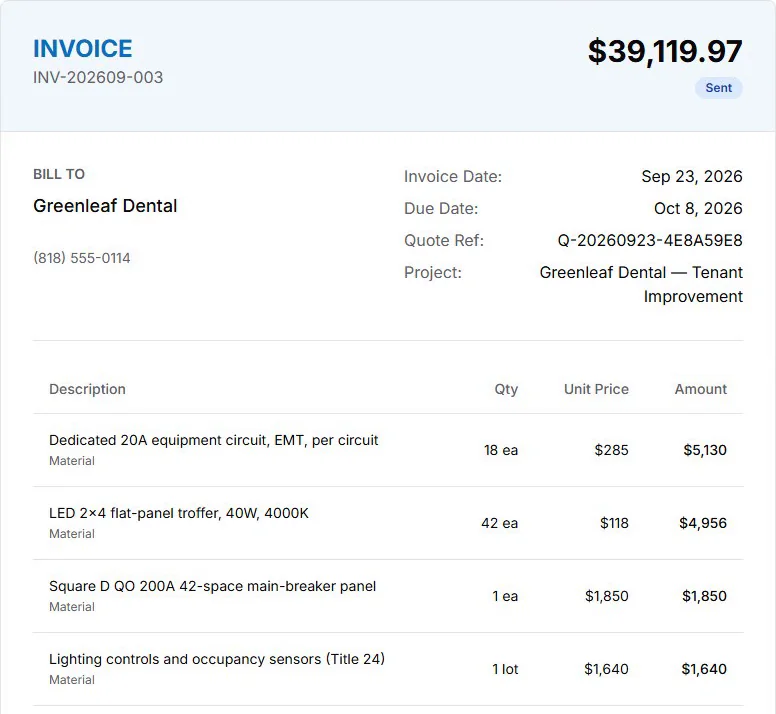
Double data entry between field management and accounting remains the silent margin killer. Industry surveys consistently find that a majority of electrical contractors still manually re-key invoices from field tickets into QuickBooks. Each re-key averages about four minutes and carries a 3 to 4 percent error rate: wrong quantities, missed change orders, and incorrect tax jurisdictions.
A live QuickBooks sync is what to ask for here — and worth asking any vendor to demonstrate. When a tech completes a job and generates an invoice in the field, a true sync posts it to QuickBooks Online automatically, with line items mapped to the correct accounts such as 5010 Materials, 5020 Subcontractors, 5030 Equipment Rental, and 5040 Permits. AceWatt’s approach today is the transparent one: no native, real-time QuickBooks connection; approved invoices land on an invoice-list spreadsheet (totals, not line items) and payroll hours export as a QuickBooks-format CSV for your bookkeeper, with full sync in development. Job costing updates in real time, so the owner sees true gross margin per project before the week ends rather than at month-close. Shops running project accounting on Sage platforms can follow the same pattern — native sync where the platform has one, bookkeeper-owned export where it does not.
Vendor bills follow the same rule. When a shipment arrives from City Electric, Crescent, or Graybar, the PO receipt logged in the field system carries the line detail your bookkeeper needs to enter the AP bill in QuickBooks against the original PO. Three-way matching of PO, receipt, and invoice is the standard to hold any platform to, and it matters once a shop is running 10 or more active jobs.
AI-Powered CRM and AI Estimating for Electrical Contractors
Electrical estimating has always been the bottleneck. A typical commercial bid package runs 40 pages of specs, 15 drawing sheets, and multiple addenda. A senior estimator needs 8 to 12 hours for quantity takeoff and pricing, and rush bids compress that to four hours while error risk climbs.
AI Estimating changes the first step. Upload the PDF set, and it drafts a quote for your review using your pricebook and assembly templates. Plan symbol counting is not reliable, so the estimator still owns the fixture, device, panelboard, conduit and wire counts; the time saved is in the drafting, not the takeoff.
The AI-Powered CRM ties estimating to the sales pipeline. Every bid becomes an opportunity tracked through stages: submitted, value engineering, negotiation, awarded, or lost. Bid stages stay visible, so the team can see which bids still need a call. For service departments, the CRM tracks maintenance agreement renewals, including 12-month PM contracts on UPS systems, generator load banks, and infrared scanning, which generates recurring revenue that smooths cash flow between projects.
Solo electricians use the lightweight version. Photograph a handwritten material list from a walkthrough, get a priced estimate in minutes, and send it with e-signature. No laptop at the kitchen table until midnight.
Simplifying Job Walk Documentation and Job Tracking
The job walk is where scope gaps originate. A tech walks a 12,000 square foot warehouse retrofit, nods at the owner's requests, and promises to send something. Three weeks later, the estimate misses the emergency lighting inverter, two additional 30A circuits for IT racks, and the fire alarm interface module. That is $4,200 in unbilled work.
AI Voice and Job Walk Documentation captures scope in real time. The tech speaks into the mobile app: add four emergency fixture units, surface mount; two dedicated 20A circuits for server rack PDUs; a fire alarm relay module for elevator recall. The system transcribes the audio, structures it into line items, tags everything with photos and GPS coordinates, and syncs it to the job file. It also captures code observations on the spot, such as working clearance measurements under NEC 110.26, so the estimate reflects field reality instead of memory.
Job Tracking then follows the project from award through closeout. Boards show each phase: engineering, submittals, procurement, rough-in, trim-out, inspection, punch list, and closeout. Custom workflows match your shop's process. A hospital project adds ICRA compliance steps. A data center adds commissioning checklists. The PM sees percent complete by phase instead of vague guesses.
Field techs log daily progress, material deliveries, and issues from the job site. Photos attach to daily reports automatically, and RFIs go out from the mobile app with drawing markups. The office sees everything in real time, with no waiting for Friday's paperwork drop.
Improving Cash Flow with Automated Follow-Up and Payment Tracking
Electrical contractors carry 45 to 65 days of AR on average. Commercial GCs pay net-60 or net-90, residential customers forget, and service calls under $2,500 often go uncollected because nobody has time to chase them.
Automated Follow-Up changes the economics with a fixed cadence of email reminders on overdue invoices:
- 1 day late: first email reminder
- 7 days late: second email reminder
- 14 days late: third email reminder
- 30 days late: fourth email reminder
- After that: calls, lien notices and any collection handoff stay with your office
Payment Tracking shows real-time status for every invoice: paid, partial, or overdue. Card payments (and ACH, where your Stripe account has it enabled) are recorded against the invoice, their balances show on the invoice-list export your bookkeeper works from, and the dashboard flags jobs with balances over 30 days, color-coded by aging bucket.
For service agreements, AceWatt schedules the recurring maintenance visits, and the Maintenance Billing page drafts each plan's due invoices in one click for you to review and send; nothing is billed or charged automatically. Solo electricians see the impact faster: the $475 service call from three weeks ago gets paid after the 7-day email reminder, with no awkward phone calls.
Conclusion: Scaling Your Electrical Shop with Unified Software
The 2026 reality is clear. Contractors running on paper, spreadsheets, and disconnected apps are ceding margin to competitors who are not. The shops growing from 3 to 10 trucks and from $2M to $8M in revenue share a common foundation: unified field service management that connects dispatch, estimating, job tracking, documentation, invoicing, and accounting in a single platform.
Electrical dispatch software with QuickBooks integration is not a convenience. It is the operational backbone that lets you bid faster, dispatch smarter, document thoroughly, invoice accurately, and collect consistently, all without adding administrative headcount.
The technology exists. The only variable is timing. Contractors who unify their stack in Q1 2026 will spend the year compounding the advantage. Those who wait will spend another year re-keying invoices and wondering why the competition keeps winning.
Your trucks are rolling. Your techs are skilled. Your systems should be too.