
_Last updated: May 2026._
Direct answer: An AI phone agent for electricians is a voice or call-intake system that answers inbound calls, gathers job details, qualifies urgency, and routes the next step. For electrical contractors, the safest setup is not hands-off. The AI can capture context and help the office respond faster, while a qualified human reviews emergencies, scope, code, safety, scheduling promises, and pricing before commitments are made.
A phone agent can be useful when your crew is on a ladder, in a panel room, or driving between jobs. But the call is only the first step. If the intake summary does not reach your CRM, calendar, quote process, job-walk notes, and invoice workflow, your office still has to retype the same information later.
What is an AI phone agent for electricians?
An AI phone agent for electricians is software that can answer calls or assist call handling with voice automation, scripted intake questions, lead qualification, appointment requests, and message summaries. Some tools act like an AI receptionist. Others are closer to an answering service. The difference matters because electrical work has safety and urgency rules that generic call scripts miss.
An electrician does not just need a message that says, "Customer needs help." The office needs the caller's name, callback number, service address, property type, job category, urgency, access notes, preferred times, and any safety warning the caller mentioned. For many jobs, the team also needs photos, panel details, equipment information, and notes about permits or utility coordination. Those details belong in a CRM for electricians, not in a disconnected voicemail transcript.
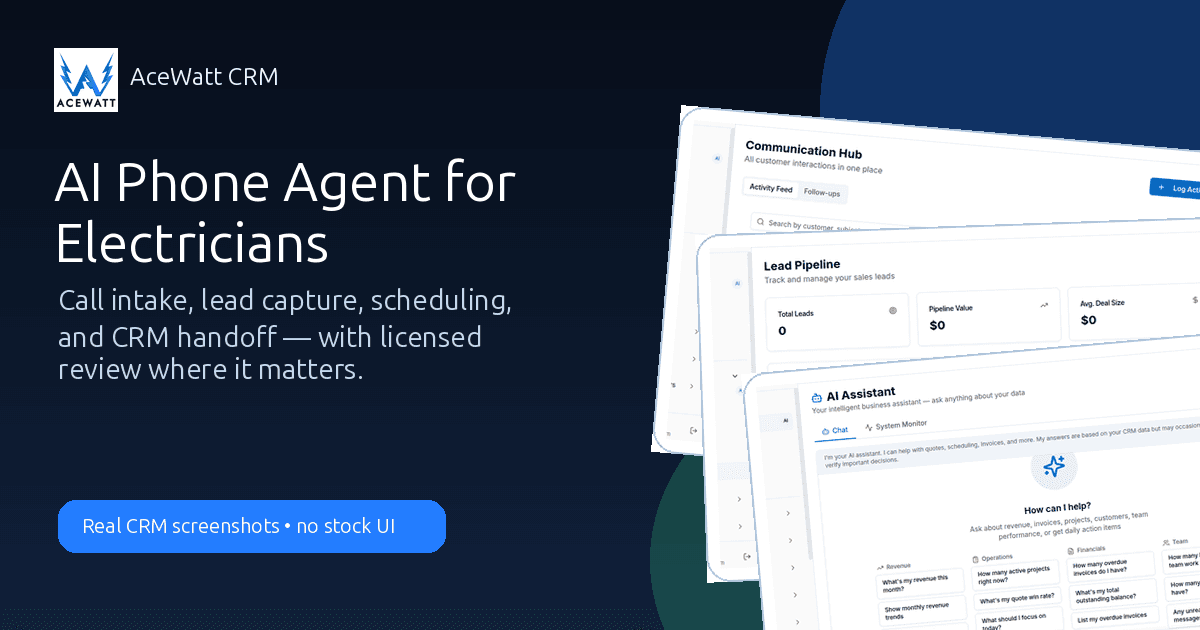
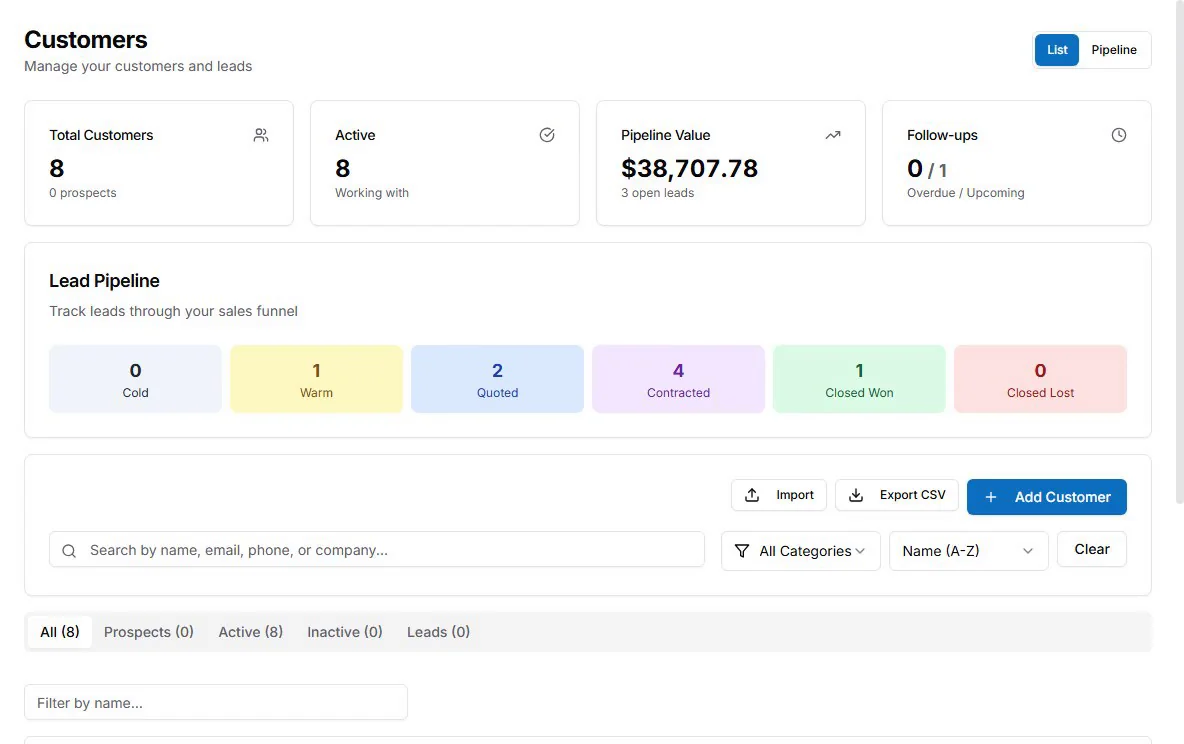
AceWatt is best described as the CRM and workflow layer around that intake. The app includes communication, lead pipeline, scheduling, quote, invoice, contract, AI assistant, job-walk, and reporting screens. If a contractor connects a phone channel or intake workflow to AceWatt, the post-call work can stay connected instead of scattered across texts and sticky notes. Contractors should verify their exact phone-provider and integration setup before relying on automatic answering.
AI phone agent vs AI answering service vs virtual receptionist
A virtual receptionist is usually a human service that answers calls and follows a script. An AI answering service uses voice AI or text automation to answer calls and summarize details. An AI phone agent may go further by asking dynamic questions, classifying urgency, and routing the next action. None of those should replace judgment from the electrical contractor.
For electrical contractors, the better question is: what happens after the call? A phone-only tool may book a callback. A workflow-connected system can pass the details into a lead record, create follow-up context, support a job-walk checklist, and keep quote and invoice history tied to the customer. That is why this guide pairs phone-agent buying criteria with the broader AI agent for electricians workflow.
Why electrical calls are harder than generic service calls
Electrical callers often describe symptoms, not scope. A homeowner may say "the breaker keeps tripping," "the lights flicker," or "there is a burning smell." A commercial property manager may ask for a panel upgrade, service troubleshooting, lighting retrofit, tenant improvement, EV charger installation, or emergency response. Those calls need careful triage.
The AI can collect what the caller says. It should not interpret hazard conditions, promise code compliance, or tell someone an energized condition is safe. For smoke, burning smells, active sparks, shock risk, downed wires, or utility hazards, the script should tell the caller to follow emergency or utility instructions and escalate to a human immediately.
The 7 call types an AI phone agent for electricians should handle
Emergency power outage or burning smell calls
The AI should identify emergency language and move quickly to escalation. Safe scripts avoid diagnosis. They can collect the address, callback number, general description, and whether anyone is in immediate danger, then instruct the caller to contact emergency services or the utility where appropriate. Your business rules decide when to call the on-call technician, dispatcher, or owner.
Panel upgrades and estimate requests
Panel upgrades usually need more than a calendar slot. Intake should capture property type, existing service size if known, desired upgrade reason, photos if available, access notes, and whether the customer has utility or permit constraints. In AceWatt, this context can support the next step: job-walk documentation, quote drafting, and customer follow-up. The final scope still belongs to the contractor.
Service and repair appointment booking
For standard troubleshooting or repair calls, an AI phone agent for electricians can gather symptoms, service address, availability windows, and preferred contact method. The scheduling step should respect your real capacity. Avoid promising same-day dispatch unless your team has confirmed availability. Tie the booked call to electrical scheduling software so the field crew and office see the same appointment context.
Commercial maintenance requests
Commercial calls often include site access rules, tenant constraints, purchase-order requirements, insurance certificates, and after-hours windows. A good phone-agent script asks for those details early. It should route the account to the correct customer record so the office can see history before quoting or dispatching work.
Warranty callbacks and repeat customers
Repeat callers should not start from scratch. The AI can ask enough to identify the customer and job, but the CRM should hold the history. If there is a warranty question, workmanship issue, or dispute, the system should route the call to the team with access to prior notes, photos, estimates, and invoices.
Spam, price shoppers, and unqualified leads
Not every call deserves the owner's immediate attention. An AI phone agent can classify spam, sales calls, vague price shoppers, out-of-area leads, and incomplete requests. The goal is not to reject good leads. The goal is to keep your crew focused while still capturing enough context to follow up on jobs that fit your service area and work type.
After-hours voicemail replacement
After-hours calls are where AI phone agents get the most attention. A useful system captures the job details while the customer is motivated, then sends a clean summary to the office. If the issue is urgent, it follows your escalation rules. If the issue is routine, the team has a structured lead ready the next morning.
What an AI phone agent for electricians should capture on every call
Every intake flow should be short enough for a real caller to finish, but specific enough for an electrician to act on. At minimum, capture:
- Name, phone, email, and service address.
- Residential, commercial, industrial, or property-management context.
- Job type: service repair, panel, EV charger, lighting, generator, inspection item, maintenance, or project work.
- Urgency and safety signals.
- Access notes, parking, gate codes, tenant restrictions, and preferred contact method.
- Photos or documents when available.
- Scheduling constraints and whether the caller wants an estimate, repair visit, or callback.
The handoff should be reviewable. A human should be able to scan the record and decide the next action without listening to the full call unless needed.
Emergency triage: when AI must hand off to a human
The safest AI call flow is conservative. For smoke, heat, burning smell, active sparks, visible arcing, shock risk, exposed energized conductors, flooded electrical equipment, downed utility lines, or a caller who says someone may be in danger, the AI should stop normal qualification and escalate. It can say that electrical hazards can be dangerous, that the caller should follow emergency or utility guidance, and that a qualified person from your team will review the request.
Do not program the agent to say a situation is safe. Do not let it diagnose code compliance. Do not let it promise a repair price or a guaranteed arrival time that your dispatcher has not confirmed.
Top AI phone agents for electricians compared in 2026
The market includes phone-only vendors and broader workflow platforms. Electricians should compare Dialzara, AgentZap, Allo, Trillet, Phonely, DaVoice, Voiceflow-style builders, and any local answering service they already trust. Vendor features and prices change, so verify directly on each live vendor page before buying.
AceWatt's angle is different. It is not trying to be only a phone answering product. AceWatt is the electrical-contractor CRM workflow that should receive intake context and carry it into leads, job walks, estimates, scheduling, follow-up, invoices, and reporting. That distinction matters when missed handoff is the real problem.
| Tool type | Best fit | Watch-out |
|---|---|---|
| AI answering service | After-hours call capture and simple appointment requests | May stop at transcript or calendar handoff |
| AI receptionist | Front-desk replacement for common calls | Requires careful emergency and safety scripting |
| Voice-agent builder | Custom scripts for shops with technical setup help | Builder still needs CRM handoff and maintenance |
| CRM-connected workflow | Shops that want call context tied to jobs, estimates, invoices, and follow-up | Verify phone-provider integration and plan features |
Why phone-only AI is not enough for electrical contractors
Phone-only AI solves the first five minutes. Electrical contractors make money in the next five days: scheduling the job walk, documenting site conditions, sending a clear estimate, following up before the lead goes cold, completing the work, and collecting payment.
If the call transcript stays in a standalone dashboard, your office still copies details into a CRM. If the call books a time without job context, the technician may arrive unprepared. If the call creates a lead but not a follow-up reminder, the estimate can sit unanswered. That is why the phone-agent decision should include the AceWatt AI Copilot, AI job walk documentation, automated estimating, and invoice handoff workflow.
How AceWatt connects intake to the electrical job workflow
A practical AceWatt workflow looks like this:
- Phone intake (a third-party AI phone agent, or AceWatt's phone menu plus your callback) captures the caller's details and job context.
- The office reviews the lead in the CRM.
- The team schedules a callback, site visit, or service appointment.
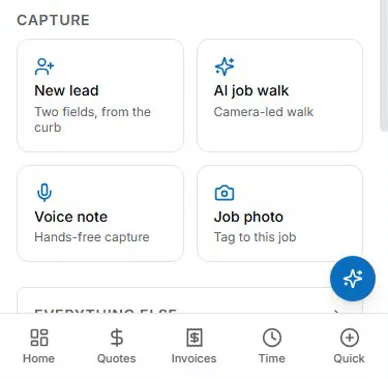
- The electrician documents the job walk with voice notes and photos.
- AceWatt helps organize estimate context for contractor review.
- The approved quote moves into job scheduling, follow-up, and invoice tracking.
The important boundary is that AI assists. It does not replace a licensed electrician, qualified estimator, dispatcher, or owner. Electrical scope, code compliance, permits, safety, service promises, and final pricing stay under human review.
FAQ: AI Phone Agents for Electricians
Can an AI phone agent answer emergency electrical calls?
It can answer and escalate, but it should not assess the hazard. For smoke, burning smells, active sparks, shock risk, downed wires, or immediate danger, use conservative scripts that tell callers to follow emergency or utility guidance and route the call to a human.
How much does an AI phone agent for electricians cost?
Pricing varies by vendor, minutes, calls, appointment volume, setup, and integrations. AceWatt pricing for the CRM starts at Starter $49/month, with Growth and Scale plans adding more AI and workflow capabilities. Verify phone-provider and answering-service costs separately.
Is an AI phone agent better than a human receptionist?
It depends. AI can cover after-hours calls and repetitive intake. Humans are better for nuance, upset customers, safety concerns, dispatch judgment, and relationship management. Many shops use AI for backup and humans for exceptions.
Can AI book electrical service appointments?
It can request or book appointments if connected to your scheduling rules. Keep safeguards in place so it does not promise availability, emergency response, or pricing that your team has not confirmed.
Can an AI phone agent connect to my CRM?
Some phone tools can pass summaries to a CRM or calendar. Before buying, run a real test call and confirm where the data lands, what fields are captured, and whether the office can act without retyping.
Does AI replace dispatchers or office staff?
No. It can reduce missed calls and organize intake, but dispatchers and office staff still handle prioritization, customer judgment, technician coordination, safety-sensitive cases, and final commitments.
Bottom line
An AI phone agent for electricians is useful when it captures the right details and escalates the right calls. It becomes more valuable when that context flows into the rest of the job lifecycle. Use the AI to answer faster. Use AceWatt to keep the lead, job walk, estimate, schedule, follow-up, invoice, and customer record connected.
Ready to compare the full workflow? Start with AI answering service for electricians, then see how an AI agent for electricians goes beyond the call.
Related Reading
- Start with the strategy: target niche long-tail keywords for electrical contractors.
To compare how the phone agent connects to estimating, scheduling, and invoicing, see AceWatt's features.