

Why Electricians Need an AI Answering Service in 2026
The phone rings while you're pulling wire through a 200-amp service upgrade. Your apprentice is on a ladder terminating a subpanel. The homeowner wants to know when the inspector arrives. You can't answer, the call goes to voicemail, and the homeowner calls the next contractor on Google.
In 2026, electrical contractors don't lose jobs because they lack technical skill. They lose them because the first point of contact fails. For a wider look at the platforms that carry those captured leads through to booked jobs, see Software That Tracks Leads and Booked Jobs for Electrical Contractors. An answering service for electricians built on AI voice technology does more than take messages. It captures leads, qualifies urgency, documents job walks, and feeds clean data into your CRM, estimating, scheduling, and accounting workflows while your crew stays focused on the work.
The Real Cost of Missed Calls for Electrical Contractors
Industry research has shown for years that roughly 80% of callers who reach voicemail hang up without leaving a message. For a solo electrician running service calls, each one of those is a potential panel upgrade ($3,500 to $6,500), a Level 2 EV charger install ($1,200 to $2,800 before any panel work), or an emergency outage call ($250 to $500 minimum) gone to a competitor.
For a shop with three trucks, the math compounds. Five missed calls a week, a 30% close rate on a $2,500 average ticket, works out to 78 lost jobs and about $195,000 in annual revenue. Add callbacks, rescheduling, and the reputational damage when a homeowner posts "never called me back" on Nextdoor, and the true cost climbs higher.
Traditional human answering services don't solve this. A generic operator reading a script can't distinguish a GFCI nuisance trip from a failing main breaker. They don't know NEC 210.8 requirements for kitchen counter receptacles, or that a "hot panel" call might mean a Federal Pacific Stab-Lok replacement: a $4,000 to $8,000 job requiring permit coordination. They take a name and number, and you still have to call back, qualify, estimate, and schedule. Most also bill per minute, so you pay for spam calls and wrong numbers on top of a monthly minimum.
How AI Answering Captures Leads, and Where AceWatt Fits
Modern AI voice agents answer on the first ring, 24/7/365, and they understand electrical trade language. When a caller says "my AFCI keeps tripping in the bedroom," the AI tags it as a service call and prompts for panel brand and age. When a GC says "I need a temp power pole and a 400-amp service for a 12-unit build," the AI recognizes a commercial project, captures the scope, and routes it to your estimator.
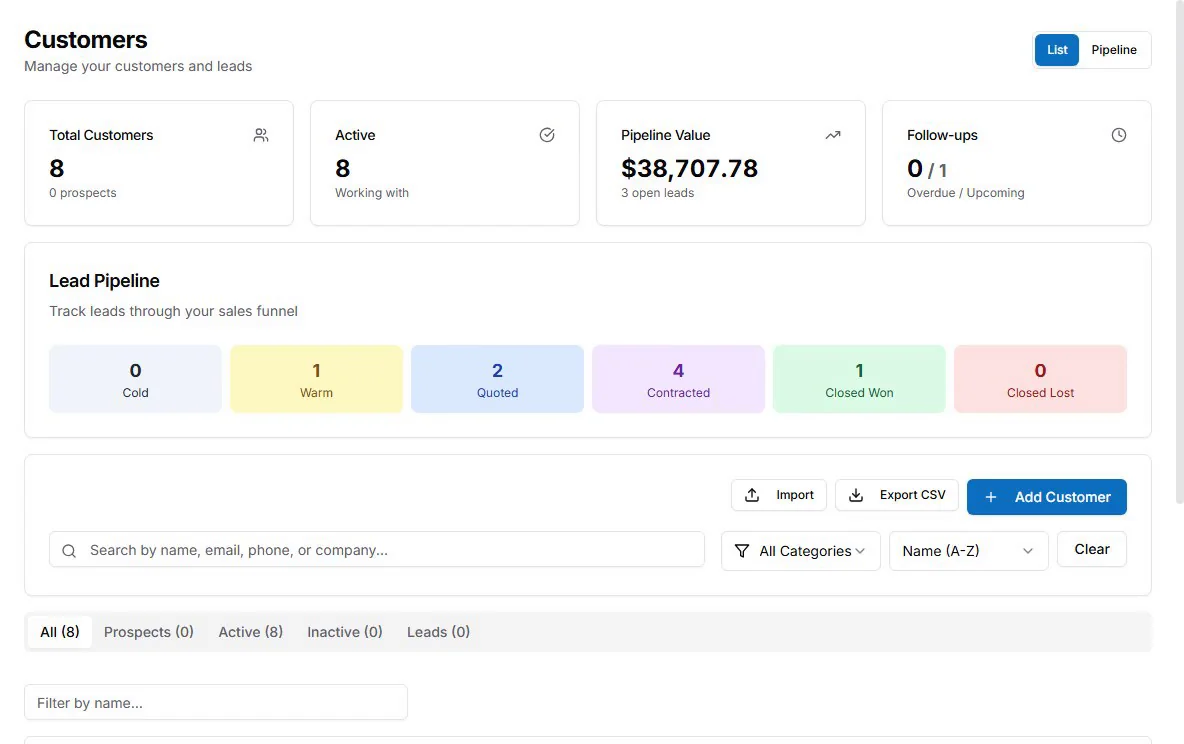
AceWatt does not answer calls with AI. It has a phone menu (Voice Receptionist) that routes callers and, after hours, tells them a team member will call back and alerts your staff, and lead forms and online booking capture the rest. When you call back or walk the job, AI Voice and Job Walk Documentation turns your dictated notes (service address, panel type, load details, urgency level, permit requirements) into a structured job summary on the customer record. No more scribbling on a receipt behind the dash.
For solo electricians, this means callbacks that start from an alert and a documented record instead of five voicemails at 8 p.m. For growing shops, your estimator opens Monday morning with a pipeline of documented, categorized opportunities instead of a stack of sticky notes.
Turning After-Hours Calls Into Booked Jobs
The caller hangs up. What happens in the next five minutes determines whether you get the job.
Your team calls back from the captured summary. Emergency calls ("smoke from the panel," "half the house is dead") go to your on-call tech first. Project inquiries (recessed lighting retrofit, subpanel for an ADU) go to your estimator for a next-day estimate slot.
Because the summary records the specific issue discussed, your callback starts with the facts: "Thanks for calling about your Federal Pacific panel in Arlington. We have Tuesday 8 to 10 AM or Wednesday 1 to 3 PM open for an assessment." The homeowner picks a window, it goes on your schedule, and the phone tag ends. Confirmed appointments with specific windows also cut no-shows, and weekend calls turn into Monday estimates before your competitor even returns their voicemail.
From First Call to Dispatch: Crew Scheduling for Electrical Shops
Capturing the lead is step one. Getting the right electrician to the right job with the right materials is where profit lives.
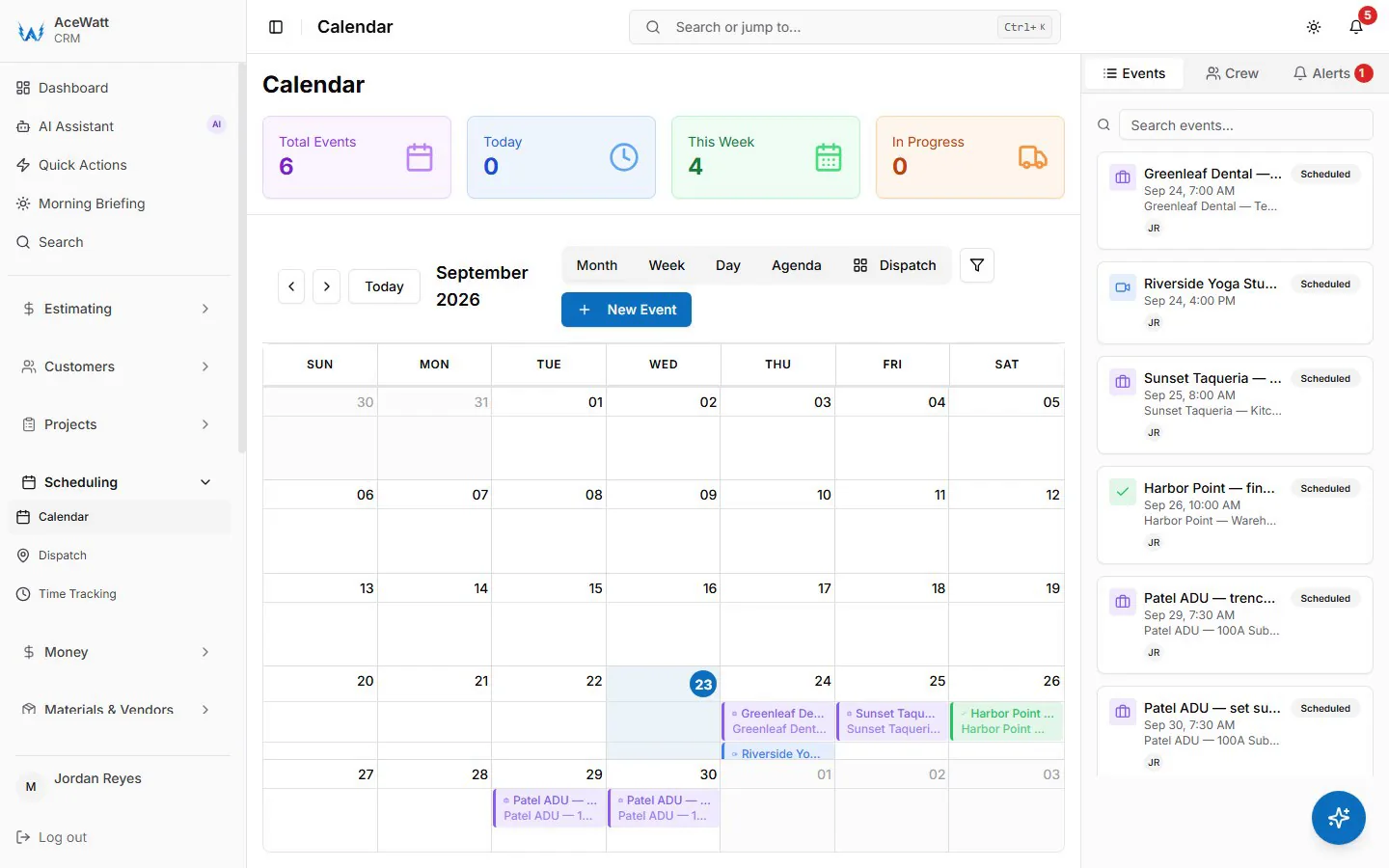
Crew Scheduling and Dispatching connects the captured job directly to your dispatch board. The job summary includes trade classification (service, rough-in, trim-out, commercial, low-voltage), required skill level (apprentice, journeyman, master), estimated hours, and special requirements such as a pulled permit, lift access, or a specific panel brand. Your dispatcher assigns the crew on the drag-and-drop dispatch board, with skill-based suggestions.
For a shop running five trucks, this eliminates the whiteboard shuffle. The 7 a.m. "who's taking the panel swap?" conversation disappears. The board's skill-based suggestion points to Tech A, who drives a van stocked with Square D QO breakers and finishes his rough-in by 11 a.m. He gets the dispatch, and Job Tracking carries the status from dispatched to complete without a single radio call. You move urgent work (outages, code corrections from failed inspections, burning smells) to the front of the queue.
AI Estimating closes the loop for project calls: for a "200-amp service upgrade, overhead to underground," it drafts the quote for your review from the job-walk notes, priced from your pricebook, saved assemblies and labor rates, plus current online retail prices.
Keeping the Back Office in Sync: CRM, Invoicing, and QuickBooks Integration
The job is done and the homeowner is happy. Now the paperwork starts, unless your systems talk to each other.
Invoicing and Payment Tracking keeps billing tied to the job. An accepted quote is invoiced and emailed automatically (a deposit invoice first, if the quote asks for one); for extra work, labor hours, materials from your price book (QO breakers, 12/2 NM-B, 1/2-inch EMT), permit fees, and change orders go on an invoice your office manager builds from the job record with a button, reviews, and sends. The homeowner pays online by card from the emailed invoice link (or by ACH, if your Stripe account has it enabled), the payment posts, and the receipt emails automatically.
QuickBooks-Ready Exports give your bookkeeper your invoice list as a spreadsheet and your payroll hours as a QuickBooks-format CSV. There is no native, real-time, bidirectional sync today; full sync is in development. Job profitability (invoiced revenue minus logged job costs) is visible per job from the Financial Hub. For the solo electrician, Friday invoicing becomes a 15-minute review. For the growing shop, your bookkeeper stops chasing field tickets and starts analyzing profitability. You learn your EV charger installs run thinner margins than panel upgrades, and you adjust pricing accordingly.
What to Look For in an Answering Service for Electricians
Not every AI platform understands electrical work. Generic field service management tools treat a panel upgrade like a plumbing leak: same script, same fields, same follow-up. That fails your callers and your dispatch board.
Trade-specific intelligence is non-negotiable. The system should recognize:
- NEC code references (210.8 GFCI, 210.12 AFCI, 230.71 disconnects, 406.12 tamper-resistant receptacles)
- Panel brands and vintage hazards (Federal Pacific, Zinsco, Pushmatic, Challenger)
- Permit types (residential service, commercial temp power, solar interconnection, low-voltage)
- Load calculation methods (NEC 220.82 versus 220.83)
- Inspection sequences (rough, service, final)
- Material specs (THHN versus XHHW, Schedule 40 versus 80 PVC, MC versus EMT)
Workflow integration matters more than feature lists. The AI must write to your CRM, trigger your estimating templates, populate your dispatch board, and sync to QuickBooks natively, not through middleware duct tape.
After-hours protocol must match your business. Solo electricians need triage that wakes them only for true emergencies. Shops need escalation trees that run from on-call tech to service manager to owner, with the system tracking certifications like state licenses, EVITP, and OSHA 30.
Data ownership protects your business. Your call recordings, transcripts, and customer records should be exportable in standard formats if you ever switch platforms. Pricing transparency respects it. Look for flat monthly tiers with included minutes rather than per-minute billing that penalizes thorough calls. A three-truck shop handling 200 calls a month should know its exact cost before signing.
The Bottom Line
Electrical contracting in 2026 rewards speed, accuracy, and systematic follow-through. The contractors winning panel upgrades, EV infrastructure, and commercial build-outs aren't better electricians. They run better businesses.
An AI-powered answering service for electricians that documents job walks, drives dispatch, and hands your bookkeeper QuickBooks-ready exports is no longer a luxury. It is the difference between a crew that is always reacting and a business that is always booking. Your trade knowledge stays in the field where it belongs, and the AI handles the front office every call, every lead, every night and weekend.
The phone will ring during your next service panel swap. Make sure something that speaks electrical answers it.