
An electrical labor rate calculator helps a contractor turn wages, payroll burden, overhead, non-billable time, and target profit into a billable hourly rate. The goal is not to copy another electrician's price. The goal is to know what one billable hour actually costs your shop before you send a service call, panel upgrade, EV charger, or remodel quote.
Quick answer: Calculate your electrical labor rate by adding technician wage, payroll burden, overhead per hour, and non-billable time, then applying a profit margin. A simple formula is: billable labor rate = (direct wage + labor burden + overhead per paid hour) ÷ billable use × profit multiplier. Review every estimate before sending; this is a business-planning worksheet, not tax, legal, accounting, or code-compliance advice.
Electrical Labor Rate Calculator Worksheet
Use this worksheet when you need a defensible starting rate for service work, job walks, and bids. Replace the sample inputs with your own numbers before quoting a real customer.
| Input | What to enter | Why it matters |
|---|---|---|
| Direct technician wage | Hourly wage or owner draw equivalent | Paid labor is the base cost, not the billable rate. |
| Labor burden | Payroll taxes, workers' comp, benefits, insurance, and paid time off | These costs follow every paid hour even when they are not visible on the job. |
| Overhead allocation | Vehicles, tools, software, rent, office help, licenses, phones, marketing | Your rate must cover the shop, not just the electrician in the truck. |
| Billable use | Percent of paid hours that become invoiceable field hours | Drive time, callbacks, admin, quoting, and material pickup reduce use. |
| Profit target | Margin needed after true cost | Profit is the money that keeps the business healthy after cost is covered. |
| Service-call minimum | Trip, diagnosis, and scheduling floor | Small jobs still consume dispatch time, fuel, and admin time. |
A contractor using AceWatt can pair this worksheet with AI job walk notes, automated estimating, invoicing, and the bid calculator so scope, labor, materials, and follow-up stay connected. All of these are collected under free electrical contractor tools.
The Labor Rate Formula
Here is the plain-English version:
- Start with the technician's paid hourly wage.
- Add payroll burden and employment-related costs.
- Add shop overhead per paid hour.
- Divide by billable use so non-billable time is covered.
- Add the target profit margin.
- Set a trip or service-call minimum so tiny jobs do not lose money.
In worksheet form:
| Formula step | Example placeholder | Contractor note |
|---|---|---|
| Direct wage | $W | Use real payroll or owner-compensation data. |
| Labor burden | $B | Include payroll taxes, insurance, benefits, and paid time off. |
| Overhead per paid hour | $O | Divide monthly overhead by paid labor hours. |
| True paid-hour cost | W + B + O | This is still not your billable rate. |
| Billable use | U% | If only 65% of paid hours are billable, divide by 0.65. |
| Profit multiplier | 1 ÷ (1 - target margin) | A 20% target margin uses 1.25, not 1.20. |
The calculation is simple. The discipline is collecting honest inputs. If you guess at overhead or ignore non-billable time, the calculator will produce a rate that looks competitive but quietly drains margin.
Labor Rate vs. Technician Wage
A wage is what the worker earns. A labor rate is what the business must charge for one billable field hour. Those are different numbers.
An electrical contractor pays for more than the hour spent inside a customer's panel or attic. The shop also pays for:
- Drive time between calls.
- Material pickup time.
- Estimating and proposal writing.
- Callbacks and warranty trips.
- Office coordination and scheduling.
- Vehicles, fuel, tools, uniforms, software, insurance, licenses, and training.
That is why pricing from wage alone causes underbidding. A technician may earn one number, while the company must bill a higher number to cover the full cost of delivering safe, professional electrical work.
For occupation context, the O*NET electrician profile is a useful public benchmark for tasks and labor-market context. Treat any outside wage data as a cost input, not as a customer billing rate.
How to Calculate Your Electrical Labor Rate Step by Step
1. Add direct labor cost
Start with the hourly cost of the person doing the work. If you are an owner-operator, do not treat your own time as free. Use a realistic owner compensation number, even if you do not pay yourself through payroll every week.
2. Add labor burden
Labor burden includes payroll taxes, workers' compensation, insurance, benefits, paid holidays, paid training, and any other employment-related cost. If you are not sure what belongs here, ask your bookkeeper or accountant. Do not rely on this article as accounting advice.
3. Allocate overhead per hour
Add up the monthly cost to keep the shop open: software, phones, rent, vehicles, fuel, tools, marketing, accounting, uniforms, licenses, equipment, and admin help. Then divide by your paid labor hours. This gives every job its fair share of the business overhead.
4. Adjust for non-billable time
Nobody bills 100% of paid hours. Electricians spend time driving, loading materials, writing estimates, answering calls, meeting inspectors, training helpers, and fixing issues. If your use is 65%, every billable hour must carry the cost of the remaining 35%.
5. Add profit target
Profit is not greed. It funds cash reserves, better tools, hiring, slow-season survival, and the ability to fix mistakes without panic. Apply profit after true cost, not before.
6. Set a service-call minimum
Small jobs can be the biggest margin leak. A ten-minute diagnostic call may still require a booked appointment, drive time, insurance, tools, admin, and follow-up. Set a minimum that covers the trip and protects the schedule.
Example Scenarios to Model
Use scenarios to test whether your rate holds up. Do not publish these numbers as market benchmarks; use your own payroll and overhead.
| Scenario | What to watch | Calculator adjustment |
|---|---|---|
| Solo electrician | Owner labor often gets treated as free | Add owner compensation and admin time. |
| Two-truck service shop | Dispatch and callbacks start to matter | Add office overhead and realistic use. |
| Five-truck shop | Managers, software, and vehicles become heavier | Allocate overhead by crew or billable hour. |
| Remodel/project work | Material staging and change orders can eat time | Add site-walk, permitting, and coordination labor. |
| Emergency service | Response readiness costs money | Set a clear after-hours/trip minimum if you offer it. |
When a number feels high, check the assumptions before discounting. Many shops discover that the rate they want to charge only works because they excluded owner time, admin time, or callbacks.
Flat Rate vs. Time and Materials
The labor rate feeds both pricing models.
Time and materials works well for troubleshooting, open-ended repairs, and jobs where the scope is uncertain. The risk is that customers may feel nervous if the meter keeps running.
Flat-rate pricing works well for repeatable work such as fixture swaps, dedicated circuits, small panel tasks, and common service calls. The risk is underestimating hidden labor if your historical data is weak.
Project pricing works for larger jobs where you can define scope, assumptions, exclusions, and milestones. The risk is change orders and missed site conditions.
No model removes the need for a true labor rate. Flat rate still needs labor math. Project pricing still needs labor math. Even a discount needs labor math so you know what margin you are giving up.
How Labor Rate Connects to Electrical Estimates
A strong estimate separates:
- Labor tasks.
- Materials and equipment.
- Permit or inspection assumptions.
- Trip, diagnostic, or mobilization costs.
- Exclusions and customer responsibilities.
- Follow-up and approval instructions.
AceWatt is built around that workflow. A contractor can capture site notes with voice documentation, organize scope in automated estimating, and turn accepted work into invoices. The electrician still reviews the scope, pricing, code/compliance assumptions, and site conditions before sending anything to the customer.
Common Labor-Rate Mistakes
Pricing off competitor rumors
Another shop's rate may be wrong for your overhead, market, crew, warranty policy, or job mix. Use competitor awareness as context, not as your calculator.
Ignoring drive time
Service businesses lose margin in the windshield. If drive time is paid but not priced, the next job subsidizes the last one.
Treating callbacks as rare
Every business has warranty trips, return visits, and customer questions. Build a reasonable reserve into your pricing instead of hoping every job goes perfectly.
Forgetting admin work
Scheduling, parts ordering, billing, collections, reviews, and customer follow-up all take time. If you do not price admin work, the owner usually absorbs it at night.
Using one rate for every job
Emergency calls, project work, warranty work, and planned maintenance may deserve different minimums or rate structures. The calculator gives a baseline; your pricing policy still needs judgment.
How Often Should You Update Your Labor Rate?
Review the calculator at least quarterly, and sooner when one of these changes:
- Wages or payroll burden increase.
- Vehicle, insurance, or fuel costs move materially.
- You hire office help.
- You add trucks or crews.
- You shift from residential service to project work, or vice versa.
- You see margin slipping even though revenue looks busy.
The NFPA 70 National Electrical Code page is a reminder that electrical work is governed by adopted code editions and local authority requirements. Labor-rate math does not replace licensed judgment, permits, inspections, or AHJ direction.
How AceWatt Helps Keep Labor Math Connected
Labor-rate math fails when it lives in a notebook that never reaches the estimate. AceWatt helps electrical contractors keep the workflow connected:
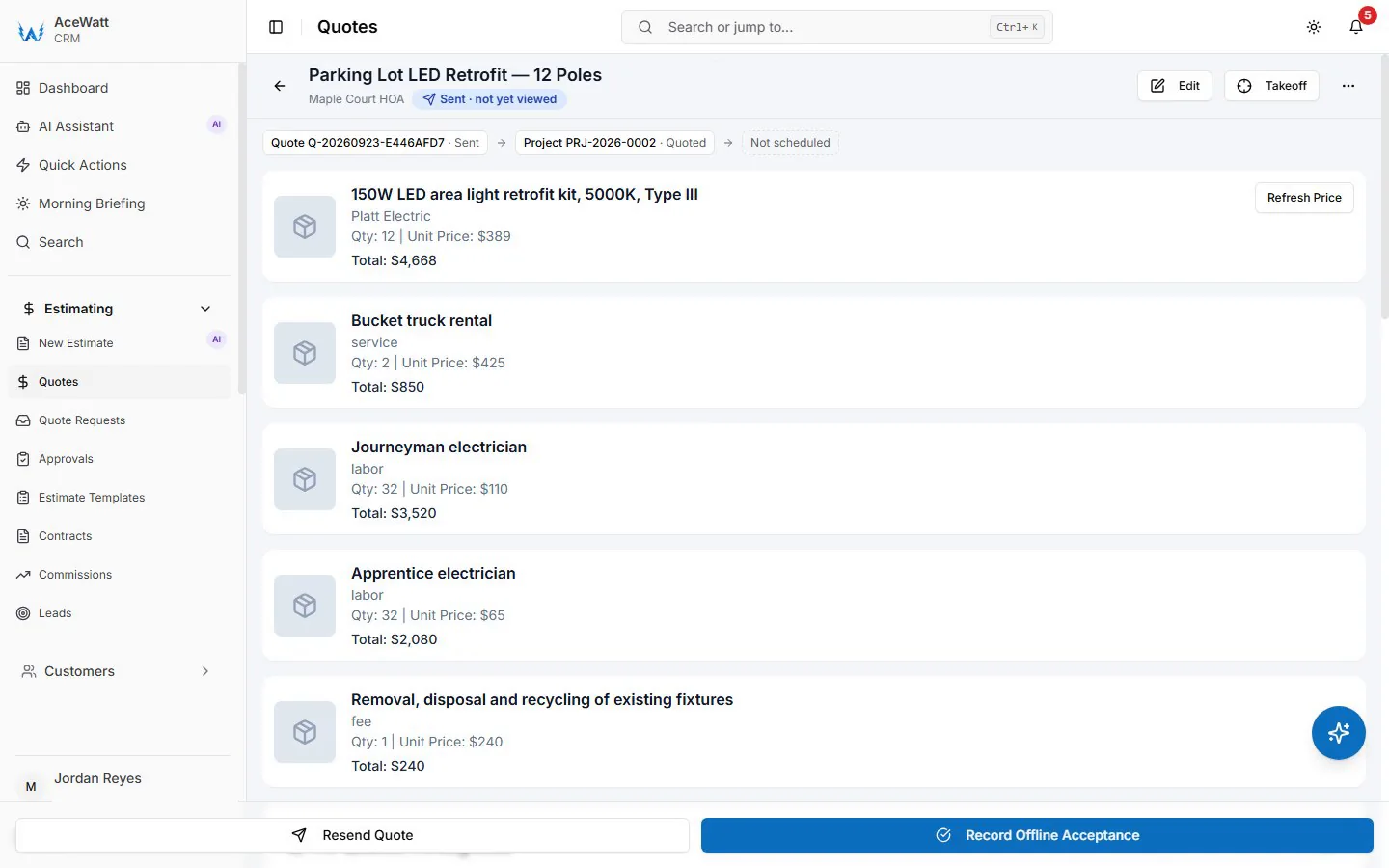
- Job walk notes capture what was seen on site.
- Automated estimating helps organize labor and scope language for review.
- CRM records keep customer history and follow-up in one place.
- Job management keeps work from disappearing after the quote is sent.
- Pricing is transparent, with a 14-day trial signup path.
AceWatt does not guarantee profit, set your legal rates, or replace a qualified contractor's judgment. It helps organize the data and follow-up so your pricing policy is easier to use consistently.
FAQs
What is a good labor rate for electrical contractors?
A good labor rate is one that covers wages, burden, overhead, non-billable time, risk, and profit for your specific shop. Public wage data and competitor pages can provide context, but your own costs should drive the rate.
How do I calculate electrician labor cost?
Start with direct wage, add labor burden, add overhead per paid hour, adjust for billable use, and then add profit. Use real payroll and bookkeeping data whenever possible.
Should electricians charge hourly or flat rate?
Hourly pricing works for uncertain troubleshooting. Flat-rate pricing works for repeatable jobs. Larger projects often need scoped project pricing. All three models still depend on a true labor-rate calculation.
What is labor burden for electricians?
Labor burden is the employment cost beyond hourly wage: payroll taxes, insurance, workers' compensation, benefits, paid time off, training, and related costs. Ask an accountant or payroll professional to verify your inputs.
Can AI calculate my final electrical price automatically?
AI can help organize notes, draft scope, and remind you what inputs to check. A licensed electrician or qualified contractor should review scope, site conditions, code/compliance issues, and final pricing before anything is sent.
Related reading: Set Electrical Contractor Hourly Rates in 2026 (By Region): regional rate benchmarks to sanity-check your calculated rate.
For labor rates alongside every other calculator and module, see the AceWatt features overview.