
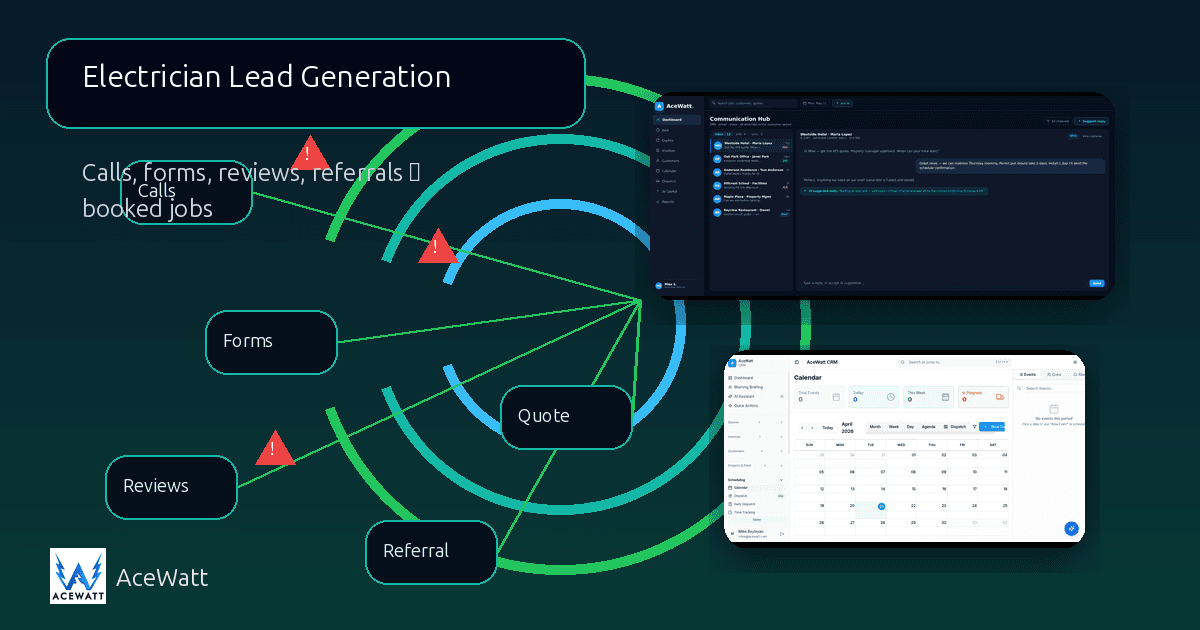
Electrician lead generation is not just getting more calls. It is building a system that turns calls, form fills, reviews, referrals, and repeat-customer opportunities into scheduled job walks, professional quotes, follow-up, booked work, and invoices.
Quick answer: The best electrician lead generation system combines Google Business Profile, local SEO pages, reviews, referral partners, paid search, quote-ready landing pages, estimate follow-up, past-customer reactivation, and a CRM that tracks every lead source. More leads help only when your shop captures them quickly, qualifies them safely, follows up consistently, and measures booked jobs instead of vanity traffic.
What Is Electrician Lead Generation?
Electrician lead generation is the process of attracting and capturing potential customers for electrical work. A lead might be a homeowner calling about a tripping breaker, a property manager requesting maintenance, a builder asking for a bid, or a business owner planning a panel upgrade.
But a lead is not the same thing as a booked job. A booked job is a lead that was answered, qualified, scheduled, quoted, followed up, won, completed, and invoiced.
That distinction matters. Many electrical contractors buy ads or chase SEO traffic without fixing the lead response workflow. The result is more noise, more missed calls, more half-filled forms, and more estimates that never receive a follow-up.
A better strategy focuses on the whole path:
- Get found by the right customer.
- Capture the lead before it goes cold.
- Qualify the job safely and accurately.
- Schedule the next step.
- Create an estimate or job record.
- Follow up until the customer decides.
- Measure which sources turn into profitable work.
AceWatt supports that operating system through CRM for electricians, AI job walk documentation, automated estimating, scheduling, invoicing, and follow-up workflows.
Why Electrical Leads Leak
Most lead-generation problems are not marketing problems. They are handoff problems.
| Leak point | What happens | Fix |
|---|---|---|
| Missed calls | The electrician is driving, on a ladder, or inside a panel | Use after-hours intake, call-back windows, or answering coverage. |
| Slow form response | The form lands in an inbox nobody checks until evening | Route every form into a CRM task or lead record. |
| No source tracking | The shop cannot tell whether SEO, ads, reviews, or referrals produced the job | Track source on each lead and quote. |
| No estimate follow-up | The quote is sent once, then forgotten | Use a 1-day, 3-day, 7-day, and 14-day follow-up rhythm. |
| No repeat-customer loop | Completed jobs never turn into reviews or future calls | Ask for reviews and schedule maintenance reminders. |
| No qualification | Crews drive to poor-fit leads | Ask about location, service type, urgency, photos, budget, and access. |
A contractor can spend more money on ads and still lose if calls go unanswered or estimates sit in limbo. Fix the leak first, then scale channels.
12 Ways to Generate More Electrician Leads
1. Optimize Google Business Profile
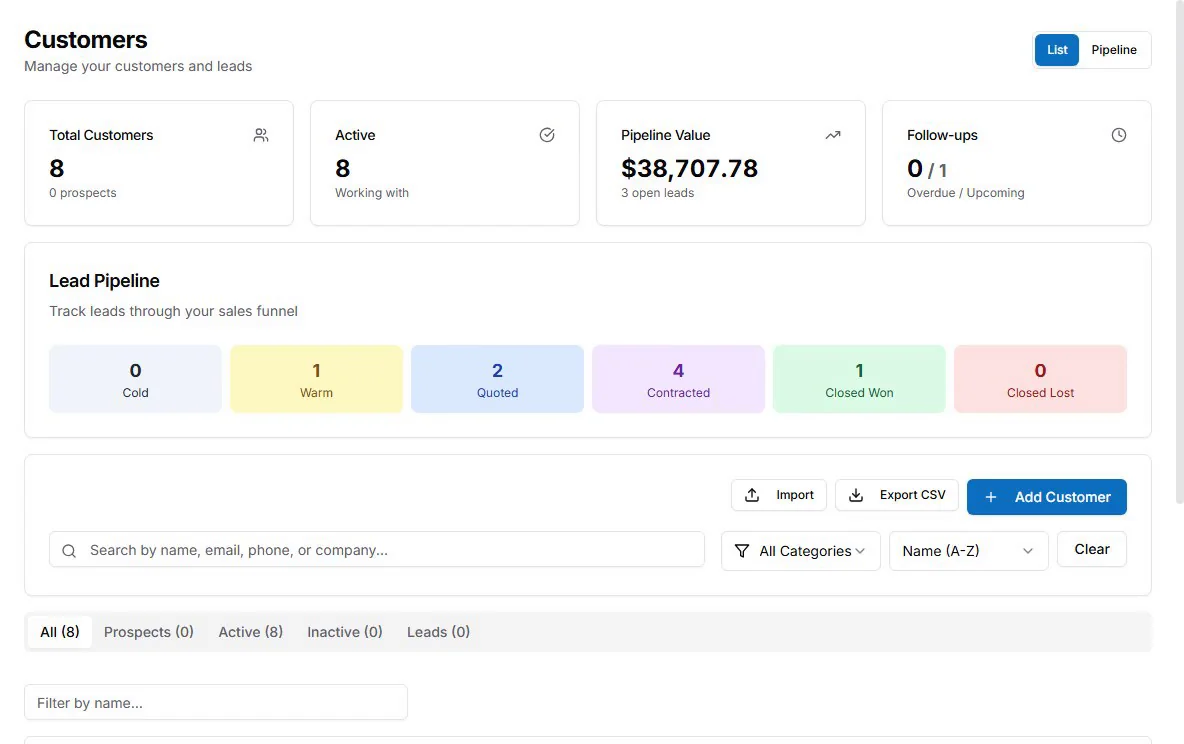
For many small shops, Google Business Profile is the first lead engine. Keep categories, service areas, hours, phone number, website, photos, services, Q&A, and reviews current. Add project photos that show real work quality, but avoid unsafe electrical images or claims you cannot support.
Use Google's Business Profile setup resources as a starting point for categories, service areas, hours, phone number, website, photos, services, Q&A, and reviews. After that, your execution matters: consistent photos, fresh reviews, accurate hours, and fast responses.
2. Build local SEO pages
Electrical leads often search by service and location: panel upgrades, EV chargers, emergency electrician, generator installation, lighting, surge protection, troubleshooting, commercial maintenance, or safety inspections.
Create focused pages that answer the service-specific question and route the lead to the next action. A useful page should explain who the service is for, what the appointment includes, what information the contractor needs, and what safety or permit issues require licensed review. Directory consistency supports the same local foundation, so keep local SEO directory listings for US contractors clean before buying more traffic.
If you are mapping service pages by job type and city, use dedicated landing pages for niche long-tail keywords to avoid thin or overlapping SEO pages.
3. Ask for reviews after every completed job
Reviews support local trust. Ask shortly after successful completion, when the customer remembers the work clearly. Keep the request simple and honest. Do not offer incentives for positive reviews or create fake review pressure. The FTC agency page on USA.gov is a direct public starting point for consumer-protection and advertising-rule research.
For the software workflow behind review requests, see electrician reputation management software.
4. Use Local Services Ads carefully
Local Services Ads can generate high-intent calls, but they must be measured by booked jobs, not just phone rings. Track lead source, appointment set, estimate sent, won/lost status, job value, and gross margin by source.
If a source produces many low-fit calls, adjust targeting, service areas, hours, or qualification. Do not assume the platform knows your ideal job mix.
5. Run high-intent Google Ads
Paid search can work when the keyword has urgent buying intent: emergency electrician, panel upgrade, EV charger installation, electrical troubleshooting, generator hookup, or commercial electrician near me. Avoid broad keywords if your budget is small.
Every ad needs a landing page that matches the service. Do not send paid traffic to a generic homepage and hope the customer finds the form.
6. Create quote-ready landing pages
A quote-ready page should have one clear CTA, a short form, a phone option, trust signals, service-area clarity, and simple copy written for the job type. The best page removes friction and helps the electrician understand the call before dispatch. For structured customer intake, customer self-quoting software for electrical contractors can collect job details and photos online before you ever pick up the phone. And if you want customers to book directly, online booking software for electricians explains when instant booking works and when a quote request form is the safer choice.
For example, an EV charger page should ask about panel capacity, charger type, parking distance, permits, and photos. A panel upgrade page should ask about existing panel size, symptoms, property type, and timeline. The page should never imply a final scope or safety decision without a qualified review.
7. Build referral partnerships
Referral partners can include realtors, property managers, builders, remodelers, HVAC companies, plumbing contractors, solar installers, insurance agents, and facility managers.
Keep it professional. Explain the jobs you want, the areas you serve, response expectations, and how you will protect their reputation. A referral partner does not want to hear that their client waited three days for a call back.
8. Use maintenance and safety checklists as lead magnets
Simple checklists can create useful leads without feeling salesy:
- Panel safety checklist.
- Home sale electrical inspection checklist.
- Rental property electrical maintenance checklist.
- EV charger readiness checklist.
- Generator installation readiness checklist.
Keep the checklist educational and conservative. It should help a property owner gather information, not tell them to perform electrical work themselves.
9. Follow up on every estimate
Estimate follow-up can be a cost-efficient lead-response activity because the lead already asked for help; actual cost depends on staff time, tools, and process.
Use a simple cadence:
| Timing | Message goal | Example |
|---|---|---|
| 1 day | Confirm receipt | "Did the estimate come through clearly?" |
| 3 days | Answer questions | "Any questions about scope, options, or timing?" |
| 7 days | Help decide | "Want me to hold a spot next week?" |
| 14 days | Close the loop | "Should I keep this open or revisit later?" |
Do not pressure people into unsafe or unnecessary work. Follow-up should clarify, not manipulate.
10. Re-engage past customers
Past customers already know you. Use reminders for annual safety checks, surge protection, generator maintenance, EV charger interest, panel upgrade planning, or commercial maintenance.
Segment by job history. A customer who recently installed an EV charger does not need the same reminder as a property manager with ongoing maintenance needs.
11. Track lead sources in a CRM
If you cannot see which source produced a booked job, you are guessing. Track:
- Lead source.
- Job type.
- Service area.
- Response time.
- Appointment set.
- Estimate sent.
- Estimate won or lost.
- Job value.
- Gross margin by source.
- Review request sent.
AceWatt's electrician job management software positioning is built around keeping jobs, estimates, customer details, and follow-up in one workflow.
12. Answer calls when the crew is busy
Electricians miss calls because electrical work requires attention. A contractor may be driving, in a crawlspace, speaking with an inspector, or working around energized equipment. Do not take risky calls while working. Use a safe lead-response system.
Lead-response tools can help when you miss calls in the field. Options include a receptionist, call forwarding, an answering service, after-hours forms, or an AI answering service workflow that captures intake details for manual review or verified CRM handoff. AI should qualify and route; it should not diagnose hazards or promise emergency response unless your operation truly supports it.
Lead Generation Metrics to Track
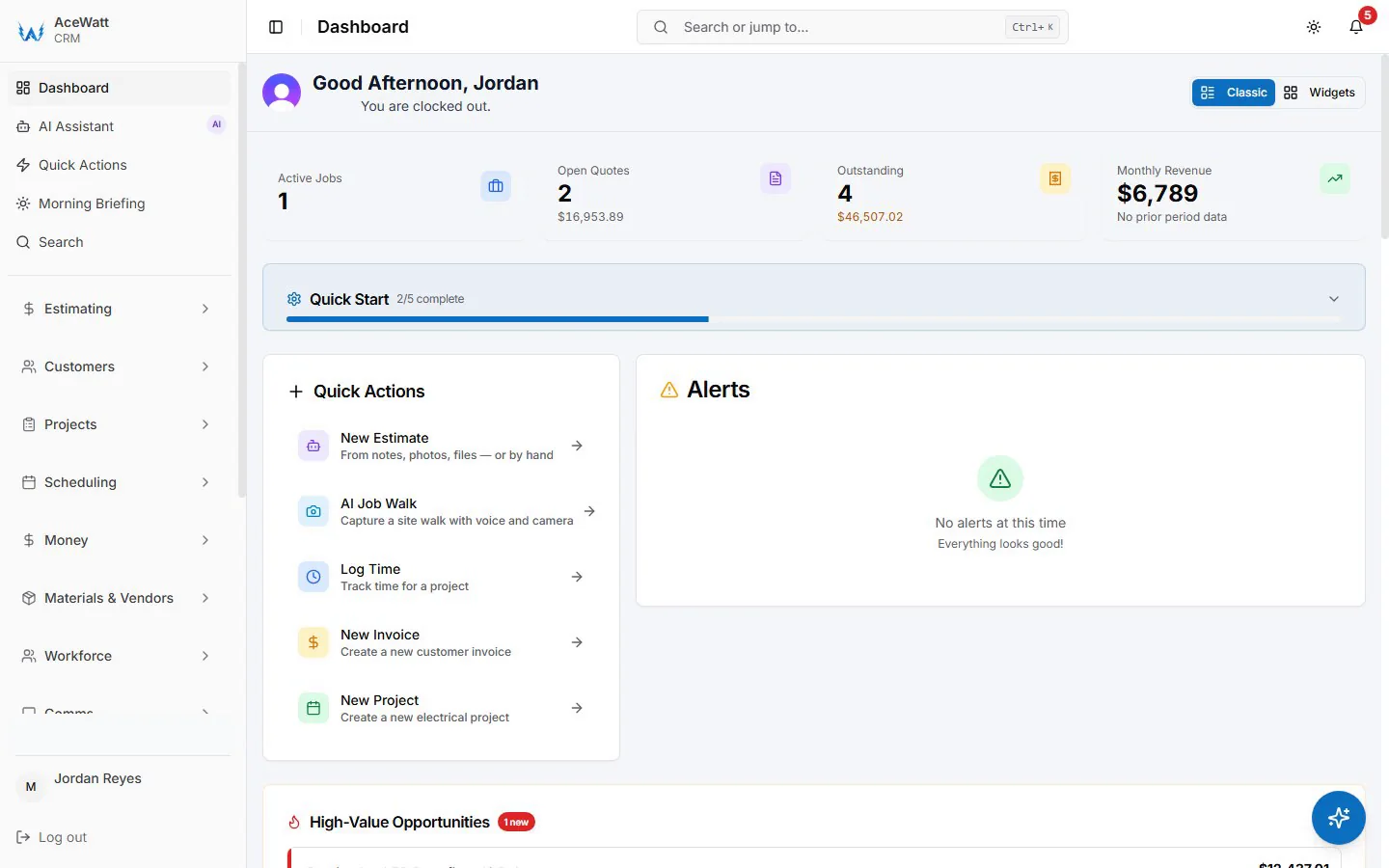
Track numbers that tie marketing to operations:
| Metric | Why it matters |
|---|---|
| Cost per lead | Shows channel efficiency, but not quality. |
| Cost per booked job | Better than cost per lead because it measures conversion. |
| Lead-to-appointment rate | Shows whether your intake process works. |
| Appointment-to-estimate rate | Shows qualification quality and sales process. |
| Estimate-to-win rate | Shows proposal quality and follow-up strength. |
| Average job value | Helps compare service types. |
| Gross margin by source | Reveals which sources produce profitable work. |
| Follow-up completion rate | Shows whether estimates are being worked. |
A source with cheap leads can still be bad if those leads never book. A source with expensive leads can still be good if they become profitable jobs.
Lead Generation by Shop Size
Solo electrician
Focus on Google Business Profile, reviews, referrals, service-area clarity, and missed-call recovery. Keep the tech stack simple. One CRM plus basic follow-up is better than five tools nobody updates.
1, 3 truck shop
Add service pages, estimate follow-up, call routing, and source tracking. Start measuring lead-to-estimate and estimate-to-win rates by job type.
4, 10 truck shop
Add paid search carefully, repeat-customer campaigns, referral partner tracking, and more disciplined scheduling. Review gross margin by source, not just revenue.
Commercial or light-industrial contractor
Build relationship-driven content: maintenance agreements, facility service pages, safety documentation, response expectations, and account-based outreach. Track longer sales cycles inside the CRM.
Buying Leads vs. Owning Your Lead Engine
Lead marketplaces can create volume, but you are often competing with other contractors for the same customer. SEO, reviews, referrals, and repeat-customer systems are slower, but they build an asset you own.
A balanced approach works best:
- Use paid channels for speed.
- Use SEO and reviews for compounding visibility.
- Use referrals for trust.
- Use CRM and follow-up to turn interest into booked work.
- Use reporting to cut waste quickly.
How AceWatt Turns Electrical Leads Into Booked Jobs
AceWatt is not an ad agency. It is the operational layer after a lead arrives.
A typical workflow looks like this:
- A call, form, referral, or repeat-customer request creates a lead.
- The lead becomes a customer or job record in CRM for electricians.
- The office or field team schedules a job walk or appointment through scheduling.
- The electrician captures site notes with AI job walk or voice documentation.
- The contractor reviews the scope and prepares an estimate through automated estimating.
- The customer can e-sign the estimate from the portal link, and your team follows up on the ones still open.
- Won work flows toward invoicing.
- The shop reviews which lead source produced the job.
The value is not magic AI. The value is fewer dropped handoffs between call, quote, follow-up, job, and invoice. If you are comparing the operating cost of lead handling, review current AceWatt pricing against the time your team spends on missed calls, rework, and manual follow-up.
FAQs
What is the best lead generation strategy for electricians?
The best strategy combines local visibility, reviews, referral partners, quote-ready pages, fast response, estimate follow-up, and CRM tracking. The right channel mix depends on service area, job type, crew size, and budget.
How do electricians get more electrical leads?
Common ways electricians try to generate more qualified opportunities include improving Google Business Profile, publishing service pages, collecting reviews, using paid search carefully, building referral relationships, re-engaging past customers, and answering every inbound call or form quickly.
Are paid electrician leads worth it?
Paid leads can be worth it when you track booked jobs and margin by source. They are risky when you only track call volume or form fills.
How fast should electricians respond to new leads?
As fast as safely possible. Homeowners often contact multiple contractors. If the electrician is driving or working around electrical equipment, the safe move is to let a receptionist, answering service, or intake workflow capture the lead and schedule a callback.
Can AI help electricians generate leads?
AI can help summarize intake from a verified answering workflow, draft follow-up, organize job-walk notes, and support CRM updates after review. It should not diagnose electrical hazards, replace licensed judgment, or promise emergency dispatch unless the contractor has real capacity.
Related reading: CRM for Electrical Contractors That Tracks Leads From Estimate to Service Call.
Related reading: AI Answering Service for Electricians: Never Miss a Lead.
Capturing leads is only the first step: follow-up, quoting, and scheduling all connect, as shown in the AceWatt features overview.