Quick answer: why you need an electrical contractor business plan
Starting an electrical contracting business without a plan is like wiring a house without a blueprint. You might get power flowing, but it won't be pretty, and it definitely won't pass inspection. A solid electrical contractor business plan template gives you a clear framework to define your services, set pricing, map out your market, and project your finances before you spend a single dollar on licenses or equipment.
Here's what a business plan actually does for you:
- Forces you to think through the hard questions: Who are your customers? What will you charge? How will you find work?
- Keeps you focused when the daily grind tries to pull you in ten directions
- Makes you fundable: Banks, investors, and even some suppliers want to see a plan before they hand over money or credit
- Gives you benchmarks so you can measure whether your business is actually working
Whether you're a journeyman striking out on your own or an established shop looking to scale, this guide walks you through every section of an electrical contractor business plan, with a free template you can start filling in today.
Free electrical contractor business plan template
Use the section-by-section breakdown below as your template. Each section includes prompts and examples tailored specifically to electrical contractors. Copy it into a Google Doc or Word file and start filling in the blanks.
Section 1: Executive summary
The executive summary is a one-page overview of your entire plan. Write it last, after you've completed every other section. It should cover:
- Business name and location: e.g., "Volt Edge Electrical, based in Austin, TX"
- Services offered: residential rewiring, commercial tenant improvements, EV charger installations
- Target market: homeowners in the greater Austin metro area, small commercial property managers
- Revenue goal: your first-year target (e.g., "$250,000 in gross revenue by month 12")
- Funding needed: how much capital you're starting with or need to borrow
- Your competitive edge: 15 years of experience, master electrician license, niche specialty in EV installations
Keep it tight. One page, no fluff.
Section 2: Company description
This section answers the basics: who you are, what you do, and how you're structured. Include:
- Legal business name and any DBA ("doing business as") names
- Legal structure: sole proprietorship, LLC, S-Corp (more on this below)
- Physical location: home office, rented shop, service area
- Mission statement: one or two sentences about what you're building
- Vision: where you want the business to be in 3 to 5 years
Example mission: "To provide safe, reliable electrical services to residential and small commercial customers in the Dallas-Fort Worth metroplex, with honest pricing and on-time service."
Section 3: Market analysis
Your market analysis proves you understand the market you're walking into. It covers your target customers, your competitors, and your place in the market.
Start with the big picture: the U.S. Bureau of Labor Statistics projects that employment of electricians will grow roughly 6 to 7% over the current decade, driven by construction demand, energy transitions (EV charging, solar, battery storage), and the ongoing need to maintain aging electrical infrastructure.
Then zoom in on your specific service area:
- How many homes and businesses are in your target zip codes?
- What's the average age of housing stock? (Older homes = more rewiring and panel upgrades)
- What construction projects are planned or underway?
- Who are the top 5 electrical contractors in your area? What do they charge? What do their Google reviews say?
Section 4: Services and pricing
List every service you plan to offer, grouped by category. Then assign a pricing model to each one.
| Service Category | Examples | Pricing Model |
|---|---|---|
| Residential service calls | Outlets, switches, breaker replacements, troubleshooting | Hourly + trip charge |
| Residential projects | Panel upgrades, whole-house rewires, generator installs | Flat rate / project-based |
| Commercial | Tenant improvements, lighting retrofits, code corrections | Project-based |
| Specialty | EV charger installations, solar tie-ins, smart home wiring | Flat rate or project-based |
We'll dig deeper into pricing strategy later in this guide.
Section 5: Marketing and lead generation strategy
A business plan isn't complete without a clear plan for how you'll get customers. For electrical contractors, the most effective channels are:
- Google Business Profile: your free listing that shows up in local search and maps
- Google Local Services Ads: pay-per-lead advertising that puts you at the top of search results
- Referrals and word-of-mouth: still the #1 source of leads for most small contractors
- Website + SEO: a simple site with your services, service area, and contact info
- Nextdoor, Facebook community groups: hyperlocal visibility
Include a monthly marketing budget and how you'll split it across channels.
Section 6: Operations plan
Your operations plan describes how the business runs day to day. Cover:
- Daily workflow: from the moment a lead comes in to the final invoice
- Scheduling and dispatch: how jobs get assigned and tracked
- Tool and vehicle management: what you need and how you maintain it
- Vendor relationships: where you buy materials, what credit terms you have
- Safety protocols: PPE requirements, OSHA compliance, lockout/tagout procedures
A CRM for electricians can automate a huge chunk of this workflow, from lead capture through invoicing.
Section 7: Management and team
Even if you're a one-person shop today, this section matters, especially if you plan to grow. Include:
- Organizational chart (even a simple one with just you)
- Key roles and responsibilities: owner/operator, apprentice(s), office manager, bookkeeper
- Hiring plan: when will you bring on your first employee? Second?
- Compensation structure: hourly, salary, commission, or a mix
- Training and licensing support: will you pay for apprentices' continuing education?
Section 8: Financial projections
This is the section that makes or breaks a business plan. You need realistic numbers for:
- Startup costs: tools, truck, licensing, insurance, deposits (covered in detail below)
- Monthly operating expenses: rent, insurance, fuel, phone, software subscriptions, loan payments
- Revenue projections: month by month for year one, then quarterly for years two and three
- Break-even point: the month when revenue covers all expenses
Use conservative assumptions. It's better to be pleasantly surprised than caught short.
Section 9: Technology and software stack
Modern electrical contractors run on software, not clipboards. Your plan should account for:
- CRM: to track leads, customers, and jobs from first call to final payment
- Estimating software: to generate professional quotes fast
- Invoicing and payment collection: to get paid on time
- Scheduling and dispatch: to keep your days organized
- Accounting: QuickBooks, FreshBooks, or similar (separate from your CRM)
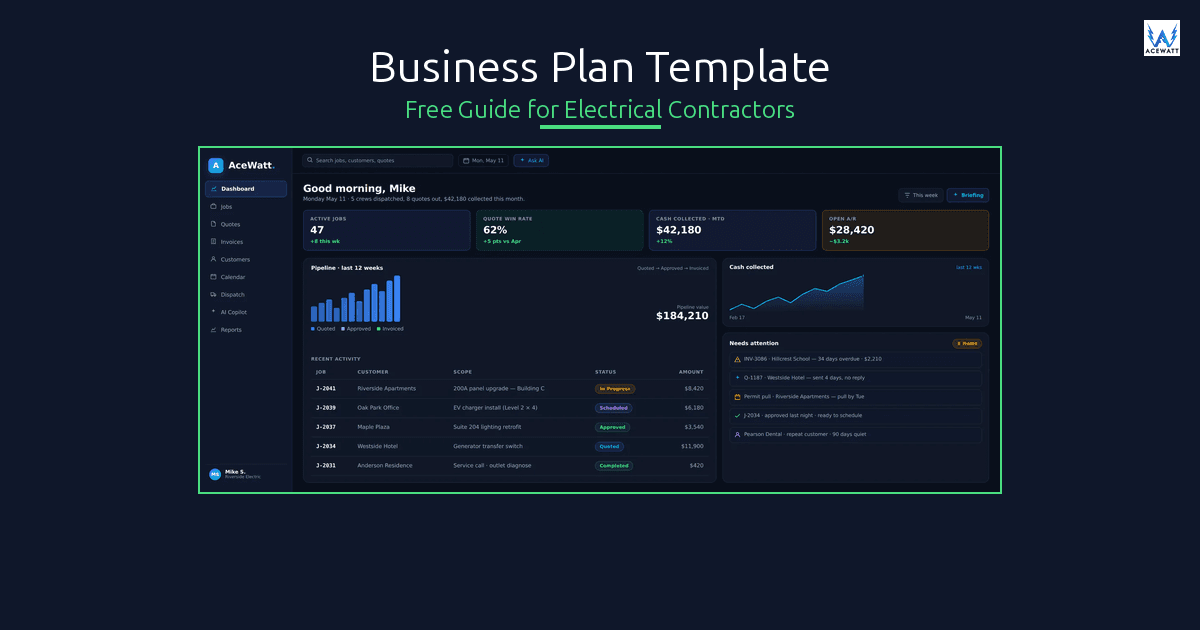
AceWatt covers CRM, estimating, invoicing, scheduling, and AI-powered features in one platform designed specifically for electrical contractors, so you don't have to stitch together five different apps.
Section 10: Growth plan
Where is this business going? Your growth plan should cover:
- Year 1 goals: revenue, number of customers, team size
- Year 2 to 3 goals: adding services, hiring, expanding your service area
- New service lines: EV charging, solar, home automation, generator installs
- Geographic expansion: adding counties or metro areas
- Exit strategy (eventually): sell the business, pass it on, merge
Having a growth plan keeps you from drifting. It also shows lenders and partners you're thinking long-term.
Company description (expanded)
Legal structure (sole proprietor, LLC, S-Corp)
Your legal structure affects your taxes, your liability, and how you pay yourself. Here's a quick comparison:
- Sole proprietorship: Easiest and cheapest to set up. You and the business are the same entity. Downside: personal assets are at risk if something goes wrong.
- LLC (Limited Liability Company): The most popular choice for small electrical contractors. It separates your personal assets from business liabilities. Relatively simple to set up and maintain.
- S-Corp: An election you make with the IRS (often as an LLC taxed as an S-Corp). Can save on self-employment taxes once you're earning above a certain threshold. Requires running payroll, which adds administrative overhead.
Talk to a CPA or business attorney before you decide. The right structure depends on your revenue, your state, and your growth plans.
Licensing and insurance requirements
Every state has different licensing requirements for electrical contractors. Most require:
- Journeyman or master electrician license: earned through a combination of classroom hours, on-the-job training, and a state exam
- Electrical contractor license: a separate license (in many states) that allows you to operate a business and pull permits
- Business license: from your city or county
Insurance is non-negotiable:
- General liability insurance: typically $1M/$2M coverage; protects against property damage and bodily injury claims
- Workers' compensation: required in most states if you have employees
- Commercial auto insurance: covers your work truck(s) and tools
- Surety bond: many states and general contractors require this
Budget $3,000 to $8,000 per year for insurance, depending on your state, team size, and coverage limits.
Service area definition
Be specific about where you work. "The whole state" is not a service area; it's a recipe for long drives and wasted time. Define:
- Primary service area: the radius or zip codes where you can arrive within 30 to 45 minutes
- Secondary service area: areas you'll serve for larger jobs or at a premium rate
- Areas you won't serve: too far, too competitive, or outside your license jurisdiction
A tight service area means less windshield time, faster response, and lower fuel costs.
Market analysis (expanded)
Target customer segments (residential, commercial, industrial)
Most electrical contractors serve one or more of these segments:
- Residential: homeowners needing repairs, upgrades, remodels, and new installations. High volume of smaller jobs. Strong referral potential.
- Commercial: property managers, retail tenants, office buildings, restaurants. Larger jobs, more paperwork, longer payment cycles.
- Industrial: factories, warehouses, manufacturing plants. High-value work but requires specialized knowledge and equipment.
For a new electrical contracting business, residential work is usually the fastest path to revenue. As you build your team and expertise, you can move into commercial and industrial work.
Competitor analysis in your service area
Don't skip this step. Open Google Maps, search "electrician near me" from your target area, and study the top 10 results:
- What services do they advertise?
- What are their review counts and ratings?
- Do they have a professional website?
- What's their estimated response time?
- Do they mention pricing on their site?
Create a simple spreadsheet with columns for name, services, reviews, strengths, and weaknesses. This tells you where the gaps are, and those gaps are your opportunities.
Your competitive advantage
After analyzing the market, articulate why a customer should choose you over the competition. Common competitive advantages for electrical contractors:
- Faster response times: same-day or next-day service when competitors are booking a week out
- Specialty expertise: EV charger certified, solar-trained, historic home specialist
- Transparent pricing: flat-rate quotes instead of "we'll see when we get there"
- Better customer experience: clean uniforms, shoe covers, text updates, online booking
- Technology-forward: digital estimates, online payments, automated follow-ups via electrical contractor software for small business
Services and pricing (expanded)
Core services
These are the bread-and-butter services that will generate most of your revenue:
- Service calls and troubleshooting: tripped breakers, flickering lights, dead outlets, GFCI replacements
- Panel upgrades: upgrading from 100-amp to 200-amp service (huge demand right now due to EV chargers and home additions)
- Outlet and switch installation: including GFCI, AFCI, USB outlets, smart switches
- Lighting installation: recessed lighting, fixture replacement, landscape lighting
- Code corrections: fixing work that doesn't meet current NEC standards
- Ceiling fan installation
Specialty services (EV charging, solar, generators)
These are higher-margin services that can differentiate your business:
- EV charger installations: Level 2 home chargers (240V). Demand is surging as EV adoption grows. Many EV owners need a panel upgrade as part of the installation.
- Solar panel electrical work: tying solar systems to the grid, installing battery backup
- Standby generator installation: whole-house generators for homeowners and businesses in storm-prone areas
- Smart home wiring: structured wiring for home automation, security cameras, Wi-Fi access points
- EV charging station maintenance: recurring service contracts for commercial EV charging sites
Pricing model: hourly vs flat rate vs project-based
Each model has pros and cons:
- Hourly rate + trip charge: Simple and transparent. Common for service calls. Typical range: $75 to $150/hour depending on your market, plus a $50 to $125 trip/diagnostic fee.
- Flat rate: You quote a fixed price for a specific job. Customers love the predictability. Requires discipline in estimating time and materials accurately.
- Project-based: Used for larger jobs (commercial TIs, whole-house rewires). Includes labor, materials, overhead, and a profit margin. Usually requires a signed contract and progress payments.
Many contractors use a hybrid: flat rate for common jobs (outlet installs, panel upgrades) and hourly or project-based for larger or unpredictable work.
How to set your rates
Don't just copy what the guy down the street charges. Work backward from your costs:
- Calculate your hourly overhead: total monthly expenses ÷ billable hours per month
- Add your desired hourly wage: what you want to take home
- Add a profit margin: 15 to 25% on top of labor + materials
- Benchmark against your market: are you in the right ballpark?
For example, if your monthly overhead is $5,000 and you expect 80 billable hours, your overhead rate is $62.50/hour. Add a $40/hour wage and a 20% margin, and you're at $123/hour. That might be right for your market, or it might not. Research local pricing and adjust.
Marketing and lead generation strategy
Google Business Profile setup
Your Google Business Profile (GBP) is the single most important free marketing tool you have. When someone searches "electrician near me," your GBP is what shows up in the map pack.
Steps to set it up properly:
- Claim or create your listing at business.google.com
- Fill out every field: business name, address, phone, hours, services, service area, photos
3 Add photos: your truck, your team, completed jobs (with customer permission), your logo
- Get reviews: ask every happy customer to leave a Google review. Respond to every review, positive and negative.
- Post updates: share project photos, seasonal tips, new services
A well-optimized GBP can generate 10 to 30+ calls per month for a local electrical contractor.
Google Local Services Ads
Local Services Ads (LSA) put your business at the very top of Google search results, above the regular ads and organic results. You pay per lead (phone call or message), not per click.
Benefits for electrical contractors:
- Google guarantees your business, which builds trust
- You only pay for qualified leads: not tire-kickers
- Budget control: set a weekly cap that fits your budget
- Background check and license verification: this weeds out unlicensed competitors
Typical cost per lead ranges from $15 to $50 depending on your market and the type of service requested. Start with a modest weekly budget ($200 to $400/week) and adjust based on your close rate.
Referral program design
Word-of-mouth is the lifeblood of local contracting businesses. Formalize it with a referral program:
- Customer referral incentive: Offer a $25 to $50 credit on future service (or a gift card) for every new customer referred
- Partner referrals: Build relationships with general contractors, HVAC companies, plumbers, and property managers who can send you work regularly
- Follow-up system: After every completed job, send a thank-you message and ask for a referral. A best CRM for electrical contractors can automate this.
How CRM software captures and tracks every lead
Here's a scenario that plays out every day: a potential customer calls, leaves a voicemail, and you're on a job site with gloves on. By the time you listen to the message three hours later, they've already called the next electrician on the list.
A purpose-built CRM solves this by:
- Capturing leads from every channel (phone, website form, Google, Facebook) in one inbox
- Auto-responding with a text or email so the customer knows you got their message
- Reminding you to follow up so no lead falls through the cracks
- Tracking every interaction so you know exactly where each prospect is in the pipeline
If you're serious about growing your electrical contracting business, lead tracking isn't optional; it's foundational. Learn more about how to manage an electrical contracting business with the right systems in place.
Operations plan
Daily workflow: from lead intake to job completion to invoice
A well-run electrical contracting business follows a consistent workflow:
- Lead comes in: call, text, web form, or referral. CRM captures it instantly.
- Qualify and schedule: confirm the job type, address, and urgency. Book the appointment.
- Dispatch: send the right electrician with the right tools and materials.
- Complete the work: diagnose, repair, install. Take before/after photos.
- Document: note materials used, time spent, and any follow-up needed.
- Invoice on the spot: generate and send the invoice from your phone or tablet before you leave.
- Collect payment: accept credit cards, ACH, or cash. Payment processing through your CRM speeds this up.
- Follow up: send a thank-you message, request a review, and ask for referrals.
When each step runs smoothly, you do more jobs per day, get paid faster, and generate more repeat business.
Scheduling and dispatch
Efficient scheduling is the difference between a profitable day and a wasteful one. Best practices:
- Group jobs by geography: minimize drive time between stops
- Block time for service calls: keep 1 to 2 slots open each day for emergency calls
- Use scheduling software: a shared calendar that your team can see and update in real time
- Send reminders: text or email customers 24 hours before the appointment to reduce no-shows
Quality control and inspection readiness
Your reputation lives or dies on the quality of your work. Build quality control into your process:
- Pre-job walkthrough: confirm scope and expectations with the customer before starting
- In-progress checks: especially on larger jobs, pause and inspect your work at key milestones
- Post-job walkthrough: show the customer what you did, test everything, and get sign-off
- Inspection prep: know your local inspector's common call-outs and address them before scheduling the inspection
- Warranty policy: stand behind your work. A clear warranty builds trust and justifies your pricing.
Technology and software stack
CRM: why every electrical contractor needs one from day one
A CRM (Customer Relationship Management system) is not a luxury; it's the operational backbone of a modern electrical contracting business. Without one, you're relying on text messages, sticky notes, and memory to manage your customers and jobs.
With a CRM, you get:
- A single customer database: every contact, job, invoice, and communication in one place
- Automated follow-ups: no more forgotten leads or missed follow-ups
- Job tracking: see the status of every job from quote to completion
- Reporting: know your revenue, close rate, average ticket, and lead sources
Estimating and quoting software
Professional estimates win jobs. Estimating software lets you:
- Build quotes fast: use templates for common jobs so you're not starting from scratch every time
- Include itemized materials and labor: customers trust transparency
- Send estimates digitally: email or text a link the customer can approve with one click
- Convert estimates to invoices: one click, no double entry
Invoicing and payment collection
Getting paid shouldn't be the hardest part of the job. Modern invoicing tools let you:
- Generate invoices immediately: from the job site, before you drive away
- Accept credit cards and ACH: make it easy for customers to pay you
- Set up recurring invoices: for maintenance contracts and commercial clients
- Track overdue payments: automated reminders save awkward phone calls
How AceWatt covers CRM, estimating, invoicing, scheduling, and AI in one platform
Instead of juggling five different subscriptions, AceWatt gives electrical contractors everything in one place:
- CRM: capture, track, and nurture every lead
- Estimating: build and send professional quotes in minutes
- Invoicing and payments: get paid faster with digital invoices and card processing
- Scheduling and dispatch: keep your team organized and on time
- AI-powered features: automated follow-ups, smart job suggestions, and insights to help you make better business decisions
AceWatt is built specifically for electrical contractors, not general contractors, not plumbers, not HVAC. That means every feature is designed around the way your business actually works. Check out our full breakdown of electrical contractor software features to see how it fits your operation.
Financial projections
Startup costs breakdown
Here's a realistic range of what it costs to start an electrical contracting business:
| Expense Category | Low Estimate | High Estimate |
|---|---|---|
| Work truck (used) | $8,000 | $25,000 |
| Tools and equipment | $3,000 | $10,000 |
| Licensing and permits | $500 | $2,500 |
| Insurance (first year) | $2,500 | $6,000 |
| Business registration (LLC) | $100 | $500 |
| Website and branding | $500 | $3,000 |
| Marketing launch (first 3 months) | $1,500 | $5,000 |
| Software subscriptions (first year) | $500 | $2,000 |
| Working capital / reserves | $5,000 | $15,000 |
| Total | $21,600 | $69,000 |
Your actual costs depend on what you already own, your state, and how aggressively you launch. Many electricians start by using a personal vehicle and building their tool kit over time, which keeps initial costs at the lower end.
Monthly operating expenses
Once you're up and running, expect these recurring costs:
| Expense | Monthly Range |
|---|---|
| Truck payment / maintenance | $300 to $700 |
| Fuel | $300 to $600 |
| Insurance (general liability + auto) | $250 to $600 |
| Phone and internet | $100 to $200 |
| Software (CRM, accounting, etc.) | $50 to $300 |
| Marketing (Google LSA, website, etc.) | $500 to $2,000 |
| Materials and supplies | varies by revenue |
| Bookkeeping / accounting | $200 to $500 |
| Office / shop rent (if applicable) | $0 to $1,500 |
| Total fixed overhead | $1,700 to $6,400 |
Revenue projections (conservative, moderate, optimistic)
Build three scenarios so you can plan for the worst and hope for the best:
| Metric | Conservative | Moderate | Optimistic |
|---|---|---|---|
| Jobs per week | 5 | 8 | 12 |
| Average ticket | $300 | $450 | $600 |
| Weekly revenue | $1,500 | $3,600 | $7,200 |
| Monthly revenue | $6,000 | $14,400 | $28,800 |
| Annual revenue (Year 1) | $72,000 | $172,800 | $345,600 |
These are illustrative ranges, not guarantees. Your actual numbers will depend on your market, your pricing, your close rate, and how many hours you're willing to work.
Break-even analysis
Your break-even point is the month when cumulative revenue equals cumulative expenses. To calculate it:
- Total your monthly fixed costs (from the table above)
- Estimate your variable costs: materials typically run 25 to 35% of revenue
- Calculate contribution margin: revenue minus variable costs
- Divide fixed costs by contribution margin to find your break-even revenue
For example, if your monthly fixed costs are $3,500 and your contribution margin is 65% (after 35% materials cost), you need $5,385 in monthly revenue to break even. At an average ticket of $450, that's roughly 12 jobs per month, about 3 per week.
Most new electrical contractors reach break-even in months 2 to 4, assuming they have a solid lead generation strategy from day one. For more on that, see our guide to electrical contractor lead generation.
Common mistakes in electrical contractor business plans
After reviewing hundreds of business plans from electrical contractors, these are the most frequent errors:
- Unrealistic revenue projections: assuming you'll be booked solid from month one. Build in ramp-up time.
- Underestimating expenses: forgetting insurance, tool replacement, fuel, and taxes. Add 15 to 20% to your expense estimates.
- No marketing plan: "word of mouth" is not a strategy, especially in year one. Allocate a specific budget and track results.
- Ignoring technology: trying to run a 2026 business with 2005 tools. A CRM often justifies its cost in captured leads alone.
- No cash reserves: running too lean with no buffer for slow months or unexpected expenses. Keep at least 2 to 3 months of expenses in reserve.
- Skipping the competitive analysis: not knowing what other electricians in your area charge, offer, or do well.
- Vague goals: "grow the business" isn't a goal. "$200K in revenue with 2 full-time electricians by December" is a goal.
Business plan samples by shop size
Solo electrician business plan
If you're a one-person operation, your plan should focus on:
- Maximizing billable hours: minimize admin time by using software to automate estimates, invoices, and follow-ups
- Controlling costs: work from a home office, use your personal truck (with commercial insurance), keep marketing targeted
- Setting boundaries: define your service area, your hours, and the types of jobs you take (and don't take)
- Realistic revenue target: $60,000 to $120,000 take-home in year one is achievable for a hardworking solo electrician in a decent market
2 to 5 person shop business plan
With a small team, your plan shifts toward management:
- Hiring and training: finding reliable apprentices and journeymen, investing in their development
- Scheduling efficiency: dispatching multiple crews, minimizing downtime between jobs
- Supervision and quality control: you can't be on every job site, so build systems for consistency
- Revenue target: $250,000 to $600,000 in year one is a reasonable range for a well-run 2 to 5 person shop
- Office support: at this size, you may need part-time help with scheduling, invoicing, and customer service
5 to 15 person shop business plan
At this scale, you're running a real company:
- Organizational structure: field supervisor, office manager, project manager, lead electricians
- Fleet management: multiple trucks, tool inventory, maintenance schedules
- Commercial work: you have the capacity for larger projects that command higher margins
- Systems and processes: everything documented, from onboarding to invoicing to safety
- Revenue target: $750,000 to $2,000,000+ depending on your market and mix of residential/commercial work
- Growth strategy: expanding service area, adding specialty services, building general contractor relationships
FAQ
Do I need a business plan to start an electrical contracting business?
Legally, no. Practically, yes. A business plan forces you to think through your services, pricing, market, and finances before you start spending money. If you're applying for a loan or seeking investors, a business plan is required. Even if you're self-funding, a written plan dramatically increases your chances of success.
What should be in an electrical contractor business plan?
At minimum, your plan should include an executive summary, company description, market analysis, services and pricing, marketing strategy, operations plan, management structure, and financial projections. A technology section is increasingly important; modern electrical contractors need software to stay competitive.
How do I write a business plan for a small electrical shop?
Start simple. You don't need a 50-page document. A 10 to 15 page plan that covers the essentials, who you serve, what you charge, how you'll get customers, and what you'll spend, is plenty for a solo or small shop. Use the template in this guide and fill in each section. The act of writing it is more valuable than the final document.
What software do I need to start an electrical contracting business?
At minimum: a CRM to track leads and customers, estimating software to generate quotes, an invoicing tool to get paid, and accounting software for taxes. Many contractors also need scheduling and dispatch tools. AceWatt combines all of these (CRM, estimating, invoicing, scheduling, and AI) in one platform built for electrical contractors. See our features page for details.
How much does it cost to start an electrical contracting business?
A realistic range is $21,000 to $69,000, depending on whether you already have a truck and tools, your state's licensing fees, and how much you invest in marketing upfront. Many electricians start lean, using a personal vehicle, building their tool kit over time, and keeping fixed costs low, and get to revenue quickly. The biggest expenses are typically your truck, insurance, and tools.
Ready to stop planning and start building? AceWatt gives you the CRM, estimating, invoicing, scheduling, and AI tools you need to run your electrical contracting business, all in one platform. Check out our pricing to find the plan that fits your shop.
For related reading, see NEC 2026 code changes for electrical contractors for the EV charging, load calculation, and documentation updates that should be reflected in your licensing/permit assumptions when you write the business plan.