
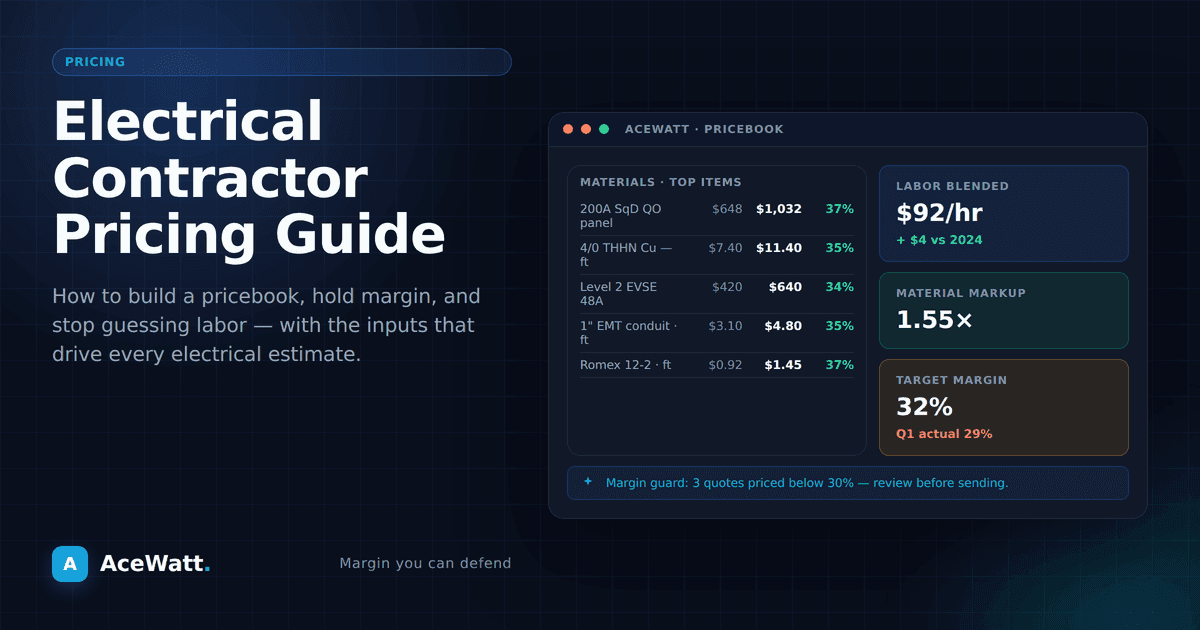
One of the hardest parts of running an electrical contracting business isn't the electrical work, it's knowing what to charge for it. Price too high and you lose bids. Price too low and you win jobs but lose money. Find the sweet spot and your business thrives.
This electrical contractor pricing guide breaks down exactly how to calculate your rates, markup your materials, and set prices that keep your business profitable without pricing yourself out of the market.
Quick Answer: Electrical Contractor Pricing in AceWatt
Electrical contractor pricing should start with real scope, real cost inputs, and contractor review. AceWatt supports electrical contractor pricing by keeping customer history, job-walk notes, quote details, material context, communication, and invoice handoff in one CRM workflow.
Good electrical contractor pricing is not just a calculator. Electrical contractor pricing needs labor cost, overhead, material markup, risk, travel time, permit or inspection assumptions, exclusions, warranty expectations, and profit margin. Electrical contractor pricing also needs a human reviewer who understands the site, the code environment, the customer request, and the contractor's actual costs.
Use AceWatt for electrical contractor pricing when you want the pricing conversation tied to the job record instead of scattered across a notebook, spreadsheet, text thread, and invoice tool. Electrical contractor pricing gets safer when the estimate shows what was captured during the job walk, what assumptions were made, and what still needs licensed or qualified review.
The practical goal of electrical contractor pricing is simple: quote clearly, protect margin, and avoid surprise scope gaps. AceWatt can help organize electrical contractor pricing records and hand them into the next step, but the contractor still approves the final electrical contractor pricing before it reaches the customer.
Before changing your electrical contractor pricing, document the assumptions behind every number. Electrical contractor pricing should show labor, materials, overhead, travel, exclusions, and margin clearly enough for another manager to review. Electrical contractor pricing should also be compared against completed job results so you can improve the process without guessing. If electrical contractor pricing is not tied to the CRM record, electrical contractor pricing decisions become harder to explain later.
Why Pricing Is the Biggest Challenge for Electrical Contractors
Most electricians start pricing based on what other contractors charge. They look at what the going rate is in their area and try to match it. The problem? You don't know how those other contractors calculated their prices. They might be losing money. They might have lower overhead. They might be pricing low just to keep their crews busy.
Your pricing needs to be based on your costs, your desired profit, and the value you deliver. Not on what the guy down the street charges.
Step 1: Calculate Your True Hourly Rate
This is the foundation of every pricing decision you'll make. Your hourly rate needs to cover:
Direct Labor Costs
What you pay yourself (and your employees) per hour, including:
- Base wages
- Payroll taxes (approximately 7.65% for the employer portion of Social Security and Medicare)
- Workers' compensation insurance (varies by state and classification, typically 3-8% of wages for electrical work)
- Benefits (health insurance, retirement contributions, PTO)
Overhead Costs
Everything it costs to keep your business running, whether or not you're on a job:
- Truck payment, insurance, fuel, and maintenance
- Tool purchases and replacement
- Insurance (general liability, commercial auto, umbrella)
- Phone and internet
- Office costs (rent, utilities, or home office portion)
- Software subscriptions (estimating, invoicing, CRM)
- Marketing and advertising
- Accounting and legal fees
- Continuing education and license renewals
How to Calculate Your Overhead Per Hour
- Add up all overhead costs for the year. Include everything listed above.
- Estimate your total billable hours for the year. A typical electrician works 2,000 hours per year but only bills about 1,200-1,500 hours after accounting for admin time, travel, estimates, and non-billable tasks.
- Divide overhead by billable hours. If your annual overhead is $40,000 and you bill 1,300 hours, your overhead per hour is about $31.
Your Target Hourly Rate
Hourly Rate = Labor Cost + Overhead Per Hour + Profit Margin
If your fully loaded labor cost is $45/hour, overhead is $31/hour, and you want a 20% profit margin:
Base cost: $45 + $31 = $76/hour With 20% profit: $76 ÷ 0.80 = $95/hour
That $95/hour is your minimum billing rate. Every hour you bill below this number means you're subsidizing the job from your own pocket.
For a more detailed breakdown of pricing strategy for electrical businesses, visit our guide for electrical contractors.
Step 2: Understand Material Markup
You're not a materials supplier. You're a contractor who procures materials as part of providing a service. That procurement takes time, knowledge, and risk. You deserve to be compensated for it.
Standard Material Markup
Many electrical contractors use material markup ranges around 15-35%, but the right number depends on your market, procurement time, material volatility, job size, and business costs. Commonly cited ranges such as 20-25% are starting points only, not a rule. This markup covers:
- Time spent ordering and picking up materials, You're not billing hourly for the trip to the supply house
- Handling and storage, Keeping common materials on the truck
- Waste and overage, The extra 10 feet of wire you don't use, the box of connectors you open for two pieces
- Price fluctuations, Copper prices change. Your quote shouldn't eat the difference.
- Returns and restocking, The material you bought but didn't need
When to Use Higher Markup
- Specialty or hard-to-find items, If you had to source it from three suppliers, charge for the effort
- Small jobs, A $10 part with a 20% markup adds $2. The time to source it is worth more than $2.
- Emergency work, After-hours material runs justify higher markup
- Items with volatile pricing, Wire and copper prices can swing significantly
When to Use Lower Markup
- Large material orders, A $5,000 panel and gear order at 20% markup adds $1,000. That might exceed the actual procurement effort.
- Ongoing contracts, Repeat customers who provide steady work may warrant slightly lower markup as a relationship builder
Step 3: Choose Your Pricing Method
There are three common pricing methods for electrical contractors. Each has pros and cons.
Hourly Pricing (Time and Materials)
You bill an hourly rate plus materials with markup.
Pros:
- Simple to calculate
- Protected from underestimating time
- Transparent for clients
Cons:
- Clients may resist open-ended pricing
- No incentive to work efficiently (from the client's perspective)
- Harder to quote over the phone
Flat-Rate Pricing (Fixed Price)
You quote a fixed price for the job based on your estimated time and materials.
Pros:
- Clients know the price upfront, no surprises
- You benefit from efficiency (finish faster, earn more per hour)
- Professional appearance
- Easier to sell over the phone
Cons:
- Risk of underestimating and eating the difference
- Requires accurate estimating skills
- Change orders need clear documentation
Value-Based Pricing
You price based on the value of the solution to the client, not just your time and materials.
Example: A restaurant calls with a power outage during dinner rush. The fix is a $15 breaker. But the value of restoring power to a restaurant full of customers is enormous. A value-based price might be $250-$400 for the emergency call, not $15 for the breaker plus one hour of labor.
Pros:
- Highest earning potential
- Rewards expertise and speed
- Aligns price with client urgency and value
Cons:
- Can feel uncomfortable if you're used to hourly pricing
- Requires confidence in your pricing
- May need client education
Most successful electrical contractors use a combination, flat-rate for standard jobs, time and materials for unknown-scope projects, and value-based for emergency and specialty work.
Step 4: Factor in Job Complexity
Not all hours are equal. Rewiring an outlet in an open garage is a very different hour than pulling wire through a finished, insulated attic in July. Your pricing should reflect this.
Complexity multipliers help you adjust pricing for difficult conditions:
- Standard conditions: Base rate (1.0x)
- Attic/crawlspace work: 1.2-1.5x
- Finished walls/ceilings: 1.3-1.5x
- Hazardous conditions: 1.5-2.0x
- After-hours/weekend emergency: 1.5-2.0x
- Working around occupied spaces: 1.1-1.3x
You can apply these multipliers to your hourly rate or bake them into flat-rate pricing. The key is to recognize that difficult conditions cost you more in time, energy, and risk.
Step 5: Know Your Local Market
Pricing doesn't happen in a vacuum. You need to understand what electrical contractors in your area typically charge. Research:
- Average hourly rates for electricians in your region
- Common flat-rate prices for standard services (panel upgrades, EV chargers, outlet installs)
- What the competition includes in their quotes (permits, cleanup, warranty)
- Seasonal demand, Higher rates during peak construction season are normal
This doesn't mean you match the market. It means you know where you stand. If your rates are 20% above the local average, you need to deliver 20% more value, through professionalism, responsiveness, warranty, or expertise.
Common Pricing Mistakes
Forgetting to Include Permit Costs
Permits are a real cost. Include them as a line item in your estimate. Don't eat them to "be competitive." You're the one whose license is on the line.
Underestimating Travel Time
If you drive 45 minutes each way for a one-hour job, you're spending as much time driving as working. Either charge for travel, build it into your flat rate, or set a minimum service call price that accounts for it.
Not Accounting for Non-Billable Time
Estimating, invoicing, supply runs, phone calls, scheduling, these are all necessary tasks that don't generate direct revenue. Your billable rate needs to be high enough to cover them.
Racing to the Bottom on Price
There will always be someone cheaper. Competing on price is a race to the bottom with no winner. Compete on professionalism, reliability, communication, and quality instead.
No Pricing Consistency
If you charge $85/hour on one job and $125/hour on the next with no clear reason, clients will notice. Consistent pricing builds trust and makes your business predictable and manageable.
Using Software to Price More Accurately
Pricing accuracy improves when you have data. Estimating and CRM software helps by:
- Tracking actual job costs, Compare what you estimated to what the job actually cost
- Storing material prices, Keep current prices from your suppliers in one place
- Calculating labor hours, Build estimates based on historical data, not guesses
- Applying your rates consistently, Standard rates, markups, and overhead built into every estimate
Over time, this data can make your pricing easier to review and explain. AceWatt's tools for electrical contractors keep pricing, estimating, customer, and job records together so contractors can compare estimates against actual job outcomes.
Pricing by Job Type: Quick Reference
Here's a rough pricing framework for common electrical jobs. These ranges vary by region, job complexity, and business size, use them as a starting point, not a definitive guide.
Service Calls
- Diagnostic/troubleshooting: $75-$200 (often applied to repair if approved)
- Minimum service call: $150-$250
Common Installations
- Outlet installation (existing circuit): $100-$200
- Light fixture installation: $100-$300
- Ceiling fan installation: $150-$350
- GFCI outlet: $150-$250
Major Work
- Panel upgrade (100 to 200 amp): $1,500-$3,500
- EV charger installation: $500-$1,500
- Whole-house surge protector: $300-$700
- Circuit addition: $200-$500
These are typical ranges, not your prices. Calculate your own based on the framework above.
Make Pricing Easier with the Right Tools
Accurate pricing starts with good data. AceWatt CRM gives you estimating, tracking, and reporting tools that make electrical contractor pricing easier to review before a quote goes out. Track actual costs, compare estimated and completed work, and build an electrical contractor pricing system that fits your specific business.
Start your 14-day free trial at acewatt.com and see how connected job records can make electrical contractor pricing clearer and easier to manage.
If faster quote turnaround is a priority, review automated estimating for electricians. To capture these rates as repeatable flat-rate prices, build an electrical contractor price book. For owner-level margin planning, read electrical contractor profit margins; if you are setting up the business foundation, use the how to start an electrical contracting business guide.
Related reading: How Much Does Electrical Contractor Software Cost in 2026? — tier-by-tier platform pricing, AI estimating add-ons, and hidden fees.