

Closing the Loop: Electrical Contractor Job Costing and Accounting Integration in 2026
Most electrical shops don't lose money on bad bids anymore. They lose it in the gap between the bid and the books: the weeks where labor hours, materials, and change orders live in texts, notebooks, and half-remembered conversations before anyone reconciles them against the estimate. Electrical contractor job costing and accounting integration is how that gap closes. The estimate, the field actuals, and the general ledger stop being three separate systems and start functioning as one. Here is what that looks like in practice for residential, commercial, and service work.
Why Job Costing Breaks Down Between the Truck and the Books in 2026
The pattern is well-worn. The estimate lives in a spreadsheet or a standalone estimating app. Hours get tracked on paper time cards or a group text. Materials come off the truck or get bought at the supply house with a company card. The bookkeeper enters invoices into QuickBooks two or three weeks later, and by the time the P&L is printed, the 2,400 sq ft rough-in you bid at 92 labor hours has quietly consumed 118, and nobody can tell you which phase ate the difference.
The economics make this more expensive every year. A journeyman electrician's fully burdened cost (wages, payroll taxes, workers' comp, truck, and tools) typically runs 1.4 to 1.6 times base wage, which puts true cost at $60 to $90 per hour in most US markets. On a flat-bid 200A panel upgrade priced at $3,200, eight unbudgeted hours of journeyman time plus a permit-driven return trip can consume a quarter of the margin before the invoice even goes out. Month-end accounting tells you that you had a good quarter. It never tells you which jobs paid for it.
What Closing the Loop Actually Means: Estimate, Field Actuals, and Ledger in One System
Closing the loop means three things live in one connected system: the cost baseline set at estimate, the actuals captured in the field, and the financial record in the ledger. When a platform pairs an AI-powered CRM, estimating, and job tracking with QuickBooks-ready exports, each job carries its budget from the first site visit to the final payment.
This is also where generic accounting software for electrical contractors falls short. QuickBooks, used alone, is a competent ledger, but the ledger is only half the loop. Without a CRM, estimating, and job-tracking layer feeding it, a contractor is doing accounting without job costing. The books will balance. Job 2417's margin will remain a mystery.
From AI Estimate to Actuals: Setting a Cost Baseline for Every Residential, Commercial, and Service Job
Job costing only works against a baseline, and AI Estimating builds one that holds up in the field. Instead of a single lump labor number, the estimate carries hours split by classification (journeyman rough-in time, apprentice pulling and trims, service diagnostic time), so crew mix decisions show up as measurable variances instead of gut feel.
Material takeoffs get the same treatment: footage of 14/2 and 12/2 NM-B for a dwelling rough-in, THHN and EMT for commercial work, panel and meter-main equipment, and the full device list, including AFCI breakers where NEC 210.12 applies and GFCI protection per 210.8, both of which materially change device cost per circuit. Service and panel work gets sized off a real load calculation under NEC 220.82 rather than a rule of thumb, so the equipment allowance matches the job. With copper pricing having swung hard enough over the past two years that a stale spreadsheet can erase the margin on an entire rough-in, a reviewed material list priced from your current pricebook is a control, not a convenience.
Each line then carries its markup and overhead recovery and becomes a cost code the crew logs against. The baseline is done before the first truck rolls.
Capturing Real Costs in the Field with Job Tracking and AI Voice Job Walk Documentation
Job Tracking measures actuals against that baseline in real time (hours by phase and cost code, materials issued from truck stock, and equipment rentals) rather than reconstructing them from memory at month-end. A superintendent sees mid-job that the rough-in is 14 hours over baseline on a Tuesday, when a crew-mix change can still fix it.
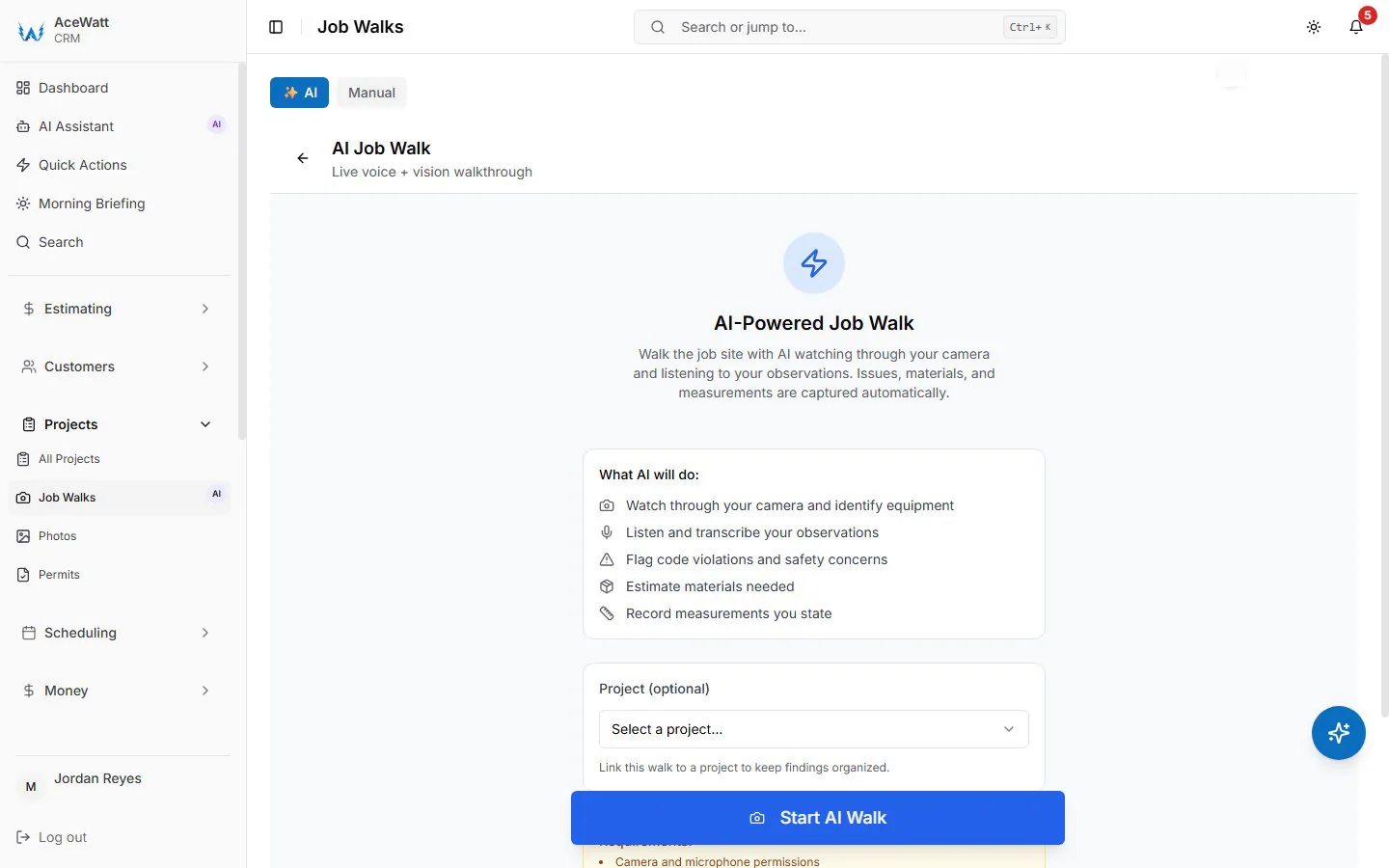
The bigger revenue lever is AI Voice and Job Walk Documentation. At the end of a walk or a service call, the tech narrates what they found and what they did: knob-and-tube discovered behind the dining room wall, an undersized equipment grounding conductor that has to be replaced back to the panel, a switch location with no neutral per NEC 404.2(C) that needs rewiring, or 140 feet of extra MC cable pulled on a T&M commercial call. That voice note is transcribed the same day into a job walk report with a materials list, which the office turns into a change order or T&M invoice line, complete with timestamps instead of a reconstruction two Fridays later. Discovered conditions and extra footage get billed when they happen. Unbilled work stops dying in a notebook in the van.
The Hidden Cost Leaks: Crew Mix, Travel Time, Change Orders, and Truck Stock
Crew Scheduling and Dispatching is a costing function, not just a calendar. Four leaks account for most silent margin erosion:
- Crew mix. Sending two journeymen where a journeyman and an apprentice would do, with the apprentice costing roughly 45 to 55 percent of journeyman scale, inflates labor cost on every rough-in hour.
- Travel time. A tech driving 45 minutes each way to a two-hour service call gives you three paid hours to bill two. Choosing the closest skilled tech from the live dispatch map makes that cost visible and correctable.
- Overtime. Hours past 40 carry a 1.5 times premium on payroll. Job costing here uses one hourly rate per job title, so watch overtime exposure in your payroll reports.
- Truck stock. Vans commonly carry $3,000 to $8,000 in materials. Without tying material issues to a job, stock shrinks and installed materials go unbilled. Cycle counts against job-level issues close both leaks.
Undocumented change orders compound all four. Every verbal "go ahead and fix it" that never becomes a signed change order is a cost with no matching revenue.
Automated Invoicing, Payment Tracking, and Automated Follow-Up for Faster Cash Collection
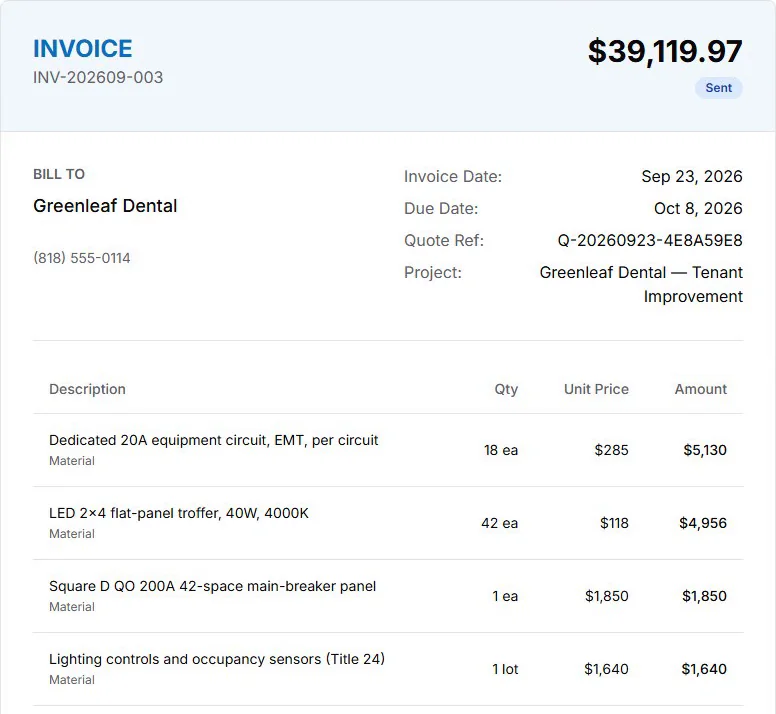
Margin isn't real until it's collected. Invoicing and Payment Tracking turns field data directly into billing: fixed-price residential work bills on a draw schedule (deposit, rough-in draw, trim and final), while T&M invoices go out with the job walk documentation, timestamps, and material issues attached. That documentation kills disputes on commercial accounts before they start. Larger commercial jobs can bill by milestone (percentage of completion) as work is completed.
Automated Follow-Up then works the receivables: email reminders with payment links at 1, 7, 14 and 30 days past due, without anyone on your team making an awkward call. For shops where days sales outstanding routinely runs 45 to 60 days on commercial work, automated dunning is the difference between funding the next job from collections or from a line of credit.
How QuickBooks-Ready Exports Connect Field Data to Your General Ledger
QuickBooks-ready exports are the close-the-loop step today: the invoice list exports as a spreadsheet and payroll hours as a QuickBooks-format CSV, and your bookkeeper posts them to the correct accounts (labor, materials, subcontract, permits). There is no native, real-time sync today; full sync is in development. Working from one export instead of paper keeps the two records from drifting apart.
The payoff is reporting that reflects field reality: a P&L that traces back to actual jobs, a work-in-process position showing over- and under-billing on long commercial projects, and per-job margin reports available days after completion instead of weeks. Electrical contractor billing software that stops at the invoice is half a system. The sync is what turns field activity into financial truth.
A Weekly Close-the-Loop Workflow for Growing Electrical Shops in 2026
For a solo electrician or a ten-truck shop, the loop closes in about 30 to 45 minutes a week:
- Monday: Review the variance report. Flag any job running more than 10 percent over its labor baseline and any unapproved change orders from last week's job walks.
- Tuesday: Resolve flags. Adjust crews through scheduling and dispatching, and get verbal changes converted to approved change orders.
- Midweek: Approve logged hours and material issues. Generate invoices directly from approved field data, T&M documentation included.
- Same day: Export the invoice list for your bookkeeper to post in QuickBooks, and confirm job costs land in the right classes.
- Friday: Review the A/R aging report. Confirm the automated follow-up sequence is running on past-due commercial accounts.
- On job close: Read the final margin against the AI estimate baseline and feed the variance back into the next estimate.
That last step is the compounding one. Field service management software for electricians combined with job costing for electrical contractors doesn't just report the past. Every completed job sharpens the next baseline. After a few months of closed loops, estimates for a panel upgrade, a residential rough-in, or a commercial T&M contract are calibrated to how your crews actually perform, in your market, at your labor rates. That is a level of precision no standalone accounting package or spreadsheet will ever deliver on its own.