
Why Electricians Need Purpose-Built Scheduling Software in 2026
Electrical contractors operate on a different clock than most trades. A solo electrician might run three service calls before lunch: a panel swap in a 1960s ranch, a GFCI troubleshoot in a kitchen remodel, and an EV charger quote for a homeowner who needs it "before the tax credit expires." Meanwhile, a growing shop coordinates a 12-week tenant build-out with permit inspections, a generator hookup requiring utility coordination, and a lighting retrofit across four floors of a medical office building. Generic scheduling tools treat these as identical calendar blocks. They aren't.
In 2026, the gap between what general field service platforms offer and what electrical work demands has widened. Code cycles (NEC 2023 adoption varies by state, with 2026 editions already in review), labor shortages, and the surge in electrification work (EV infrastructure, heat pump circuits, solar-ready panels) mean scheduling isn't just about who shows up when. It's about licensing compliance, inspection sequencing, material lead times, and crew qualification matching. Electrician scheduling software built for the trade handles these variables natively. General tools force workarounds that cost callbacks, failed inspections, and lost bids.
Core Features to Look for in Electrician Scheduling Software
Not all scheduling features translate to electrical work. What actually matters on the job site:
License-aware crew assignment A journeyman can rough-in a 200-amp service upgrade. An apprentice cannot pull the permit or call for the rough-in inspection. A master electrician must sign off on the final. Scheduling software that doesn't track license levels, expiration dates, and state reciprocity creates compliance risk. The right platform flags unqualified assignments before the crew leaves the shop.
Job-type templates with inspection milestones A panel upgrade follows a different critical path than a lighting retrofit. Panel work: load calculation → permit → utility disconnect → rough-in inspection → final inspection → utility reconnect. Lighting retrofit: photometric layout → fixture procurement → install → controls commissioning. Software with pre-built electrical job templates auto-populates these sequences, including hold points for AHJ inspections.
Material and vendor lead-time integration Specialty panels (Schneider, Eaton, Siemens), EV chargers (ChargePoint, Wallbox, Tesla), and generators (Generac, Kohler) have lead times ranging from 2 days to 14 weeks. Scheduling that doesn't pull vendor ETAs into the timeline creates phantom availability: crews scheduled for work the gear hasn't arrived for.
Mobile-first field access with offline mode Job sites (especially commercial basements, parking garages, and rural service calls) have spotty connectivity. Electricians need to view drawings, mark up as-builts, log time, and capture photos without a signal. Data syncs when connectivity returns.
Real-time crew GPS and ETA sharing Dispatchers and customers both need visibility. A homeowner waiting for a 2-hour service window deserves a live ETA. A project manager coordinating three crews on a commercial site needs to know which foreman will hit the panel first for the inspection walk-through.
AI-Powered Crew Scheduling and Dispatching for Electrical Work
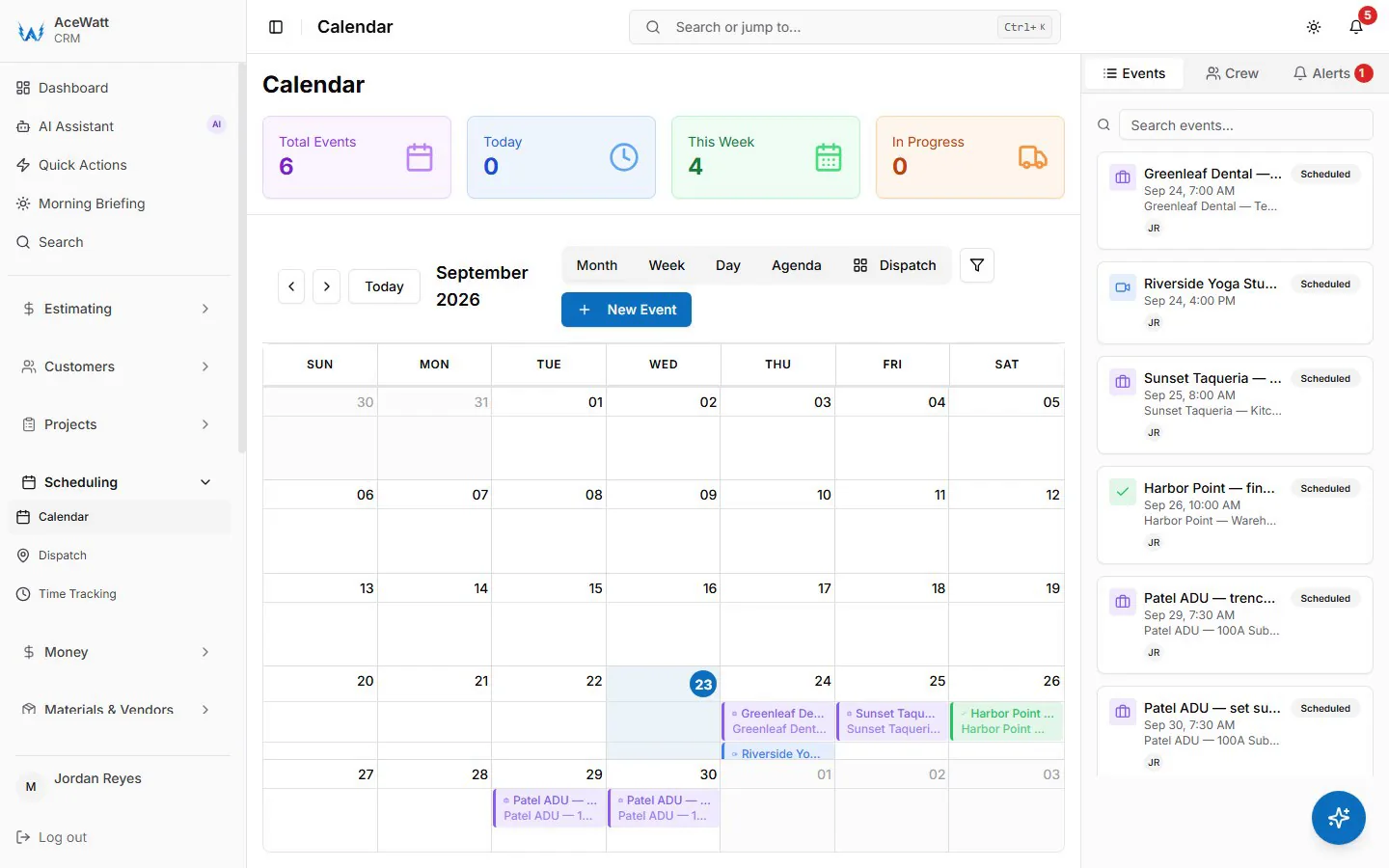
AI dispatching isn't a buzzword. It solves the daily puzzle of matching the right electrician to each job and time slot. The variables are specific:
- License tier: Master, journeyman, apprentice (with hour-tracking for apprenticeship programs)
- Specialization: Low-voltage, fire alarm, solar, EVSE, industrial controls, residential service
- Vehicle and tool load: Bucket truck, pipe threader, megohmmeter, thermal imager, conduit bender
- Geography: Drive-time optimization across metro areas, accounting for traffic patterns at 7 AM vs. 3 PM
- Overtime rules: Union agreements, state labor laws, per-diem thresholds for travel jobs
An AI engine evaluates all constraints simultaneously. When a 400-amp service upgrade request hits the board at 4:30 PM Friday, the system identifies: which master electricians have Saturday availability, who's within 30 minutes of the site, who has a bucket truck assigned, and who hasn't hit 40 hours yet. It presents the optimal dispatch in seconds, not the 20 minutes a dispatcher spends on the phone and text chains.
For growing shops running 5+ crews, this compounds. A single optimized dispatch decision saves 1 to 2 hours of windshield time per crew per week. Across 10 crews, that's 500 to 1,000 billable hours recovered annually.
Connecting Job Walks, Documentation, and Real-Time Job Tracking
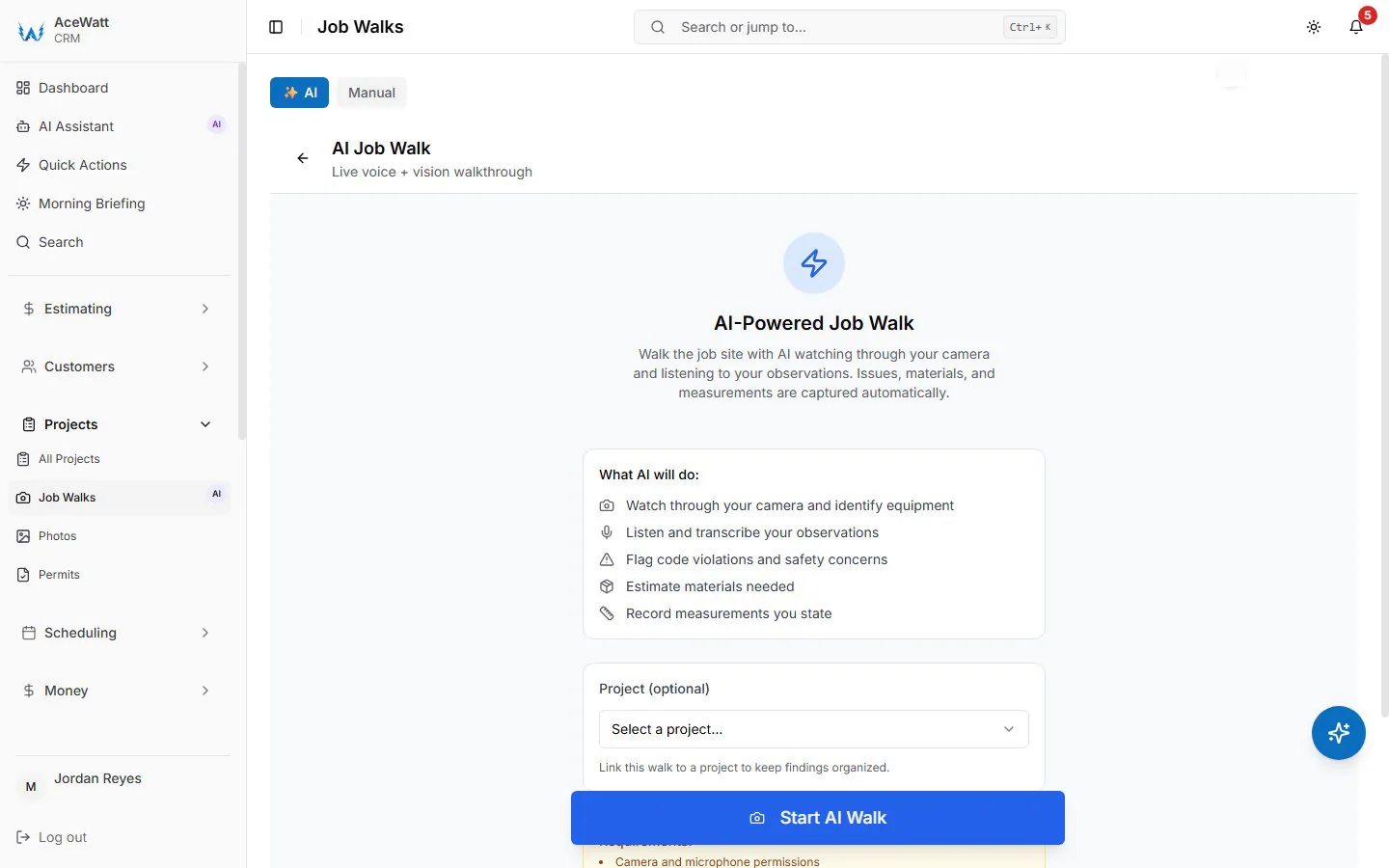
The job walk is where profit is made or lost. Missed details (an undersized service entrance, a missing ground rod, a panel with no spare spaces) become change orders or callbacks. In 2026, AI voice capture transforms this process.
An electrician walks a 12,000 sq. ft. tenant build-out. Instead of scribbling on a notepad, they narrate: "Main distribution panel, 400A, 42-circuit, 12 spaces open. Existing feeder is 500 kcmil CU in 3-inch EMT. Need 200A subpanel for HVAC, 100A for lighting control. Conduit run from MDP to mechanical room: 85 feet, three 90s. Existing load calc shows 280A demand." The AI transcribes, structures, and tags: panel specs, conduit measurements, load data, photo attachments. It auto-generates a material list and feeds the AI estimating engine.
Back at the office, the estimator opens the job walk record. Every detail is searchable. No "what did he say about the feeder size?" calls. No missed items.
Real-time job tracking closes the loop. Field crews update task status ("rough-in complete," "awaiting inspection," "trim-out started") from the mobile app. The schedule adjusts automatically. If the rough-in inspection fails, the next crew's dispatch shifts. The project manager sees the delay instantly, not at the weekly meeting.
Automating Follow-Ups to Win More Panel Upgrades, EV Charger Installs, and Service Calls
Electrical work has a recurring revenue engine most contractors underutilize. Every service call creates a follow-up opportunity:
- Surge protection: 85% of homes lack whole-house surge protection (NEC 2023 230.67). A post-service automated sequence: Day 3, an educational email on surge risks. Day 10, a quote for panel-integrated SPD. Day 30, a seasonal reminder for storm season.
- EV charger installs: Homeowners who inquired but didn't buy. Sequence: Week 1, tax credit update. Week 4, utility rebate alert. Week 8, "neighbor just installed" social proof.
- Smoke/CO detector upgrades: NEC 2023 requires 10-year sealed battery units in specific locations. Annual automated check: "Your detectors are 8 years old. Code-compliant replacement: $X."
- Generator maintenance: Annual load bank test, oil change, battery replacement. Recurring revenue at $350 to $600 per visit.
AI-powered CRM builds these sequences once. Triggers fire off service completion, quote acceptance/decline, permit finalization, or anniversary dates. No manual list pulling and no "I meant to call them." The system tracks open rates, click-throughs, and booked jobs, then refines timing and messaging automatically.
For a solo electrician, this runs in the background while they're on a ladder. For a shop with 3,000 past customers, it activates a dormant database without hiring a salesperson.
Integrating Scheduling with Estimating, Invoicing, and QuickBooks Sync
The bid-to-cash cycle kills cash flow when systems don't talk. Typical disconnected workflow:
- Estimate in spreadsheet → email PDF
- Customer approves → manually create job in scheduling
- Crew completes work → paper timesheets → manual entry
- Invoice created in separate system → emailed
- Payment received → manually mark paid → manually enter in QuickBooks
That's five touchpoints, five chances for error, and days or weeks of delay.
Integrated workflow with AI estimating and a QuickBooks handoff:
- Job walk data → AI estimating drafts a line-item estimate for review, priced from your pricebook, labor rates and current online retail prices
- Estimate sent via CRM → customer approves digitally → job auto-created in scheduler with phases, milestones, and material POs
- Crew logs time and materials in mobile app → real-time job costing vs. estimate
- Accepted estimate is invoiced and emailed automatically → online payment (card; ACH if enabled in your Stripe account)
- Payment posts against the invoice → invoice list exported for your bookkeeper's QuickBooks entry
Job costing becomes real time rather than a month-end surprise.
How Growing Electrical Shops Roll Out Scheduling Software Successfully
Adoption fails when leadership treats it as an IT project instead of an operations transformation. Successful rollouts follow a pattern:
Phase 1: Pilot with one crew (2 to 3 weeks) Pick a foreman who's tech-comfortable and vocal. Run their entire workflow (service calls, small projects, material ordering) through the platform. Document friction points: missing job types, awkward mobile flows, notification overload. Fix before expanding.
Phase 2: Standardize job templates and naming conventions Define: "Panel Upgrade: 200A Residential," "EVSE Install: Level 2, Single Port," "Tenant Build-Out: Commercial, <5,000 sq ft." Consistent naming enables reporting. Without it, "panel job" and "service upgrade" and "main swap" are three different line items in every report.
Phase 3: Train dispatchers first, then crews Dispatchers are the air traffic controllers. They need deep training on AI dispatch logic, override rules, and exception handling. Crews need 30 minutes on mobile app basics: clock in/out, task status, photo upload, voice notes. Over-training field crews creates resistance.
Phase 4: Connect the financial loop Map chart of accounts, tax codes, and payment terms to QuickBooks. Run parallel for one pay cycle, old process and new, to verify reconciliation. Then cut over.
Phase 5: Activate automated follow-ups Import customer database. Tag by job type, year, equipment installed. Launch the first three sequences (surge, EV, detector). Monitor for two weeks. Adjust messaging based on response data.
Metrics to watch week 1, month 1, quarter 1:
- Schedule adherence (% of jobs starting within 15 min of scheduled time)
- Dispatch time (minutes from request to crew assigned)
- Invoice-to-payment days
- Job cost variance (actual vs. estimated labor hours)
- Follow-up conversion rate (sequences → booked jobs)
Shops that hit 90%+ schedule adherence and sub-10-day invoice-to-payment within 90 days typically see 15 to 22% revenue growth per electrician in year one. The gain comes not from working harder but from eliminating the gaps between the truck, the office, and the bank.
The Bottom Line
Electrician scheduling software in 2026 isn't a calendar. It's the operational backbone that connects the job walk to the estimate, the crew to the inspection, the invoice to the bank deposit, and the past customer to the next upgrade. Generic tools force electrical contractors to build workarounds for licensing, inspections, material lead times, and code-driven sequences. Purpose-built platforms encode that knowledge once, then execute it on every job, every day.
The contractors winning the electrification boom aren't just better at pulling wire. They're better at orchestrating the entire lifecycle of electrical work, from the first homeowner call to the final QuickBooks reconciliation. The software difference is measurable, and the competitive gap is widening.
- Ready to stop juggling the whiteboard? See contractor scheduling software built for electricians