

Electrical Distributor Software in 2026: Quote from Plans, Track Contractor Accounts & Drop-Offs
Search for electrical distributor software and the results describe systems that run the supply house: Epicor Eclipse, Epicor Prophet 21, Infor CloudSuite Distribution, DDI System Inform. You cannot buy any of them, and you would not want to. That software still decides how fast a plan quote comes back, what pricing tier you sit at, and whether material lands on the job or on a curb. This guide covers what electrical supply house software does at each of those points, where it stops at the counter, and how to run your side of the transaction in 2026.
1. What Electrical Distributor Software Covers in 2026: Counter Quotes, Will-Call, and Contractor Accounts
Distributor software is the branch's system of record: inventory across branches and warehouses, purchasing from manufacturers like Eaton, Schneider Electric, ABB, and Leviton, daily price updates from trade pricing services like TRA-SER, counter sales, accounts receivable, and the general ledger. Most branches expose a slice of it through a portal where your login shows contract pricing, stock at nearby branches, and order history.
Three functions touch contractors directly:
- Plan and spec quoting. You email a PDF plan set, the quote desk estimator builds the material list, prices it at your tier, and returns a quote. Wire and cable quotes often carry a 24 to 48 hour validity window because copper is commodity priced and reprices daily.
- Contractor account tracking. The system holds your credit limit, net-30 terms, pricing tier, tax exemption certificates, and a job tag field the counter attaches to each purchase so statements sort by job. Many branches offer 2/10 net 30 terms: a 2 percent discount when the invoice is paid inside 10 days.
- Will-call and job-site delivery. Orders stage for counter pickup or schedule for delivery, with liftgate service on drops without a dock. Panelboards, transformers, and switchgear ship on a boom truck booked days in advance.
Distributor software starts and ends at the distributor. The buyer on this search is you, the contractor, so the rest of this guide follows each workflow across the counter.
2. Quoting from Plans: What the Supply House Sees vs. What Your Own AI Draft Shows First
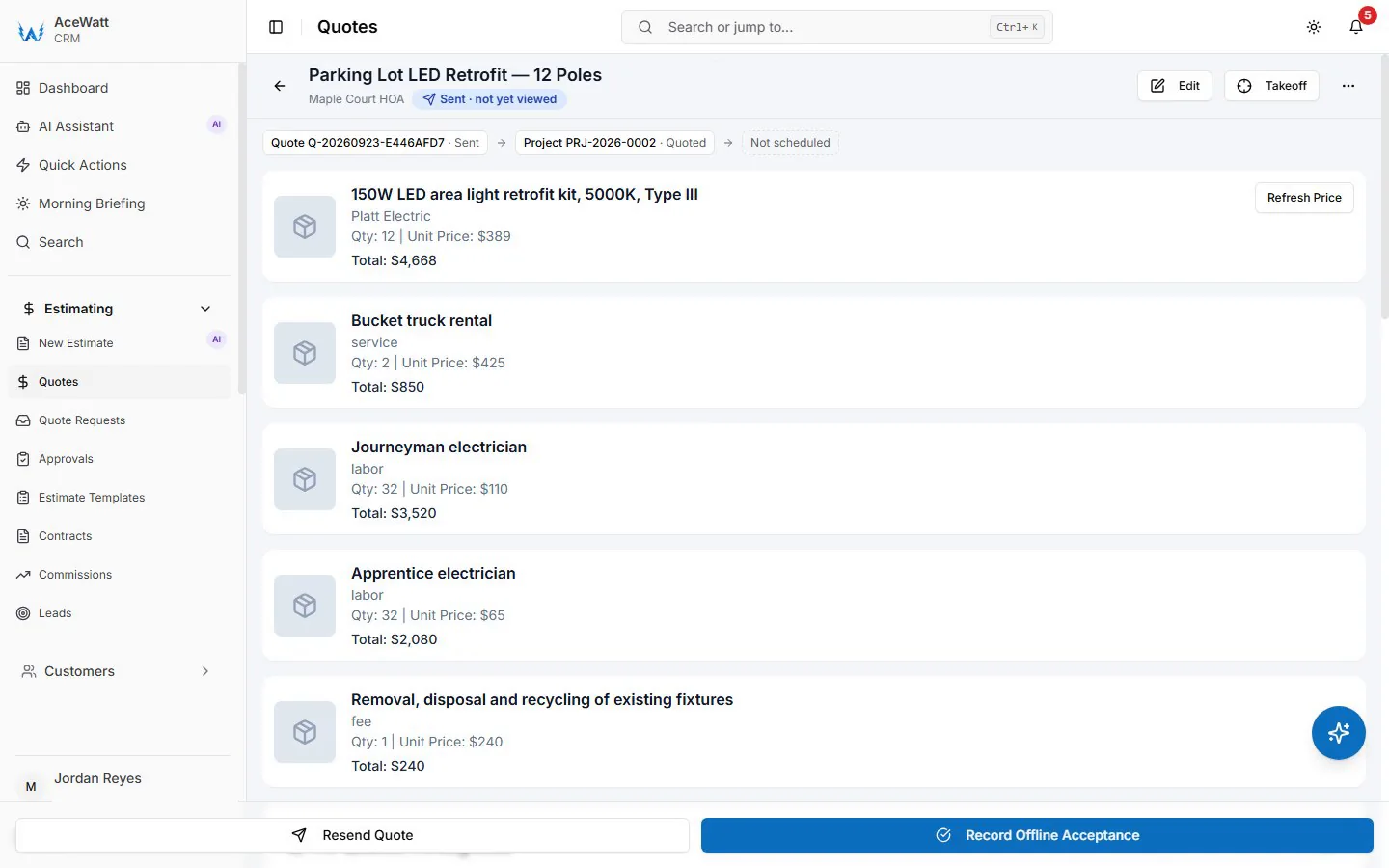
On a plan quote, the supply house estimator runs a takeoff in a tool like Trimble Accubid or McCormick Systems, counting fixtures, devices, branch circuits, and home runs, then pricing the list at your tier. Turnaround runs 24 to 72 hours for residential and light commercial packages, and a full commercial set can sit in the quote queue three to five business days, with special-order lighting behind that. The quote costs you nothing. The bid date does not wait: general contractors routinely want subcontractor numbers within 48 hours of a walkthrough.
That timeline works when the distributor acts as your estimating department. It fails when the bid is due Friday and the quote returns Tuesday. Run your own draft first. AI Estimating from AceWatt takes the same PDF plans you were about to email the counter and drafts a priced quote for your review, from your pricebook and assembly templates. Check every device and circuit count yourself, then send the quote desk a tightened line-item list; the counter works faster from a list than from a full plan set. Your draft also carries labor hours and margin, so you can check the counter's number against your own before committing a price. AI electrical estimating software has shortened the drafting step, but plan counts still need a human check before the number goes out.
3. Contractor Account Tracking: Credit Terms, Job-Level Billing, and T&M Pricing Tiers
Your account record inside Eclipse or Prophet 21 is where the branch tracks its relationship with you: credit limit, net-30 terms, pricing tier, tax exemption certificates, and the job tag field. Two contractors buying the same 250 foot coil of 12/2 MC cable can pay different prices based on volume history, and your markup on time and material work is only as strong as the tier you buy at.
The pain shows up at billing time. The monthly statement arrives sorted by invoice date, and when the counter skips the job tag you rebuild which receipt belongs to which address from memory, weeks later. Electricians searching for time and material billing software are usually trying to close this exact handoff: turning what the distributor charged and what the technician logged into an invoice the same day.
Invoicing and Payment Tracking closes it. Log the distributor charge to the job at cost, clock the labor hours down to the torque check on terminations that NEC 110.14(D) requires, and build the T&M invoice from that record: labor at the hourly rate for the tech's job title, materials priced by you, because markup lives on quotes and is not added to invoices automatically. Payment status sits next to each job, so you can see which invoices cleared and which need a call. The invoice goes out from the office or from an electrician invoice app on the tailgate, and either way the material costs and the hours are already on the job.
4. Drop-Offs and Deliveries: Scheduling Material to Land When Your Crew Is On Site
Delivery mechanics live inside the distributor's system. Order by the branch cutoff, usually 4 or 5 PM, and material stages for the next morning's route. Free delivery typically starts above a minimum order in the $500 to $1,000 range, liftgate service covers drops without a dock, and many branches charge a restocking fee of 15 to 25 percent on returned special-order lighting. Boom deliveries for panelboards and switchgear book separately, often days out.
The failure mode is scheduling. Material delivered when no one is on site sits on a curb, and 250 feet of MC cable left on a curb does not always stay there. The reverse costs just as much: three people on the clock waiting out a delivery window of sometime between 8 and noon.
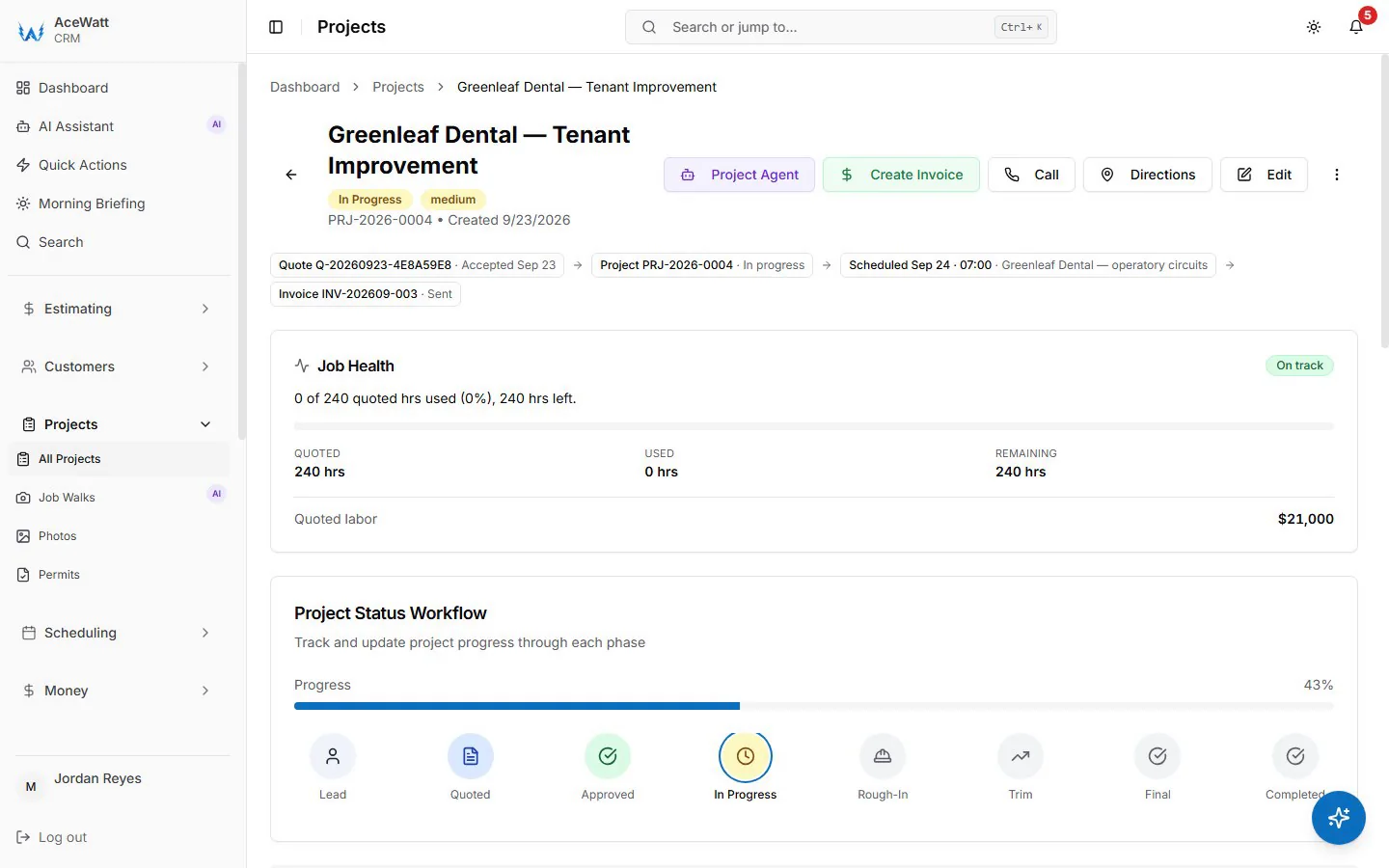
Crew Scheduling and Dispatching puts the confirmed delivery window next to the crew assignment. Staged material lands the morning the crew starts, a helper grabs the will-call order on the way to the site, and the boom truck is booked for the day the switchgear actually gets set.
5. Where Distributor Software Stops: The Gaps on the Electrician's Side of the Counter
The distributor's ERP runs their branch. It does not run yours, and the gaps are predictable:
- Estimates. The quote desk prices material. It produces no labor hours, no crew plan, and no bid you can submit.
- Schedule. Will-call staging times and delivery windows never reach your dispatch board.
- Invoices. Their accounts receivable bills you. The accounts receivable that pays your crew is yours to run.
- Documentation. A substitution agreed verbally at the counter gets a SKU in their system and nothing else, and a swapped fixture still has to meet listing and labeling requirements under NEC 110.3(B) when the inspector shows up.
- Customer follow-up. Their CRM tracks their relationship with you. Yours needs to track bids sent, quotes gone quiet, and service customers due for a callback.
Statements arrive monthly. Job costing needs purchases matched to jobs today. That gap is what electrical contractor software on your side of the counter exists to close.
6. The 2026 Contractor Stack: AI Estimating, Job Tracking, and Invoicing That Works With Your Supply House
The 2026 stack for an electrical shop mirrors the workflows above, one tool per handoff. Job management software for electricians now covers estimating, CRM, scheduling, job tracking, and invoicing in a single platform, with accounting sync instead of double entry. On AceWatt, the pieces line up like this:
- AI Estimating drafts a quote from the plan PDF for your review before anything goes to the counter.
- The lead lives in an AI CRM for electrical contractors, and the GC can e-sign the quote you sent Monday instead of letting it sit in an inbox.
- Scheduling aligns delivery windows, crew days, and will-call pickups.
- Job Tracking shows material costs logged to the job at cost, plus crew notes from the field.
- Invoicing emails the invoice automatically once the quote is accepted (a deposit invoice first, if the quote asks for one), and extra hours and material costs are billed from the job record with a button the day the work closes.
For choosing the customer-tracking piece, see our guide to the best CRM for electrical contractors. The distributor's ERP stays on their side. Your platform handles everything the counter hands you.
7. How AceWatt Closes the Loop: CRM, Payment Tracking, Job Walk Documentation, and QuickBooks-Ready Exports
Run one tenant build-out from first call to final payment. Monday, a property manager calls about a 2,800 square foot suite: a new 42-space panel, full device package, 34 recessed fixtures. The call lands in the AI-powered CRM with contact, address, and scope attached to a job record, so the lead never lives in a text thread. Tuesday morning the plan PDF goes through AI Estimating and comes back as a draft quote for review, and the estimator checks the fixture and device counts against the plans. A tightened line-item version goes to the quote desk instead of the full plan set, and the counter quote returns Wednesday because the list was already built. The proposal goes out by email, you follow up by phone, and the property manager e-signs it.
The job is won. Crew Scheduling and Dispatching puts the crew start date and the confirmed delivery window on the same board, so the branch stages the panel and fixture package for the morning the crew mobilizes. Job Tracking shows each material purchase logged to the job at cost as it is picked up.
Then the moment that decides whether the final invoice holds up. On the walk-through, the tenant asks to swap the specified fixtures for a higher lumen package and add six receptacles along the north wall. That conversation happens in a hallway, verbally, which is exactly where scope changes go to die. AI Voice and Job Walk Documentation records it, transcribes it, and files it on the job record with a timestamp. The substitution is checked against listing and labeling requirements, the change order exists as a documented line, and the invoice matches what was actually installed.
Invoicing and Payment Tracking already emailed the invoice for the accepted quote's line items when the GC accepted it; at closeout, the office bills the approved change order from the job record with a button, with the logged hours and material costs on the same job record; markup was set on the quote. Payment status sits on the job until the check clears.
Job costing in AceWatt does the quiet work underneath. Every distributor purchase coded to the job lands on that job's cost record, so when the branch statement arrives at month end it reconciles against per-job profit instead of a guess, and your bookkeeper gets the invoice list and payroll hours as QuickBooks-ready exports. The 2/10 net 30 discount gets taken or skipped based on real margin numbers, not a feeling.
8. Questions to Ask in 2026: Getting Your Supply House and Your Software to Work Together
The hours leak at the handoff between the branch's ERP and your platform. Ask these before the next job.
At the counter:
- What is the cutoff for next-day delivery, and can the branch commit to a window tight enough to schedule a crew against? A window of sometime between 8 and noon strands either material or labor.
- Can job-tagged order history be exported in a format your software can read? Branches running Eclipse or Prophet 21 can produce a CSV export on request, and larger accounts can set up EDI 850 and 810 documents for purchase orders and invoices.
- How fast does the quote desk turn a revision? Addenda land days before bid dates, and the answer decides whether your number survives the change.
About your own platform:
- Does the takeoff run on the plan PDF before anything goes to the quote desk?
- Do distributor receipts attach to the job without retyping, and can the T&M invoice go out the day the work closes?
- Are counter substitutions and walk-through change orders documented, with audio, before the invoice is built?
- Do purchases flow into QuickBooks job costing automatically, so the month-end statement reconciles against real per-job profit?
Start with the plan set currently on your desk: run the AI estimating draft, check its counts, send the tightened line-item list to your quote desk, and time both turnarounds against the bid date.
Related Reading
- See all CRM features for electrical contractors in one platform.
- AI quote builder for electrical work: turning a plan upload into a priced quote before anything hits the quote desk.
- How to price electrical work: labor, material markup, overhead, and margin from the contractor side of the counter.
- Automated estimating: how AceWatt drafts estimates from plans and job-walk notes.