
Picture this: You're standing in a customer's basement, looking at a 200-amp panel upgrade that needs to happen. The homeowner is standing next to you, watching. They want a price. They want it now. And they've already told you they're getting two other quotes.
In the old workflow, here's what happens next. You leave the job site, drive back to the office, open your estimating spreadsheet, look up material costs, calculate labor hours, apply your markup, format everything into a presentable document, and email it over. Best case? That estimate goes out the next morning. Worst case? It takes two or three days because you got busy with other jobs.
By then, the other contractor, the one who sent their estimate while still on site, already has the job.
Speed wins in electrical contracting. And AI-powered quote builders are changing the game by letting you generate accurate, professional estimates quickly, often while you're still standing in front of the customer.
The Estimating Bottleneck Every Electrician Knows
Estimating is one of the most critical, and most time-consuming, tasks in an electrical business. Every job starts with an estimate. Every customer expects one. And every estimate you send represents potential revenue.
But the traditional estimating process is full of friction:
- Manual material lookup. You know what materials you need, but finding current pricing means checking supplier websites, calling distributors, or referencing outdated price sheets. The branch side of that conversation is its own workflow; see electrical distributor software and quote desks, or the best CRM for electrical distributors if you are managing the contractor-account side of a branch.
- Labor calculation guesswork. How long will this job actually take? Your experience gives you a good sense, but calculating hours for every line item takes time.
- Formatting and presentation. A handwritten number on the back of a business card doesn't inspire confidence. Customers expect professional-looking estimates with itemized breakdowns.
- Double entry. You write the estimate, then you enter the same information into your job management system, then you enter it again into your invoicing system.
- Follow-up delays. After you send the estimate, do you follow up? When? How? Most electricians send estimates and hope for the best.
The result is a process that takes 30 to 90 minutes per estimate for most electrical contractors. During busy periods, when you're running multiple jobs a day, estimates pile up. Response times stretch. And deals go to faster competitors.
How an AI Quote Builder Works for Electricians
An AI electrical estimating tool uses artificial intelligence to automate the heavy lifting in the estimating process. Here's how it works in practice:
Step 1: Capture the Job Walk
Instead of manually selecting line items and entering quantities, you describe the job in plain language. Type it out or, with a tool like AceWatt, speak it using voice documentation.
"200-amp panel upgrade. Current panel is a 100-amp Zinsco. Need to replace the panel, upgrade the service entrance cable, add a new grounding system, and install a whole-house surge protector. Customer also wants two additional circuits run to a finished basement, one 20-amp for a home office and one 15-amp for general lighting."
That's it. The AI understands what you're describing and gets to work.
Step 2: AI Extracts Scope and Builds the Estimate
Within seconds, the AI:
- Identifies the required materials based on the job description and your standard practices
- Calculates material costs using current pricing data
- Estimates labor hours based on the scope and complexity of the work
- Applies your labor rate and markup percentage
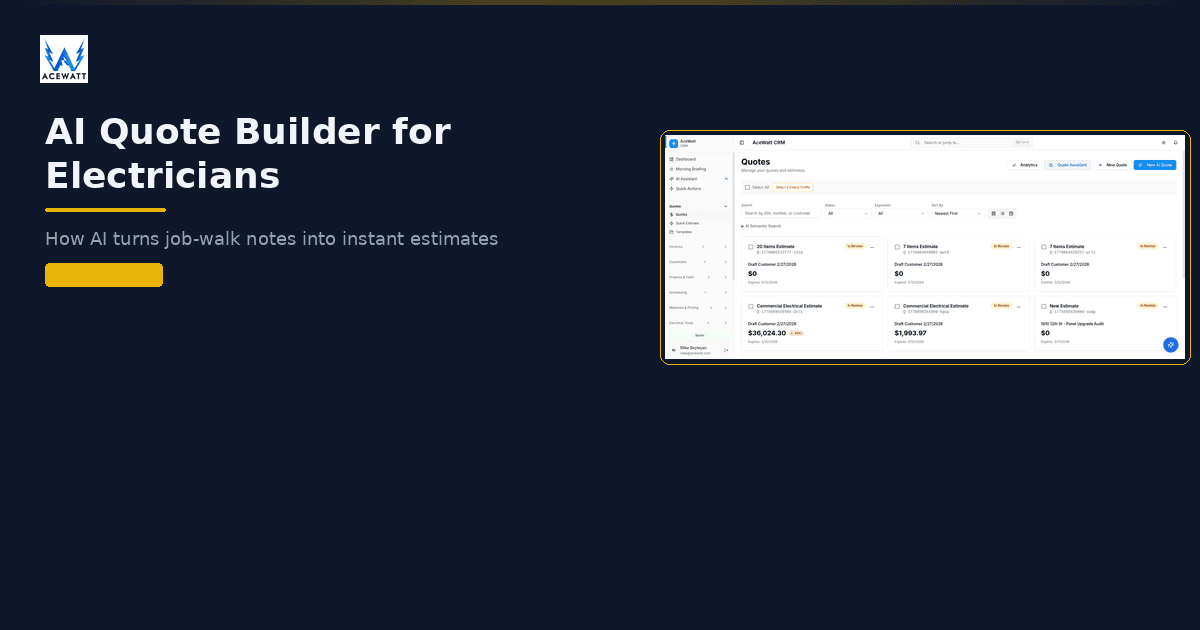
- Generates line items with descriptions, quantities, unit prices, and totals
- Creates a professional, branded document ready to send to the customer
You review the estimate, make any adjustments, and send it, often while you're still on site with the customer.
Step 3: Send, Track, and Follow Up
The estimate goes directly to the customer by email. They see a professional, itemized document with your branding. They can approve it digitally. And you get notified the moment they do.
If they don't respond, the follow-up is yours to send; the automatic reminders start later, on overdue invoices (1, 7, 14 and 30 days late).
Step 4: Convert to Invoice
When the customer approves the proposal, it converts directly to an invoice, no double entry, no reformatting. The estimating-to-invoicing pipeline is seamless.
What Makes AI Estimating Different from Software Templates
You might be thinking, "I already use estimating software with templates. What's different about AI?"
Template-based estimating software is better than spreadsheets, but it still requires you to:
- Select the right template
- Manually choose line items
- Enter quantities and adjust pricing
- Review and format the output
It's faster than starting from scratch, but it's still a manual process. And it requires you to be at a computer.
AI estimating is fundamentally different. You describe the job in natural language, and the AI does the rest. It's the difference between ordering from a menu (templates) and having a chef who already knows what you want (AI).
Key advantages of AI over templates:
- No template selection required. The AI adapts to the specific job, not a generic category.
- Dynamic material pricing. AI can pull current pricing data instead of relying on static template prices that may be months out of date.
- Scope comprehension. AI understands context, it knows that a panel upgrade in a 1960s home with aluminum wiring is different from a panel upgrade in a newer home.
- Natural language input. Speak or type in the same language you'd use to describe the job to another electrician. No forms to fill out.
- Continuous learning. The more estimates you create, the more the AI learns your pricing, preferences, and typical scopes of work.
The Real-World Impact: Speed, Accuracy, Revenue
Speed to Quote
With AI estimating, you can deliver a professional quote before you leave the customer's property. In a competitive situation, that's often the difference between winning and losing the job.
Consider a scenario where a property manager needs quotes from three electricians for an office build-out. The first electrician emails a quote the same afternoon. The second sends one the next morning. The third takes three days because they're backed up with other estimates. Who wins? Usually the first one, because speed signals professionalism before the work even starts.
Accuracy and Consistency
AI doesn't forget to include permit costs. It doesn't accidentally omit the grounding electrode conductor. It doesn't underprice materials because you were thinking of last year's copper prices. By standardizing your estimating process, AI reduces the variability that comes with manual estimation. That protects your margins on every job.
Higher Close Rates
Faster quotes lead to higher close rates. When a customer receives a detailed, branded, itemized estimate quickly after your site visit, it communicates competence and reliability. They trust you more because the experience feels organized and professional.
Time Savings
If you create 10 estimates per week and AI saves you 30 minutes per estimate, that's 5 hours per week reclaimed. At a $100/hour billable rate, that's $500 per week, or $26,000 per year, in time savings alone.
What to Look for in an AI Quote Builder for Electricians
Not all AI quote builders are created equal. If you're evaluating tools for your electrical business, here's what matters:
Electrical-specific scope library. Generic contractor tools don't understand the difference between EMT and RMC, or why a service upgrade is different from a service change. Look for AI that's trained on electrical contractor workflows.
Voice-to-notes documentation. The fastest way to capture scope on a job walk is to speak it, not type it. Voice documentation lets you capture scope hands-free while you inspect the site.
Photo attachment and site documentation. Your quote should be backed by visual evidence, panel photos, site conditions, existing wiring. This protects you from scope disputes and callbacks.
Option cards (good-better-best). Present customers with tiered options instead of a single price. This increases average ticket size and gives customers control over their buying decision.
Follow-up automation. The quote builder should connect to a CRM that automatically follows up on unsent proposals. This is where most electrical contractors lose deals, silence after the estimate.
CRM integration. Your quote builder should be part of a larger customer management system, not a standalone tool. Customer history, past jobs, and communication records should all be connected.
Invoice conversion. When a proposal is approved, it should convert to an invoice with one click, no re-entering data.
Mobile-friendly field workflow. You should be able to build and send estimates from your phone or tablet while standing on the job site.
AI Quote Builder Tools for Electricians (2026)
The market for AI quoting tools is still emerging, but a few platforms stand out for electrical contractors:
AceWatt
AceWatt is built specifically for electrical contractors. Its AI quote builder connects directly to job-walk documentation, you capture scope with voice and photos, then AI helps build your estimate from the documented scope.
Key features:
- AI scope extraction from voice notes and job-walk data
- Customer e-signature on quotes and contracts
- Good-better-best option cards
- Invoice conversion from approved proposals
- Full CRM with customer history
Best for: Residential and commercial electrical contractors who want an integrated AI quoting workflow connected to their CRM and invoicing.
Learn more at AceWatt's automated estimating features.
OpenClaw
OpenClaw is an agentic AI platform for electrical contractors. It focuses on AI concierge capabilities, handling quote follow-up, emergency dispatch coordination, and permit tracking through AI agents.
Key features:
- AI agent handles quote follow-up communications
- Emergency dispatch coordination
- Permit tracking and management
- Agentic AI that can take actions on your behalf
Best for: Contractors who want AI to actively manage operational tasks beyond just quoting, including dispatch and permit coordination.
Traditional Estimating Software with AI Features
Platforms like BuildOps, ServiceTitan, and McCormick are adding AI-assisted features to their existing estimating workflows. These are typically AI-assisted takeoff and pricing tools layered onto traditional estimating processes.
Best for: Larger shops with established estimating workflows who want AI augmentation rather than a new workflow.
For a broader comparison of field service software options, see our guide to the best field service software for electricians in 2026.
AI Quote Builder vs Traditional Estimating Software
| Factor | AI Quote Builder | Traditional Estimating Software |
|---|---|---|
| Speed of first quote | Minutes from voice/text description | 10, 30 minutes with template selection |
| Ease of use for field teams | Speak naturally, AI handles the rest | Requires training on software interface |
| Trade-specific scope knowledge | Built for electrical workflows | Template-based, requires manual customization |
| Follow-up and CRM integration | Built-in automation | Usually requires separate CRM tool |
| Pricing and accessibility | Monthly subscription, free trials available | Often higher cost, enterprise licensing |
How to Get Started with an AI Quote Builder
- Start with your job-walk process. Begin by documenting every job walk with voice notes and photos. This data feeds the AI and improves your estimates.
- Test with a real job. Take a real panel upgrade, service call, or wiring job you're quoting and run it through the AI quote builder. Compare the output to what you would have produced manually.
- Compare AI output vs your manual quotes. Check material lists, labor estimates, and total pricing. Most contractors find the AI is within 5% to 10% of their manual estimates, and catches items they might have missed.
- Roll out to your field team. Once you're confident in the output, train your crew to use voice documentation on every job walk.
- Track results. Measure quotes sent per week, response rate, close rate, and time per estimate. Compare to your pre-AI baseline. For help with broader estimating strategy, see our guide on how to estimate electrical work.
Addressing Common Concerns
"Can AI really understand electrical work?"
Yes, when the AI is trained on electrical contractor workflows, not generic business processes. AceWatt's AI understands the difference between a service upgrade and a service change. It knows that EMT, RMC, and PVC are conduit types, not random acronyms. It's built for your industry.
"What if the estimate is wrong?"
AI generates a draft estimate. You review it before it goes to the customer. If something needs adjusting, a different material, a higher labor estimate for difficult access, an additional line item, you can edit it in seconds. The AI does the heavy lifting. You apply your professional judgment.
"Is my data safe?"
Reputable AI estimating platforms, including AceWatt, use encrypted data storage and don't share your pricing, customer data, or business information with third parties. Your data is yours.
"Do I need to be tech-savvy?"
No. If you can describe a job out loud, which every electrician does every day, you can use AI estimating. The whole point is that it works the way you already think and communicate.
Frequently Asked Questions
What is the best AI quote builder for electricians?
The best AI quote builder depends on your shop size and workflow. AceWatt connects AI quoting to the rest of the job for electrical contractors: job-walk documentation, AI scope extraction, customer e-signature on the quote, and invoice conversion. OpenClaw is worth considering if you want AI agents that handle broader operational tasks. Evaluate based on whether you need an integrated quoting workflow (AceWatt) or an AI concierge across operations (OpenClaw).
Can AI write electrical estimates?
AI can generate draft electrical estimates from job descriptions, voice notes, and scope documentation. The AI identifies materials, calculates costs, estimates labor, and applies markup. However, every AI-generated estimate should be reviewed by a licensed electrician or qualified estimator before it's sent to the customer. AI accelerates the estimating process, it doesn't replace professional judgment.
How accurate are AI quote builders for electrical work?
AI quote builders typically produce estimates within 5% to 10% of manual estimates for common job types like panel upgrades, EV charger installs, and service calls. Accuracy improves as the system learns your specific pricing, materials, and labor patterns. Complex or unusual jobs may require more manual adjustment. Always review AI-generated estimates before sending them to customers.
What's the difference between AI quoting and AI estimating?
AI quoting focuses on generating customer-facing proposals quickly, scope, pricing, and presentation. AI estimating goes deeper into material takeoffs, detailed labor calculations, and cost engineering. AceWatt's automated estimating bridges both: it handles the detail work of estimating while producing professional proposals ready for the customer.
Is an AI quote builder worth it for a small electrical shop?
For many small electrical shops, yes, if the estimate volume is high enough and every AI-assisted quote is reviewed before it reaches a customer. If you're creating five or more estimates per week, an AI quote builder can reduce repetitive estimating work. If faster quoting helps you respond before competitors, the time savings may justify the investment. Check current pricing to evaluate against your volume.
Want to see how AceWatt's full platform compares to other options? Read our comparison of Jobber vs Housecall Pro vs AceWatt for electrical contractors.
For current plan options, compare tiers on the AceWatt pricing page. For broader field service software comparisons, see best field service software for electricians 2026.
For related reading, For a side-by-side of AI estimating tools, takeoff workflows, and quote-builder features, see best AI estimating software for electrical contractors (2026).