
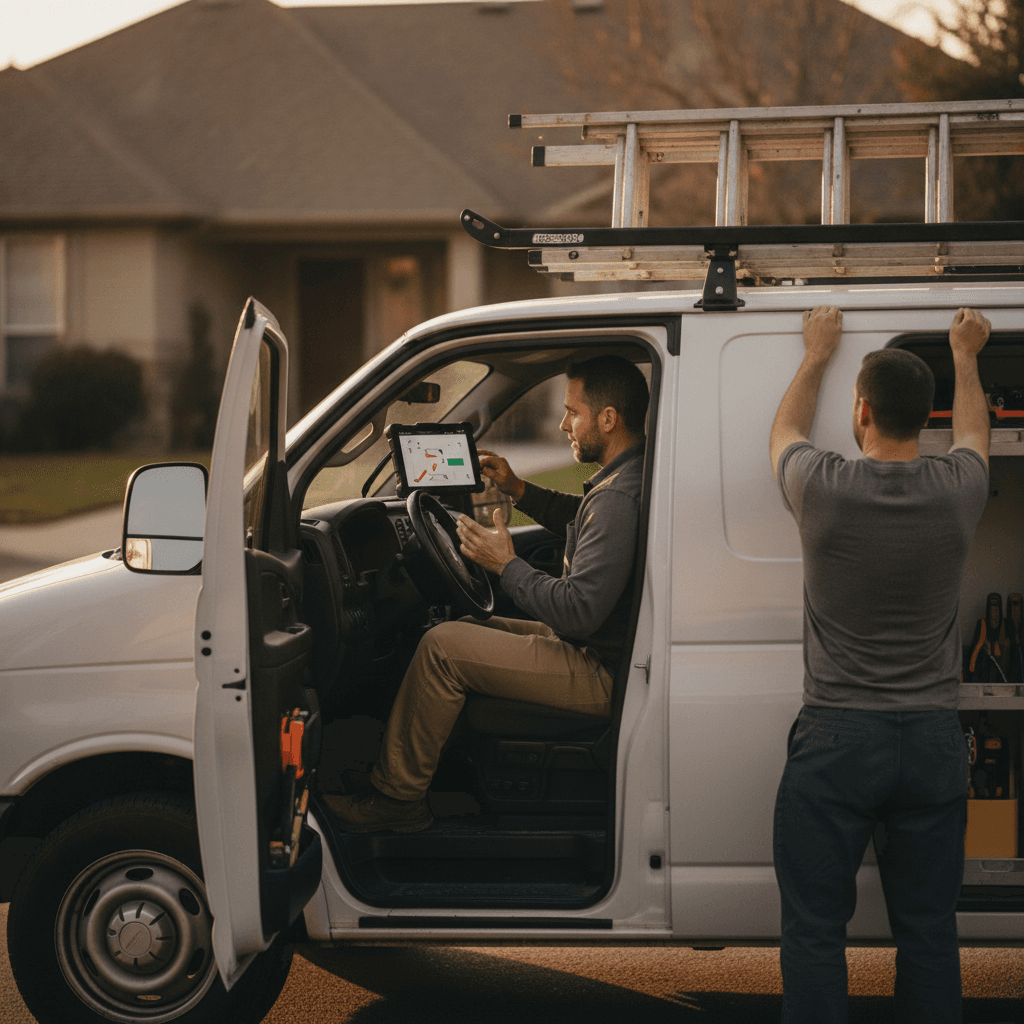
Electrical dispatch software with real-time crew GPS tracking gives your shop a live view of every technician, job status, and urgent call in one system. Here is how to evaluate it in 2026 — including where dedicated GPS tracking ends and the job-management layer begins.
When a commercial tenant loses power on a Friday night, or a homeowner calls about a sparking receptacle behind a kitchen island, every minute between the call and the truck arrival matters. For growing electrical shops juggling service calls, rough-ins, trim-outs, and change orders across multiple job sites, dispatching the right electrician to the right place at the right time is the difference between a profitable week and a chaotic one.
Modern electrical dispatch software with GPS tracking and emergency routing gives dispatchers and shop owners a live view of every technician, every job status, and every urgent call in one system built specifically for electrical contracting.
Here is how the right platform transforms dispatch operations for electrical contractors in 2026.
Why Electrical Dispatch Software with GPS Tracking Matters in 2026
Electrical contracting operates under tight margins. Fuel costs, labor shortages, and rising customer expectations have squeezed profitability on service work across the board. According to the U.S. Bureau of Labor Statistics, employment of electricians is projected to grow faster than the average for all occupations through 2033. That means every qualified electrician on your payroll needs to be deployed efficiently. None of them should be sitting in traffic or driving back across town because dispatch lacked visibility into their location.
Generic CRM tools and whiteboard dispatch boards cannot keep up. They lack the field service workflows electricians need: multi-stage job scheduling, permit and inspection tracking, code-driven scope documentation, and real-time coordination between the office and the field. Electrical contractors need dispatch software built around how electrical work actually gets done, from emergency service calls to multi-week commercial build-outs.
Real-Time Crew GPS Tracking: Seeing Every Electrician in the Field
Knowing where your crews are at any given moment is foundational to efficient dispatch. Real-time crew GPS tracking gives dispatchers a live map view of every electrician on the road and on site, so routing decisions are based on actual location rather than guesses or last-known check-ins.
For solo electricians, this means the office (or a virtual assistant) can direct a nearby supplier pickup or redirect the next call without playing phone tag. For multi-truck shops, GPS tracking eliminates the dead time spent figuring out who is closest to a same-day add-on call.
Key operational benefits include:
- Reduced drive time and fuel costs by assigning the nearest qualified technician
- Accurate ETAs for homeowners, general contractors, and property managers
- Overtime control by identifying when crews are running long and reassigning remaining calls
- Job site accountability with location-stamped arrivals and departures
This visibility is especially valuable for shops managing service agreements with commercial clients, where response time SLAs of two to four hours may be contractually enforced.
Emergency Call Routing for Urgent Electrical Service Calls
Electrical emergencies do not follow a schedule. Panel failures, arc-fault trips, storm-damaged service entrances, and lost neutrals demand an immediate response, and the speed of that response depends on how fast dispatch can route the right electrician.
Emergency electrical service routing prioritizes calls based on urgency, crew location, skill level, and current job status. A journeyman finishing a residential rough-in twenty minutes away might be the best fit for a panel failure call. A master electrician tied up at a commercial inspection may not be available for four hours. Without intelligent routing, dispatchers operate blind.
Effective emergency routing weighs four factors:
- Proximity to the emergency site, pulled from live GPS data
- Skill level and licensing, since not every technician is qualified for service entrance or high-voltage work
- Current job status: whether the crew is wrapping up, mid-troubleshoot, or stuck waiting on an inspection
- Parts and materials on the truck, because the closest electrician may not have the breakers, wire, or fixtures the job requires
When a call comes in about sparking at a subpanel, the system should surface the nearest available electrician with the right qualifications and inventory, not just the nearest truck.
How Crew Scheduling and Dispatching Cuts Response Times for Growing Electrical Shops
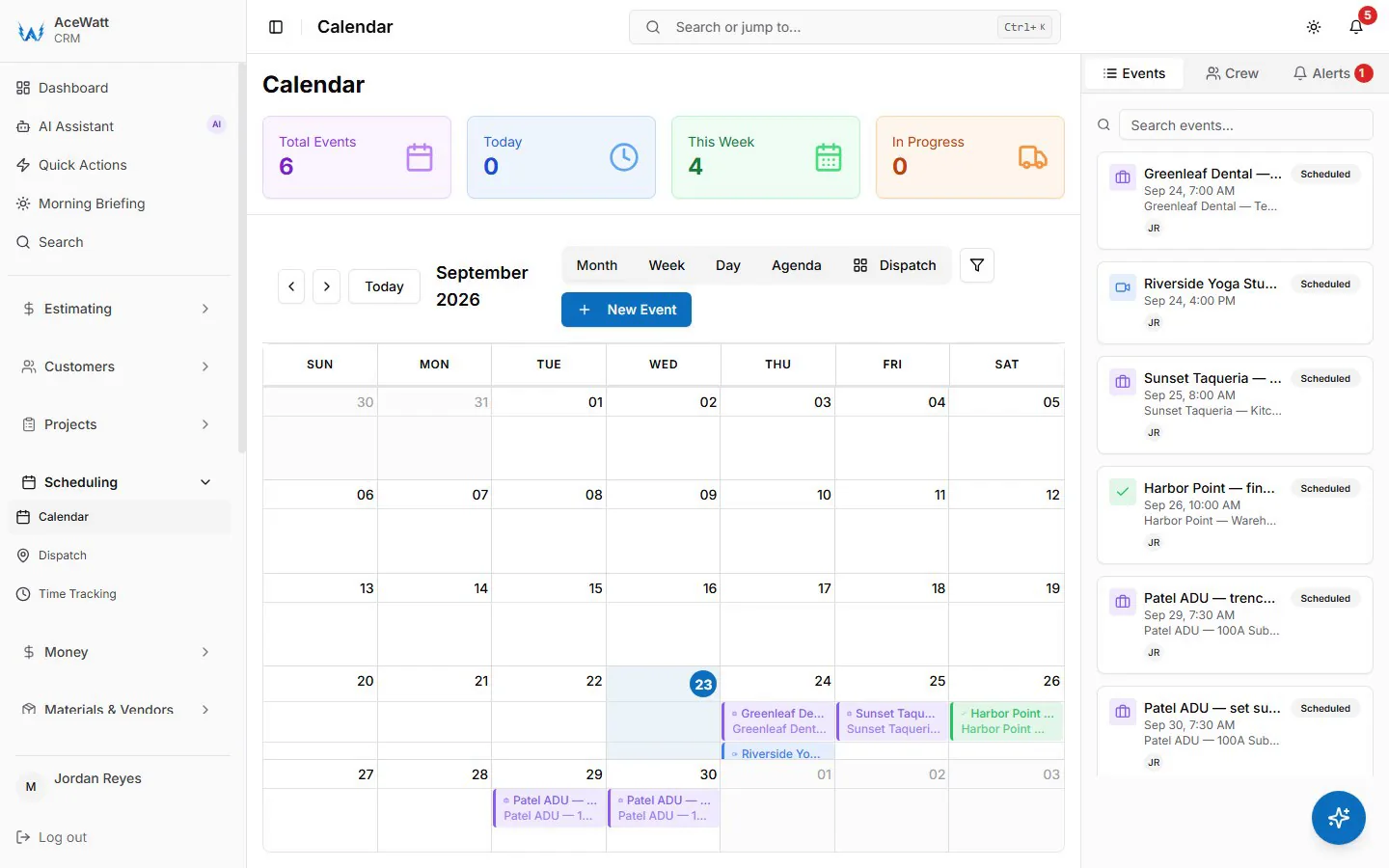
Screenshots in this guide show an AceWatt demo company with sample data.
As electrical shops grow from two trucks to ten, scheduling complexity increases exponentially. Coordinating new construction phases, T&M service calls, change orders, and emergency work across multiple crews requires a scheduling system built for the trades.
Crew scheduling and dispatching software lets shop owners see technician availability in real time, reassign jobs on the fly, and avoid sending the wrong crew to a complex commercial job. A well-designed dispatch board shows:
- Which electricians are available, on break, or on a call
- Skill sets and certifications for each technician
- Job duration estimates based on historical data
- Drive time between jobs
- Priority flags for emergency calls
This prevents the classic growing-shop problem: overpromising on response times because the schedule was built on assumptions rather than real data. When dispatchers can drag and drop assignments based on live conditions, response times drop, customers stay informed, and fewer calls get pushed to the next day.
Connecting Dispatch to Job Tracking for End-to-End Project Visibility
Dispatch does not exist in a vacuum. When a crew finishes a rough-in, starts a trim-out, or hits a delay waiting on an inspector, that information needs to reach the dispatcher immediately. Disconnected systems create blind spots that lead to double-booked crews, missed callbacks, and unhappy customers.
Integrated Job Tracking connects the field to the office in real time. Electricians update job status from their mobile devices: rough-in complete, material needed, inspection scheduled, job closed. Dispatchers see those updates instantly, which enables smarter same-day routing for solo electricians and multi-truck shops alike.
Consider two scenarios. If a two-person crew finishes a commercial tenant build-out an hour ahead of schedule, the dispatcher can immediately assign a nearby service call instead of letting that hour vanish. If a residential rewiring job runs long due to knob-and-tube complications, dispatch can reassign the next scheduled call to another technician without calling the customer to apologize for a no-show.
Using AI Voice and Job Walk Documentation to Keep Dispatch Accurate
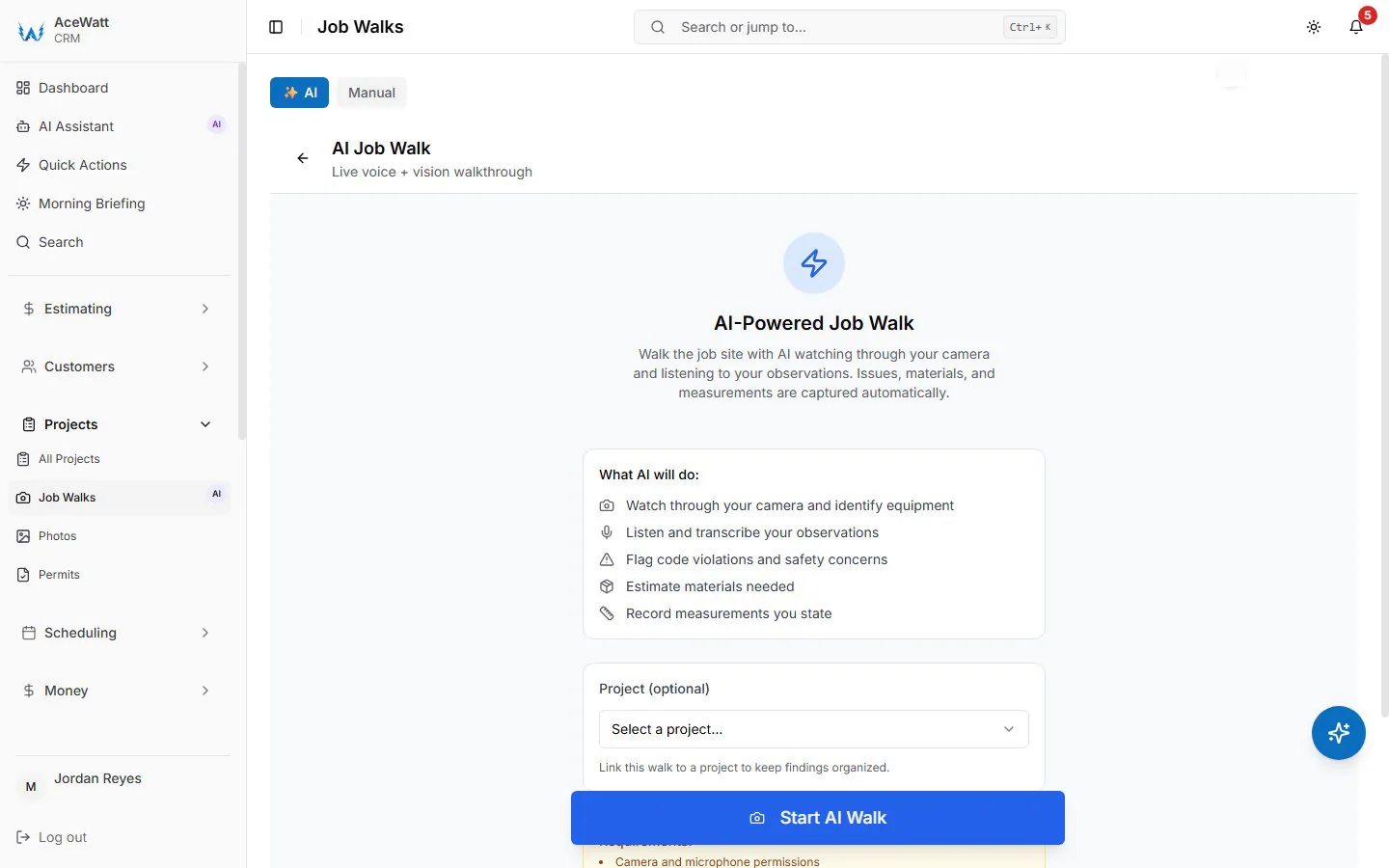
One of the biggest dispatch challenges is incomplete information. A homeowner calls and describes a "weird buzzing sound" near the breaker panel. A property manager reports flickering lights on the third floor. Without accurate context, dispatchers send crews in blind, and the first thirty minutes on site become a discovery process instead of productive work.
AI Voice and Job Walk Documentation solves this by capturing site conditions and scope details automatically. When a technician arrives and walks the job, the AI documents the conversation, the existing conditions, and the scope of work, creating an accurate record before work begins. That record also feeds AI Estimating, so quotes reflect real material counts and access challenges rather than a vague phone summary.
For dispatch, this means:
- Better crew assignment based on documented scope
- Fewer callbacks because the next technician has full context from the prior visit
- More accurate estimates pulled from captured material counts and site conditions
- Cleaner handoffs between office staff, dispatchers, and field crews
When an emergency call comes in, dispatchers can pull up AI-documented history on that customer and site, including past service notes, panel upgrades, or known issues that inform the response. An AI-powered CRM keeps that history searchable and attached to the account rather than buried in a text thread.
Automated Follow-Up and QuickBooks-Ready Exports: Closing the Loop After the Call
Dispatch does not end when the truck leaves the job site. For emergency electrical work, keeping the customer informed is critical, especially for property managers overseeing multiple buildings or homeowners anxious about a panel repair.
Automated Follow-Up handles the money side of that loop: automatic email reminders on overdue invoices at 1, 7, 14 and 30 days late. Status updates during the call, like en route or job complete, are still a call or message from your office, and they build trust during high-stress situations.
Once the job closes, QuickBooks-ready exports hand your bookkeeper the invoice list as a spreadsheet and payroll hours as a QuickBooks-format CSV; full sync is in development. Invoicing and Payment Tracking built into the same platform means no double entry, no lost tickets, and no week-long lag between completed work and billed revenue. For growing electrical shops, that built-in invoicing is what turns a dispatched call into billed revenue without administrative overhead.
What to Look For in Electrical Dispatch Software: A 2026 Buyer's Checklist for Contractors
Not all field service platforms are built for electrical contractors. When evaluating dispatch software for your shop this year, look for:
- Real-time GPS tracking with live map views of every crew and technician
- Emergency routing that factors in skill level, location, and truck inventory
- Drag-and-drop crew scheduling built for multi-stage electrical projects, not generic service calls
- Job tracking that connects field updates to dispatch in real time
- AI voice and job walk documentation for accurate scope capture
- Automated customer follow-up for emergency dispatch communication
- QuickBooks sync for seamless invoicing and payment tracking
- AI estimating tools that generate quotes directly from job site documentation
- Trade-specific workflows that understand rough-ins, trim-outs, inspections, and permit tracking
- A mobile-first field app that electricians will actually use on site
Generic CRM tools and legacy service management platforms were not built for the realities of electrical contracting. A 200-amp service upgrade, a commercial tenant build-out, and an emergency panel repair all require different dispatch workflows. The right platform supports all three without workarounds.
For electrical contractors looking to grow without adding back-office overhead, dispatch software built for the trade is one of the highest-use investments available. Real-time GPS tracking, intelligent emergency routing, integrated job tracking, and AI-powered documentation combine to create a dispatch operation that responds faster, communicates better, and bills more efficiently. That combination gives shop owners the visibility they need to scale with confidence.
One boundary to keep straight when you shortlist tools: AceWatt is not a GPS vehicle-tracking product, and its route optimization is straight-line only (Scale plan), with no drive-time or traffic-aware routing. It is the electrical-contractor job layer around dispatch — the dispatch board, job statuses, customer history, AI job-walk documentation, invoicing, and follow-up — so the dispatch decisions your GPS tool informs land on one connected job record. For the fundamentals, see our electrical dispatch software guide and dispatch vs. scheduling for electrical contractors, then compare capabilities on AceWatt pricing.
Frequently Asked Questions
Does AceWatt offer GPS fleet tracking or route optimization?
Not GPS fleet tracking. AceWatt offers straight-line route optimization on the Scale plan, with no drive-time or traffic-aware routing, and it is not GPS vehicle tracking software. AceWatt focuses on AI-assisted job context, scheduling, dispatch board visibility, customer records, estimating, follow-up, and the financial pipeline. If GPS vehicle tracking is the top need, evaluate dedicated routing tools or vendor routing modules directly.
How do electrical contractors dispatch emergency calls?
Emergency dispatch works best when the on-call rotation, job statuses, and customer history live in one place: the call comes in, the dispatcher sees which tech is closest to finishing, and the customer gets a text with the arrival window. GPS tools add vehicle location; the dispatch board adds the job context that prevents a wrong-truck send.
What is the difference between GPS fleet tracking and dispatch software?
GPS fleet tracking shows where vehicles are. Dispatch software assigns, sequences, and tracks the work itself — who is on which job, what changed, and what the customer was told. Most growing electrical shops need both, connected by a shared job record.