
Why 5-20 Truck Electrical Fleets Are Outgrowing Manual Dispatch Boards in 2026
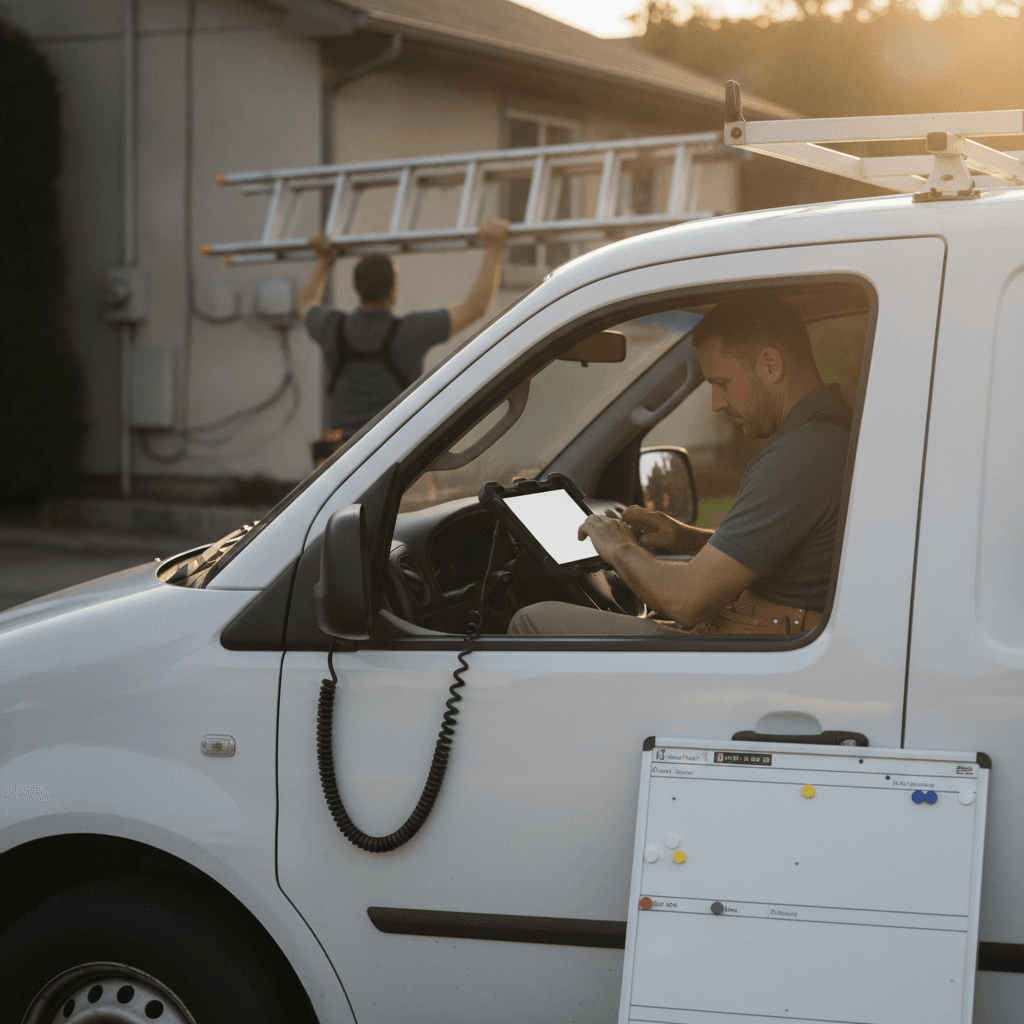
The whiteboard in the front office has been the dispatch center for electrical shops for decades. A grid of names, truck numbers, and job addresses. Maybe a magnetic board with color-coded tags for service calls, rough-ins, and panel swaps. It works, until it doesn't.
For electrical contractors running 5 to 20 trucks, the breaking point usually arrives quietly. A journeyman shows up to a commercial tenant improvement without the right conduit bender because the office texted the wrong truck. An apprentice gets dispatched to a 400-amp service upgrade that requires a master electrician on site per NEC 110.24. A service call for a tripped 200-amp breaker at a data center sits unassigned for 45 minutes because the dispatcher didn't know which truck was closest.
These aren't hypothetical scenarios. They're the daily friction points that push growing electrical shops to evaluate electrical dispatch software gps tracking fleet solutions in 2026.
What Electrical Dispatch Software with GPS Tracking Actually Replaces
Most shops don't replace the whiteboard with a single tool. They replace a chain of manual workarounds:
| Manual Process | What It Costs | What Replaces It |
|---|---|---|
| Dispatcher texts/calls each truck for location | 8-12 hours/week of office time | Real-time GPS fleet view with geofenced job sites |
| Paper timesheets reconciled against job tickets | 3-5 hours/week + 5-8% payroll leakage | Automated clock-in/clock-out via geofence arrival/departure |
| Service call ETAs guessed over radio | Missed windows, angry GCs/property managers | Customer-facing tracking links with live ETA |
| Job packets printed, handed off, returned incomplete | Missed change orders, forgotten materials | Digital job packets with AI Voice capture from the field |
The shift isn't cosmetic. It's operational. When a dispatcher can see that Truck 7 (journeyman + apprentice, fully stocked for lighting retrofit) is 3.2 miles from a service call while Truck 12 (apprentice only, no bucket truck access) is 1.8 miles away, the right dispatch decision becomes obvious. The software makes the constraint visible.
Crew Scheduling and Dispatching: Matching Journeymen, Apprentices, and Skills to the Right Job
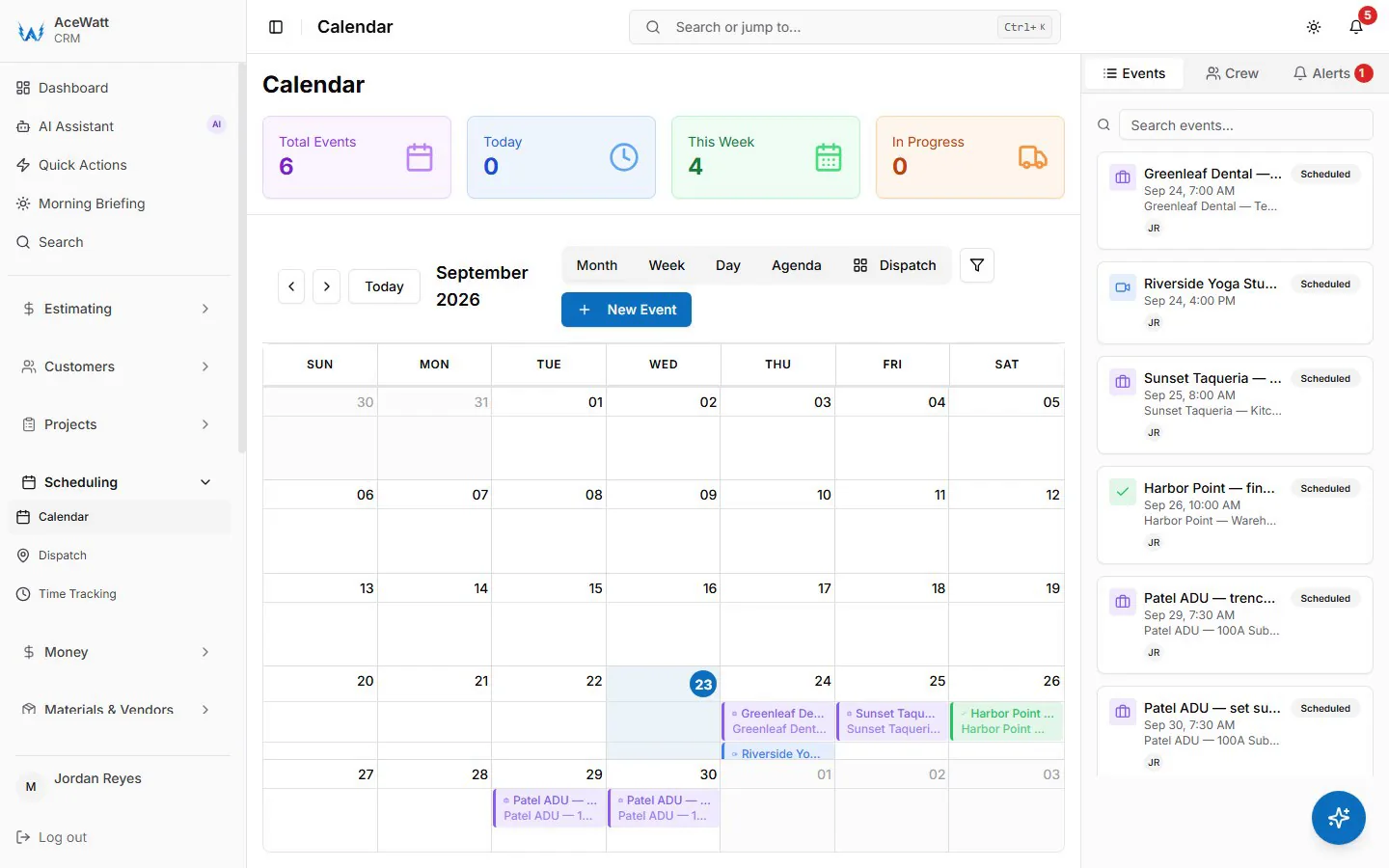
Generic field service platforms route by proximity. Electrical contracting requires routing by qualification.
A proper Crew Scheduling and Dispatching module for electrical shops must handle:
- License tier enforcement: Master, journeyman, apprentice ratios per state/jurisdiction (e.g., California C-10 requires 1:1 journeyman-to-apprentice on commercial; Texas TDLR allows 1:3 on residential)
- Specialty tags: Bucket truck certified, NFPA 70E qualified, EVSE commissioning trained, solar PV certified, low-voltage structured cabling
- Service agreement priority: Platinum maintenance contract customers get 2-hour response windows; standard calls get 4-hour
- Tool/asset tracking: Which trucks carry the 100A three-phase analyzer? The thermal imager? The megohmmeter?
When a 277/480V panel replacement comes in for a hospital wing, the dispatcher filters for: active master electrician + NFPA 70E card + bucket truck + thermal camera. Two trucks match. GPS shows Truck 3 is 14 minutes out; Truck 9 is 22. Dispatch takes 15 seconds.
No texts. No callbacks. No "I thought you had the megger."
GPS Tracking ROI: Windshield Time, Service Windows, and After-Hours Calls
For a 10-truck electrical fleet averaging 18 service calls per truck per week, windshield time typically consumes 18-22% of paid hours. That's 7.2-8.8 hours per tech per week, or $350-$450 in direct labor at $50/hr loaded cost.
GPS tracking with geofenced job sites attacks this three ways:
1. Route Optimization Across Multi-Stop Days
A tech hitting three panel inspections, a troubleshooting call, and a rough-in walkthrough across a metro area wastes 45-60 minutes with manual sequencing. Algorithmically optimized routing recovers 30-40% of that.
2. Geofenced Arrival/Departure = Automated Job Clock-In
No more "I got there at 7:55" vs. "The ticket says 8:12." Geofence radius (typically 150-200 ft for commercial, 300 ft for residential) triggers automatic timestamp. Office sees real-time status: En Route → On Site → Working → Complete. Payroll exports match field reality.
3. After-Hours Emergency Response
2:17 AM: Water treatment plant loses power to VFD bank. On-call rotation pulls up GPS. Truck 4 (master electrician, VFD spare in inventory) is 11 minutes from home, 19 minutes from plant. Truck 11 (apprentice only) is 6 minutes from plant but unqualified. Dispatcher assigns Truck 4, sends customer ETA link. Plant manager sees live tracking. Invoice generated at 5:43 AM with actual arrival timestamp.
Typical payback: 60-90 days for a 5-20 truck fleet. A 12-truck shop recovering 3.5 hours/tech/week at $50/hr = $2,100/week = $109,200/year. Software cost: $150-$300/truck/month. Math works.
Pairing AI Estimating and Automated Follow-Up with GPS Dispatch for Faster Bids
The dispatch board doesn't exist in isolation. It feeds the revenue engine.
Scenario: Truck 6 completes a service call. Bad 100A breaker in a restaurant kitchen. Tech identifies corrosion in the panel, recommends full 200A panel swap + surge protection.
Old workflow: Tech scribbles notes on invoice. Returns to shop next day. Estimator calls restaurant manager 3 days later. Quote sent via email. Follow-up forgotten. Job lost.
Integrated workflow:
- Tech uses AI Voice and Job Walk Documentation on-site: "Restaurant panel, 100A Zinsco, heavy corrosion, recommend 200A Eaton BR panel with whole-home surge, 12 circuits, 2-day job." Audio transcribed, structured into line items.
- AI Estimating pulls current material pricing (Eaton BR2020B1200 $1,240, surge protector $380, breakers $420), applies shop labor rates (16 hrs × $135/hr = $2,160), adds 15% contingency. Quote: $4,876.
- Quote emailed to the restaurant owner with a customer portal link to review and e-sign; the follow-up call stays with your team.
- Upon approval, the invoice is emailed automatically (a deposit invoice first, if the quote asks for one), and the dispatcher drags the job onto the Crew Scheduling and Dispatching board with skill-based suggestions.
- Job Tracking monitors progress. Invoicing and Payment Tracking shows what has been paid. QuickBooks-Ready Exports give your bookkeeper the invoice list for AR.
Days 3-5 compressed to hours.
AI Voice and Job Walk Documentation: Hands-Free Capture from the Field to the Office
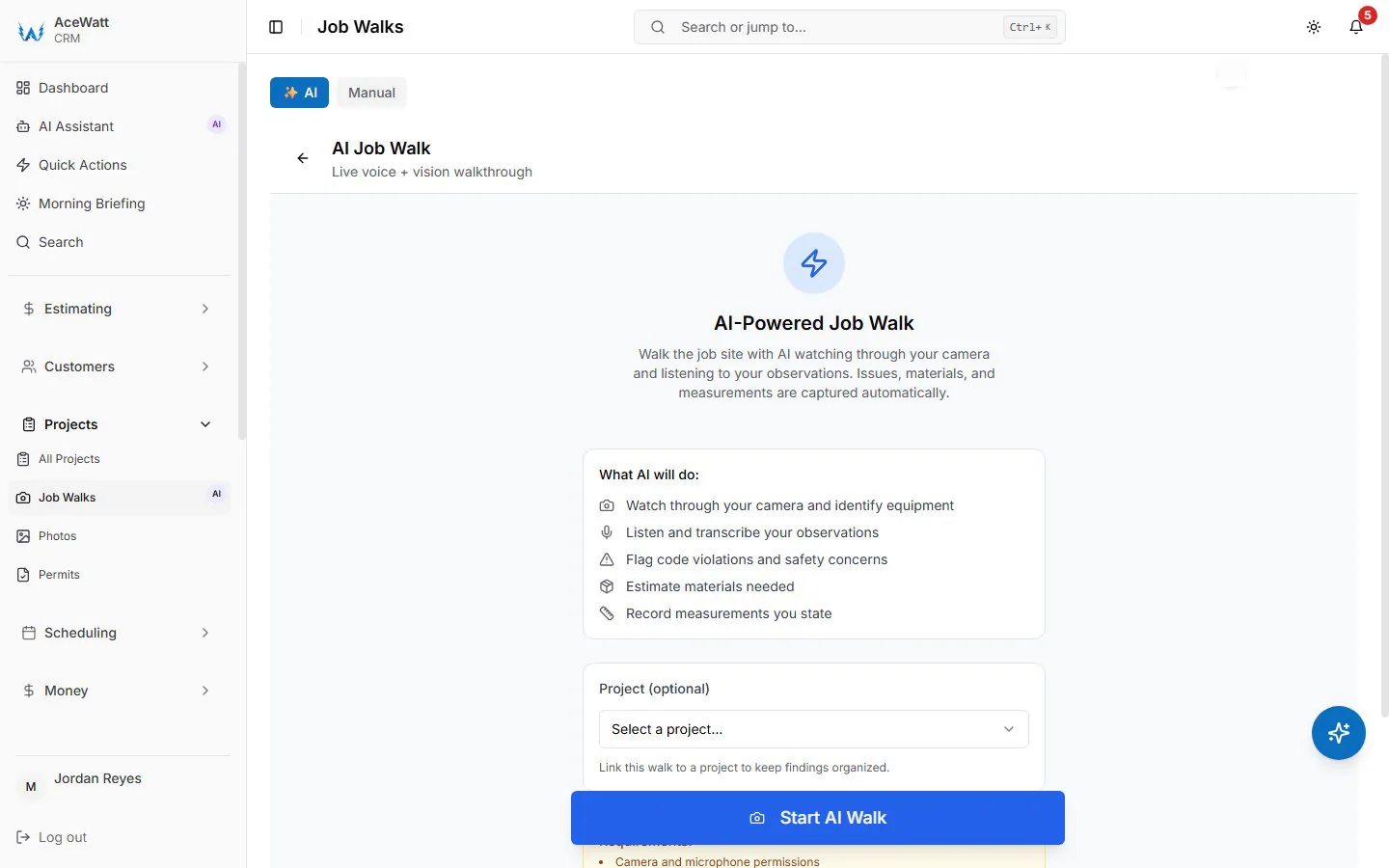
Electricians work with their hands. Clipboards, tablets, and phone keyboards slow them down, or get skipped entirely.
AI Voice capture solves this at the point of work:
- Panel schedules: "Panel A, 42 circuits, 200A main, 12 spares, feeds kitchen HVAC lighting receptacles" → structured panel schedule in job file
- Load calculations: "Adding 3-ton mini-split, 240V 30A, existing panel at 78% demand factor" → NEC 220.83 calc auto-generated
- Change order triggers: "Customer wants two extra USB receptacles in conference room, need 12/2 Romex and AFCI breaker" → added to the job walk report's materials list, so AI Estimating can draft the extra work as a quote for your review before the tech leaves site
- Material requests: "Need 3/4 EMT, 10 sticks, 4 couplings, 2 connectors for tomorrow's rough-in" → purchase order queued for warehouse pull
All hands-free. All timestamped. All searchable. No end-of-day paperwork marathon. No "I'll remember to tell the estimator" moments that vanish by morning.
Closing the Loop: Job Tracking, Invoicing, and QuickBooks-Ready Exports
The dispatch-to-invoice gap is where electrical shops bleed margin.
Typical leakage points:
- Service call completed but never invoiced (2-4% of calls)
- Time & material tickets missing hours or materials (8-12% underbilling)
- Progress billing on multi-week projects delayed 10-14 days
- Retention invoices forgotten on commercial jobs
- QuickBooks entries duplicated or miscoded (job costing corrupted)
Integrated loop eliminates each:
| Stage | Automation |
|---|---|
| Job dispatch | Creates job record with customer, location, crew, equipment, contract type |
| Field completion | Tech marks complete → office builds the invoice from the job record with a button, with actual hours, materials, and photos |
| Review/approve | PM/owner reviews on mobile → one-tap approve or edit |
| Send & track | Email to customer with payment link (card, Apple Pay; ACH if enabled in your Stripe account) → real-time pay status |
| QuickBooks-ready export | Invoice list (status, total, balance, due date) as a spreadsheet and payroll hours as a CSV for your bookkeeper |
| Aging follow-up | Automatic email reminders at 1, 7, 14 and 30 days late → aging report from 0–30 to 120+ days |
Implementation Roadmap: Migrating an Electrical Shop Off Whiteboards in 30 Days
Switching dispatch systems mid-season feels risky. A phased approach minimizes disruption:
Week 1: Foundation (Days 1-7)
- Data import: Customer list, service agreements, equipment records, price book from QuickBooks/CSV
- User setup: Office staff (dispatch, estimating, AR), field users (techs, foremen, PMs)
- Crew setup: Put the mobile app on each tech's phone (clock in/out with location and an at-the-job-site flag); note each tech's skills for dispatch suggestions
- License/qualification matrix: Enter each tech's license #, expiration, certifications, specialty tags
Week 2: Parallel Run (Days 8-14)
- Morning huddle: Dispatcher runs both whiteboard and software for 5 days
- Field adoption: Techs use mobile app for clock-in, job notes, photo capture; paper tickets still primary
- Office feedback loop: Daily 15-min standup to flag mismatches, missing data, workflow friction
- QuickBooks export test: Run 5 test invoices through the export; check the invoice list your bookkeeper receives
Week 3: Cutover (Days 15-21)
- Whiteboard retired: All dispatch through software
- Job site check: Confirm the at-the-job-site flag reads correctly on clock-ins at your usual sites (parking lots, multi-building campuses)
- Automated Follow-Up check: Confirm overdue-invoice email reminders (1, 7, 14 and 30 days late) are going out
- AI Voice pilot: 2-3 techs test job walk documentation on 3-4 jobs each
Week 4: Optimization (Days 22-30)
- Reporting baseline: Pull first-month KPIs (on-time arrival, invoice cycle time, DSO)
- Board tuning: Review how skill-based suggestions match your crews, and on the Scale plan use straight-line route optimization to order multi-stop days
- Advanced features: Enable AI Estimating templates for common jobs (panel swap, EV charger, service upgrade, lighting retrofit)
- Team retrospective: 30-min session on what's faster, what's still clunky, and what training is needed
Critical success factor: Designate one "super user" in the office who owns the system. Not the owner. Not the lead dispatcher. Someone who learns every workflow, trains new hires, and escalates bugs. Shops without a super user revert to whiteboards within 90 days.
The Bottom Line
Manual dispatch doesn't scale past 3-4 trucks without chaos. By 5 trucks, you're losing money on windshield time, missed upsells, and invoicing gaps. By 10, you're losing techs who tire of the disorganization. By 20, you're uncompetitive on service response.
The electrical contractors winning commercial maintenance contracts, landing design-build work, and keeping their best journeymen in 2026 aren't the ones with the biggest yellow pages ad. They're the ones who know exactly where every truck is, which tech has which ticket, and that every completed job becomes an accurate invoice before the truck leaves the driveway.
The whiteboard served its purpose. The job has changed. The tools should too.
Related Reading
Related reading: Electrical Dispatch Software for Emergency Service: Real-Time Crew Tracking & Automated Customer ETA Alerts.