

Why Time and Material Billing Breaks Down for Electrical Contractors in 2026
Time and material work is where electrical shops lose money they have already earned. The labor was performed, the material was installed, and the customer signed off on the work, yet the invoice that goes out ten days later quietly underbills the job. In 2026, residential service upgrades, commercial tenant build-outs, and industrial troubleshooting still run on T&M contracts, and too many shops still track them with memory and a spiral notebook. The math is unforgiving: a crew that forgets to bill four hours of labor and $150 in fittings across ten jobs a month gives away more than a full week of revenue over a year. Moving to an electrical contractor CRM in 2026 replaces end-of-week reconstruction with real-time capture at the point of work, and that single shift often determines whether a T&M job finishes at a profit or at a discount.
The Hidden Cost of Office-First Reconciliation: Disputed Hours and Missing Material
The traditional workflow is the problem. An electrician hands a carbon-copy ticket or a notebook of scrawled numbers to the office at the end of the week, and office staff spend hours deciphering handwriting, decoding NEC references, and matching labor to phases of work. Invoicing slides from same-day to five to fourteen days out, and on commercial projects with NET 45 or NET 60 terms, that delay pushes real payment toward the 75-day mark.
The disputes are worse. When a project manager questions 200 feet of MC cable and four overtime hours, a vague handwritten ticket offers no defense, so the contractor eats the charge or burns an afternoon reconstructing evidence. Missing materials such as forgotten grounding bushings, an unrecorded spool of #10 THHN, or an unbilled day-rate trencher rental at $180 to $250 per day come straight off the bottom line. On T&M work, where margins often run 10 to 20 percent, losing even 5 percent of ticket value to reconciliation error can erase the profit on the entire job.
Mobile Field Capture: Logging Labor, Conduit, Wire Pulls, and Fixtures at the Point of Work
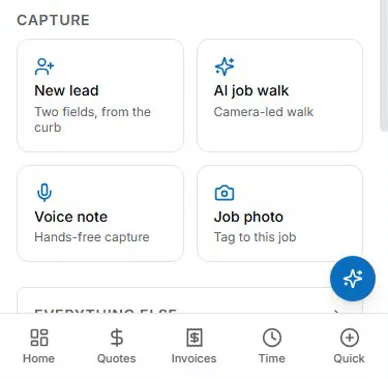
An electrician time and material invoicing app earns its keep on the ladder, not in the truck cab at 5 p.m. Field service management software for electricians should let a tech open the active work order and log entries the moment the work happens: switching a 200-amp meter main, pulling 4/0 AWG aluminum URD to a detached shop, or hanging the sixth LED high bay in a warehouse row.
The mechanism matters. A material tracking app for electricians should pull from a live material database tied to your supplier pricing, so the cost of EMT, sweeps, straps, and fittings is locked in at the moment of installation rather than estimated from last quarter's price sheet. Copper has been volatile enough that a 1,000-foot spool of #12 THHN can swing $50 or more between the order date and the invoice date, and guessing quantities guarantees someone absorbs the difference. Real-time capture also lets the customer approve the running ticket on site, which converts later disputes into same-day sign-offs.
AI Voice and Job Walk Documentation: Capturing Material Counts Without a Clipboard
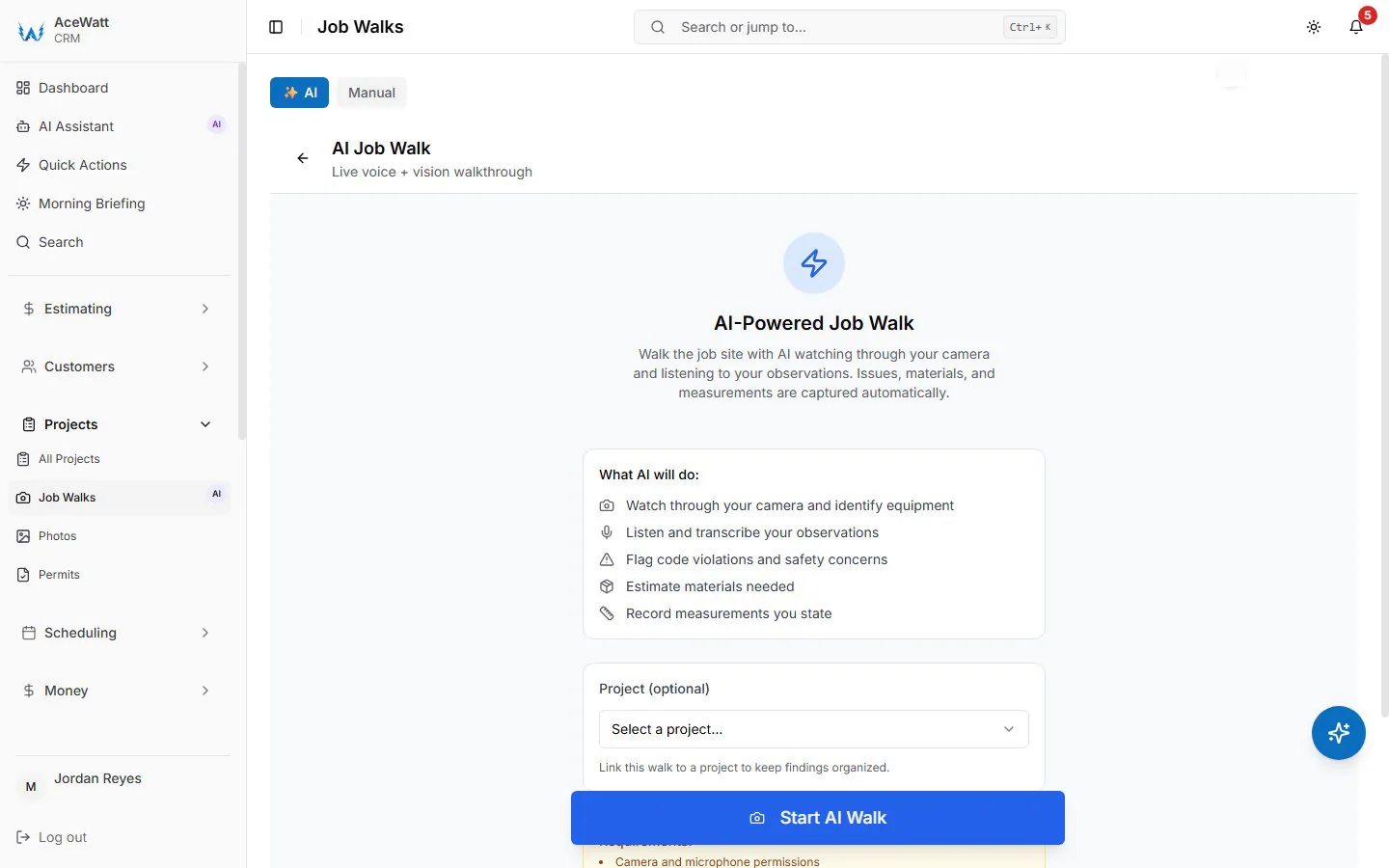
The weak point of any mobile system is the electrician standing on a ladder with both hands occupied. AI Voice and Job Walk Documentation solves that. A tech can dictate material usage and labor notes hands-free while still at the panel, and the AI voice job documentation transcribes, categorizes, and attaches the entry to the active work order without a single tap on a screen.
The log reads like the work itself. On a breaker swap, the entry comes out as plain trade language: "Installed six 2-pole 30-amp breakers, 50 feet of 10 AWG THHN black, 50 feet of 10 AWG THHN green, three 3/4-inch EMT connectors." The system parses that into discrete billable line items with correct units and pricing. Job walk documentation pairs the voice log with photos of the panel before and after, so a code correction such as an NEC 110.26 working-space violation or damaged conductor insulation found mid-job is documented as it happens, not reconstructed when the customer pushes back on a change order.
Tying Job Tracking to Invoicing and Payment Tracking for T&M Projects
Orphaned time entries destroy profitability. When labor is logged against a date but not a job, the shop eats it, and electrical contractor job costing software exists precisely to prevent that. Mobile Job Tracking tethers every time entry to a specific service ticket or work order from the moment the tech clocks in on site. When the job closes, the office builds the invoice from the job record with a button, from the field-captured labor, material, and equipment lines, with no re-entry.
Electrical crew dispatch and job tracking software also protects the front end of that pipeline. Crew Scheduling and Dispatching suggests electricians by skill on the drag-and-drop board, so a journeyman is not parked on a parking-lot pole light job that calls for a different skill set, and drive time between sites is captured as part of the billable day. On the back end, Automated Follow-Up reduces unpaid T&M invoices with automatic email reminders at 1, 7, 14 and 30 days late, and invoices that once aged past 60 days start landing on schedule.
QuickBooks Accounting Sync: Closing the Loop Between the Field and the Back Office
Once the field captures the data, the books have to reflect it without a second round of typing. Manual entry into accounting software creates a bottleneck and requires dedicated staff, a cost solo electricians and growing shops rarely have the overhead to support. QuickBooks sync for electrical contractors sends field-captured T&M line items straight into the general ledger, mapped to the right items, classes, and customers, with no office staffer re-keying conduit counts, labor rates, or equipment rentals. AceWatt's version today is QuickBooks-ready exports: your invoice list as a spreadsheet and your payroll hours as a QuickBooks-format CSV for your bookkeeper. There is no native, real-time, bidirectional sync today; full sync is in development.
The payoff shows up in job-level visibility. When a tech marks a commercial trenching job complete, the rental cost for the boring machine is logged to the job at cost, and the job's margin in AceWatt updates the same day instead of at month end. Contractors can see which T&M jobs actually made money while the next one is still in progress, which is the only honest way to set labor rates for the bids that follow.
What to Look for in Electrical Contractor Time and Material Billing Software Built for Mobile
If you are comparing electrical contractor time and material billing software, mobile capture should be the first filter, because the system only works if data gets recorded at the point of work. Evaluate four things:
- Live material database integration. Pricing should pull from your suppliers and update when costs move, not sit in a static spreadsheet.
- AI voice capture with job walk documentation. Electricians work with their hands. If logging material requires stopping work to type, field adoption will fail.
- Crew Scheduling and Dispatching tied to job tracking. Dispatch, time entry, and billing must share one record per job rather than pass data between disconnected modules.
- Automated Follow-Up and QuickBooks sync. The invoice, the payment reminder, and the ledger entry should all originate from the same approved field log.
A mobile T&M billing platform for electrical contractors should also include AI Estimating that learns from completed jobs, so your material and labor history feeds the next quote instead of collecting dust in a filing cabinet.
Rolling Out Mobile T&M Capture Across Solo Electricians and Multi-Crew Shops
Solo electricians and growing shops benefit most from mobile-first T&M software because neither can staff a dedicated back-office role to reconcile handwritten tickets every evening. For a solo operator, the back office fits in a phone: dictate the ticket, capture payment, and have the invoice built from the driver's seat before the next call. For a shop running ten or twenty trucks, rollout is a standardization play. Import the material list, set labor rates by license class, configure the follow-up cadence, then train every apprentice and journeyman on the same voice capture workflow so billing protocol no longer depends on who happened to run the job.
The transition often covers its cost within the first few months, because the revenue recovered from miscounted fittings, unrecorded labor, and slow-paying invoices usually exceeds the software cost. Every hour worked and every foot of wire pulled represents money already spent on labor, fuel, and material. Capturing it correctly at the point of work is the difference between a T&M operation that scales and one that stays busy without getting ahead.
Related reading: Mobile Time & Material Capture for Electricians: Eliminating Paper Tickets & Revenue Leakage.