
Electrical Contractor Industry Statistics 2026: The Numbers That Run the Trade
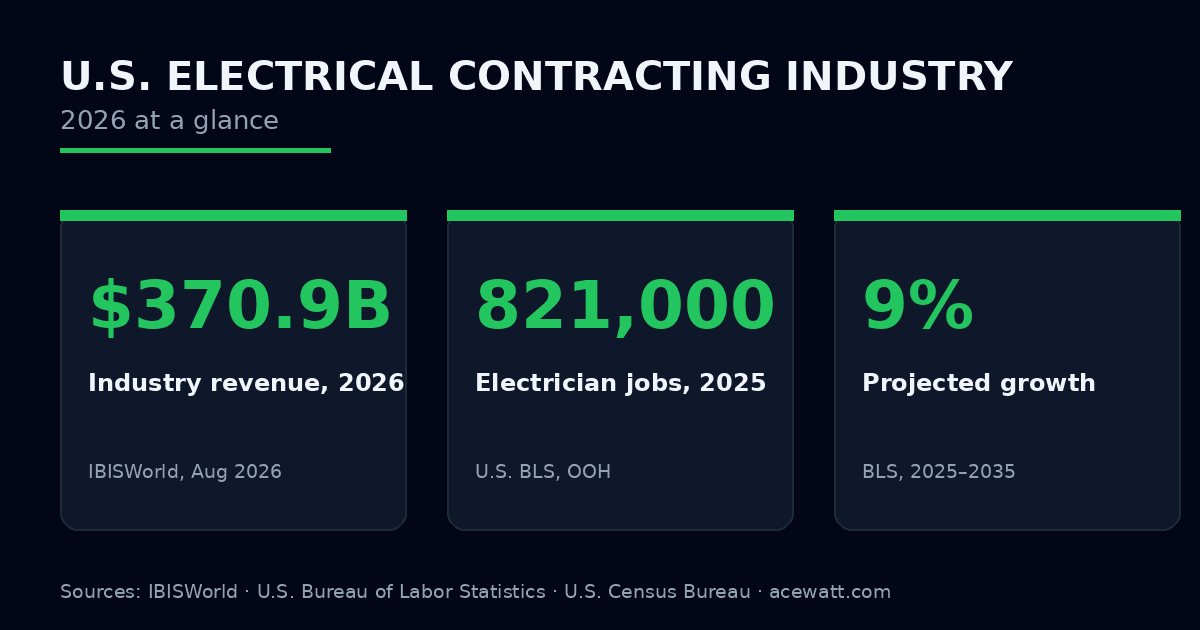
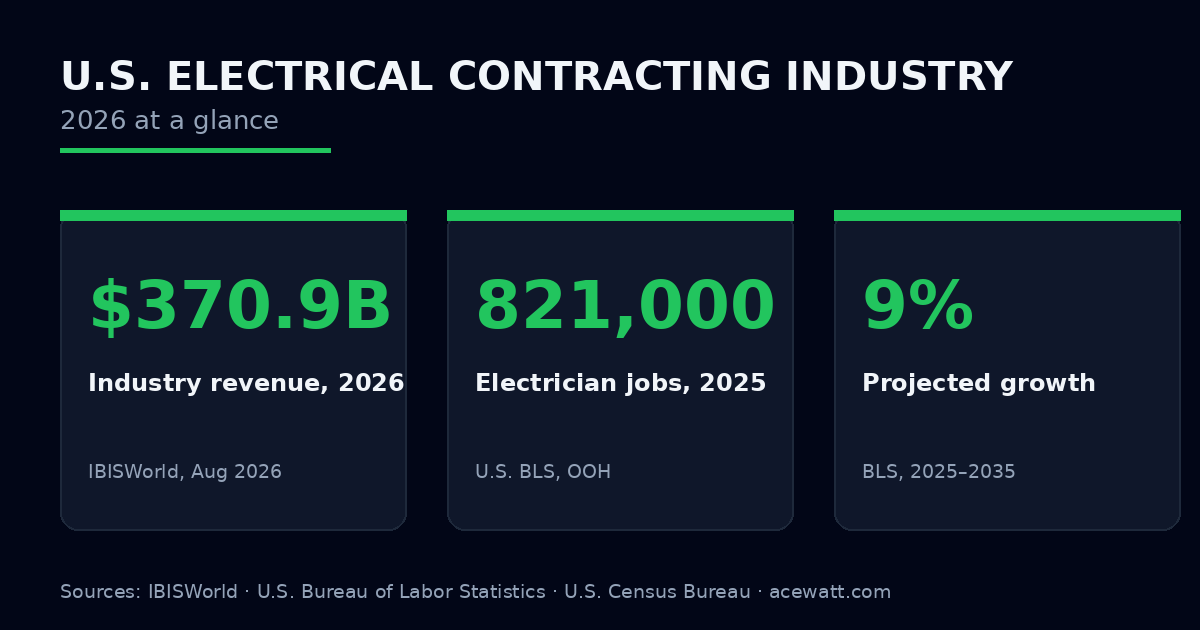
The U.S. electrical contracting industry generated $370.9 billion in revenue in 2026 across roughly 269,000 businesses, and the Bureau of Labor Statistics projects electrician employment to grow 9 percent through 2035. Those are the headline electrical contractor industry statistics for 2026, and every number below carries its source. If you are writing a business plan, chasing a loan, or deciding whether to hire your next apprentice, this is the data to build the case on.
Last updated November 3, 2026. Checked against IBISWorld, the U.S. Bureau of Labor Statistics, the U.S. Census Bureau, and the Department of Energy's Lawrence Berkeley National Laboratory.
The Industry at a Glance
| Statistic | Value | Source | Year |
|---|---|---|---|
| U.S. electricians industry revenue | $370.9 billion | IBISWorld | 2026 |
| 5-year revenue CAGR | 6.2% | IBISWorld | 2021–2026 |
| Electrician businesses in the U.S. | ~269,000 | IBISWorld | 2026 |
| Employer establishments (NAICS 238210) | 83,342 | U.S. Census Bureau, CBP | 2023 |
| Electrician jobs | 821,000 | BLS, Occupational Outlook Handbook | 2025 |
| Median annual wage | $63,190 | BLS | May 2025 |
| Projected employment growth | 9% | BLS Employment Projections | 2025–2035 |
| Annual job openings | 72,700 | BLS Employment Projections | 2025–2035 |
How Big Is the Electrical Contracting Market in 2026?
IBISWorld's August 2026 update puts the U.S. electricians industry at $370.9 billion in revenue for 2026. The industry has grown at a 6.2 percent compound annual rate since 2021, a run that outpaced both HVAC ($159.4 billion) and plumbing ($208.1 billion), making electrical the largest of the three core trades. Even IBISWorld's estimate of a roughly 1.1 percent revenue dip in 2026, driven by macroeconomic uncertainty, lands on a base more than triple the size it was two decades ago.
Two cautions keep these electrical contractor industry statistics honest. First, "market size" figures vary by definition: some trackers report the broader electrical contracting sector (NAICS 238210), others the "electricians" industry, and older roundups still cite IBISWorld's previous $347.5 billion estimate from an earlier release. Second, growth has not been evenly spread: data centers, grid upgrades, and electrification have pulled demand toward commercial and industrial work while residential remodeling softened.
For context on concentration: the 50 largest electrical contractors posted a record $59.5 billion in combined revenue in 2025 (EC&M Top 50 ranking, as reported in Simpro's 2026 statistics roundup). That means the top 50 firms control well under a fifth of the market. The rest of that $370.9 billion is spread across thousands of shops the size of yours.
How Many Electrical Contractors Are There in the US?
The honest answer depends on what you count, and the gap between the two official numbers is itself one of the more revealing electrical contractor industry statistics.
- ~269,000 electrician businesses (IBISWorld's 2026 count. This includes sole proprietors and nonemployer firms, which is why it is the larger figure).
- 83,342 employer establishments (the U.S. Census Bureau's County Business Patterns count for NAICS 238210 (electrical contractors and other wiring installation contractors). These are shops with payroll, and together they employ roughly 1.0 million people.
Read those two numbers together and the picture is sharp: the overwhelming majority of electrical contractors are one-truck or few-truck operations. Most industry businesses generate under $2 million in annual revenue (IBISWorld, via Simpro's 2026 roundup), and the Small Business Administration sets the industry's size standard at $19 million in average annual receipts, a ceiling the vast majority of shops never approach.
If you run a small shop, this is good news. Your competitors are not dominant national brands; they are other owner-operators fighting the same scheduling, quoting, and cash-flow battles you are. The firms that professionalize first, with fast quotes, clean invoicing, and follow-up that does not depend on memory, take share in a market built almost entirely of small players. Our guide on how to manage an electrical contracting business covers those systems in depth.
Electrician Employment, Wages, and Outlook
Employment Today
The Bureau of Labor Statistics counted 821,000 electrician jobs in 2025 in its Occupational Outlook Handbook. The wage-and-salary subset is slightly smaller, at 757,220 employed electricians in the May 2025 Occupational Employment and Wage Statistics survey, with another 63,630 helpers-electricians (apprentices and pre-journeyman labor) earning a mean of $44,080 while they train.
What Electricians Earn
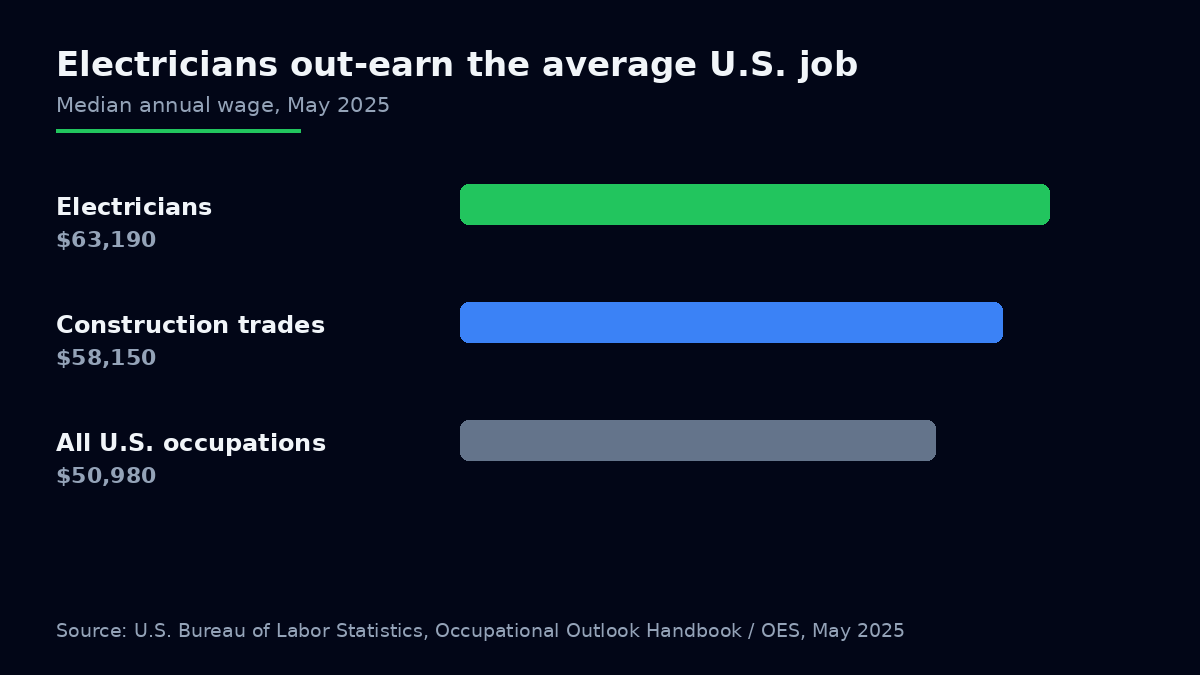
Wage data anchors most electrical contractor industry statistics for a simple reason: labor is the trade's largest cost line. The median annual wage for electricians was $63,190 in May 2025 (about $30.38 an hour), against $58,150 for construction trades overall and $50,980 for all U.S. occupations. The mean annual wage across employed electricians was $71,490, pulled up by overtime and high-cost metro markets. Regional variation is dramatic: our electrician salary by state breakdown shows the spread from the lowest-paying states to Illinois and California territory well above $80,000.
For shop owners, the wage data is a budgeting input, not just a recruiting fact. Every hour of journeyman time you spend driving to the supply house, retyping estimates, or chasing invoice approvals is billed at none of these rates. It is also why quoting speed keeps showing up in every operational benchmark: labor is the industry's largest cost line, and electrical contractor hourly rates only pencil out when wrench time stays high.
The 10-Year Outlook
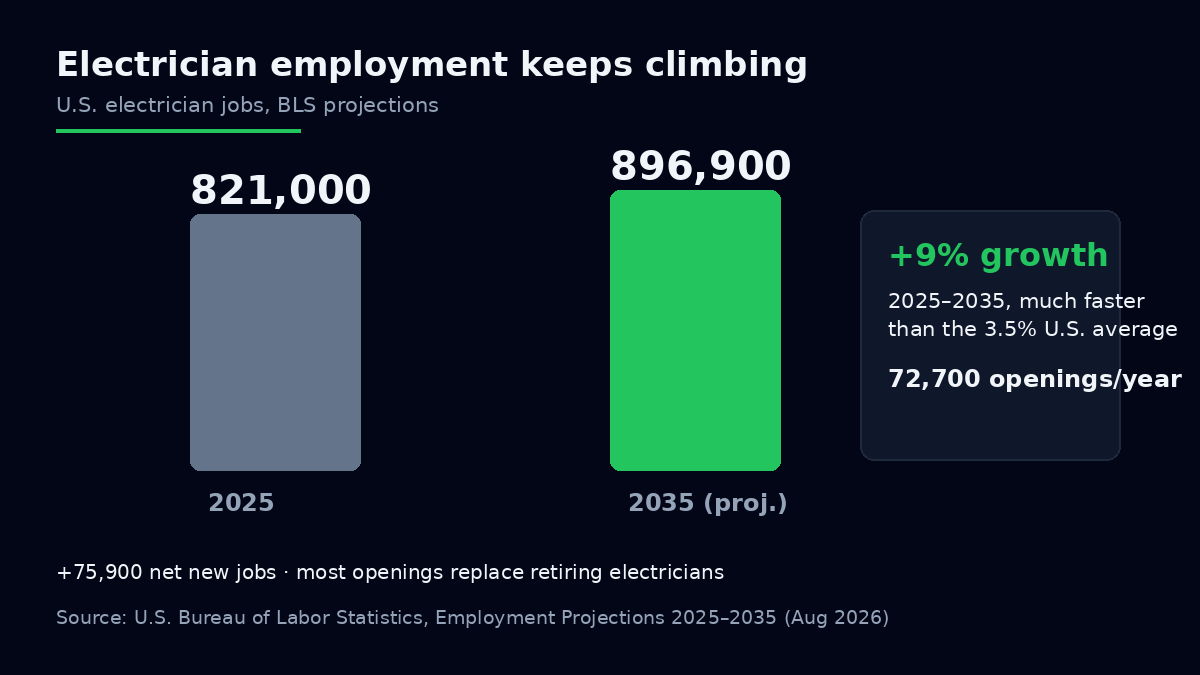
BLS projects electrician employment to grow 9 percent from 2025 to 2035, much faster than the 3.5 percent average for all occupations, adding about 75,900 jobs and bringing the trade to roughly 896,900 positions by 2035. About 72,700 openings per year are projected over the decade, and most of those openings replace electricians retiring or leaving the trade rather than representing net new seats. The outlook is the part of the electrical contractor industry statistics picture that shop owners should plan around for the next ten years of hiring.
The Demand Engine: Data Centers and Electrification
The single biggest story inside current electrical contractor industry statistics is where the demand is coming from.
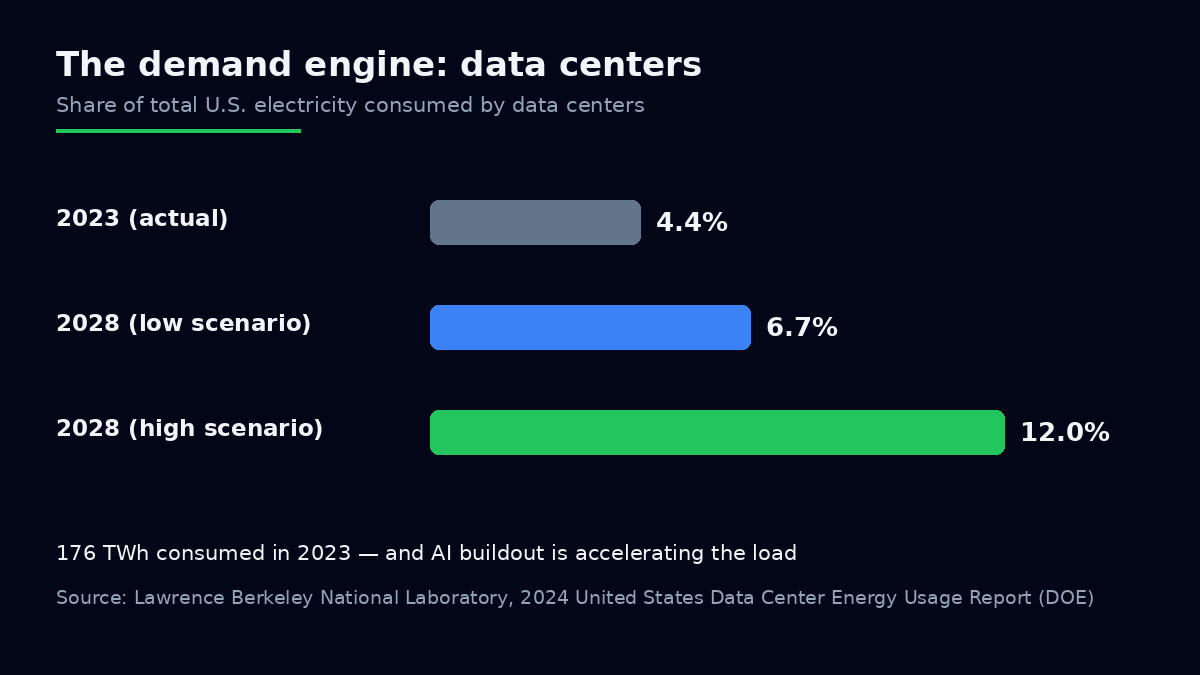
- Data centers used 176 terawatt-hours of U.S. electricity in 2023, or 4.4 percent of the national total, and the Department of Energy's Lawrence Berkeley National Laboratory projects that share reaching 6.7 to 12 percent by 2028 depending on the scenario.
- U.S. data center construction hit a seasonally adjusted annual rate of $50.7 billion in April 2026, up from $39.8 billion a year earlier (U.S. Census Bureau data, via Data Center Knowledge), roughly 27 percent growth in twelve months.
- Electrical systems account for an estimated 45 to 70 percent of data center construction cost, per IBEW estimates reported by Fortune in 2026.
- Globally, the International Energy Agency puts data center electricity consumption at roughly 485 TWh in 2025, heading toward about 950 TWh by 2030.
Behind the buildings, electrification is doing the same work across the rest of the economy: heat pumps replacing furnaces, EV chargers in every new parking structure, solar and storage on rooftops, and a grid that needs rebuilding to carry all of it. The BLS explicitly names AI technologies and data center demand among the reasons electrician employment is expected to rise.
The Workforce Shortage in One Paragraph
Workforce numbers are the one category of electrical contractor industry statistics where the news is uniformly tough: demand is rising faster than the pipeline of people who can wire it. McKinsey projects the U.S. will need roughly 130,000 additional electricians by 2030 for AI infrastructure alone; Associated Builders and Constructors estimates construction needs 349,000 net new workers in 2026; and in the AGC/NCCER 2026 workforce survey, 58 percent of contractors doing data center work said those projects have increased competition for skilled workers. Combined with BLS's 72,700 annual openings, the shortage math is a replacement problem more than a demand problem: the work exists, the crews do not. Shops that train apprentices and retain journeyman will bill work their competitors physically cannot staff.
What These Numbers Mean for Your Electrical Business
Electrical contractor industry statistics are not trivia; they are next-year decisions.
- Prices have room. A $370.9 billion market growing 6.2 percent annually with a labor shortage underneath it means rate pressure runs upward. If your hourly rates have not moved in two years, the market moved without you.
- Speed is the moat. When 72,700 openings a year strain every shop, the winning differentiator is not another truck. It is quoting faster and following up automatically so the estimators you do have touch more bids. That is the core case for using a CRM built for electrical contractors instead of a paper trail.
- Commercial and industrial pay attention to data centers. The 45-to-70-percent electrical share of data center construction cost means the trade's biggest single demand driver is also its most electrical-intensive project type. Firms positioning for that work need job costing and progress billing that can handle large, multi-phase contracts.
- Small is normal. In an industry where most businesses stay under $2 million in revenue, professional operations are a competitive weapon, not table stakes.
Sources and Methodology
Every figure above comes from a named public source, checked November 3, 2026:
- IBISWorld: Electricians in the US, market size and industry counts (August 2026 update).
- U.S. Bureau of Labor Statistics: Occupational Outlook Handbook: Electricians (May 2025 wages, 2025–2035 projections, released August 2026); OEWS May 2025 national table.
- U.S. Census Bureau: County Business Patterns, NAICS 238210 (2023).
- Lawrence Berkeley National Laboratory / DOE: 2024 United States Data Center Energy Usage Report.
- International Energy Agency: Key Questions on Energy and AI (April 2026).
- McKinsey, ABC, AGC/NCCER, EC&M (via Simpro): workforce and concentration figures as cited inline.
Where sources disagreed (market size, business counts), both figures are shown with their definitions. Statistics pages earn trust only when dated and sourced; if a number here cannot be traced, it does not belong on the page.
Frequently Asked Questions
How big is the electrical contractor industry in 2026?
The U.S. electricians industry generated $370.9 billion in revenue in 2026, per IBISWorld's August 2026 update, after growing at a 6.2 percent compound annual rate since 2021. It is the largest of the three core trades, bigger than HVAC and plumbing combined.
How many electrical contractors are there in the US?
About 269,000 electrician businesses operate in the U.S. per IBISWorld's 2026 count, which includes sole proprietors. The Census Bureau counted 83,342 employer establishments with payroll in NAICS 238210, employing roughly 1.0 million people.
What is the average electrician salary in 2026?
The median annual wage for electricians was $63,190 as of May 2025 (about $30.38 per hour), per the BLS. The mean annual wage across employed electricians was $71,490, with wide variation by state and market.
Is electrician employment growing?
Yes. The BLS projects electrician employment to grow 9 percent from 2025 to 2035, much faster than the 3.5 percent average for all occupations, with about 72,700 openings per year, most replacing retiring workers. Employment growth is the most reliable bright spot in the 2026 electrical contractor industry statistics.
What is the biggest challenge facing electrical contractors in 2026?
The skilled-labor shortage. McKinsey projects roughly 130,000 additional electricians are needed by 2030 for AI infrastructure alone, and 58 percent of data-center contractors in the AGC/NCCER 2026 survey reported increased competition for skilled workers.