

Electrical Contractor CRM, Dispatch, and Scheduling Integration: A 2026 Guide to One Connected Workflow
Ask an electrical contractor where their customer information lives and you will get a familiar answer: some in a phone, some in texts, some on paper work orders in the truck, some in QuickBooks, and some in the head of whoever has been answering the phones the longest. It works, until it does not. Dropped callbacks, double-booked crews, estimates that never get followed up on, and invoices sent a week after the job ends all trace back to the same root cause: the office and the field are running on disconnected systems.
This guide breaks down what integration actually means for an electrical shop, what it costs to keep flying blind, and what to look for when you evaluate electrical contractor CRM, dispatch, and scheduling integration in 2026.
1. Why Electrical Contractors Need Integrated CRM, Dispatch, and Scheduling in 2026
The electrical trade is not getting simpler. EV charger installations under NEC Article 625, panel upgrades to 200A services, energy storage tie-ins under Article 706, and whole-home electrification retrofits have added new job types on top of the steady diet of service calls, remodels, and commercial maintenance work. Bureau of Labor Statistics projections show electrician employment growing around 11 percent through the early 2030s, with roughly 80,000 openings a year from growth and retirements. Median electrician wages have pushed past $60,000 a year, which means every hour a technician spends hunting for job details or waiting on a callback from the office is expensive.
Volume is the other pressure point. A solo electrician running three jobs a day plus callbacks and estimate requests is already juggling 20 or more open threads in a week. A six-truck shop running 25 to 30 jobs a week cannot manage that on texts and a shared spreadsheet without things falling through the cracks. The shops winning right now are the ones where a call comes in, the job gets scheduled, the right tech gets dispatched, the work gets documented, and the invoice goes out, all inside one connected workflow.
2. The Real Cost of Disconnected Electrical Office and Field Workflows
Disconnected workflows bleed money in ways that rarely show up on a single invoice. They show up in aggregate.
Lost billable hours. If a technician spends 30 minutes a day on status calls with the office, retyping notes, and chasing paperwork, and your billable rate is $125 an hour, that is roughly $15,600 per tech per year in lost billable capacity. Across a three-truck shop, you are approaching $47,000.
Missed callbacks. A missed call that goes to a full voicemail box is often a lost job. Residential customers typically call the next electrician on the list. One missed $400 panel diagnostic per week is more than $20,000 a year in lost revenue, before any referral or review value.
Dispatch friction. When the dispatcher has to call three techs to find out who is free, who is closest, and who has the thermal imaging camera or bucket truck, the schedule is already stale by the time it is built. Industry estimates put the fully loaded cost of a truck roll at $150 to $300 once drive time, fuel, and overhead are counted, so every wasted or misassigned dispatch carries real weight.
Slow, disputed invoices. Paper work orders invoiced a week later, with no photos and no documentation of what was found, invite disputes and delay payment. A $2,800 panel upgrade invoice that sits unpaid for 45 days because the customer "does not remember approving that" is a cash flow problem you created in the field.
Double entry into accounting. Office staff retyping field invoices into QuickBooks, mismatched item names, and unclassified payments turn every month-end reconciliation and every tax filing into a cleanup project.
3. Core Features to Look for in Electrical Contractor CRM Dispatch Scheduling Integration
Not every field service platform is built for electrical work. When you evaluate electrical dispatch software and CRM tools, look for these capabilities in a single system:
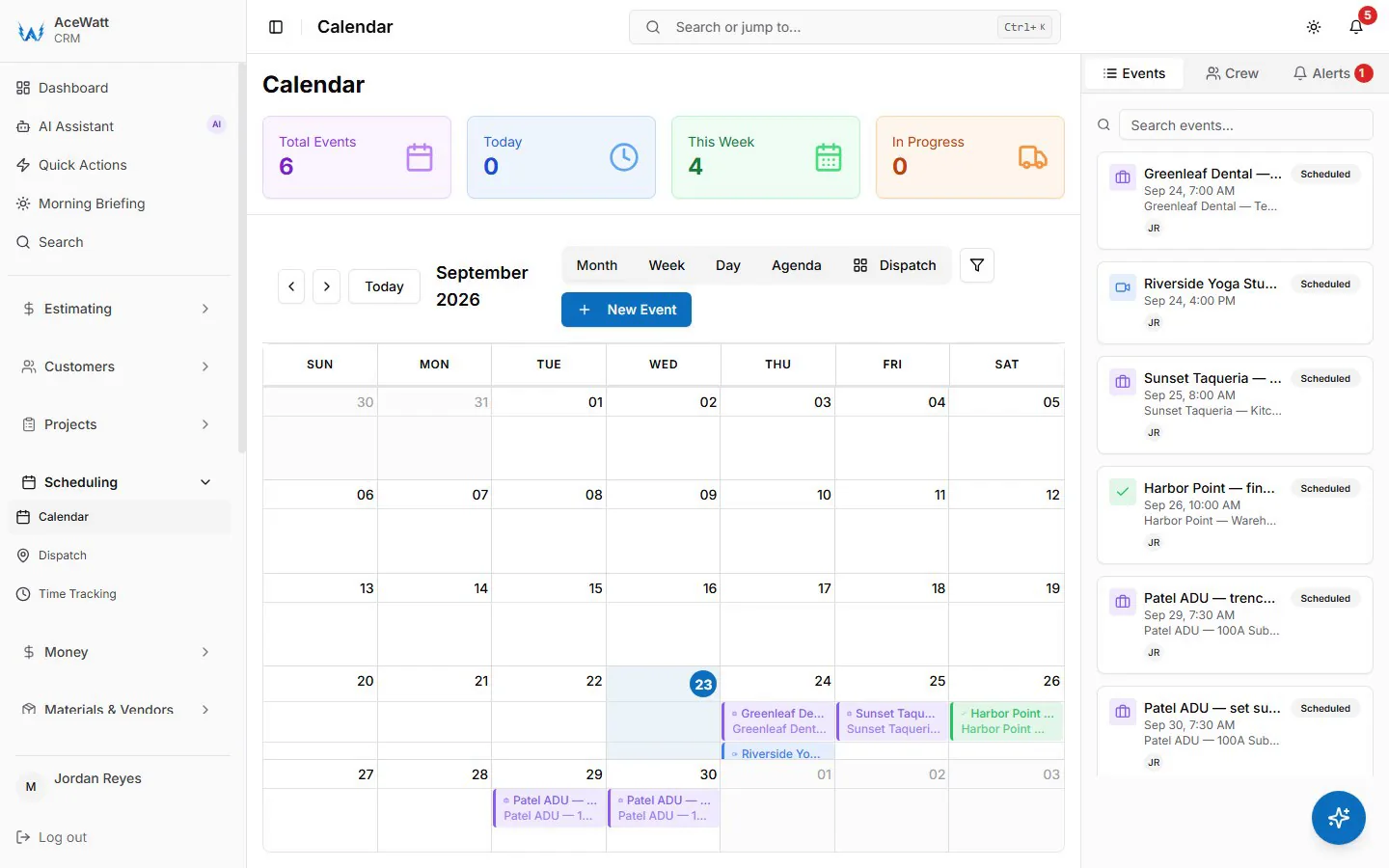
- An electrical-specific CRM. Customer records should hold service history plus equipment detail: panel brand and amperage, breaker type, generator model, EV charger location, and notes from prior visits. When a customer calls about a tripping breaker, the answer should be two clicks away.
- Crew scheduling and dispatching by skill, location, and equipment. The dispatcher should be able to filter by license level, residential versus commercial certification, geographic zone, and gear on the truck. A 200A service upgrade needs different staffing than a ceiling fan install or a thermal scan of a switchgear room.
- AI estimating. Strong electrical estimating software turns a material list into a priced estimate using your labor hours and markup. You should be able to build reusable templates for repeat jobs like panel upgrades, EV charger installs, and recessed lighting circuits.
- Job tracking with photos and voice documentation. Status stages, notes, before-and-after photos, and AI voice transcription of job walk findings should live on the job record, visible to office and field at the same time.
- Automated follow-up. Appointment confirmations, estimate reminders, review requests, and maintenance recalls should run on their own without someone remembering to send them.
- Field invoicing and payment tracking. The electrician invoice app side matters: techs should be able to build a time and material invoice on site, take a card or ACH payment, and close the job before they leave the driveway.
- QuickBooks sync. Customers, invoices, and payments should flow into QuickBooks Online automatically, with no retyping.
- Offline mobile capability. Basements, crawlspaces, and mechanical rooms kill cell signal. The mobile app needs to work offline and sync later.
4. How AI-Powered CRM and Automated Follow-Up Fit Into Electrical Job Management
A Harvard Business Review study on lead response found that companies that contacted an inbound lead within an hour were roughly seven times more likely to qualify it than those that waited two hours or more. In residential electrical work, speed to lead decides who wins the job, and most small shops cannot dedicate a person to answering every call within minutes.
That is where an AI-powered CRM changes the economics:
- Every inquiry creates a record. Call details, address, job description, and requested time window are captured and logged, so nothing lives only in a text thread.
- Automated follow-up runs on schedule. In AceWatt, overdue invoices get email reminders at 1, 7, 14 and 30 days late, and after a job is marked complete, AceWatt emails the customer a short satisfaction survey. Appointment confirmations and estimate follow-up stay with your office.
- Recall and maintenance reminders generate future work. Annual generator service, smoke alarm replacement cycles under the NFPA 72 ten-year guidance, and thermal re-scans become automated touchpoints instead of forgotten promises.
- AI voice and job walk documentation protects the job. A tech narrates findings at the panel, and the transcription lands on the job record. When the customer questions a change order three weeks later, the documented findings, timestamped and photographed, settle it.
The result is fewer missed callbacks, faster response times, and a higher close rate without adding office payroll.
5. Connecting Dispatch, Job Tracking, and Invoicing for Electrical Contractors
The value of job management software for electricians is the handoff. Here is what a connected job looks like from end to end:
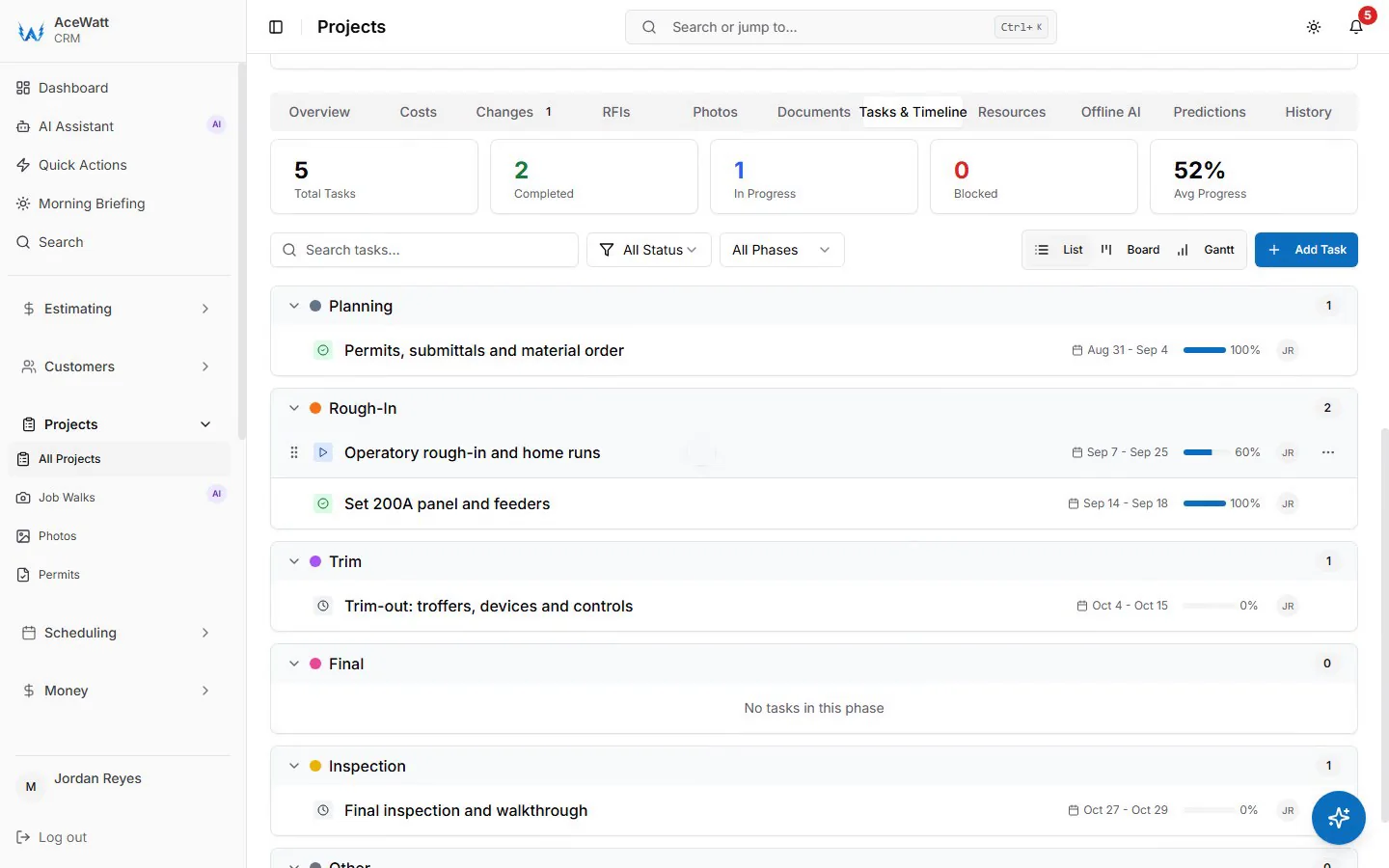
- A call or web inquiry lands in the CRM and creates a customer record with address, gate code, and job description.
- The dispatcher drag-and-drops the job onto the right tech based on skill, location, and truck inventory.
- The tech opens the job card on a phone and sees prior history, notes, and photos from every past visit.
- Status moves from Scheduled to En Route to On Site, and the office sees it in real time on the dispatch board.
- Job walk photos and voice notes document conditions before work starts and the result after it is done.
- A mid-job discovery, say an open junction box buried behind drywall or a receptacle near a sink requiring GFCI protection under NEC 210.8, becomes a photo-backed change order approved on the spot.
- Marking the job complete triggers the invoice, the customer pays on site, and the payment status updates automatically.
When these steps live in separate tools, each handoff is a chance to lose information. When they live in one system, the office, the field, and the customer are all looking at the same job.
6. QuickBooks Accounting Sync and Electrical Time and Material Billing
Time and material work is where disconnected systems hurt most, because T&M billing has too many moving parts for paper. Solid electrical contractor time and material billing software should handle:
- Labor pulled from clock in and clock out on each job, flowing straight to the invoice.
- Materials logged from the truck or supplier with your markup applied automatically. Most service shops run cost-plus in the 20 to 35 percent range, and that margin disappears when receipts ride around in a door pocket for a week.
- Service call fees and change orders as line items on the same invoice, tied to the documented job record.
- Deposits and milestones. A 30 to 50 percent deposit on a panel upgrade or generator install, and milestone billing on commercial work, should be standard functions, not workarounds.
With true QuickBooks Online sync, customers, items, invoices, and payments post to your accounting system without double entry. Class tracking lets you see profit and loss separately for residential service, commercial work, and new construction. The payoff is cleaner reporting, job costing you can trust, fewer reconciliation errors, and tax seasons that do not start with a data cleanup project. That combination of field invoicing plus accounting sync is what separates a true electrical invoice app from a generic billing tool, and it is the foundation of practical electrical accounting software for growing shops.
7. Buyer Checklist: Evaluating Electrical Dispatch Software and Job Management Software in 2026
Before you sign a contract, verify the following:
- Built for electrical, not generic field service. Does it understand panel upgrades, T&M service work, and NEC-driven change orders, or is electrical an afterthought?
- Scales from solo to multi-crew. The same system should work when it is you and a van, and when it is six trucks and a dispatcher running electrical contractor scheduling software at full speed.
- One workflow, end to end. CRM, AI estimating, dispatch, job tracking, invoicing, payment tracking, and QuickBooks sync in a single thread, with no re-keying between steps.
- Automated follow-up included. Confirmations, estimate reminders, review requests, and recall campaigns should be native features.
- AI voice and job walk documentation so field notes, photos, and transcribed findings attach to the job automatically.
- T&M billing with material markup, labor hours, change orders, and deposits.
- QuickBooks Online sync with item and class mapping, tested against your actual chart of accounts before you commit.
- Offline mobile performance in basements and mechanical rooms.
- Real onboarding support and a clear timeline, measured in days, not months.
The Bottom Line
Every disconnected tool in your shop is a place where jobs, hours, and money leak out quietly. In 2026, the electrical contractors growing fastest are not necessarily the best electricians in their market. They are the ones whose office and field systems finally talk to each other, from the first phone call to the payment clearing in QuickBooks. Integration is no longer a luxury for large shops. It is the operating standard for any electrical business that intends to grow past the whiteboard.
Related Reading
- Electrical Contractor Scheduling Software
- Electrical Dispatch Software
- Dispatch vs Scheduling: Why Electrical Contractors Need Both
- Best Electrician CRM Software 2026: the CRM landscape behind scheduling and dispatch tools.